North Dakota Trail Tax Instead of a Trail Sticker
North Dakota ATV and UTV owners may hear about a trail tax and assume it buys a separate trail sticker. It doesn’t work that way: for residents who need to register an off-highway vehicle, the trail tax is part of the registration process. Knowing what that charge does—and what it does not authorize—helps you avoid confusing registration with a visitor permit or park access.
What North Dakota’s trail tax is
North Dakota collects an off-highway trail tax as part of the registration process for covered machines. It is not a stand-alone sticker you buy for each ride, and it is not a daily fee charged at a trailhead. For a resident whose machine must be registered, the tax is included with the registration charges.
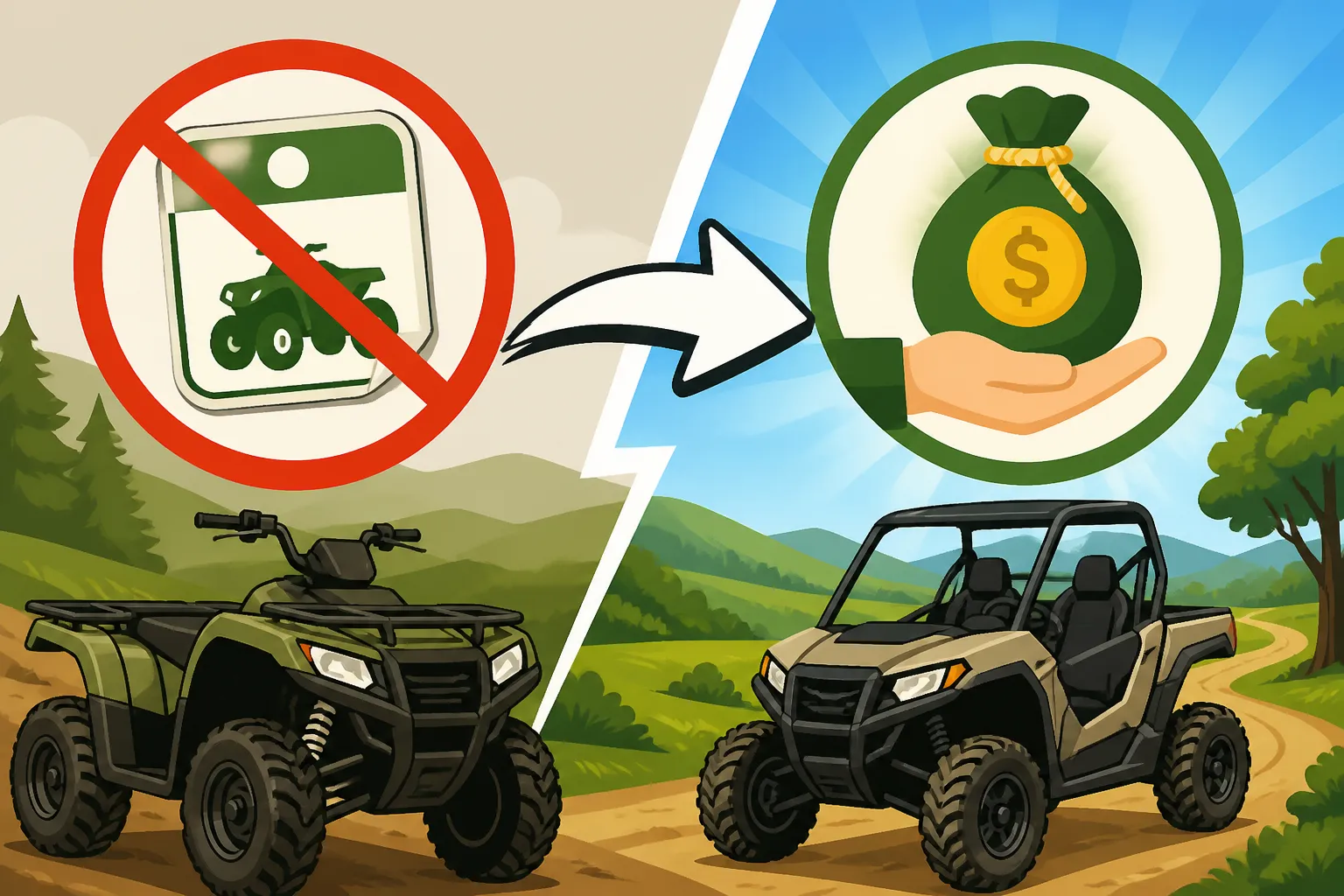
That distinction explains why owners may not see a separate trail-tax decal. The decal or plate identifies the machine as registered; the tax is an amount collected through the registration system. In other words, the display item and the funding charge do different jobs. The trail tax is not a second piece of equipment to attach to your ATV or UTV.
The registration receipt is the best place to check how charges have been recorded. Depending on the transaction, it may show a registration charge and a trail-tax charge as separate items. If you are comparing a receipt with an older one, or working out what is due for a particular machine, confirm the current amounts and requirements with the state agency or a motor vehicle branch. Fees and administrative details can change.
Registration itself generally follows a two-year cycle, but the specific renewal date and paperwork can depend on the machine and transaction. For details about the cycle, see North Dakota’s Two-Year OHV Registration. For a closer look at the total state registration charges, see North Dakota OHV Registration Cost.
It is also worth keeping the trail tax separate in your mind from the title. A title records ownership; registration allows a machine covered by the law to be registered for operation. The trail tax is collected within that registration process. A title document does not take the place of a current registration, and a registration receipt does not establish every right to ride on every parcel of land.
The short version is:
- Trail tax: A charge collected through registration and associated with trail-related funding.
- Registration plate or decal: The display item used to identify a registered machine.
- Trail permit: A separate permission or permit that may apply in particular situations, such as for a visitor or a specific public recreation area.
- Land access: Permission to use a particular road, trail, or property under its own rules.
If you are looking for a trail sticker to attach to a resident-registered ATV or UTV, you may be looking for the wrong item. North Dakota does not require residents to buy a separate resident trail permit in place of registration; the registration process includes the trail-tax component. More on that distinction is in North Dakota Has No Trail Permit for Residents.
What the trail tax does and does not provide
The trail tax supports North Dakota’s trail-related system, but paying it should not be treated as a universal pass to ride anywhere. It does not give an owner blanket access to private property, convert a closed route into an open one, or override a trail manager’s restrictions.
Think of the trail tax as one part of the state’s registration framework—not as a map of where your machine may go. Before riding, check the rules for the specific land or route. Access can depend on the landowner, managing agency, posted signs, local restrictions, seasonal conditions, and the type of machine. For a broader explanation of how registration relates to access, see North Dakota Registration and Trail Access.
It is not a separate trail sticker
A registration plate or decal is a way to display registration. It is not the trail tax itself, even if the tax appears on the same receipt. North Dakota lets owners choose between a plate and a decal in situations where that choice is available. That display choice does not remove the tax or create a different level of access. See Why North Dakota Lets You Pick a Plate or Decal for more on the difference.
The practical consequence is simple: do not look for an extra resident trail sticker to prove that the trail tax has been paid. Keep the registration current and display the plate or decal as required. If you are unsure what a particular charge on your receipt represents, ask the issuing office rather than relying on a sticker that may not be part of the process.
It is not a nonresident permit
Visitors may face a different requirement from North Dakota residents. A nonresident permit is a separate authorization, not another name for the trail tax. A visiting rider should check whether the machine’s home-state registration qualifies for any applicable exemption, how long that status applies, and whether a North Dakota permit is required. The state does not offer blanket reciprocity that makes every other state’s registration a substitute for all North Dakota requirements.
A visitor who is required to obtain a permit should not assume the resident trail tax has already handled it. The machine may be registered elsewhere, but that does not automatically answer whether the rider needs a North Dakota nonresident permit. Start with North Dakota Non-Resident OHV Permit and North Dakota Registration Versus a Non-Resident Permit to identify which process applies.
It does not replace a park entrance permit
A state park entrance permit is another separate matter. The OHV trail tax does not automatically pay for a tow vehicle’s park entrance permit, camping, parking, or any other fee a recreation area may charge. The vehicle carrying the ATV or UTV and the machine itself may have different requirements.
If your destination is a state park, check the park’s current entrance, parking, and riding rules before leaving home. A machine can be properly registered and still need to follow the park’s specific access arrangements. See North Dakota State Park Entrance Permits for the distinction between park entry and OHV registration.
The key takeaway is that the tax is connected to registration, but registration is only one piece of a legal ride. Confirm the machine is eligible and properly registered, then confirm that the intended route is open to that kind of machine and that you have any additional permission or permit the location requires.
How residents should handle registration and the tax
For a North Dakota resident, the most useful starting point is the machine’s classification and intended use. ATVs and UTVs are both off-highway vehicles in everyday conversation, but legal definitions and registration treatment can depend on the machine’s design. A machine’s seat, steering arrangement, width, weight, tires, and other characteristics may matter. If you are unsure which category applies, review North Dakota’s Class I, II and III Machines before completing the paperwork.
Once you have identified the machine, use this process:
- Check whether the machine must be registered. The answer can depend on where and how you operate it. A private-land exemption may apply in limited circumstances, but it should not be assumed to cover riding on public land or public routes. Review North Dakota Registration Exemptions Explained if you think an exemption applies.
- Gather the ownership information. Depending on the machine and how you acquired it, you may need title or ownership documents and identifying information such as the vehicle identification number. If paperwork is incomplete, do not assume the trail tax is the only issue to resolve.
- Complete the appropriate registration transaction. Use the current state process and make sure the machine’s details match its paperwork. New purchases, transfers, homemade machines, and machines with missing records can require different supporting documents.
- Review the itemized receipt. Check that you understand the charges, the registration period, and the information recorded for the machine. Ask the issuing office about any line item you cannot identify.
- Display the plate or decal as directed. The required placement matters. A valid receipt does not make a badly placed or obscured display item compliant.
- Check the route before riding. Registration does not establish that a trail, road, ditch, or parcel is open. Look at land-manager information, posted signs, and local rules, and get permission where needed.
A common source of confusion is a buyer’s expectation that paying one registration bill covers every future riding situation. It does not. The trail tax is part of the resident registration system, but an owner may still need to check local restrictions, obtain landowner permission, follow equipment rules, and make sure the machine is appropriate for the route.
The two-year registration cycle also means that a valid registration is not permanent. Mark the expiration date and plan to renew through the correct process. Do not rely only on the condition of a decal: a faded decal might be hard to read even though the registration remains current, while a clear-looking decal can be expired. If you need help interpreting a renewal date or the charges on the receipt, compare the transaction with When a North Dakota OHV Registration Expires and Reading the Two Charges on Your Registration Receipt.
When you think an exemption applies
Some owners use a machine only on private land or for a narrow purpose and wonder whether registration is necessary. Exemptions are specific, so consider both where the machine is used and the purpose of its use. The fact that a machine is primarily used on a farm, at a cabin, or on a private parcel does not automatically settle whether registration is required for every trip.
A ride that begins on private property may cross a boundary, use a public route, or reach a public riding area. That change can affect which rules apply. Before relying on an exemption, read its conditions and check with the agency responsible for registration. North Dakota’s Exemption for Machines Used on Private Land is a useful starting point for private-land questions.
Keep the paperwork that supports your registration or exemption in an accessible place. If an officer or land manager asks about the machine, being able to identify its registration status and explain the basis for an exemption can make the conversation clearer. Do not treat an exemption as permission to enter a parcel where you do not have access rights.
How visitors and special situations differ
The trail tax is easiest to understand when the owner lives in North Dakota and is completing a resident registration. Other situations call for a separate check because the machine’s registration, owner, or destination may change the applicable process.
| Situation | What to check | What not to assume |
|---|---|---|
| North Dakota resident registering an eligible OHV | Current registration requirements, the trail-tax line item, and plate or decal display rules | That a separate resident trail sticker is required |
| Visitor bringing a machine registered elsewhere | Whether a North Dakota nonresident permit is required and how long any exemption applies | That an out-of-state registration automatically satisfies every North Dakota rule |
| Rider going to a state park | Park entrance, parking, trail access, and machine rules | That the OHV trail tax covers the tow vehicle’s park entry |
| Owner using a machine only on private land | The exact terms of any registration exemption and whether the planned route leaves the parcel | That private-land use automatically exempts every trip |
| Buyer with incomplete ownership papers | Title, registration, VIN, and acceptable proof-of-ownership requirements | That paying the trail tax will cure missing ownership documents |
Visitors with out-of-state registration
A visiting rider should verify the rule before traveling rather than after arriving at a trailhead. North Dakota’s rules distinguish between a resident machine and a machine registered elsewhere, and the visitor’s length of stay can matter. The applicable time threshold and permit conditions should be confirmed with the state because they determine when an out-of-state rider needs additional authorization.
Do not rely on a home-state sticker alone as proof that North Dakota’s visitor requirements have been met. A registration document may show that the machine is legal in its home state, while North Dakota may still require a visitor permit for operation within the state. The permit is not the same as a resident’s trail-tax payment, and purchasing one does not create permission to ride on closed or private land.
If you are staying longer than a short visit, check what happens when the initial visitor exemption ends. A continuing stay can trigger a different obligation, including the possibility of North Dakota registration. The important thing is to verify the rule before the stay crosses the relevant limit. Start with North Dakota’s 30-Day Out-of-State Rule and confirm the current permit process at the official point of sale or issuing agency.
Tracked dirt bikes and other machine-specific permits
Some machines have requirements that sit alongside the general OHV registration framework. A tracked dirt bike, for example, can require a separate permit. That requirement is not a second resident trail sticker and should not be confused with the trail tax. Owners should check the machine-specific rules before assuming that ordinary registration covers every configuration.
Similarly, classification can matter for machines that look like familiar ATVs or UTVs but fall into a different legal category based on their design. For a vehicle that has been modified or fitted with unusual equipment, ask the responsible office how it is classified before riding. Do not use the trail-tax receipt as a substitute for checking a special permit or classification requirement.
Common misunderstandings and practical checks
The phrase “trail tax” sounds as if it buys a defined quantity of trail use. In practice, it is more useful to think of it as a registration-related charge tied to the state’s trail system. It does not operate like a per-ride ticket, and it does not promise that a particular route will be open on the day you arrive.
Here are mistakes that are easy to avoid:
- Looking for a separate sticker: Residents who are required to register should follow the plate or decal instructions. The tax is collected through registration; it is not necessarily displayed as its own sticker.
- Assuming registration means universal access: A current registration does not authorize trespassing or riding on a closed route. Check access rules separately.
- Treating a visitor permit as the trail tax: The permit and the resident registration charge serve different administrative purposes. Determine which applies to your situation.
- Forgetting the tow vehicle: A park entrance permit or parking rule may apply to the truck or trailer even when the OHV has its own registration.
- Assuming a private sale avoids state requirements: A change in ownership can require paperwork and may affect the machine’s registration status. Confirm the steps before riding.
- Relying on an old receipt or decal: Use the current registration period and verify any unclear status with the issuing agency.
- Assuming one machine’s documents cover another: Registration and permits are generally tied to an individual machine. Check the requirements for each ATV or UTV you plan to bring.
For a purchase or transfer, make the registration questions part of the paperwork review. Ask the seller for documents that identify the machine and support ownership. If there is a mismatch between the VIN, title, bill of sale, or registration record, resolve it before counting on the machine for a trip. A trail-tax payment cannot establish ownership or fix an identification problem.
It is also sensible to check access close to the ride date. Weather, maintenance, land-management decisions, and local restrictions can affect where riding is allowed. A route that was open on a previous visit may not be open now. The charge shown on a registration receipt does not tell you whether a trail is currently open, nor does it guarantee that the surface is suitable for your machine.
If you are planning a ride with a group, make sure each machine has its own required registration or permit. One rider’s paperwork does not cover the other machines in the group. Before departure, check that registration is current, the plate or decal is properly displayed, the rider has any required permit, and the destination allows the machine’s type and width.
When a receipt seems to show both a registration charge and a trail-tax charge, that does not mean you have been billed twice for the same sticker. The items are separate components of the transaction. If the description is unclear or the amount differs from what you expected, ask the office that processed the registration to explain the current charges. For an overview of why the charge is collected through registration, see Where Trail Tax Money Is Spent.
Frequently Asked Questions
Does North Dakota require a separate trail sticker for residents?
The trail tax is collected through registration; it is not generally a separate resident trail sticker. Residents should follow the current registration and plate or decal display requirements for their machine.
Does paying the trail tax let me ride any North Dakota trail?
No. Registration and trail-tax payment do not provide blanket access. Check whether the specific route is open to your machine, follow posted restrictions, and get permission before entering private land.
Is a nonresident permit the same as the trail tax?
No. A nonresident permit is a separate requirement that may apply to a visitor operating a machine registered elsewhere. Check the current visitor rules and do not assume an out-of-state registration replaces every North Dakota requirement.
Does the trail tax cover my state park entrance permit?
Not necessarily. OHV registration and park entrance requirements are separate. Check the park’s current rules for the machine, tow vehicle, parking, and access.
Disclaimer
This article is for general informational purposes only and does not constitute professional advice. Laws, prices and regulations vary by location and change over time. Consult a qualified professional for guidance on your specific situation.