What a Licensed Sixteen-Year-Old May Ride
A North Dakota teen with a driver’s license may assume that license also allows them to ride an ATV or UTV on public roads. It does not work that simply: the rules distinguish between riding off-road and operating an OHV on a roadway, and the Class III road exception applies to drivers over 16. Here’s how a licensed sixteen-year-old can tell what is and isn’t allowed.
Does a licensed sixteen-year-old need an OHV safety certificate?
North Dakota’s safety-certificate rule depends on both age and whether the young rider has a valid driver’s license or learner’s permit. According to the North Dakota Parks and Recreation Department, youth ages 12 to 16 who do not have either must take an OHV safety certification class to operate on allowed public lands. A sixteen-year-old with a valid license is not in that group.
That answers the certification question, but it does not mean a driver’s license is a general OHV permit. The rider must still follow the rules for the machine, the land, and the type of riding. A license does not automatically authorize an ATV or UTV on a highway.
The certificate requirement applies to operation on land other than a parent’s, including designated trails and ditches, according to the North Dakota Parks and Recreation Department. A teen riding on a parent’s land may therefore face a different certification requirement, but that exception does not make private property rules a substitute for public-land registration or permission.
For a younger rider who does need certification, the department offers a hands-on course and an online option. According to the North Dakota Parks and Recreation Department, riders must be at least 12 to become certified; children who are 11 and turn 12 within six months of a class date may take the test, but receive their card later. The hands-on sessions are offered from May through August, and students must complete an introductory online course before attending. The department’s class requirements and options are covered in North Dakota OHV Safety Certificates at Age 12 and North Dakota Safety Course Online.
A licensed teen should still be ready to show proof of the license if asked and should not treat the lack of a certificate requirement as proof that every riding location is open. Public trails, public lands, ditches, and roadways have separate rules. For the rules aimed at younger teens, see North Dakota Rules for Riders Under 16.
Where can a sixteen-year-old ride an ATV or UTV?
Off-road riding and roadway riding are different permissions. On public land, OHVs generally must be properly registered or permitted, according to the North Dakota Parks and Recreation Department. A rider must also use a route or area where OHV operation is allowed; registration alone does not grant access to every trail, ditch, or parcel of land.
North Dakota classifies the machines by type. According to the North Dakota Parks and Recreation Department, Class I OHVs are motorcycles or dirt bikes, Class II OHVs are ATVs, and Class III OHVs are UTVs or side-by-sides. A rule that applies to a Class III machine does not automatically apply to an ATV.
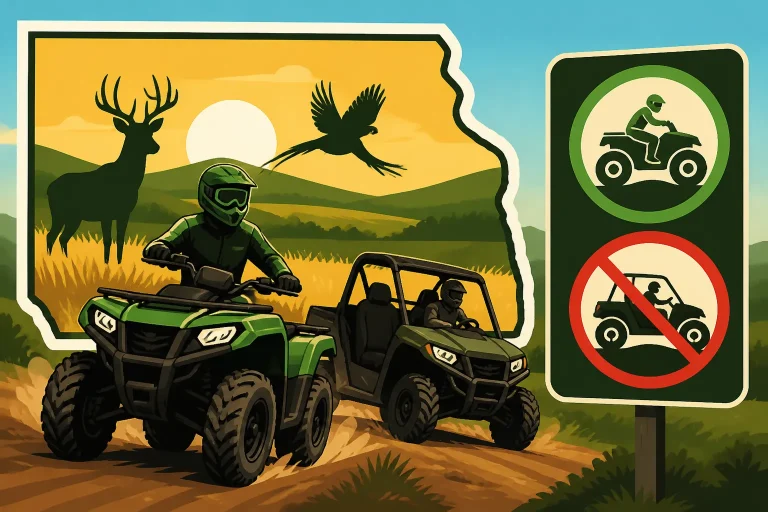
The key road rule is narrower than many families expect. According to the North Dakota Parks and Recreation Department, a licensed driver over 16 may operate a registered Class III OHV on a paved highway designated and posted at a speed not exceeding 65 miles per hour. The rule says over 16, so a rider who is exactly 16 should not assume they qualify for this exception, even if they hold a driver’s license. It applies to registered Class III machines, not Class II ATVs.
| Situation | What a licensed sixteen-year-old should understand |
|---|---|
| Public off-road area or designated trail | The OHV generally needs proper registration or a permit, and the rider must stay where OHVs are allowed, according to the North Dakota Parks and Recreation Department. |
| Public ditch | A driver’s license does not make every ditch a legal route. Check the applicable ditch and local riding rules before setting out. |
| Paved highway | The stated Class III exception is for a licensed driver over 16, not a rider who is exactly 16, according to the North Dakota Parks and Recreation Department. |
| ATV on a roadway | The Class III highway exception is not an ATV exception. Do not assume a Class II ATV can use the same roadway rule. |
| Shoulder or inside slope | OHV operation there is illegal, according to the North Dakota Parks and Recreation Department. |
The roadway exception also has equipment and machine requirements. According to the North Dakota Parks and Recreation Department, a Class III OHV using a paved highway designated and posted at up to 65 miles per hour must be capable of reaching at least 30 miles per hour. Roadway operation requires a motor of at least 350 cubic centimeters, and an OHV on a roadway must have a horn audible at 200 feet under normal conditions. These requirements do not turn a road into an approved route: the highway must still meet the designation and posting conditions.
The department also says Class II and Class III OHVs operated on a right-of-way and trails require a headlamp and a tail lamp. That equipment rule is not a general permission to ride in the right-of-way: operating on a highway shoulder or inside slope remains illegal. Before a ride that may approach a road, review North Dakota ATV Road Rules by Surface Type and North Dakota Equipment Required on a Roadway.
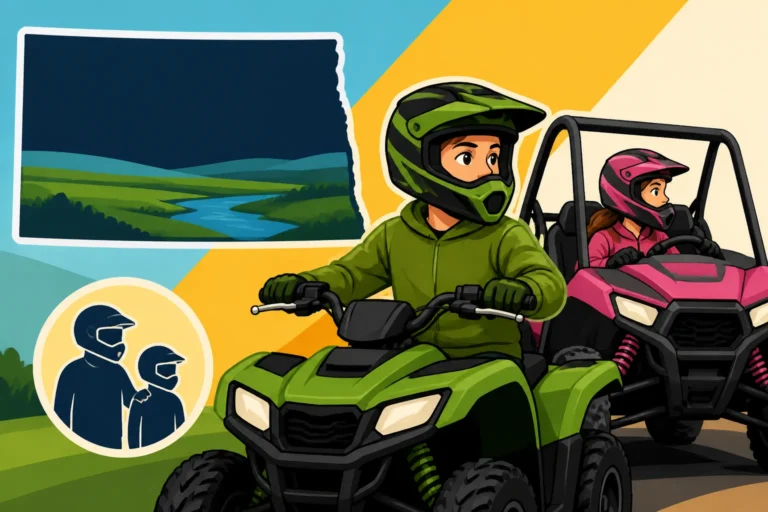
A passenger’s age matters, too. According to the North Dakota Parks and Recreation Department, riders and passengers under 18 must wear a DOT-approved helmet while riding any OHV, including dirt bikes, ATVs, and side-by-sides. A sixteen-year-old is still under 18, so a driver’s license does not remove the helmet requirement. See North Dakota Helmet Law for Riders Under 18 for more on the rule.
Registration, permits, and a sensible pre-ride check
For public-land riding, confirm that the machine is registered or permitted before leaving home. According to the North Dakota Parks and Recreation Department, resident OHVs operating on public lands and trails need North Dakota registration, while owners of out-of-state registered OHVs need a non-resident public trails and lands access permit. The department lists the resident registration fee as $20 as of November 2026; registration covers a two-year period and expires in even-numbered years.
The non-resident permit is valid from January 1 to December 31, according to the North Dakota Parks and Recreation Department. A teen visiting from another state should check that the machine’s paperwork covers North Dakota public trails and lands; an out-of-state registration by itself is not enough under the department’s stated rule. For details on the two paths, see Do You Need to Register an ATV in North Dakota? and North Dakota Non-Resident OHV Permit.
Registration paperwork asks for identifying and ownership details. According to the North Dakota Parks and Recreation Department, the OHV application includes the owner’s name and address, plus the make, year, and serial number. Make sure those details match the machine and documents, especially if the machine was recently bought or is registered to a parent.
Operators must also be able to provide proof of liability insurance coverage, according to the North Dakota Parks and Recreation Department. Keep the required paperwork accessible and check that the coverage applies to the machine and use planned. A driver’s license, safety certificate, registration, permit, and insurance proof serve different purposes; having one does not replace the others.
A practical pre-ride check for a licensed sixteen-year-old:
- Identify the machine’s class. Confirm whether it is a Class I dirt bike, Class II ATV, or Class III UTV. The roadway exception described by the department is specific to Class III machines.
- Confirm the rider’s age against the road rule. A license at 16 does not satisfy wording that applies to a licensed driver over 16.
- Check the destination. Verify the trail, public land, or route permits OHV use. Do not assume public access means motorized access.
- Check registration or permit status. Resident and out-of-state machines have different requirements for public lands and trails.
- Carry proof of liability insurance. The department says operators must be able to provide it.
- Wear the required helmet. Riders under 18 need a DOT-approved helmet, whether on an ATV, UTV, or dirt bike.
- Keep roadway riding separate from trail riding. If a route includes a road, confirm that the particular machine, rider, highway, and equipment meet the applicable conditions. Avoid the shoulder and inside slope.
If the teen is shopping for a helmet, an online marketplace such as Amazon may offer options, but the listing alone is not proof that a helmet is DOT-approved. Check the helmet itself for the required DOT marking and choose one that fits securely. The legal requirement concerns the helmet standard, not where it was purchased.
The safest reading is straightforward: a licensed sixteen-year-old may ride an OHV where that machine is allowed and properly registered or permitted, but the license does not create a blanket right to ride on public roads. In particular, do not stretch the Class III highway exception to cover an exactly sixteen-year-old rider or an ATV. When a planned route reaches a roadway, verify the current requirements with the North Dakota Parks and Recreation Department before riding.
Sources
- North Dakota Parks and Recreation Department — OHV Permits & Registration | ND Parks and Recreation – Business and Grants (checked November 3, 2026)
- North Dakota Parks and Recreation Department — OHV Safety | ND Parks and Recreation – Business and Grants (checked November 3, 2026)
- North Dakota Parks and Recreation Department — Motorized Safety | North Dakota Parks and Recreation (checked November 3, 2026)
- North Dakota Parks and Recreation Department — OHV Trails | ND Parks and Recreation – Business and Grants (checked November 3, 2026)
- North Dakota Parks and Recreation Department — Snowmobile Permits & Registration | ND Parks and Recreation – Business and Grants (checked November 3, 2026)
- North Dakota Parks and Recreation Department — Snowmobile Trails | ND Parks and Recreation – Business and Grants (checked November 3, 2026)
- North Dakota Parks and Recreation Department — 04-2022%20OHV%20Brochure%20WEB.pdf (checked November 3, 2026)
Disclaimer
This article is for general informational purposes only and does not constitute professional advice. Laws, prices and regulations vary by location and change over time. Consult a qualified professional for guidance on your specific situation.