North Dakota Certificates Issued by the Director
North Dakota parents and young riders can easily confuse an OHV safety certificate with a registration decal or visitor permit. The certificate is proof that a rider completed approved safety training; it does not, by itself, authorize every ride. Here’s who may need one, how it is issued, and what to check before riding.
What a North Dakota OHV safety certificate proves
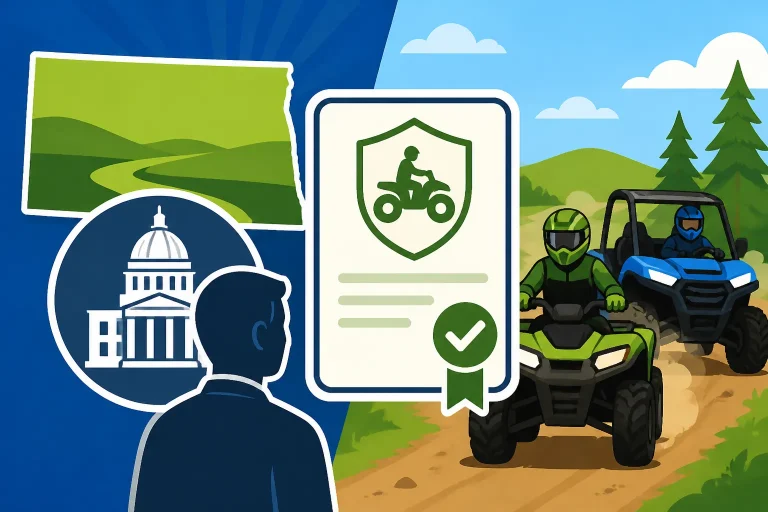
A North Dakota OHV safety certificate records that a rider has completed an approved off-highway vehicle safety course. The certificate is issued by the director, rather than being something a rider creates or receives simply by registering a machine.
The certificate is about the operator’s training. It is not:
- A title proving ownership
- A registration plate or decal for the ATV or UTV
- A non-resident permit
- Permission to ride on a particular trail, road, or private parcel
- A substitute for following age, equipment, supervision, or access rules
That distinction matters because several documents may come up during the same trip. A machine may need registration, and a visiting rider may need a permit, while a young operator may also need a safety certificate. Each requirement addresses a different question: Is the machine properly recorded? Is this visitor permitted to ride in North Dakota? Has this young operator completed the required safety training?
For a broader overview of age and training, see North Dakota OHV Safety Certificates at Age 12 and North Dakota Rules for Riders Under 16. The certificate is one piece of responsible riding preparation, not a pass that overrides other rules.
What the director’s role means
The director’s role connects the certificate to a state-approved training process. In practical terms, a rider should complete a course accepted by North Dakota and follow the department’s instructions for receiving proof of completion. A certificate from an unrelated class, a private training session, or another state should not be assumed to qualify just because it covered similar safety subjects.
The course and certificate are intended to show that the rider has received basic instruction relevant to operating an OHV. That can include safe operation, responsible conduct, and awareness of rules. Training is especially useful for children who are still developing judgment and for families who are introducing a young rider to a machine with more power, weight, or speed than a small youth vehicle.
The certificate does not guarantee that a rider is skilled enough for every machine or terrain. A child who has passed a course may still need close supervision, an appropriately sized vehicle, protective equipment, and practice in a controlled setting. A certificate also does not make an unsafe passenger arrangement legal or turn a closed road into an open one.
Who may need one
North Dakota’s training requirement is particularly relevant to operators under 16. The details can depend on where and how the machine is being operated, and exceptions may apply in specific circumstances. Parents should not assume that a child is exempt simply because an adult is nearby, the ride is short, or the machine belongs to the family.
The rules can also differ between riding on public land or a public road and riding on a parent’s own land. See North Dakota Riders on a Parent’s Land for the private-property issue, and North Dakota Parent Riding With a Child for the supervision question. These are separate considerations: an exception for one setting or circumstance does not automatically carry over to another.
Before relying on an exception, confirm the current requirement with the state agency responsible for the course or with the relevant local authority. This is particularly important if the planned ride involves a trail, public road, state-managed area, or a child operating without an adult directly present.
Age, supervision, and where the machine will be ridden
The first question is not simply, “Does my child have a card?” It is: “How old is the operator, and where will the machine be used?” Those details can affect whether the rider must have a certificate, whether supervision is required, and whether another rule applies.
North Dakota training information describes age 12 as an important point for OHV safety certification. A young person approaching that age may be able to take training or a test under specific conditions, but families should confirm eligibility and timing before enrolling. Do not assume that being close to an age threshold means the certificate requirement has already been met, or that course completion removes other restrictions.
The relevant age is the age of the person operating the machine, not the age of the owner. A parent who owns and registers a UTV does not satisfy a child operator’s training requirement by holding a certificate themselves. Likewise, one child’s certificate does not cover a sibling.
| Situation | What to check |
|---|---|
| Operator is under 16 | Confirm whether the planned location and operation require a certificate, and whether supervision rules also apply. |
| Rider is approaching age 12 | Check current course eligibility and timing directly with the state program. |
| Child is riding on a parent’s land | Confirm the private-land rule; do not assume it applies on public land or a public road. |
| Adult accompanies a young rider | Check whether that changes the requirement in the specific situation; accompaniment may not replace a required certificate. |
| Rider is visiting from another state | Verify whether the home-state certificate is recognized and whether a separate visitor permit is needed. |
| Ride includes a public road | Check road-use, equipment, age, and operator requirements separately from the training certificate. |
Supervision does not answer every question
An adult’s presence can improve safety, but it should not be treated as a universal legal substitute for training. Families sometimes assume a parent riding alongside a child is enough. That may be a reasonable safety practice, but it does not necessarily satisfy a certificate requirement that applies to the child.
Similarly, a certificate does not necessarily remove a supervision requirement. If a rule says a young operator must be accompanied in a particular situation, course completion alone may not meet that separate condition. Check the requirements together rather than choosing whichever one seems easier to satisfy.
For children, the safest approach is to plan around both legal eligibility and practical ability. Match the machine to the rider’s size and experience; make sure the rider can reach and use controls; practice stopping and turning away from traffic; and establish clear boundaries for where the child may ride. A certificate is a useful foundation, but it cannot replace adult judgment about whether a particular machine or route is appropriate.
Public land, private property, and roads are not interchangeable
“Off-highway” can make riders think that every place away from a paved highway has the same rules. It does not. A trail on public land, a private farm field, a state park road, and a public highway can all have different access and operator requirements.
Private property is not automatically a no-rules zone. Permission and ownership matter, but so can the kind of land, how it is used, and whether a public road is involved. A family may have more control over the setting on its own land, yet that does not necessarily authorize riding across a neighbor’s field or using a public ditch to reach it. For access questions, review North Dakota Posted Land Rules for Riders and North Dakota Trespass Law for Riders.
Road operation brings another layer of rules. A certificate does not establish that the machine is eligible for roadway use or that the young operator may drive it on a particular road. Registration, required equipment, road-specific limits, and age or licensing rules may still apply. Read North Dakota ATV Road Rules by Surface Type before treating a route between two fields as a simple continuation of off-road riding.
How a rider gets a certificate
The basic path is to take a safety course approved for North Dakota, complete its requirements, and follow the issuing agency’s process for receiving the certificate. Course availability and delivery methods can change, so check the state program’s current instructions before making plans.
North Dakota provides safety training through state-supported options, which may include online instruction or classroom sessions. Whether a particular format is available to a rider can depend on age, course schedule, and program rules. Use the state’s course information rather than assuming a video, school activity, dealer lesson, or another state’s class will produce a North Dakota certificate.
A practical sequence is:
- Confirm the rider’s eligibility. Check the current minimum age and any rules for someone approaching the eligible age.
- Choose an approved course. Verify that the course is recognized for North Dakota OHV certification.
- Complete the course requirements. Follow the instructions for lessons, testing, and any identity or registration details the program requests.
- Confirm that completion was recorded. Make sure the issuing program has processed the result and that the certificate is available.
- Keep proof accessible. Follow the department’s current directions about carrying or presenting the certificate.
- Check the ride separately. Confirm machine registration, visitor permits, land access, and any road-use requirements.
If a course is taken online, completion of the lessons may not be the final step. The rider may also need to pass an assessment or complete a separate process to have the certificate issued. Read the instructions carefully and keep any confirmation until the official certificate or record is available.
For in-person training, check the schedule and location before traveling. Classes may not be offered continuously in every community. If a family is planning a trip around a course, confirm the date, enrollment process, age eligibility, and what the rider needs to bring. The state’s training options are summarized in North Dakota Safety Training Run by the State and North Dakota Online Safety Course Option.
What to do if proof does not arrive
If the rider completed the course but cannot find a certificate, do not assume that a course completion screen or an email automatically counts as the final issued document. Check the program account or confirmation message, then contact the agency or course administrator using its current contact instructions.
When asking for help, have the rider’s identifying details and course information available. Explain whether the rider needs a replacement, whether the course appears incomplete, or whether the certificate cannot be located. The question is not just whether the rider remembers passing; it is whether the issuing authority’s record shows the required completion.
If the record cannot be confirmed before a planned ride, the prudent choice is to delay the young operator’s ride in any setting where the certificate may be required. An adult can still transport or supervise the child, but that does not make an unverified document valid.
Certificates from other states and visitor permits
A certificate issued elsewhere and a North Dakota non-resident permit are different things. One concerns safety-course completion; the other concerns a visiting rider’s permission to operate in the state under the applicable visitor rules. Having one does not automatically satisfy the other.
Visitors should check whether North Dakota recognizes the specific safety certificate they hold. Recognition can depend on the issuing program and North Dakota’s current standards, so do not rely on a generic claim that “all state cards count.” Ask the state program or the relevant agency before traveling, especially if the operator is under 16.
North Dakota’s visitor rules also have their own time and permit conditions. Those rules are separate from the young-rider safety requirement. A visitor may need to resolve both issues: whether the machine or operator needs a permit, and whether the rider’s out-of-state training credential is accepted. See North Dakota’s Non-Resident OHV Permit and North Dakota Has No Reciprocity With Any State for the distinction between visitor permits and reciprocity.
“No reciprocity” should not be read as meaning that no out-of-state training record can ever be considered. Reciprocity for registration or permits and acceptance of a safety credential are different questions. Confirm certificate recognition directly rather than trying to infer it from a permit rule.
A family crossing the border should check the following before loading the machine:
- Whether the young operator needs a North Dakota certificate
- Whether the rider’s home-state credential is recognized
- Whether the machine needs a visitor permit or other paperwork
- Whether the destination allows OHV use
- Whether the route to the destination includes roads with separate operating rules
- Whether the rider must carry proof or can have the record verified another way
A sticker from the rider’s home state should not be treated as proof of training, and a safety certificate should not be treated as a visitor permit. If the rider plans to stay beyond the period covered by visitor rules, ask what changes and when; do not assume that a short-visit exemption continues indefinitely. North Dakota Visitors Staying Over 30 Days covers that timing question.
Keep the certificate in context
Families can prevent most paperwork confusion by building a simple pre-ride check around the operator, the machine, and the location. The certificate answers only the training question. It does not establish that the machine is registered, that a visitor has the required permit, or that the trail or property is open to riding.
Use this checklist before a young operator rides:
- Operator: Is the rider old enough for the planned activity? Does the rider need a safety certificate or supervision?
- Certificate: Was the course approved, and does the state record show completion?
- Machine: Is the ATV or UTV correctly titled or registered when required?
- Visitor status: Does an out-of-state rider need a North Dakota permit?
- Access: Is the land open to OHV use, and is permission required?
- Route: Does the trip involve a public road, ditch, trail, or other area with separate rules?
- Equipment: Does the machine meet the requirements for the place and type of riding?
- Proof: Can the rider or parent produce the required document if asked?
If a child has a certificate but the machine is not properly registered, the paperwork is incomplete. If the machine is registered but the child lacks a required certificate, that is not fixed by the registration. If both are in order but the route crosses posted land without permission, access is still a problem.
For the first ride after training, keep the route short and controlled. Choose a place where the rider can practice starts, stops, turns, and safe spacing without traffic or obstacles. Review how to signal a stop, what to do if the machine stalls, and where the rider must not go. The point of safety training is not simply to obtain a document; it is to give the young operator a usable starting point for making safer decisions.
Parents should also revisit the rules as a child gets older, moves to a larger machine, or begins riding in a new setting. A certificate remains evidence of course completion, but age-based requirements, road eligibility, and local access conditions can change with the ride. When there is doubt, confirm the specific rule before the trip rather than interpreting the certificate as a broad authorization.
Frequently Asked Questions
Does registering an ATV or UTV issue a safety certificate?
No. Registration concerns the machine. A safety certificate documents an operator’s completion of approved training. The two may both be relevant, but they are separate requirements.
Does an adult riding with a child replace the certificate?
Do not assume so. Supervision and course certification are separate issues, and an adult’s presence may not satisfy a certificate requirement. Confirm the rule for the child’s age and planned riding location.
Can a certificate from another state be used in North Dakota?
It may depend on the certificate and the state program that issued it. Ask the North Dakota program or responsible agency whether that particular credential is accepted. Do not confuse certificate recognition with permit reciprocity.
Does a certificate let a child ride anywhere?
No. It does not grant land access, satisfy registration or visitor-permit rules, or make a road open to OHVs. Check each requirement for the machine, operator, route, and destination.
Disclaimer
This article is for general informational purposes only and does not constitute professional advice. Laws, prices and regulations vary by location and change over time. Consult a qualified professional for guidance on your specific situation.