North Dakota’s Two-Year OHV Registration
Navigating the world of off-highway vehicle (OHV) registration can feel like trying to solve a puzzle with half the pieces missing, especially when you're just trying to get your ATV or UTV ready for some prairie adventures. Forget the hassle and confusion; this guide is here to walk you through everything you need to know about North Dakota's distinct two-year OHV registration system, ensuring your machine is legal and ready to ride.
Understanding North Dakota's Unique Two-Year Registration Cycle
North Dakota does things a little differently when it comes to registering your beloved ATV or UTV. Instead of the annual dance of paperwork and fees, the state has embraced a two-year registration cycle. This system, while initially seeming like just another bureaucratic hurdle, is actually designed with riders in mind, aiming to simplify the process and reduce the frequency of administrative tasks. It's a common point of confusion for new residents or those used to other state's systems, but once you understand the rhythm, it makes a lot of sense.
Why North Dakota Opts for a Two-Year Approach
The move to a two-year registration cycle wasn't just a random decision; it's a practical solution that offers benefits for both the state and, more importantly, for us riders. Think about it: instead of remembering to renew every single year, you get a full 24 months of legal riding before you even need to think about it again. This reduces the administrative load on the North Dakota Department of Transportation and the Parks and Recreation Department, allowing them to focus more on trail maintenance and rider safety initiatives. For us, it means less paperwork, fewer trips to the motor vehicle branch, and less chance of accidentally letting your registration lapse while you're out enjoying the open country. This system aims for efficiency and rider convenience, a welcome change from annual renewals that can easily slip through the cracks of a busy schedule.
The Specifics of the Registration Period
So, how does this two-year cycle actually work? It's designed to align with a consistent end date, specifically, all OHV registrations in North Dakota are set to expire on December 31st of even-numbered years. This means that if you register your machine at any point during an odd-numbered year, your initial registration period will be less than two full years, but it will still carry you through until the end of the next even-numbered year. For example, if you register your brand-new side-by-side in July of an odd year, you'll still pay the full two-year fee, but your current registration will be valid until December 31st of the following even year. This fixed expiration date is a key detail for budgeting and planning your renewal, and it’s why the state has its particular [North Dakota's Two-Year Registration Cycle]. Understanding this specific timeline is crucial so you don't get caught off guard, especially if you're purchasing a machine mid-cycle.
The Advantage of a Longer Registration Period for Riders
The most obvious benefit of North Dakota's two-year system is the sheer convenience it offers. Imagine not having to worry about remembering an annual renewal date. This longer cycle means less frequent engagement with bureaucracy, saving you precious time and a fair bit of mental energy. It provides a consistent framework for budgeting your OHV expenses, as you know exactly when the next registration payment will be due. Furthermore, by doubling the time between renewals, the state significantly reduces the likelihood of accidental lapses in registration. No one wants to be caught riding an unregistered machine simply because they forgot the annual deadline. This extended period ensures you can enjoy your machine with peace of mind, knowing your legal obligations are handled for a longer stretch. It's truly a system designed to keep you on the trails and off the treadmill of yearly paperwork.
Deconstructing the North Dakota OHV Registration Costs
When you register your off-highway vehicle in North Dakota, you're not just paying a single fee; your payment is typically broken down into two distinct parts. These charges serve different but equally important purposes, funding both the administrative aspects of the OHV program and the maintenance of the very trails we love to ride. It's a system that ensures the costs are distributed fairly and transparently, directly supporting the OHV community across the state. Understanding these components helps you see where your money goes and why this registration is so vital for maintaining our riding opportunities.
The Core Registration Fee
At the heart of your OHV registration is a foundational fee, typically a modest, fixed amount, which covers the administrative overhead of the North Dakota Department of Transportation. This portion of your payment is essentially what keeps the lights on for the OHV program, funding the processing of applications, maintaining records, and ensuring that the system runs smoothly. It's a standard charge per machine, meaning it doesn't prorate based on when you register during the two-year cycle. You pay this fee whether you register at the beginning or halfway through the period. This fixed cost is a fundamental part of [North Dakota Charges $5 Registration Plus $15 Trail Tax], ensuring a steady revenue stream for the essential operations that support all OHV owners in the state.
The Mandatory Trail Tax
Beyond the administrative fee, there's another crucial component to your registration: the trail tax. This charge, often a slightly larger fixed amount, is specifically earmarked for the enhancement and upkeep of North Dakota's vast network of OHV trails and riding areas. This isn't just a fee; it's an investment back into the community. The funds generated from this tax directly support projects like trail maintenance, signage, mapping, and the development of new riding opportunities. Knowing [Where the Trail Tax Actually Goes] can provide a sense of satisfaction that your contribution directly impacts the quality of your riding experiences. It's the reason why we have well-maintained routes like those in Pembina Gorge and on the Roughrider OHV Trail. This dedicated funding mechanism ensures that the natural beauty and adventurous spirit of North Dakota remain accessible and enjoyable for all OHV enthusiasts.
Totaling Up the Initial Outlay
When you combine both the core registration fee and the mandatory trail tax, you arrive at the total cost for your two-year OHV registration. While specific figures can change, you can expect a set amount that covers your machine for the entire two-year period, as outlined in [North Dakota's Two-Year Registration Cycle]. This combined cost is typically paid upfront and ensures your machine is legally registered to operate on designated public lands and trails. It's important to view this as a comprehensive, two-year investment rather than a single annual expense, simplifying your financial planning. Many new owners often wonder about the actual [North Dakota Registration Cost Per Year], but it's important to remember it's a fixed charge for the entire cycle. This initial outlay is a one-time payment for the full cycle, regardless of when within the period you make your purchase or renewal.
The Process of Initial OHV Registration in North Dakota
Getting your off-highway vehicle officially registered in North Dakota might seem like a daunting task, but it's a straightforward process once you know what to expect. The key is to arrive prepared with the correct documentation and to understand your options for submitting your application. This initial registration is what transforms your new or newly acquired machine from a personal asset into a fully legal and recognized vehicle for the trails and ditches of North Dakota. It's the first step to unlocking all the riding opportunities the state has to offer.
Gathering Your Essential Documentation
Before you even think about heading to a motor vehicle branch, the most critical step is to gather all the necessary paperwork. This includes proving ownership of your OHV. For a new machine purchased from a dealer, you'll typically have a manufacturer's certificate of origin (MCO) and a bill of sale. If you bought your machine from a private seller, you'll need a properly executed [North Dakota Bill of Sale Form SFN 2888] or, in some cases, a [North Dakota Statement of Ownership Form SFN 2903]. If the machine was previously titled in another state, you'll need that title. Don't forget your personal identification, such as a valid driver's license, as they'll need to verify your identity. Having everything in order prevents frustrating delays and ensures a smooth transaction, letting you get back to planning your first ride much faster.
Where to Submit Your Registration
Once your documents are in hand, you have a few options for where to complete your registration. The most common method is to visit one of the many motor vehicle branch offices located across North Dakota. These offices are staffed with knowledgeable professionals who can guide you through the process, verify your documents, and collect the necessary fees. You can find a list of these locations on the North Dakota Department of Transportation website. [Registering at a Motor Vehicle Branch] is often preferred by those with questions or who need to handle a title transfer simultaneously. While online options for initial registration might be limited, especially if a title is involved, some renewals can be processed digitally. Always check the official state website for the most current information regarding submission methods and specific branch requirements.
Receiving Your Registration and Decal/Plate
After successfully submitting your application and payment, the final step is receiving your official proof of registration. North Dakota offers you a choice: you can receive either a registration decal or a license plate for your OHV. Many riders appreciate having this option, allowing them to pick what best suits their machine and aesthetic preferences. This choice is clearly outlined in [North Dakota OHV Plate or Decal: Your Choice]. Regardless of whether you choose a plate or a decal, it will bear your registration number and expiration date. It's crucial to properly affix this to your machine according to [North Dakota Decal Placement Rules] – typically on the rear for a plate or a visible fender location for a decal. This decal or plate, along with your registration certificate (which you should keep in your wallet or with your machine's documents), signifies that your OHV is legally registered and ready to hit the trails, granting you the peace of mind that comes with compliance.
Renewing Your North Dakota OHV Registration
Just like your initial registration, renewing your North Dakota OHV registration is a straightforward process, though thankfully, it only comes around every two years. Because of this longer cycle, it's easy to forget when your renewal is due, making it even more important to understand the timeline and how to keep your registration current. Keeping your registration up to date is not just about avoiding potential fines; it's about ensuring you contribute to the upkeep of the trails and remain a responsible member of the OHV community.
Understanding the Renewal Timeline
Given the unique two-year cycle, renewals aren't an annual event, which is both a blessing and a potential pitfall. As established, all OHV registrations in North Dakota expire on December 31st of even-numbered years. This means that if you initially registered your machine in an odd year, your first renewal will occur at the end of the next even year, effectively giving you a shorter initial period. After that first renewal, your machine will then fall into the regular two-year cycle. While the state aims to send out renewal reminders, it's always best practice to mark your calendar and keep track of your own expiration date. Don't rely solely on a piece of mail that might get lost in the shuffle. Staying aware of this fixed expiration date, which aligns with [Why North Dakota Registrations End on Even Years], is key to avoiding any last-minute rushes or, worse, riding on an expired registration.
Renewal Methods and Convenience
When it comes time to renew, North Dakota offers several convenient methods to make the process as painless as possible. Many riders find that renewing online is the quickest and easiest option, allowing them to complete the process from the comfort of their home or even on the go. You'll typically need your current registration information and a valid payment method. For those who prefer traditional methods, renewing by mail is also an option, requiring you to send in your renewal notice and payment. Of course, if you have questions or prefer face-to-face interaction, you can always visit a motor vehicle branch in person. Regardless of your chosen method, the goal is to make [North Dakota ATV Registration Renewal] as accessible as possible, ensuring that you can easily maintain your machine's legal status without excessive hassle.
What Happens if You Miss the Renewal Deadline
Life happens, and sometimes, despite our best intentions, a renewal deadline can slip our minds. If you find yourself in this situation, it's important to address it promptly. Riding an OHV with an expired registration is against the law in North Dakota, and if you're stopped by law enforcement, you could face penalties. These can include fines, which can certainly put a damper on your riding budget. Understanding [North Dakota Penalties for Riding Unregistered] highlights the importance of timely renewal. The good news is that typically, you can still renew your registration even if it's past the expiration date; you'll just need to pay the standard renewal fee. There might be additional late fees depending on how long it's been expired, but getting back on track is usually a simple process. The best advice is to renew as soon as you realize it's expired to avoid any further complications or potential citations while out on the trails.
Titling Your OHV Alongside Registration
While often discussed together, titling and registration are distinct processes, each serving a vital role in establishing your legal ownership and permission to operate your off-highway vehicle in North Dakota. Think of registration as your license to ride, showing you've paid your dues for trail access and administrative costs. Titling, on the other hand, is the official document that declares you the legal owner of the machine. Both are crucial, and in North Dakota, you'll often handle them at the same time, especially when acquiring a new OHV or transferring ownership.
The Distinction Between Title and Registration
It's a common point of confusion for many new OHV owners: what's the difference between a title and a registration? Simply put, your registration is your permission slip to operate your OHV on public lands and trails. It shows you've paid the necessary fees for a specific period and are compliant with state regulations for riding. The registration certificate and decal or plate prove this permission. Your title, however, is the legal document proving who owns the machine. It's like the deed to a house, establishing ownership and containing important details about the vehicle itself, such as the VIN and previous owner information. While you need both to legally ride your machine off your private land, they fulfill entirely different legal functions. Understanding this separation is fundamental to being a responsible OHV owner.
North Dakota's Titling Requirements
In North Dakota, virtually all OHVs must be titled. This requirement applies whether you're purchasing a brand-new machine from a dealership, bringing in a used ATV from another state, or even if you've bought a machine in a private sale. The titling process typically happens concurrently with your initial registration at a motor vehicle branch. You'll need to provide proof of ownership, such as a manufacturer's certificate of origin (MCO) for new machines, a properly assigned title from the previous owner, or a bill of sale. There's a small, fixed [North Dakota Title Fee of $5] that's paid once to establish your ownership. For detailed guidance on what exactly you'll need, refer to [Titling an ATV in North Dakota]. When you're dealing with private sales or gifting a machine, having proper legal forms is crucial. Resources like LawDepot can be incredibly useful here, providing templates for documents such as a bill of sale or a statement of ownership. This ensures that the transfer of property is legally sound and prevents headaches down the road when you go to register and title the machine.
Handling Ownership Transfers and Special Cases
Life isn't always a straight line, and neither is OHV ownership. There are several special scenarios when it comes to titling and registration. If you're [Buying From a Private Seller in North Dakota], you'll need to ensure the previous owner properly signs over their title, and a clear bill of sale is essential. For [North Dakota Registration After the Owner Dies], the process involves estate documentation. If you've poured your heart and soul into building a [North Dakota Registration for a Homemade Machine], you'll need to follow specific procedures for VIN assignment and valuation before it can be titled. In all these cases, accurate documentation is paramount. Using legal document services like LawDepot can help you generate or understand the necessary forms, such as a legally binding bill of sale or a statement of ownership, to ensure a smooth transition of title and registration. This attention to detail protects both buyers and sellers and streamlines the often-complex process of proving legal ownership for non-standard transactions.
Exemptions and Special Circumstances for OHV Registration
While North Dakota's two-year registration system is mandatory for most OHV owners, there are specific situations where you might find yourself exempt, or where different rules apply. It's not a one-size-fits-all approach, and understanding these nuances can save you time, money, and potential headaches. From riding on private land to welcoming out-of-state visitors, the state has provisions for various circumstances, acknowledging that not every OHV use case is the same.
When You Might Be Exempt from Registration
Not every off-highway vehicle in North Dakota needs to be registered. The most common exemption applies to machines that are used exclusively on private land. If your ATV or UTV never leaves your own property, you generally don't need to register it. This is a significant point for those who use their machines solely for farm work or recreation on their acreage, as highlighted in [North Dakota Private Land Only Exemption] or [Registering a Machine That Never Leaves Your Own Land]. Additionally, OHVs used strictly for organized track racing events are often exempt from general registration, as their use is contained within a controlled environment, which ties into [North Dakota Track Racing Exemption]. It's crucial, however, to ensure your usage strictly adheres to these definitions to avoid legal issues. Any deviation onto public roads or trails, even for a short distance, would typically negate these exemptions.
Non-Resident Rules and Permits
For our friends visiting North Dakota from out of state, the rules are a little different. If you're bringing your OHV into North Dakota for recreational use, you're generally exempt from North Dakota registration for up to 30 consecutive days, provided your machine is legally registered in your home state or province. This aligns with [North Dakota's 30-Day Out-of-State Rule]. However, if your visit extends beyond 30 days, or if your home state doesn't require OHV registration, you will need to obtain a North Dakota non-resident permit. This permit allows you to legally operate your OHV on designated trails and public lands for a specified period, typically one year. Details on how to get one are usually found under [North Dakota Non-Resident OHV Permit] on the state's Parks and Recreation website. These permits are crucial for ensuring out-of-state riders are also contributing to trail maintenance and are easily obtainable, often at state parks or online, making North Dakota a welcoming state for OHV tourism.
Changing Information: Address, Ownership, Machine Details
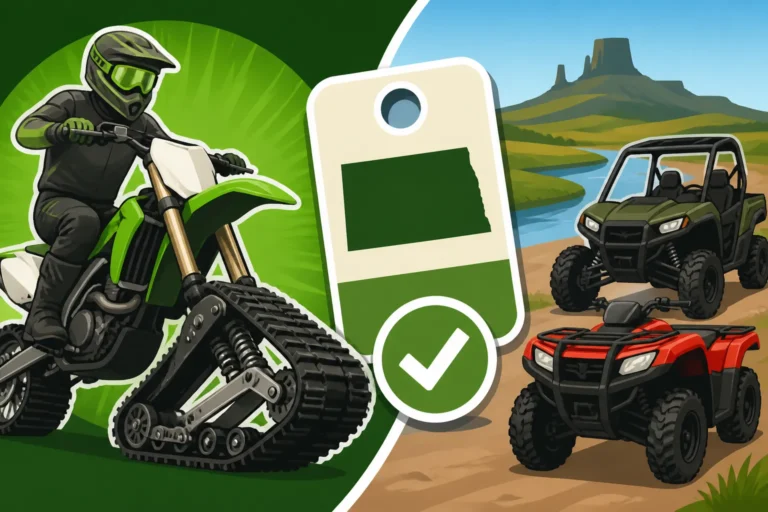
Maintaining accurate records with the state is an ongoing responsibility for OHV owners. If you move, it's essential to update your address on your registration. This ensures you receive important notices, including renewal reminders. You should notify the state of an [North Dakota Address Change Notice] in a timely manner. Similarly, if you've added modifications to your OHV that change its class (e.g., adding tracks to a dirt bike, which might then require a [North Dakota Tracked Dirt Bike Permit at $25]), or if there's any other significant change to your machine's details, it's wise to consult with the DMV. When ownership changes, the new owner is responsible for titling and registering the machine in their name. The previous owner's registration does not transfer. If you're navigating complex ownership changes, having a well-drafted bill of sale, perhaps using a template from LawDepot, can provide invaluable clarity and legal backing for the transaction, making the subsequent registration process much smoother. Keeping your information current is not just a formality; it's a vital part of responsible OHV ownership in North Dakota.
Key Aspects of North Dakota OHV Registration
| Aspect | Description | Applies to | Cost Component | Renewal Cycle |
|---|---|---|---|---|
| Registration Period | Fixed two-year cycle, expiring December 31st of even-numbered years. | All registrable OHVs | Covered by the combined Registration Fee + Trail Tax. | Every two years |
| Registration Fee | A modest, fixed administrative charge. | All registrable OHVs | Typically a small, set dollar amount. | Included in the two-year registration payment |
| Trail Tax | A mandatory charge dedicated to OHV trail maintenance and development. | All registrable OHVs | Typically a set dollar amount, higher than the registration fee. | Included in the two-year registration payment |
| Titling Requirement | Proof of legal ownership for almost all OHVs; separate from registration. | Most OHVs, especially new, transferred, or out-of-state. | A separate, one-time fixed fee (e.g., North Dakota Title Fee of $5). | Once per machine unless ownership changes |
| Proof of Registration | Either a decal or a plate, displayed on the machine, plus a physical certificate. | All registered OHVs | N/A (included in registration) | Issued upon initial registration and each renewal |
| Non-Resident Permit | Required for out-of-state OHVs staying over 30 days, or if home state does not require registration. | Visiting OHVs from other states/provinces | A specific permit fee (e.g., North Dakota Non-Resident OHV Permit cost). | Typically annual (January to December) |
| Exemptions | Primarily for machines used solely on private land or for organized track racing. | Specific use-cases only | N/A (no cost if exempt) | N/A (not applicable) |
Disclaimer
This article is for general informational purposes only and does not constitute professional advice. Laws, prices and regulations vary by location and change over time. Consult a qualified professional for guidance on your specific situation.