North Dakota Riders on a Parent’s Land
North Dakota parents often want to know whether a child can ride an ATV or UTV on family land without a safety certificate. The short answer is that a limited private-land exception may apply, but it does not follow the rider onto public trails or roads. Here’s how to separate the certificate question from registration, permits, land access and practical safety.
What the parent-land exception means
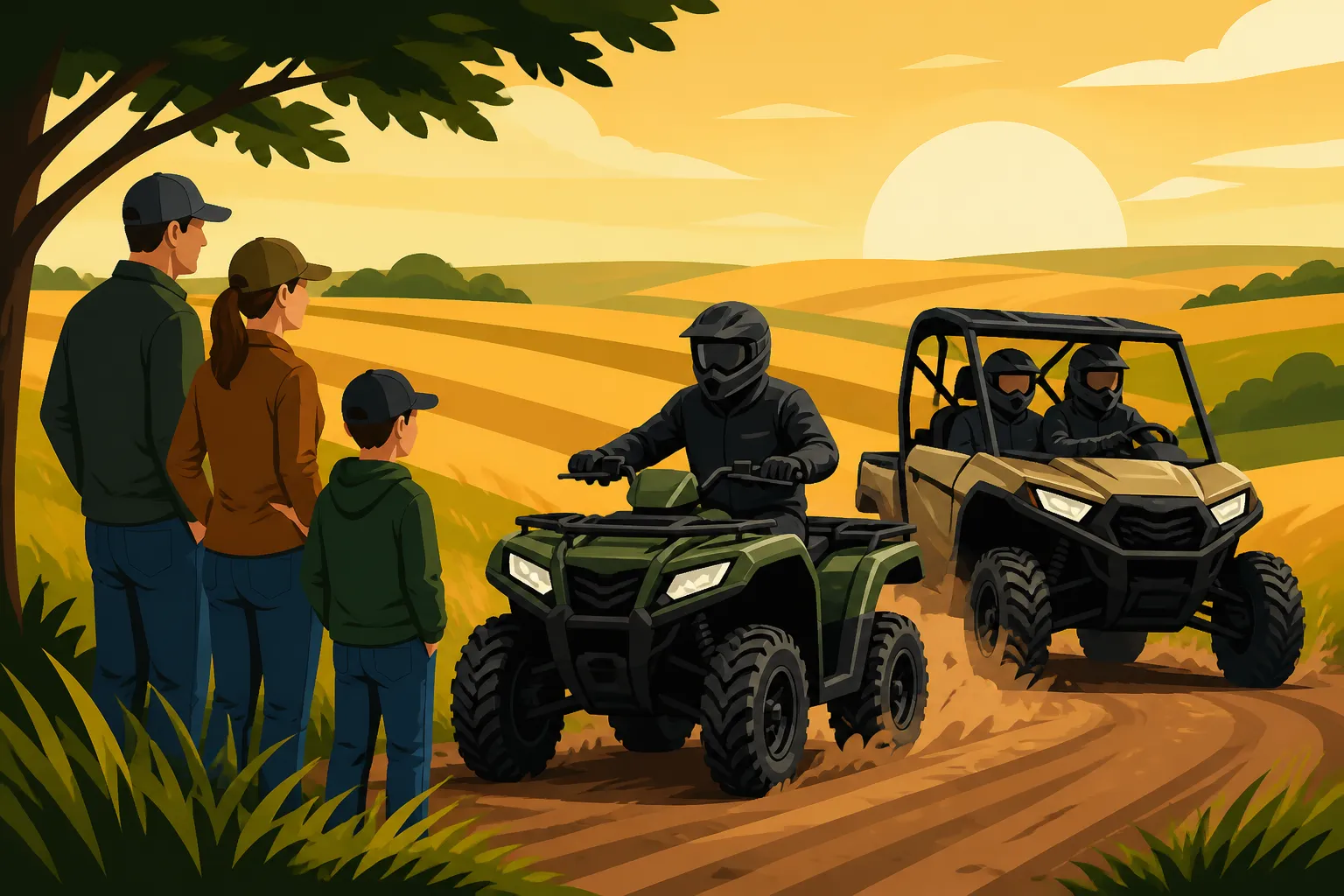
North Dakota has a safety-certificate requirement for many OHV riders under 16 operating away from the limited private-land exception. A rider may operate on land owned by a parent without carrying the certificate required for riding in places where that rule applies. The key point is that the exception is tied to the location and ownership of the land, not simply to the fact that a parent is present.
That distinction matters. A parent riding alongside a child on a public trail does not turn the trail into private family land. Nor does a parent’s permission make someone else’s property eligible for the exception. For the details of the general age and certificate rules, see North Dakota OHV Safety Certificates at Age 12 and North Dakota Riders Under 16 Without a License.
The certificate exception is also not a general approval for every kind of riding. It does not, by itself, settle whether the child may ride a particular machine, whether the machine needs registration, or whether the route is open to OHVs. Those questions have their own requirements.
Think of the parent-land exception as a narrow answer to one question: whether the child needs the safety certificate for operation on that qualifying private land. It does not replace other rules that may apply to the machine or the rider.
| Situation | Does the parent-land exception answer the certificate question? | What else to check |
|---|---|---|
| Child rides on land owned by a parent | It may apply to the certificate requirement | Whether the land is truly private and whether the machine is used only there |
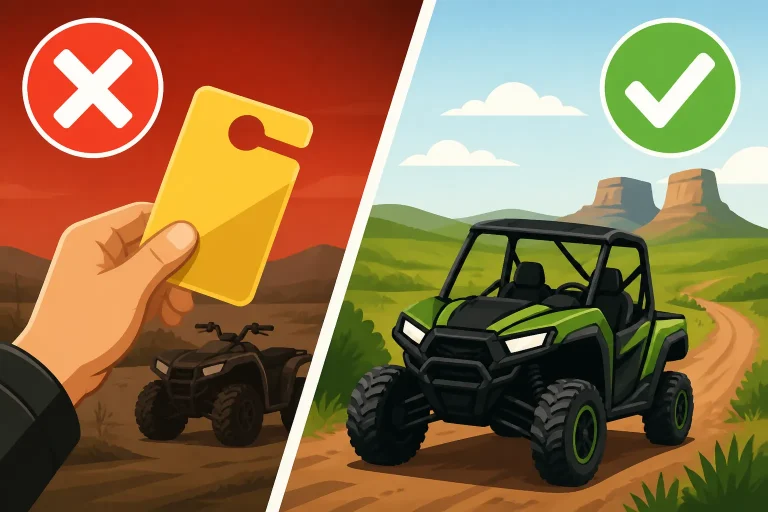
| Parent accompanies child on a public OHV trail | No; the parent’s presence does not make the trail private land | Certificate, registration or permit, trail rules and age-related requirements |
| Child rides on a neighbor’s or relative’s land | Do not assume the exception applies | The ownership and legal status of the land, plus permission and applicable requirements |
| Child crosses or rides along a public road | The private-land exception does not carry over to the road | Road-use eligibility, equipment, age and operating rules |
| Machine is used both on family land and public riding areas | The private-land exception does not cover the public trips | Registration, certificate and any permit requirements for those trips |
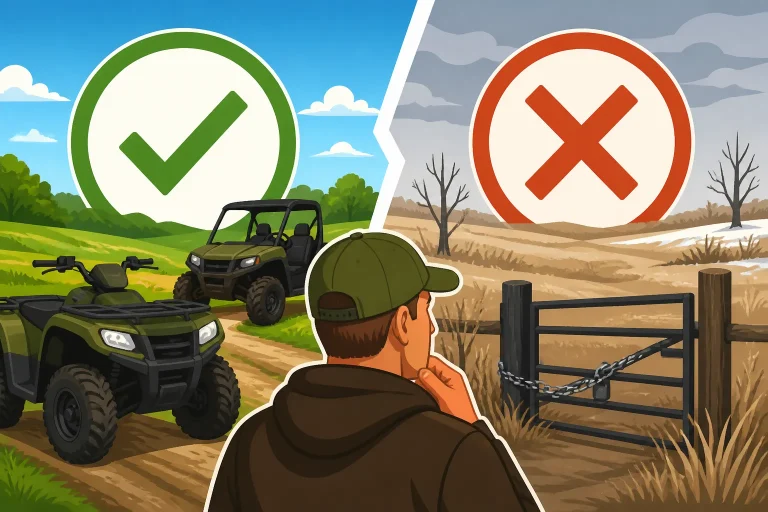
The safest interpretation is to treat the exception as applying only while the child remains on the qualifying private property. If a ride leaves that land, even briefly, stop and check which rules govern the next part of the route before setting out.
Where the exception stops
A property boundary can change the rules. A route that begins in a farmyard or pasture may connect to a public road, a trail, a ditch or another parcel. The child’s certificate status on the parent’s land does not automatically answer whether the child can continue onto that adjoining area.
Public land, public roads and designated OHV trails are not simply extensions of private family property. For example, parental supervision does not substitute for the certificate when the applicable rules require one for a public ride. Likewise, a home-state card, sticker or registration does not necessarily satisfy North Dakota requirements for a visitor. North Dakota does not offer broad state-to-state reciprocity for OHV requirements; see North Dakota Has No Reciprocity With Any State and North Dakota Non-Resident OHV Permit.
Do not rely on informal descriptions such as “the trail behind the farm” or “the road we always use.” First identify who owns or manages the route and whether it is open to OHVs. A trail across private land may require permission. A public route may have its own age, registration, equipment or access rules. North Dakota Posted Land Rules for Riders explains why permission and posting matter when a ride reaches another person’s property.
Roads need a separate check
Being allowed to ride on private land does not make an ATV or UTV road-legal. Road operation has separate requirements, and some roadways or roadway areas are closed to OHVs. A child’s age, the machine’s type and capability, required equipment, the road’s posted speed and local restrictions can all matter. Read North Dakota ATV Road Rules by Surface Type before planning a route that uses any roadway.
A brief road crossing is still different from remaining on the parent’s property. Do not assume the parent-land certificate exception authorizes a crossing, roadside travel or ditch riding. Check the specific crossing and route rules, including whether that location is legally open to the machine.
Property ownership is not the same as permission
The exception is about land owned by a parent, not just land where a parent has permission to ride. A parent may have a lease, a work arrangement or permission to use a neighbor’s field, but those facts do not automatically make the land eligible for the parent-owned-land exception. When ownership or access is unclear, verify the exact situation rather than stretching the exception to fit.
Even on a parent’s property, other people’s rights can affect a route. A public right-of-way, easement, shared access road or posted boundary may mean the rider is no longer simply operating on the family’s private land. If the route follows a fence line or approaches a neighbor’s parcel, get clear permission and keep the child within the area the family is entitled to use.
The certificate exception does not settle registration or permits
Certificate requirements and machine paperwork are separate. A child might not need a safety certificate for a ride on qualifying parent-owned land, while the machine’s registration status still depends on how and where it is used.
North Dakota’s private-land-only registration exemption is generally tied to a machine being kept and operated exclusively on private property. If the ATV or UTV will also be used on public trails or other places where registration is required, do not assume that occasional private-land use makes the machine exempt. See North Dakota’s Exemption for Machines Used on Private Land and North Dakota Registration Exemptions Explained for the separate registration question.
A simple way to think about it:
- Certificate: Is the rider required to have the relevant safety certificate for this location and activity?
- Registration: Is the machine required to be registered for where it will be operated?
- Visitor permit: If the machine or rider is visiting from outside North Dakota, does a non-resident permit apply to the planned public riding?
- Access: Is the route open, and does the rider have permission to use it?
- Road use: If any part of the route uses a road or right-of-way, are the machine and rider allowed there?
One answer does not automatically determine the others. A certificate does not replace registration. Registration does not grant access to private property. A visitor permit does not make a closed road or trail open. And the parent-land exception does not serve as a substitute for any paperwork required for public riding.
If the child rides only on family property
If the machine will stay on the parent’s land, focus on confirming the property boundary and the scope of any private-land exemption. Keep the route within the property and avoid assuming that a connecting path, access lane or road is included. If the machine will be moved to a public riding area later, treat that as a separate trip and check its requirements before the machine leaves home.
If the child will ride on public ground
For a public ride, check the child’s certificate status, the machine’s registration and any permit requirement before leaving. Visitors should not assume that their home state’s documentation is enough. How to Buy a North Dakota OHV Permit can help with the permit process, while North Dakota Registration Versus a Non-Resident Permit explains why the two documents are not interchangeable.
Also verify access at the specific riding area. Public ownership alone does not always mean motorized riding is allowed everywhere. Rules can differ among trails, roads, parks, wildlife areas and other public lands. Confirm current access and closures with the land manager before planning a family ride.
A practical plan for parents
A few minutes of planning can prevent a child from crossing into a situation where the private-land exception no longer fits. Use this process before handing over the keys.
- Confirm the child’s age and certificate status. If the child is under 16, check whether the planned location falls within the private-land exception or whether the child needs a certificate. The state safety course has an age floor; see North Dakota Safety Course Minimum Age for the related details.
- Confirm who owns the riding area. Identify the parcel and its boundaries. Do not rely on a familiar path or a family member’s verbal description if the route touches other property.
- Map the entire ride, not just the starting point. Mark any roads, ditches, trails, shared lanes and crossings. A route can leave the qualifying private land without the rider realizing it.
- Check the machine’s paperwork separately. Determine whether the machine is used exclusively on private property or will also be operated where North Dakota registration or a visitor permit is required.
- Check access and local rules. Get permission where needed and verify the status of public routes. Do not treat a posted or closed area as open just because it connects to the family property.
- Set clear riding limits. Tell the child where to ride, where not to ride and what to do if they reach a boundary, gate or road. For younger riders, a defined route and close adult supervision are sensible safeguards even when a certificate exception applies.
- Recheck before a public ride. A later trip to a trailhead, park or public riding area is a different situation. Confirm certificates, registration, permits and access for that outing.
For a child learning to ride, keep the machine and route appropriate to the rider’s ability. Use a properly fitted helmet and protective gear, explain how to stop safely, and establish a way for the child to contact an adult. A DOT-compliant helmet should fit securely; if comparing options through Amazon or another retailer, check the certification label and fit rather than choosing by appearance alone.
Do not let the certificate exception create a false sense of security. The exception addresses a legal requirement for a particular setting; it does not teach the child how to control the machine or remove the risks of uneven ground, hidden obstacles, steep slopes or other riders. Start with a controlled area, keep the riding pace modest and stay close enough to intervene.
Common misunderstandings to avoid
The most frequent mistake is treating “my parent is here” as the same thing as “I am on land owned by my parent.” They are not interchangeable. The exception is tied to the land and its ownership, so adult presence alone does not extend it to a public trail, a neighbor’s parcel or a road.
Another common mistake is assuming that the private-land exception waives all paperwork. It does not. Safety certificates, registration, visitor permits and land access answer different questions. Check each one that applies to the ride.
It is also easy to overlook a short route segment. A child may be riding on the parent’s field, then follow a ditch or lane to reach another field. That connecting stretch may fall under different rules. Plan the whole route and treat every boundary crossing as a point to verify.
Finally, do not assume that an exception for one child or machine applies to every family member or vehicle. The relevant details can change with the rider’s age, the machine, the land and whether the ride uses public routes. When facts do not fit the straightforward parent-owned-land situation, confirm the rule with the appropriate state authority or a qualified professional before riding.
Frequently Asked Questions
Can a child ride an ATV on a parent’s land without a safety certificate in North Dakota?
A limited exception may allow operation on land owned by the child’s parent without the certificate required for applicable riding elsewhere. Keep the child on that qualifying private land; do not assume the exception covers public trails, roads or other property.
Does a parent need to ride alongside the child for the exception to apply?
The important distinction is the status of the land, not simply whether a parent is present. Adult supervision is a sensible safety practice, but it does not make a public route qualify as parent-owned private land.
Does the certificate exception mean the ATV or UTV does not need registration?
No. Certificate and registration rules are separate. A private-land-only registration exemption may apply when a machine is used exclusively on private property, but use on public riding areas can change the paperwork requirements.
Can a child use the exception on a neighbor’s land if the parent has permission?
Do not assume so. Permission to ride on someone else’s land is not the same as land owned by the parent. Check the precise rule and get clear landowner permission before riding.
Disclaimer
This article is for general informational purposes only and does not constitute professional advice. Laws, prices and regulations vary by location and change over time. Consult a qualified professional for guidance on your specific situation.