North Dakota Riders on Family Land
A child riding an ATV or UTV on a family property may face different requirements than one riding a public trail, but “family land” is not a pass for every rule. The key questions are who owns the land, whether the ride stays on private ground, and whether the rider or machine later enters a public area. Here’s how to sort those questions before anyone starts the engine.
What the family-land exception does and does not mean
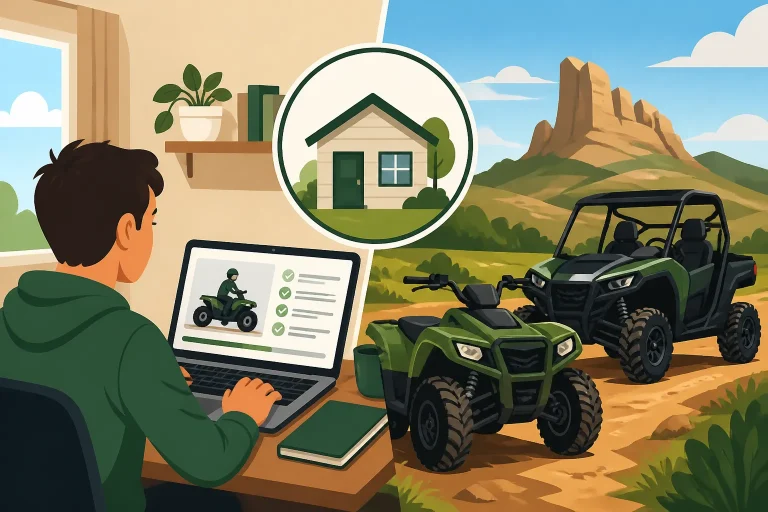
North Dakota’s rules treat riding on a parent’s land differently from riding on public land for some youth safety-certificate requirements. That distinction matters most when a rider is under 16 and has not yet obtained the state OHV safety certificate. The exception is tied to the land and circumstances of the ride; it should not be read as a general exemption from all ATV and UTV rules.
The central point is that a family relationship by itself does not establish that a ride qualifies. A child riding on land owned by a parent or guardian is a different case from a child riding on a grandparent’s acreage, a relative’s farm, or a neighbor’s property. Those situations may still be private-land rides, but the parent-land exception may not apply in the same way. If the owner is not the child’s parent or guardian, confirm the current rule with the appropriate North Dakota agency before relying on an exception.
| Riding situation | What to check |
|---|---|
| A child rides on land owned by a parent or guardian | Whether the youth safety-certificate exception applies to that particular ride |
| A child rides on a relative’s land | Landowner permission and whether the parent-land exception covers the situation |
| A child rides on a public trail or other public riding area | Safety-certificate requirements, machine registration, and any permit requirements |
| A child rides along or crosses a public road | Road-use rules, equipment requirements, and whether the machine is legally allowed on that road |
| The machine is used only on private property | Whether a private-land registration exemption applies, and whether the machine will remain exclusively on that land |
The family-land exception is not the same thing as a general safety recommendation. A rider who is legally exempt from a certificate requirement still needs age-appropriate instruction, adult oversight, and a machine suited to their size and skill. A child should know how to stop, steer, and respond to an emergency before riding independently. Adults should also set boundaries that the rider can understand and follow.
A rider who uses public riding areas should not assume that riding on family property earlier in the day changes the public-land requirements. The legal context changes when the machine leaves private property. For the state’s youth training rules, see North Dakota OHV Safety Certificates at Age 12 and North Dakota Safety Course Minimum Age. For the specific parent-land question, North Dakota Riders on a Parent’s Land covers the closely related issue.
Define the land and the route before riding
“Family land” can mean a home lot, a farm, pasture, a hunting parcel, or a rural property held by more than one relative. Before riding, be clear about who owns or controls the property and where the rider is allowed to go. A family member’s permission does not necessarily authorize travel across a neighboring parcel, down a public road, or onto public land.
A simple boundary plan avoids many misunderstandings. Identify the approved riding area, mark places the child must avoid, and explain what to do if the rider gets turned around or reaches a fence, gate, road, waterway, or another person’s property. If more than one household or landowner controls the property, get permission from the people whose land the route would cross.
Private ground is not the same as every nearby route
A ride can begin on family property and then cross a legal boundary. A ditch, section line, farm access, trail, or road may look like a natural extension of the property but have different ownership and access rules. Do not treat a route as private just because it is next to a family field or because riders have used it before.
If the route leaves the property, pause and check the rules for that specific land and surface. Permission to ride on a private parcel does not automatically grant permission to ride on another parcel. Public areas may also have separate restrictions, designated routes, or permit requirements. North Dakota’s North Dakota Posted Land Rules for Riders and North Dakota Electronic Posting and Riders explain why checking land access is important even in familiar rural areas.
Roads deserve special attention. A private-land exception for a youth certificate does not automatically allow a child to ride a public roadway. Road riding has its own requirements, and some machines or riders may not qualify for particular road use. The rules can depend on the road surface, posted speed, machine type, equipment, and rider. Review North Dakota ATV Road Rules by Surface Type before planning a route that uses a road, ditch, shoulder, or crossing.
If the property is near public land, do not assume the boundary is obvious from the seat of a machine. Use a map or other reliable property information, and keep young riders well inside the approved area. Make the boundary easy to recognize on the ground where practical. Fences and gates may show property limits, but they do not necessarily show where riding is permitted.
Registration, permits, and insurance are separate questions
A youth safety-certificate exception does not automatically exempt the machine from registration or other requirements. These are separate parts of the rules: one concerns the rider’s training, while another concerns the machine and where it is operated. Treat each question independently rather than assuming that permission to ride on family land settles everything.
North Dakota has an exemption associated with machines used only on private land. The important condition is the machine’s use: an ATV or UTV kept and operated exclusively on private property may be treated differently from one that is taken onto public riding areas or roadways. If the machine is used beyond the property, confirm whether registration is required before that trip. See North Dakota Private Land Only Exemption and North Dakota Registration Exemptions Explained for more on how the exemption is described.
A machine can also have ownership paperwork questions even if it is not being registered for public use. Registration, title, proof of ownership, and permission to operate are not interchangeable. If a machine is bought, inherited, or transferred within the family, keep records showing who owns it. Titling an ATV in North Dakota explains the title side of the process.
Permits can matter when a North Dakota resident or visitor takes a machine onto public land. A private-property ride does not substitute for a required public-land permit, and an out-of-state registration or decal may not satisfy North Dakota’s requirements for a visitor. Before taking a family machine to a trail or public riding area, check the rules for that area and the rider’s residency status. North Dakota Registration Versus a Non-Resident Permit explains the difference between these forms of authorization.
Insurance is another separate consideration. A machine used only on family property may be handled differently by an insurer than one used on roads or public riding areas. Ask the insurer what the policy covers, including injury to a rider, damage to the machine, and liability involving another person. Do not assume coverage applies just because the machine is insured for a different use. For more context, see North Dakota Insurance Requirements at Registration.
A practical way to keep the paperwork straight is to ask four questions before each outing:
- Is the rider allowed to operate in this location, and does the youth certificate rule apply?
- Is this route entirely on property where the owner has given permission?
- Does the machine need registration or a permit for the planned use?
- Does the insurance policy cover the rider, machine, and location?
The answers can change between a ride around a family pasture and a trip to a public trailhead. Recheck them when the route, machine, rider, or destination changes.
Make family-property riding safer and easier to supervise
A legal exception is not a substitute for a safe setup. Family property can include hazards that are easy for an adult to overlook: irrigation ditches, steep banks, wire, livestock, equipment, hidden holes, soft ground, and vehicles entering from a yard or farm road. Walk or inspect the riding area before giving a child permission to use it, especially after weather or farm work has changed the terrain.
Match the machine to the rider rather than choosing one based only on what is available. A child should be able to reach and operate the controls while seated correctly, and the machine should not be too powerful or heavy for the rider to manage. Follow the manufacturer’s age and passenger guidance. Never add a passenger if the machine was not designed to carry one.
Set clear rules before the engine starts. For a young or inexperienced rider, useful boundaries include:
- Ride only in the approved area and during agreed hours.
- Stay away from roads, livestock, buildings, machinery, and water.
- Do not carry passengers or let another person take the controls.
- Stop and return to an adult if the machine behaves unexpectedly.
- Wear a properly fitted helmet and appropriate protective gear.
- Do not ride when tired, impaired, or unable to see the route clearly.
Supervision should fit the rider’s age, skill, and the property. An adult being somewhere on the acreage is not necessarily enough if a young rider is out of sight, beyond hearing, or operating in a place where help cannot reach them quickly. Agree on a check-in plan and make sure the child knows how to shut the machine off. Consider starting with a short, familiar route and expanding it only as the rider demonstrates good judgment.
If a machine will be used both on private land and in public areas, set up the paperwork and safety habits for the more demanding use. Do not let a child infer that because the machine is allowed in a field, it may also be ridden in a ditch, on a road, or on a public trail. Explain the boundary explicitly before the ride. For a broader overview of what owners must handle, see What North Dakota’s OHV Law Requires of Owners.
When a family property is shared, put the riding rules in writing or make sure all adults communicate them consistently. A parent may allow a child to use one field while another owner expects that area to remain closed because of crops, livestock, or equipment. A clear agreement protects the rider and reduces conflict among landowners.
The safest approach is to treat the family-land exception as a narrow answer to a specific rule, not as blanket permission. Confirm that the land and rider fit the exception, keep the ride on authorized private property, and separately check registration, permit, road-use, and insurance requirements whenever the machine leaves that property.
Disclaimer
This article is for general informational purposes only and does not constitute professional advice. Laws, prices and regulations vary by location and change over time. Consult a qualified professional for guidance on your specific situation.