North Dakota Sound Limits on Public Land
A loud ATV or UTV can draw complaints even when it has a muffler, but the applicable rule depends on where you ride. North Dakota does not have one sound limit that automatically applies to every public riding area. The key is to identify the land manager, understand any location-specific noise rule, and keep your machine’s exhaust system in proper condition.
North Dakota public-land sound limits depend on who manages the land
“Public land” is not one uniform category. A trail, road, or recreation area may be managed by a federal agency, the state, a county, or another public body. Each manager can have its own operating rules, and a statewide equipment requirement is not the same as a noise limit that applies at a particular site.
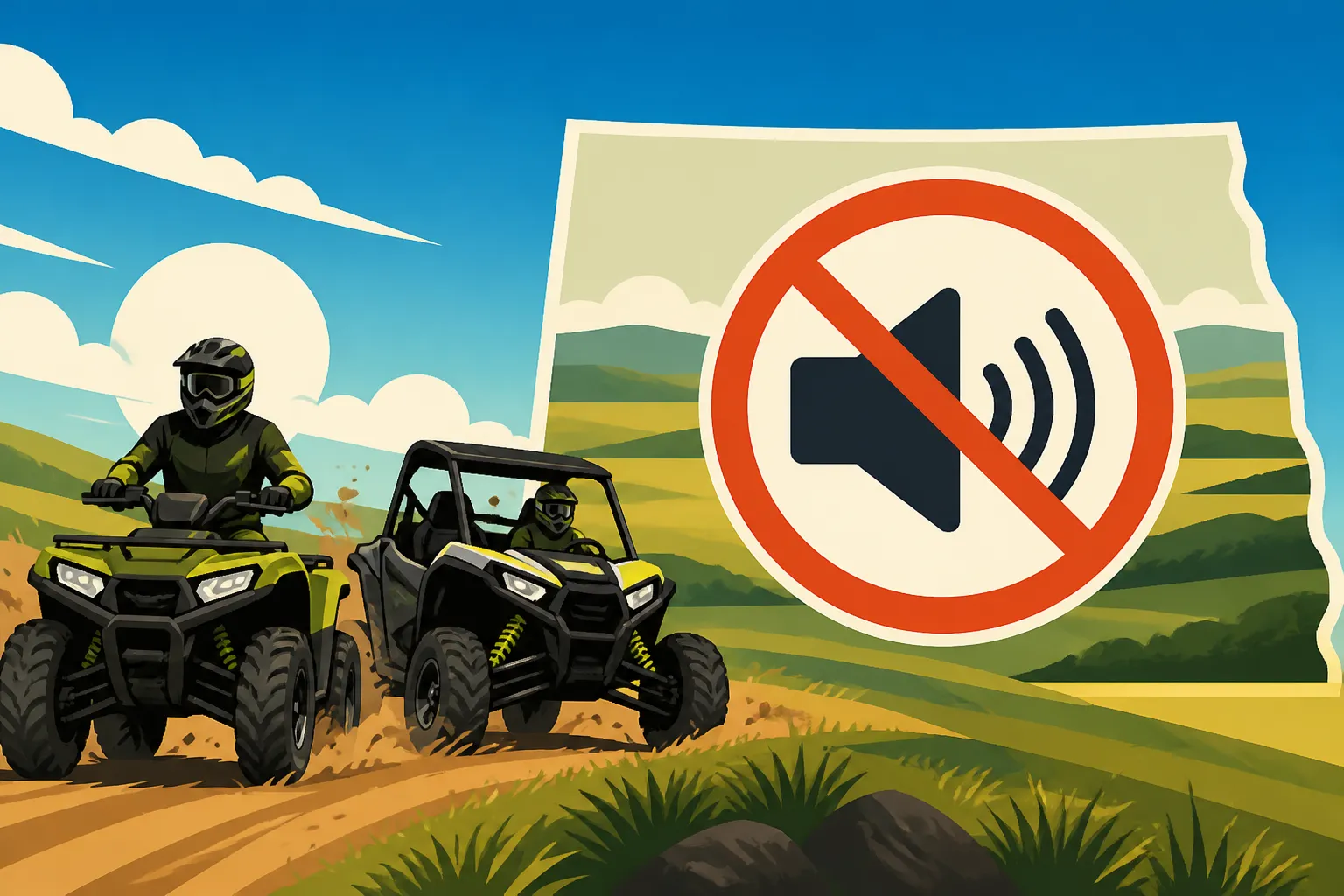
One important federal rule applies on National Forest System lands. It prohibits operating a device that produces noise exceeding 60 decibels on the A-weighted scale when measured at 50 feet, unless the Forest Service authorizes it. That rule is relevant when riding on applicable Forest Service land, including parts of the Dakota Prairie Grasslands. It is not a blanket 60-decibel rule for every public road, state recreation area, or parcel in North Dakota.
Other public areas may restrict noise through their own rules, operating hours, closures, or requirements to use specified routes. The details can depend on the site and the type of activity. A machine that is permitted on one route may not be allowed elsewhere, regardless of how quiet it is.
| Where you are riding | What to check | Why it matters |
|---|---|---|
| National Forest System land | Forest Service noise and motor-vehicle rules, plus the area’s route designations | The 60 dBA at 50 feet rule applies to covered Forest Service land unless authorized |
| State-managed recreation land | The current site rules, posted notices, and any operating restrictions | State sites may have rules that differ from federal land |
| County or locally managed land | The managing agency’s rules and local restrictions | Local conditions can vary by place |
| Public road or right-of-way | Road-use requirements and applicable vehicle equipment rules | A public road is not automatically an approved OHV route |
| Private land | The landowner’s permission and any applicable noise rules | Permission to enter does not necessarily remove other legal requirements |
Before a ride, identify the land manager rather than relying on a general claim that “public land allows it” or “public land has a certain decibel limit.” For routes on the Dakota Prairie Grasslands, consult the relevant North Dakota Grassland Motor Vehicle Use Maps. For other areas, check the agency responsible for the specific trail or parcel. The broader list of places to ride in North Dakota OHV Trails: All Four Riding Areas can help you distinguish between riding areas, but always confirm current rules for your intended destination.
It also helps to separate a sound limit from a route-access rule. A quiet machine does not become legal on a route closed to motor vehicles, and an open route does not necessarily exempt you from a noise restriction. Check both before you unload.
Mufflers, exhaust changes, and what a sound check can tell you
A sound limit is only one part of the noise picture. North Dakota OHV equipment requirements also matter, and a functioning muffler is central to controlling exhaust noise. For the state equipment rules, see North Dakota Muffler Requirements. If your ride may cross areas with fire-prevention requirements, review What North Dakota Says About Spark Arresters as well; a spark arrester and a muffler serve different purposes, even when they are part of the same exhaust assembly.
A machine may sound louder after an exhaust change, a damaged component, or a loose connection. A missing or altered muffler can cause practical problems beyond the possibility of a citation: it can make conversation difficult, disturb nearby residents or campers, and lead a land manager to investigate a complaint. Noise also carries farther across open prairie, water, and quiet valleys than it may seem to from the rider’s seat.
Inspect the exhaust before leaving
Use a basic inspection to catch obvious problems before riding:
- Look for missing or loose parts. Check the muffler, exhaust pipe, clamps, and mounting points. A loose connection can make the machine louder and may allow hot exhaust to escape where it should not.
- Check for damage or obvious modifications. A cracked component, removed baffle, or altered exhaust can change noise levels. If you are unsure whether a replacement part meets the machine’s requirements, ask a qualified repair shop or the manufacturer.
- Listen for a sudden change. If the machine has become noticeably louder since its last ride, do not assume the sound is normal. Have the exhaust checked before heading to a public riding area.
- Avoid judging it only from the driver’s seat. The rider is close to the engine and may not hear how the machine sounds to someone standing nearby.
A handheld sound meter can help you compare your machine’s noise before and after a repair or modification. A basic meter sold through retailers such as Amazon may be useful for rough checks, but a consumer reading is not automatically an official measurement. The meter’s accuracy, settings, distance, direction, surrounding noise, and test method can all affect the result.
A phone app is even less conclusive. Microphones differ between devices, and an app may not be calibrated for a legal measurement. Use either kind of tool to spot a possible issue, not to prove that your ATV or UTV meets a legal limit.
For a meaningful comparison, keep the test conditions consistent. Measure at a known distance, use the same meter and settings, and avoid taking a reading next to a wall, vehicle, or other surface that can reflect sound. Wind, traffic, other machines, and the riding surface can also affect what the meter records. If an agency conducts an official test, follow its procedure rather than substituting your own reading.
A modification can affect more than the sound number
An aftermarket exhaust can change the machine’s sound, emissions, performance, or compliance with manufacturer specifications. The fact that a part fits does not establish that it is legal for every public riding area. Ask the seller or installer what the part changes and whether it preserves required noise-control equipment. Keep documentation for replacement parts if it helps explain what was installed, but do not treat paperwork as a substitute for meeting the applicable rule.
If your ATV or UTV is used both on private property and public routes, set it up for the stricter use you expect. A machine that is acceptable on a large private parcel may still be too loud for a public area with a sound rule or nearby campsites. Landowner permission is important, but it does not automatically override a public agency’s restrictions once you enter public land.
How to check the rule and avoid a noise problem on your ride
The most reliable approach is to check the exact location and prepare the machine before traveling. Do not rely only on an old social-media post, a trail map without rule details, or a friend’s memory of a previous visit. Land status, route access, and operating restrictions can change.
Use this process:
- Pin down the exact route or property. A town, park name, or general region may include land managed by different agencies. Identify the trailhead and the roads or trails you plan to use.
- Find the land manager. Look for the agency named on the official map, signs, or site information. If you cannot tell who manages the route, ask before riding.
- Check the current rules. Look for a sound limit, muffler requirement, operating hours, vehicle restrictions, or special conditions. If the rule is unclear, contact the managing office and describe your machine and planned route.
- Check route access separately. Confirm the route is open to your type of OHV. Maps and signs may distinguish motorized routes from roads closed to off-highway vehicles. North Dakota Trail Closures After Rain is a useful reminder that conditions and access can change, although weather closures are separate from sound rules.
- Inspect the machine. Make sure the exhaust is secure and intact, and repair an unusual increase in noise before the trip.
- Ride considerately. Avoid unnecessary revving, aggressive acceleration, and extended idling near homes, campsites, trailheads, or other users. Choose a suitable pace and give other riders and land users space.
- Follow instructions from officials. If an officer or land manager asks you to stop, identify the route and explain where you are headed. What an Officer Can Ask to See can help you prepare for a routine stop.
If someone complains about the noise
Do not respond by revving the engine, arguing from a distance, or continuing to ride past the person. Reduce the noise by slowing down or shutting the machine off when safe. If the complaint comes from an official, ask which rule applies and whether the issue is the exhaust system, a measured sound level, the route, or the time of operation. Those are different concerns, and knowing which one is involved helps you respond appropriately.
A complaint is not proof that a machine violates a specific decibel rule, but it is a practical warning that your sound level may be disruptive or that you are in a sensitive area. If the official identifies a defect or restriction, follow the instruction and resolve the issue before riding again. Do not rely on a consumer meter reading to dispute an official procedure.
Good riding habits help prevent problems even where a specific decibel threshold is not posted. Keep the exhaust system in good condition, avoid unnecessary noise, and respect quiet areas. North Dakota Trail Etiquette Locals Expect offers broader advice for sharing riding areas with other users.
A quick pre-ride checklist
Before setting out on public land, confirm:
- You know who manages the route.
- Your OHV is allowed on that route.
- You have checked current sound and equipment rules for that land.
- The muffler and exhaust are present, secure, and in working condition.
- You are not relying on a phone app or personal meter as official proof.
- You are prepared to comply with posted restrictions or an official’s instructions.
If the route is on Forest Service land, pay particular attention to the applicable federal noise rule and any site-specific directions. Elsewhere, do not assume the same number applies. Check with the agency responsible for the land, and make your machine as quiet as reasonably possible without compromising safe operation.
Disclaimer
This article is for general informational purposes only and does not constitute professional advice. Laws, prices and regulations vary by location and change over time. Consult a qualified professional for guidance on your specific situation.