Buying a Permit Online Before You Travel
If you’re bringing an ATV, UTV or dirt bike into North Dakota, it can be easy to confuse a visitor permit with vehicle registration. The state offers out-of-state OHV owners an online permit, but it does not replace every requirement or guarantee that a trail is open. Here’s what to check before you travel and how to avoid buying the wrong authorization.
Who needs the online North Dakota OHV permit
The online permit is for owners of OHVs registered outside North Dakota. According to the North Dakota Parks and Recreation Department, owners of out-of-state registered OHVs must purchase a non-resident public trails and lands access permit. The department says visitors can buy it through the official North Dakota state park reservation portal.
This is separate from North Dakota registration. According to the North Dakota Parks and Recreation Department, OHVs operated on public land in the state generally must be registered with the North Dakota Department of Transportation. Resident machines operating on public lands and trails require that registration, while an out-of-state owner needs the non-resident permit for the visitor’s machine.
The distinction matters if you’re planning a trip with a machine registered in another state. A home-state registration does not remove North Dakota’s non-resident permit requirement. Conversely, buying a non-resident permit is not the same as registering a machine as a North Dakota resident. For a fuller comparison, see North Dakota Registration Versus a Non-Resident Permit and North Dakota’s Non-Resident OHV Permit.
According to the North Dakota Parks and Recreation Department, the non-resident permit costs $10 per year, and non-resident permits are valid from January 1 to December 31. The resident OHV registration fee is $20 for a two-year period, paid on a cycle that expires in even-numbered years; both fees are stated by the department as of November 2026. The two amounts apply to different situations, so don’t choose between them based only on which one looks more convenient.
| Your situation | What to check before riding |
|---|---|
| Your OHV is registered outside North Dakota | According to the North Dakota Parks and Recreation Department, purchase the non-resident public trails and lands access permit. |
| You own a North Dakota machine and will ride on public land | According to the North Dakota Parks and Recreation Department, resident OHVs generally need North Dakota registration through the Department of Transportation. |
| You’re unsure whether your home-state paperwork qualifies | Check the machine’s registration status and North Dakota’s visitor rules; a permit does not turn an out-of-state registration into North Dakota registration. |
| You’re bringing a tracked dirt bike | Check the separate tracked dirt bike permit requirement before relying on the ordinary OHV permit. |
| You plan to ride on a particular trail or public area | Confirm that the area allows OHV use and is open when you arrive. A permit does not guarantee access. |
A permit is for the covered access requirement, not a blanket approval to ride anywhere. Your machine still has to be allowed on the land or trail, and other rules can apply to the rider, vehicle and route. North Dakota also has specific requirements for riding on roadways, so a visitor permit should not be treated as permission to use a public road. If you’re sorting out the state’s broader reciprocity rules, North Dakota Has No Reciprocity With Any State is a useful next read.
How to buy the permit online before leaving
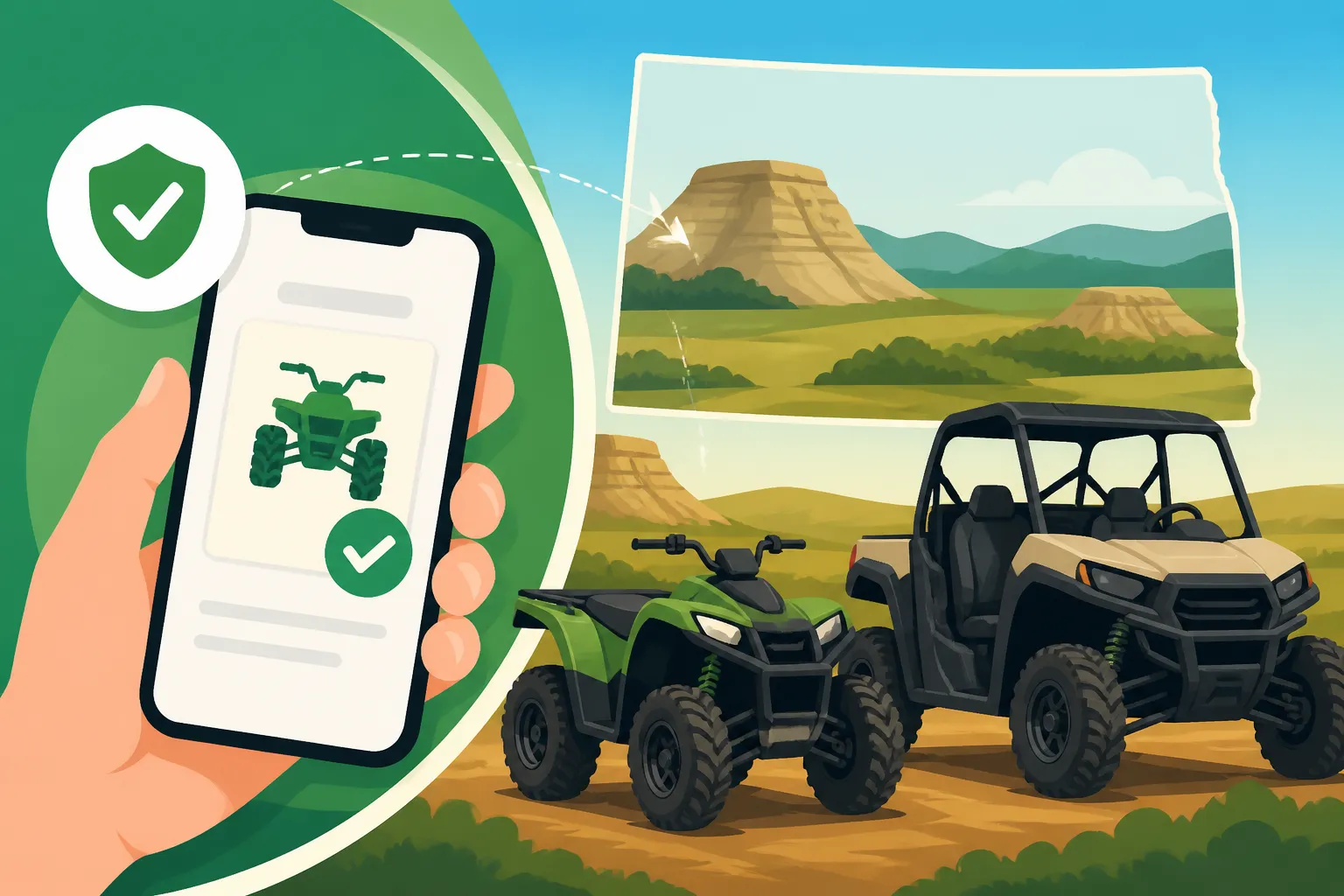
The North Dakota Parks and Recreation Department identifies the official state park reservation portal as the online purchase channel for the non-resident public trails and lands access permit. Use the official portal rather than assuming that a marketplace listing, third-party page or an out-of-state registration site can issue North Dakota’s permit.
The safest approach is to complete the purchase before you set out, then keep a record of the transaction and be ready to show any confirmation or permit details provided by the portal. Follow the current prompts on the official site: portal screens and required fields can change, and the department’s stated facts do not specify every step of the checkout process.
Before submitting, make sure you are selecting the permit for an out-of-state OHV, not a North Dakota registration or a park entrance permit. They serve different purposes. If you are uncertain which option applies, pause and confirm with the department rather than buying the first item that mentions trails.
It also helps to have your machine’s paperwork available while you work through the portal. The North Dakota Parks and Recreation Department says the OHV registration application asks for the owner’s name and address, make, year and serial number. Those are the details specified for the registration application; do not assume that the non-resident permit checkout asks for precisely the same information. Use the portal’s own instructions for the permit purchase.
A practical pre-trip sequence is:
- Confirm that the OHV is registered outside North Dakota and that you are buying for the machine you intend to bring.
- Open the official North Dakota state park reservation portal and locate the non-resident public trails and lands access permit.
- Read the portal’s current terms and prompts before submitting payment.
- Save the purchase confirmation or permit information supplied after checkout, and keep it accessible during your trip.
- Check the permit’s valid dates against your travel dates. According to the North Dakota Parks and Recreation Department, the non-resident permit year runs from January 1 through December 31.
- Check the rules and current status for each riding area you plan to visit.
The department’s portal is the source for purchasing the permit online, but it is still worth checking the permit details before travel rather than leaving the purchase until arrival. For more on the online option and its calendar, see North Dakota Permits Sold Online and North Dakota Non-Resident Permits Run January to December.
What the permit does not cover
The name “public trails and lands access permit” can sound broader than it is. It addresses the non-resident permit requirement for an out-of-state registered OHV; it does not establish that every public parcel is open to motorized riding. Access depends on the area’s rules, and a closure or local restriction can still prevent riding.
Trail conditions can change, too. The North Dakota Parks and Recreation Department says closures at Pembina Gorge State Park, Roughrider OHV Trail and Turtle Mountain State Recreation Area are evaluated every 24 hours. Check the status of your intended destination close to departure and again before riding, rather than assuming a permit means the route will be open. The department provides North Dakota state park and recreation area trail information through the OuterSpatial app.
A permit also does not make a machine road-legal or remove operator requirements. North Dakota has separate roadway rules, and a trail permit alone does not mean an OHV can be ridden on a highway. For example, roadway operation has equipment and machine requirements, and shoulder and inside-slope riding is prohibited according to the North Dakota Parks and Recreation Department. If your trip involves riding beyond a designated trail, review the relevant rules first, including North Dakota Permit for a Visiting Machine and North Dakota Rules for Riding a Gravel Road.
Age-related safety requirements are another separate issue. According to the North Dakota Parks and Recreation Department, youth ages 12 through 15 without a valid driver’s license or learner’s permit must take an OHV safety certification class to legally operate on allowed public lands. Riders and passengers under age 18 must wear a DOT-approved helmet when riding an OHV. The permit does not substitute for safety certification or required protective gear.
For a group trip, check the rules for each rider, not just the paperwork for the vehicle. A parent or other adult may need to verify that a young rider meets the applicable training requirement before arriving at the trailhead. The department offers hands-on OHV safety courses, but availability and course details should be checked directly if a rider needs certification before the trip.
Final checks before you travel
Treat the permit as one item on a short pre-trip checklist, not as the only paperwork or access check. Confirm that the machine’s out-of-state registration is in order, buy the North Dakota non-resident permit through the official portal, and keep the purchase information available. Then verify that your destination permits the kind of machine you’re bringing and has no closure or other restriction in effect.
If you’re travelling with more than one machine, make sure you have checked the requirements for each one. Do not assume that one permit covers multiple OHVs unless the portal or department explicitly confirms that. The same caution applies when an OHV is borrowed, rented or registered to someone else: check what the current purchase process requires and who is responsible for obtaining the permit.
Use the calendar carefully. According to the North Dakota Parks and Recreation Department, a non-resident permit is valid within the January-to-December calendar year. If your visit crosses a year boundary, or if you are planning a later trip after an earlier visit, confirm the permit’s dates rather than relying on a prior purchase.
The most useful distinction to keep in mind is simple: North Dakota registration applies to resident machines under the state’s registration rules, while the non-resident access permit applies to out-of-state registered OHVs visiting public trails and lands. Buying online before travel can make the permit requirement easier to manage, but it does not replace registration where required, safety requirements, destination rules or a final trail-status check.
Sources
- North Dakota Parks and Recreation Department — OHV Permits & Registration | ND Parks and Recreation – Business and Grants (checked November 3, 2026)
- North Dakota Parks and Recreation Department — OHV Safety | ND Parks and Recreation – Business and Grants (checked November 3, 2026)
- North Dakota Parks and Recreation Department — Motorized Safety | North Dakota Parks and Recreation (checked November 3, 2026)
- North Dakota Parks and Recreation Department — Off-Highway Vehicles (OHV) | ND Parks and Recreation – Business and Grants (checked November 3, 2026)
- North Dakota Parks and Recreation Department — Snowmobile Permits & Registration | ND Parks and Recreation – Business and Grants (checked November 3, 2026)
- North Dakota Parks and Recreation Department — Snowmobile Safety | ND Parks and Recreation – Business and Grants (checked November 3, 2026)
- North Dakota Parks and Recreation Department — Snowmobile Trails | ND Parks and Recreation – Business and Grants (checked November 3, 2026)
- North Dakota Parks and Recreation Department — 04-2022%20OHV%20Brochure%20WEB.pdf (checked November 3, 2026)
Disclaimer
This article is for general informational purposes only and does not constitute professional advice. Laws, prices and regulations vary by location and change over time. Consult a qualified professional for guidance on your specific situation.