Visibility in Blowing Snow
Riding an ATV or UTV in North Dakota during the winter can be an incredible experience, but when the snow starts blowing, what was once an adventure can quickly turn into a terrifying and dangerous situation. Low visibility due to blowing snow isn't just an inconvenience; it's a genuine threat that can lead to disorientation, accidents, and even getting lost. This guide is here to walk you through the unique challenges of navigating your off-highway vehicle (OHV) in those infamous prairie whiteouts, offering practical advice and strategies to keep you safe and prepared.
Understanding the Unique Dangers of Blowing Snow for OHV Riders
When you're out on your quad or side-by-side in North Dakota, a little snow can be fun. A lot of snow can be challenging. But blowing snow? That's an entirely different beast, creating conditions that are arguably more hazardous than heavy snowfall itself. It's not just about the snow coming down; it's about the snow that's already on the ground being whipped up by the wind, creating a disorienting, featureless void.
Why Blowing Snow Is So Dangerous
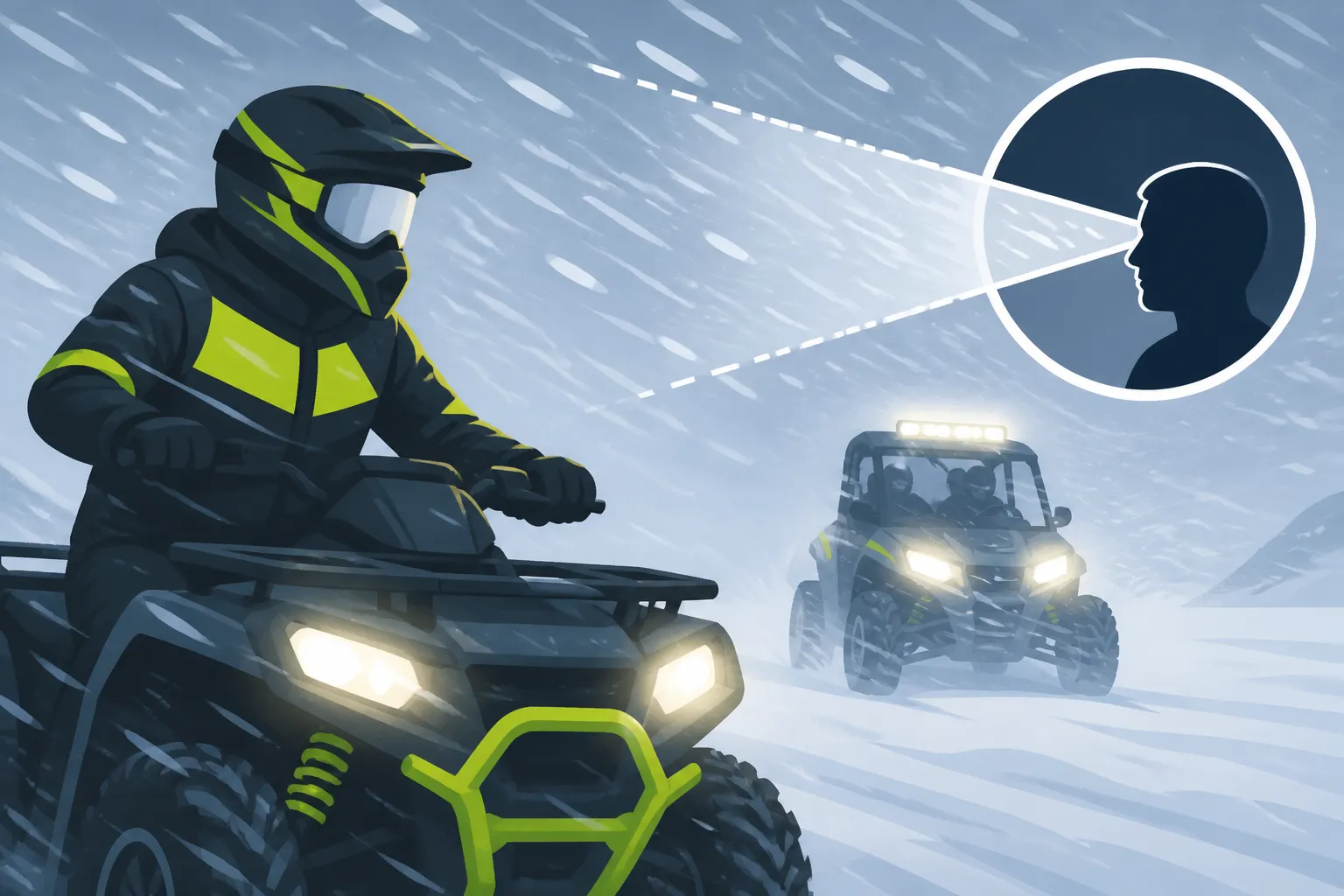
Imagine driving a vehicle through thick fog, but instead of just fog, you also have tiny, abrasive ice crystals pelting you and obscuring your vision even further. That's a bit like what blowing snow is for an OHV rider. The key danger isn't just reduced visibility, it's zero visibility. Whiteout conditions eliminate the horizon, the ground, and any discernible features, making it impossible to tell up from down, or where the ditch ends and the road begins. This isn't just metaphorical; it can genuinely cause vertigo and disorientation, especially when you're moving. What might seem like a manageable situation on a clear, still day becomes a life-threatening scenario when visibility drops to mere feet, or even inches.
Think about navigating a section line or a field when the ground and sky blend into one seamless canvas of white. You lose depth perception, the ability to judge distances, and even the direction of travel can become a guessing game. Furthermore, the wind associated with blowing snow brings extreme cold, increasing the risk of frostbite and hypothermia, particularly when a breakdown or getting stuck leaves you exposed for an extended period. [North Dakota Riding in Winter Snow] has its own joys, but it demands respect for conditions like these.
Common Accidents Caused by Low Visibility
The types of accidents stemming from blowing snow are often catastrophic because they occur when a rider has no visual cues. Without being able to see, riders frequently veer off course, hitting unseen obstacles like fence posts, culverts, or even farm equipment partially buried in drifts. It's easy to drive into a ditch or off a significant drop-off that would be obvious in normal conditions. Consider the subtle shift of a snowdrift that looks flat but hides a steep incline or a hidden drop.
Another common scenario involves collisions with other vehicles or stationary objects. Even if you're the only one out there, you might not see a gate, a parked vehicle, or even a tree until it's too late. When riding with a group, the danger of rear-ending a lead rider or getting separated becomes very real, as communication can be difficult and visual contact easily lost. A machine can also get stuck in a deep, hidden drift, leading to prolonged exposure to the elements while attempting to free it. These aren't just minor bumps; they can result in serious injuries, extensive machine damage, and a very frightening experience far from help.
Preparing Your Machine and Yourself for Low Visibility
The key to surviving a North Dakota whiteout on your OHV isn't just knowing what to do when it happens; it's about being prepared long before the first snowflake starts to blow. Your machine needs to be equipped for battle, and you need to be dressed and geared up as if you're venturing into an arctic expedition. This proactive approach can literally be the difference between a minor inconvenience and a major emergency.
Essential Machine Upgrades for Better Visibility
Standard factory lighting on most ATVs and UTVs just isn't cut out for serious blowing snow. You'll want to invest in significant lighting upgrades. LED light bars are a popular choice, offering intense, broad illumination that can help cut through the whiteout, albeit often by illuminating the snow particles themselves, which can still be disorienting. Amber or yellow-tinted lights can sometimes be more effective in snow and fog, as they reduce glare. Consider adding auxiliary forward-facing lights mounted lower on your machine to help illuminate the ground immediately in front of you, and rear-facing lights that are highly visible to anyone behind you.
Cab enclosures, especially for UTVs, are invaluable. A full enclosure with a sturdy windshield and wipers (if applicable) can protect you from the direct assault of the snow and wind, allowing you to focus on navigation rather than fighting the elements. Companies like SuperATV offer a range of enclosures, hard cabs, and windshields designed to create a more protected environment inside your UTV. Make sure your windshield is clean and treated with a water-repellent coating. For ATVs, hand guards and heated grips are crucial for maintaining control and comfort. Lastly, ensure all your existing lights – headlights, taillights, brake lights – are clean, functioning perfectly, and free of snow or ice build-up. A [North Dakota Mirror and Horn Requirements] check is also wise, though a mirror won't help much in zero visibility, the horn could be a lifesaver.
Personal Gear to Enhance Your Vision and Safety
Layering is paramount for staying warm, but your outer layer needs to be highly visible. Bright, fluorescent colors like orange, yellow, or lime green are crucial. Consider reflective tape on your helmet and jacket, especially if you anticipate riding near roads or other vehicles. Helmets are always a good idea, but in blowing snow, a full-face helmet with a heated visor can prevent fogging and ice buildup, maintaining your visual clarity. If a heated visor isn't an option, an anti-fog insert or spray is the next best thing.
Goggles or eyeglasses are a must, even within a helmet. In extreme conditions, a second pair of goggles tucked away can be a lifesaver if your primary pair becomes iced over or too scratched to see through. For those who wear prescription glasses, ensure they are clean and that you have a secure strap to prevent them from flying off. Beyond vision, personal navigation tools are non-negotiable. A reliable GPS unit with pre-loaded maps, a compass, and even a physical map as a backup are critical for maintaining direction when visual cues are gone. Make sure all electronic devices are fully charged and stored in waterproof bags. And don't forget a whistle for emergency signaling – sometimes shouting just won't cut it against the wind.
Here's a quick comparison of visibility enhancement tools:
| Category | Item | Primary Benefit | Considerations |
|---|---|---|---|
| Lighting | LED Light Bar | High intensity, broad illumination | Can create glare on snow particles |
| Amber/Yellow Lights | Reduced glare, better contrast in snow/fog | May not be as bright as white LEDs | |
| Lower-mounted Aux Lights | Illuminates ground directly in front | Less effective for distance visibility | |
| Protection | Full Cab Enclosure (UTV) | Shields from direct snow/wind, improved comfort | Can collect snow on windshield, requires wipers/defrost |
| Heated Visor (Helmet) | Prevents fogging and icing of vision | Requires power, specific helmet compatibility | |
| Anti-fog Goggles/Spray | Maintains clear vision without fogging | Needs regular application, can wear off | |
| Navigation | GPS Unit with Maps | Provides real-time location and direction | Battery life dependent, signal loss in remote areas |
| Compass & Physical Map | Analog backup, no power required | Requires understanding of navigation, map can get wet | |
| Visibility | Hi-Vis Outerwear | Makes rider more visible to others | Doesn't help rider's vision, but increases safety |
| Reflective Tape | Enhances visibility in low light | Only effective when light hits it |
Riding Strategies and Safety Protocols
Even with the best gear and machine upgrades, riding in blowing snow requires a fundamentally different approach. You can't just power through it like a summer afternoon. It's about slowing down, tuning into your other senses, and prioritizing safety above all else. North Dakota's vast, open landscape, while beautiful, offers little in the way of visual references when a whiteout descends.
Slowing Down and Maintaining Situational Awareness
The most important rule in blowing snow is simple: slow down. Way down. What might feel like a crawling pace will likely be your safest speed. This gives you more time to react to the almost non-existent visual cues you do have and reduces the impact if you hit an unseen obstacle. Maintain a much greater following distance if you're riding with others. In these conditions, it's often better to stop periodically and let your eyes adjust, or to scout ahead on foot if you're unsure about a tricky section, rather than risk a high-speed collision.
Situational awareness extends beyond just what you can (or can't) see. Pay attention to the sound of your engine – is it laboring unexpectedly, suggesting you're plowing through a deep drift? Feel the terrain under your tires – is it suddenly softer, icier, or does the machine feel like it's tilting? Use your GPS constantly, not just to know where you are, but to anticipate upcoming turns, changes in elevation, or potential hazards that you won't be able to see. Remember that [North Dakota Rules for Riding a Gravel Road] or a section line are different from riding an open field, and in a whiteout, those distinctions become dangerously blurred.
Navigation and Communication in Whiteout Conditions
Navigating in a whiteout is where your preparedness truly pays off. Rely heavily on your GPS. Set waypoints frequently, especially at turns or landmarks you can identify before visibility drops. If you're following a known trail or road, try to stick to the edge where snow might be less disturbed, or where you might pick up the faint outline of a fence line or a power pole, using it as a guide. If you lose sight of all references, stop. Do not try to guess. Consult your map and GPS, and if necessary, wait for conditions to improve. This might mean sheltering in your UTV cab or finding some natural cover until the worst passes.
When riding in a group, communication is paramount. Handheld radios are far superior to shouting in windy, snowy conditions. Establish clear signals and protocols before you even leave. For example, if the lead rider stops, everyone stops. If someone gets separated, what's the plan? A distress signal (like three short horn blasts repeated, or a pre-arranged radio call) should be understood by all. Consider carrying a small, powerful flashlight or beacon that can penetrate the blowing snow for short-range signaling. Make sure everyone knows [North Dakota Accident Reporting for an OHV] procedures, just in case.
Post-Ride Considerations and Emergency Preparedness
Even if you successfully navigate a whiteout and make it back to safety, the journey isn't truly over until you've debriefed and taken care of your machine. Moreover, the unpredictable nature of North Dakota winters demands a robust emergency plan, because even the most experienced riders can get caught off guard.
Checking Your Machine After Exposure to Blowing Snow
Blowing snow isn't just fluffy powder; it often contains abrasive ice crystals and can pack into every crevice of your machine. After a ride in these conditions, a thorough inspection is crucial. First, check your air filter. Fine snow and ice particles can bypass filters, leading to water ingestion or engine damage. Replace or clean your air filter if it's wet or clogged. Inspect all electrical connections for moisture and corrosion. Snow can melt and refreeze in critical areas, causing electrical shorts or malfunctions.
Pay close attention to your brakes and suspension. Ice and packed snow can interfere with brake caliper function or seize suspension components. A careful wash might be needed, but remember that washing in freezing temperatures can quickly create new ice issues. If you do wash, ensure the machine is thoroughly dried, especially brakes, before parking it where temperatures will drop again. Finally, don't forget to check your tires for any damage from hidden debris and ensure proper inflation; cold temperatures can significantly reduce tire pressure. Consider what [North Dakota Maintenance Costs Per Year] might include in a climate like this.
What to Do If You Get Lost or Stranded
Despite your best efforts, getting lost or stranded in North Dakota's blowing snow is a real possibility. The first rule is: don't panic. Panic leads to poor decisions. Stay with your machine. Your ATV or UTV is much easier to spot than a person wandering around, and it provides some shelter. Conserve your fuel; turn off the engine unless you absolutely need heat (if you have an enclosure) or light.
Use your communication devices immediately. Attempt to call for help using your cell phone or satellite communicator. If you're with a group, huddle together for warmth and to maintain morale. Deploy any emergency signaling devices you have – a brightly colored tarp, a signal mirror (though useless in a whiteout, it might help once the sun comes out), or a distress flare if appropriate and safe. [North Dakota Insurance Requirements at Registration] might not cover all scenarios, but having proper liability and comprehensive coverage is always a good idea. Ration any food and water you have, and make efforts to stay dry and warm. If you have an emergency kit, now is the time to use it. This kit should ideally include extra warm clothes, high-energy snacks, a first-aid kit, a small shovel, fire-starting materials, and a portable power bank for your electronics. Knowing your location using GPS and being able to relay it accurately will significantly aid rescue efforts.
Disclaimer
This article is for general informational purposes only and does not constitute professional advice. Laws, prices and regulations vary by location and change over time. Consult a qualified professional for guidance on your specific situation.