What North Dakota Says About Spark Arresters
A spark arrester can look like a small detail on an ATV or UTV, but whether you need one depends on where you ride. North Dakota does not have one simple rule that covers every machine and every riding area. The practical answer is to distinguish statewide equipment rules from requirements set by the land manager, then check your machine before heading out.
Is a spark arrester required on every North Dakota ATV or UTV?
North Dakota’s general OHV requirements do not appear to create a universal spark-arrester rule for every ATV or UTV ride. That does not mean you can assume the equipment is optional everywhere. Rules can differ between private property, state-managed riding areas, federal land and other public locations.
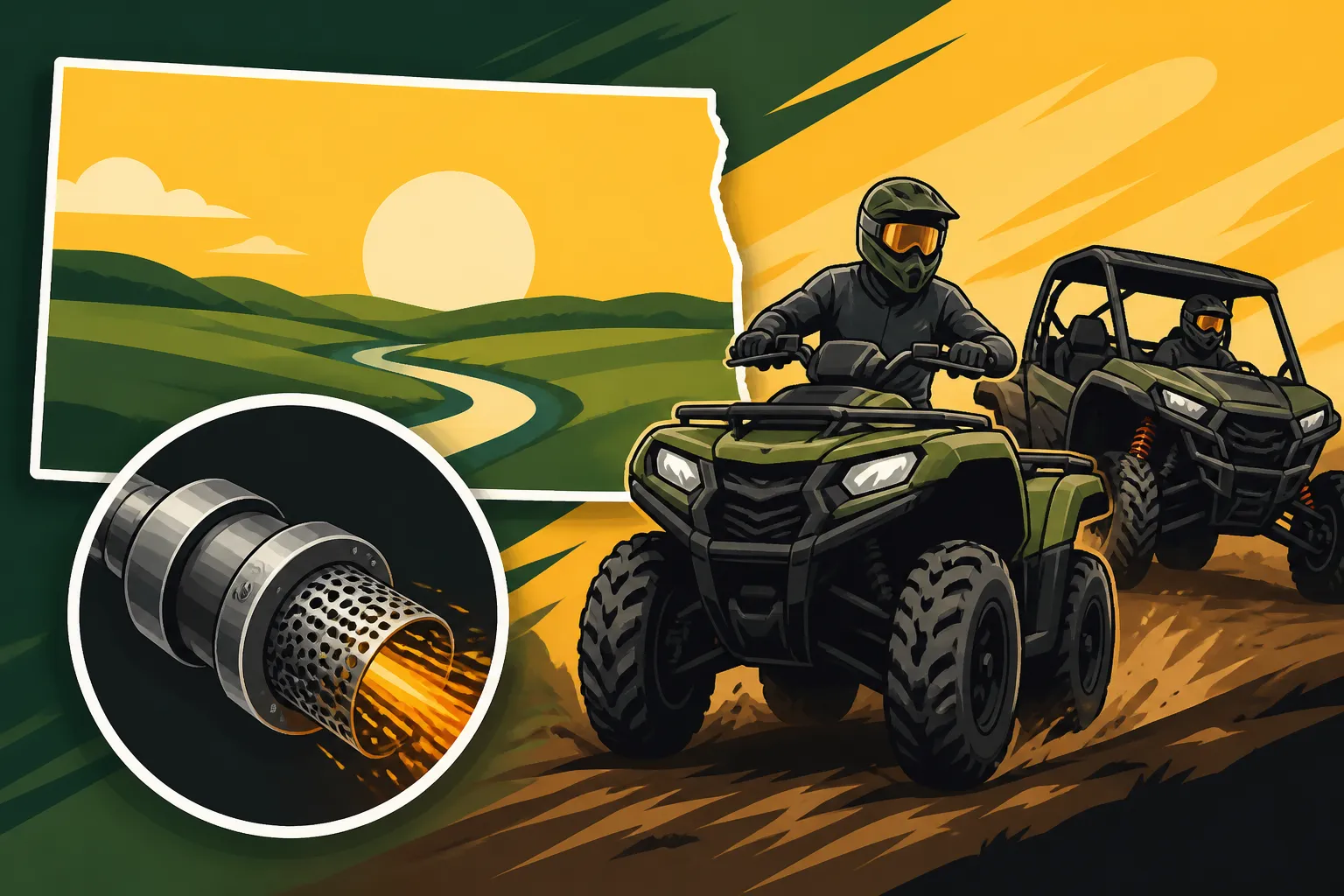
A spark arrester is a device designed to trap or cool hot particles leaving an engine’s exhaust. It is not the same thing as a muffler, and a quiet exhaust does not automatically mean it has an approved spark arrester. Some exhaust systems include one as part of the original equipment; others may have a removable screen or a replaceable component. The owner’s manual or manufacturer can help identify what is fitted to your machine.
The distinction matters because a requirement may come from the agency responsible for the land rather than from a single statewide OHV equipment rule. For example, public-land managers may set conditions intended to reduce fire risk or protect a riding area. Those conditions can apply to machines using that area even if the same machine is not subject to that requirement on private land.
In practice, treat the answer as location-specific:
- On private land: Check the owner’s rules and any applicable local requirements. Permission to ride does not necessarily mean every machine setup is acceptable.
- On state-managed land: Read the rules for the specific park or riding area. A general statewide registration or equipment rule is not a substitute for site requirements.
- On federal land: Check the responsible federal agency’s current motor-vehicle and fire-prevention rules. Requirements can depend on the land, route and conditions.
- At an organized event: Follow the organizer’s rules as well as the land manager’s requirements. Event organizers may set equipment standards for participants.
For broader context on which rules apply to different types of machines and rides, see What North Dakota’s OHV Law Requires of Owners. If you are planning to ride on federal grassland roads, North Dakota Grassland Motor Vehicle Use Maps can help with the separate question of where motorized travel is allowed.
The safest takeaway is straightforward: do not infer that a spark arrester is required everywhere, and do not infer that it is never required because North Dakota has no single rule for every ride. Identify the land manager and check its current requirements before you unload.
Where the land manager’s rules matter
North Dakota riding areas do not all have the same rules. The agency responsible for a property can set conditions for access, equipment, fire prevention and route use. The requirements may also change when conditions such as dry vegetation or elevated fire danger prompt temporary restrictions.
This is especially important on public land. A machine may be registered and otherwise properly equipped yet still fail to meet a particular area’s operating rules. Registration allows the machine to meet a legal requirement; it does not grant unrestricted access or override site-specific conditions.
Federal land
Federal land can have its own requirements for off-road equipment. On National Forest System land, for example, spark-arrester standards may apply to internal-combustion equipment. The relevant question is not just whether a screen is present, but whether the device meets the standard required by the land manager and is kept in effective working condition.
Before riding, check the rules for the specific property and route. A motor-vehicle map tells you where motorized use is allowed, but it may not answer every equipment question. Confirm the current requirements with the managing agency, especially if you are unsure whether your exhaust has an approved device. The article North Dakota Riding on Corps of Engineers Land covers why the land manager matters on another type of public property.
State and local riding areas
State parks and other state-managed sites may set operating conditions for their own facilities. Do not assume a requirement at one location applies to every state property, or that a rule you followed at one trail system is enough for another. Review the area’s posted notices and official information before travel.
Local ordinances can also address how and where OHVs may be operated. They are not a replacement for state or land-manager rules. If you are unsure which authority controls a route, ask the property manager or local law enforcement rather than relying on an old forum post or a sign you saw somewhere else.
Temporary fire restrictions
Fire restrictions can affect access or equipment expectations when conditions are dry. Requirements may be temporary, area-specific and updated as conditions change. A machine that was allowed on a route earlier in the season may not be allowed under a later restriction.
Check North Dakota Fire Restrictions in Dry Years before a trip when fire danger is a concern. Also check for closures and alerts through the land manager’s official channels. North Dakota Trail Status by App and Phone can help with trail-status checks, but confirm that the information covers the particular location and any fire-related restrictions.
| Riding location or situation | What to check | Why it matters |
|---|---|---|
| Private property | Landowner rules and applicable local requirements | Permission to ride does not automatically establish what equipment is acceptable |
| State-managed area | The specific site’s current rules and notices | Requirements can vary from one property to another |
| Federal land | The managing agency’s equipment and fire rules | Federal standards may apply in addition to North Dakota OHV requirements |
| Organized ride | Event rules and the land manager’s conditions | The organizer may impose equipment checks or participation requirements |
| Dry or high-fire-risk conditions | Current fire restrictions and closures | Temporary restrictions can change access or operating conditions |
How to check whether your machine is ready
A quick pre-ride check is more useful than guessing from the appearance of an exhaust outlet. A screen can be missing, damaged or the wrong part for the exhaust system. A stock machine is not automatically compliant for every location, either; the relevant standard depends on the rule that applies.
Use this process before riding somewhere with a spark-arrester requirement:
- Identify who manages the riding area. Check the official information for the property, trail or route. If several agencies share management, confirm which one sets the equipment rule.
- Read the current requirement. Look for the exact language about spark arresters, approved devices, exhaust systems and equipment inspections. If the wording is unclear, contact the agency rather than assuming.
- Check your owner’s manual and exhaust documentation. Find out whether the original exhaust includes a spark arrester, whether it is removable and how the manufacturer identifies the component.
- Inspect the device. Make sure it is installed, secure and not visibly damaged, clogged or altered. Do not remove it just to improve exhaust flow.
- Confirm the part is accepted for the location. If the rule calls for an approved or certified arrester, verify that your specific part meets that requirement. A generic screen is not automatically equivalent.
- Recheck before later trips. Seasonal fire restrictions, closures and local notices can change after you have made your initial plans.
If an agency or officer asks to check equipment, being able to identify the device and its documentation can make the conversation easier. An equipment check may involve more than looking for a visible screen, so do not rely on appearance alone. For more on the kinds of equipment questions that can come up during a stop, see North Dakota Equipment Checks at a Stop.
If you cannot confirm that your machine meets the rules for a particular site, the practical choice is to postpone riding there until you have an answer. Riding somewhere else where the equipment is permitted is better than relying on an assumption that could result in being turned away or cited.
Choosing, maintaining and replacing an arrester
If you need to add or replace a spark arrester, start with the machine manufacturer and the land manager’s standard. Fit matters: an exhaust component intended for a different engine or muffler may not install correctly or meet the requirement. A part that appears similar is not proof of compliance.
Ask the manufacturer or a qualified powersports service shop to confirm:
- The correct part for your make, model and exhaust system
- Whether the part is a spark arrester or only a noise-control component
- Whether it meets the standard required where you plan to ride
- How it should be installed, inspected and cleaned
- Whether changing the exhaust affects warranty, emissions equipment or other manufacturer requirements
Online marketplaces, including Amazon, may show replacement screens and exhaust components, but a listing is only a starting point. Confirm the exact fitment and any approval documentation with the manufacturer or seller, and compare it with the land manager’s requirement. Avoid choosing a part based only on a product title, a photo or a claim that it is “universal.”
Maintenance matters after installation. Follow the manufacturer’s instructions for inspection and cleaning. A device packed with carbon, damaged by heat or altered to increase exhaust flow may not perform as intended. Do not drill out, remove or modify a screen to make the machine louder or improve airflow; that can undermine the very function the device is meant to serve and may leave the machine out of compliance.
A spark arrester is also not a guarantee against starting a fire. Use care when stopping in dry grass, keep hot exhaust components away from combustible material and follow any posted fire restrictions. If a land manager has closed an area or prohibited certain equipment, do not treat an installed arrester as permission to ride.
The best rule of thumb is to check two things before every unfamiliar ride: whether the route is open to your machine, and whether the machine meets that location’s equipment rules. For state registration, permits and reciprocity questions, see North Dakota’s Non-Resident OHV Permit. Those requirements address access and paperwork; they do not replace spark-arrester rules set by a land manager.
Disclaimer
This article is for general informational purposes only and does not constitute professional advice. Laws, prices and regulations vary by location and change over time. Consult a qualified professional for guidance on your specific situation.