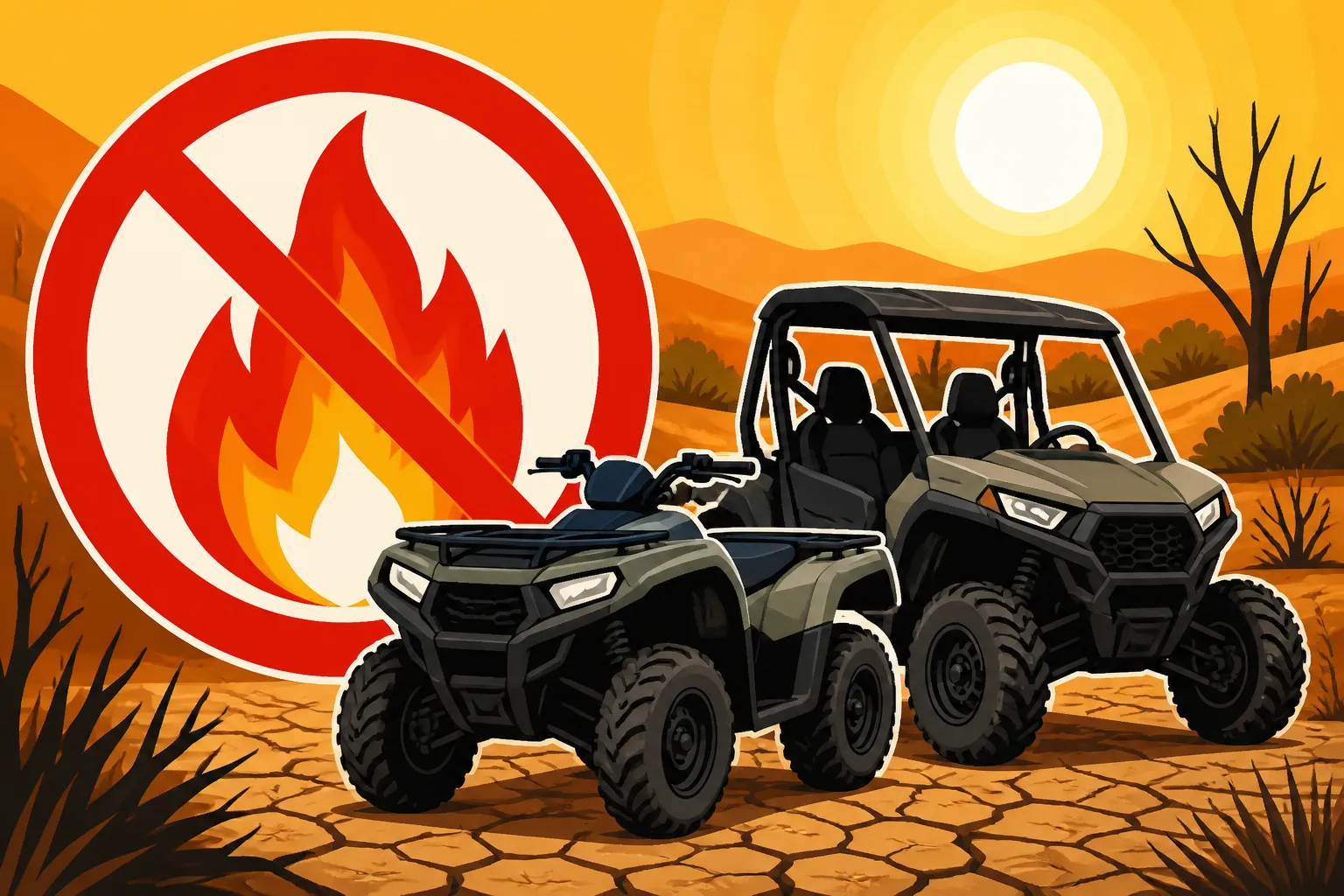
North Dakota Fire Restrictions in Dry Years
Dry conditions can turn an ordinary ATV or UTV ride into a fire-risk decision, and a registration sticker or visitor permit does not guarantee that every route is open. North Dakota restrictions may vary by land manager and change with weather. Here’s how to check what applies, prepare your machine and gear, and decide when postponing a ride is the safer choice.
Why fire restrictions can affect an ATV or UTV ride
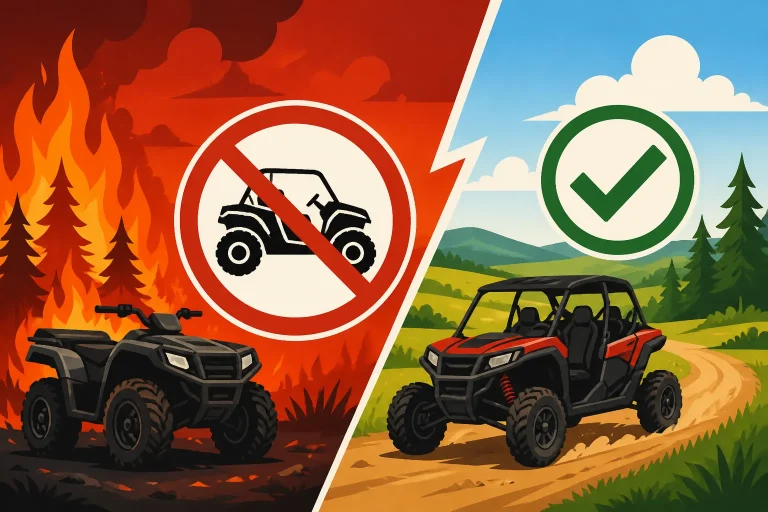
In a dry year, grass, brush and other vegetation can catch fire quickly. Wind can help a small ignition spread, and a fire in open prairie or wooded terrain may be hard to reach. An ATV or UTV does not have to be the cause of a fire for restrictions to matter: a closure can affect where you may ride, park, camp or stop.
Restrictions are not always a single statewide rule. They can be set for specific public lands, parks, campgrounds or other areas, and the limits may differ between neighboring properties. A route that remains open on one parcel may be closed on another. Conditions can also change after you plan a trip, so information you checked earlier in the week may no longer be enough.
A fire restriction can cover activities such as campfires, charcoal grills, smoking, or using equipment that could create sparks. In a severe situation, land managers may close a campground, trail or riding area, or restrict access more broadly. These are examples of possible measures, not a list that applies everywhere. Read the current notice for the specific place you intend to visit.
Also distinguish a fire restriction from an OHV access rule. A site may be open to vehicle travel but have a separate fire ban, or a fire-risk response may include closing the area to vehicles. Do not assume that a riding route is open just because a campground nearby is accepting visitors.
Permits and registrations have a different purpose. A North Dakota registration or a visitor permit can address requirements for operating a machine; it does not override a temporary closure or fire restriction. For visitor rules, see North Dakota’s Non-Resident OHV Permit. For current route or area conditions, North Dakota Trail Status by App and Phone can help you locate status information, but confirm restrictions with the land manager responsible for your destination.
Check the rules for the land you plan to ride
Before leaving, identify who manages the exact place you intend to use. A trailhead may be close to several types of land, each with its own rules and contact point. Look for the current fire notice, area closure information and OHV access status together rather than relying on a single general fire-danger message.
| What to check | Why it matters | What to confirm |
|---|---|---|
| Land manager and boundaries | Nearby areas can have different rules | Who manages the trail, road, campground and parking area |
| Current fire notice | Restrictions can change with conditions | Which activities are prohibited and where the notice applies |
| OHV access status | Fire response may involve a closure | Whether machines may enter, ride or park in the area |
| Route and surface | Not every road or trail is open to OHVs | Approved routes, gates and any local restrictions |
| Campground rules | Campfire and cooking rules may differ from riding rules | Whether fires, grills or other heat sources are allowed |
| Machine requirements | Equipment rules can depend on the land and conditions | Any spark-arrester or other fire-prevention requirement |
If you plan to ride on national grassland roads, review the relevant North Dakota Grassland Motor Vehicle Use Maps and any current fire notice. A map helps with route authorization; it should not be treated as a real-time closure bulletin. Check for temporary orders or updates as well.
For state parks, wildlife areas, and other public properties, use the managing agency’s current notices or contact the office responsible for the area. A state park entrance permit, OHV registration or trail permit is not permission to ignore a fire restriction. If the area is closed, or the rule is unclear, ask before unloading your machine.
A phone call can be especially useful when a notice is vague about boundaries or activities. Ask specific questions: Is the route open to ATVs and UTVs today? Does the restriction apply to the trailhead and parking area? Are cooking devices allowed, and if so, what kinds? Are there separate campground rules? Keep the answer in mind for the trip, but follow any newer posted direction you encounter on site.
Do not assume that a fire ban applies only to campfires. Read the full wording. A restriction might address smoking, open flames, stoves, tools or vehicle access. Nor should you assume that a grill or stove is allowed because it has a shutoff valve or is sold for camping. The notice—not a product description—determines what is permitted at that location.
For background on how restrictions can affect riding, see Fire Danger and Riding Restrictions. If the issue is a machine’s exhaust or ignition risk, check What North Dakota Says About Spark Arresters. Requirements can depend on the land and applicable rules, so do not treat a general equipment checklist as proof that a particular machine meets them.
Prepare the machine and your group before you go
Good preparation reduces avoidable ignition risks, but it does not make a closed area safe or give you permission to ride under a restriction. Start by checking your machine for problems that could create heat or sparks. Make sure the exhaust system is in good condition, remove dry grass and debris from around hot components, and avoid carrying loose material that can collect near the engine or exhaust.
Pay attention to where you stop. Dry grass can be close to an exhaust or other hot parts, particularly if you pull off a designated route or park in tall vegetation. Use the designated parking area and follow instructions about where machines may be staged. Do not drive through dry brush to reach a preferred viewing or unloading spot.
Carry basic emergency supplies appropriate to the route and your group. A suitable fire extinguisher, first-aid supplies, water, a charged phone and a way to navigate if service drops can all be useful. An extinguisher is a precaution, not a reason to continue riding into a restricted area or attempt to fight a spreading wildfire. If a small fire cannot be handled safely and immediately, move away and contact emergency services.
If buying a compact extinguisher through Amazon or another retailer, check that it is appropriate for the risks around your vehicle, clearly labeled, in usable condition and secured so it cannot become a hazard in a rollover. Read the manufacturer’s instructions before the trip. Do not store it where heat exposure could damage it, and do not assume that any small extinguisher satisfies a land manager’s rules.
Before anyone in the group starts an engine, agree on a few basics:
- Stay on routes that are open and authorized for your machine.
- Do not park in dry grass or drive off-route around a gate or closure.
- Follow posted instructions about smoking, cooking and fires.
- Keep children and passengers close during stops, and make sure everyone knows how to leave the area.
- Carry enough water and fuel for the planned route, without relying on a remote site to have supplies.
- Choose a meeting point in case the group becomes separated.
- Leave early if wind, smoke or changing conditions make the ride unsafe.
A change in weather does not necessarily mean that an official restriction has been lifted. Rain in one part of the state may not improve conditions at your destination, and a brief shower may not soak dry vegetation. Check for an official update before changing your plan. Likewise, a posted closure remains in effect until the responsible authority says otherwise.
If you are riding somewhere with limited reception, save maps and contact information before you leave. Plan a route that allows you to turn around without pushing farther into remote terrain. Information about North Dakota Riding Areas With Cell Service can help when choosing a destination, but coverage can vary within an area. Do not count on being able to look up a new notice once you are already deep into a route.
When to change plans or leave the area
The safest choice may be to postpone a ride when the area is closed, when rules are unclear, or when conditions make a small mistake difficult to control. This is particularly important if your plan depends on camping or cooking and the current restrictions do not clearly allow those activities. Choose another open area only after checking its own access and fire rules; a closure at one site does not automatically make a neighboring site an appropriate substitute.
Use this decision sequence before unloading:
- Confirm the destination. Identify the specific trail, road, campground and land manager rather than checking only the nearest town.
- Check current notices. Look for both fire restrictions and OHV closures, including temporary changes.
- Read the full conditions. Confirm what activities are limited and whether the rules apply to your planned route and equipment.
- Contact the manager if needed. Ask for clarification instead of guessing from a short headline or an old post.
- Make a fallback plan. Pick a different verified-open destination or reschedule before you travel farther.
Once you are riding, stop and reassess if you see smoke, encounter new closure signs, or learn that a restriction has changed. Follow staff instructions, avoid blocking access roads, and leave by an open route. If you spot a fire, move to a safe place and report its location to emergency services. Do not ride toward smoke to investigate, and do not attempt to cross an active fire area.
Be cautious about treating a map, social media post or a report from another rider as final authority. These can point you toward useful information, but restrictions can be updated, and an unofficial report may leave out the boundary or activity involved. Check the responsible land manager’s current direction. For closures related to weather and trail conditions, North Dakota Trail Closures After a Storm is also useful context, though a wet-weather closure and a fire restriction are separate issues.
The key is to make the check part of trip planning, not something to do only when you arrive. Confirm the land, the route, the fire rules and the machine-access status shortly before departure. If you cannot verify that your planned activity is allowed, pick a destination with clear current rules or wait for conditions to improve. A permit and a ready-to-ride machine are no substitute for an open route and a safe decision.
Disclaimer
This article is for general informational purposes only and does not constitute professional advice. Laws, prices and regulations vary by location and change over time. Consult a qualified professional for guidance on your specific situation.