What an Officer Can Ask to See
Riding your ATV or UTV across North Dakota's vast landscapes, whether on designated trails, ditches, or private land, is a fantastic experience. But the freedom of the open prairie comes with responsibilities, and understanding what an officer might ask to see during a stop is crucial for a smooth and legal ride. This guide will walk you through the essential documents, machine requirements, and practical tips to ensure you're prepared and confident if you ever encounter law enforcement, helping you navigate your adventures without unnecessary stress or legal headaches.
Understanding the Initial Stop: Why an Officer Might Pull You Over
It can be startling to see emergency lights in your rearview mirror when you're out enjoying a ride, especially on an ATV or UTV. Knowing why an officer might initiate a stop can help alleviate some of that initial surprise and give you a better understanding of what to expect. Most stops aren't meant to spoil your fun, but rather to ensure everyone's safety and adherence to state regulations.
Common Reasons for an OHV Stop
Officers are on the lookout for a variety of things, and a stop might stem from anything from a minor equipment issue to a more serious safety concern. One of the most common reasons an officer might pull you over is if your machine appears to be unregistered. North Dakota law requires nearly all OHVs operating on public land or for certain types of private land access to be properly registered, displaying a visible decal or plate. If that sticker is missing, expired, or obscured, it's a red flag.
Another frequent reason for a stop involves where you're riding. Operating your ATV or UTV in a prohibited area, such as a closed roadway, private land without permission, or absolutely off-limits places like interstate highways, will almost certainly get an officer's attention. Similarly, if your machine is missing required equipment for the area you're in – like headlights and taillights after dark, or mirrors and a horn if you're on a public roadway – an officer might stop you to investigate. Lastly, and perhaps most importantly, if you're operating recklessly, unsafely, or in a manner that suggests impairment, such as excessive speed or improper passenger transport, law enforcement will act swiftly to ensure public safety.
The Officer's Authority to Ask for Identification
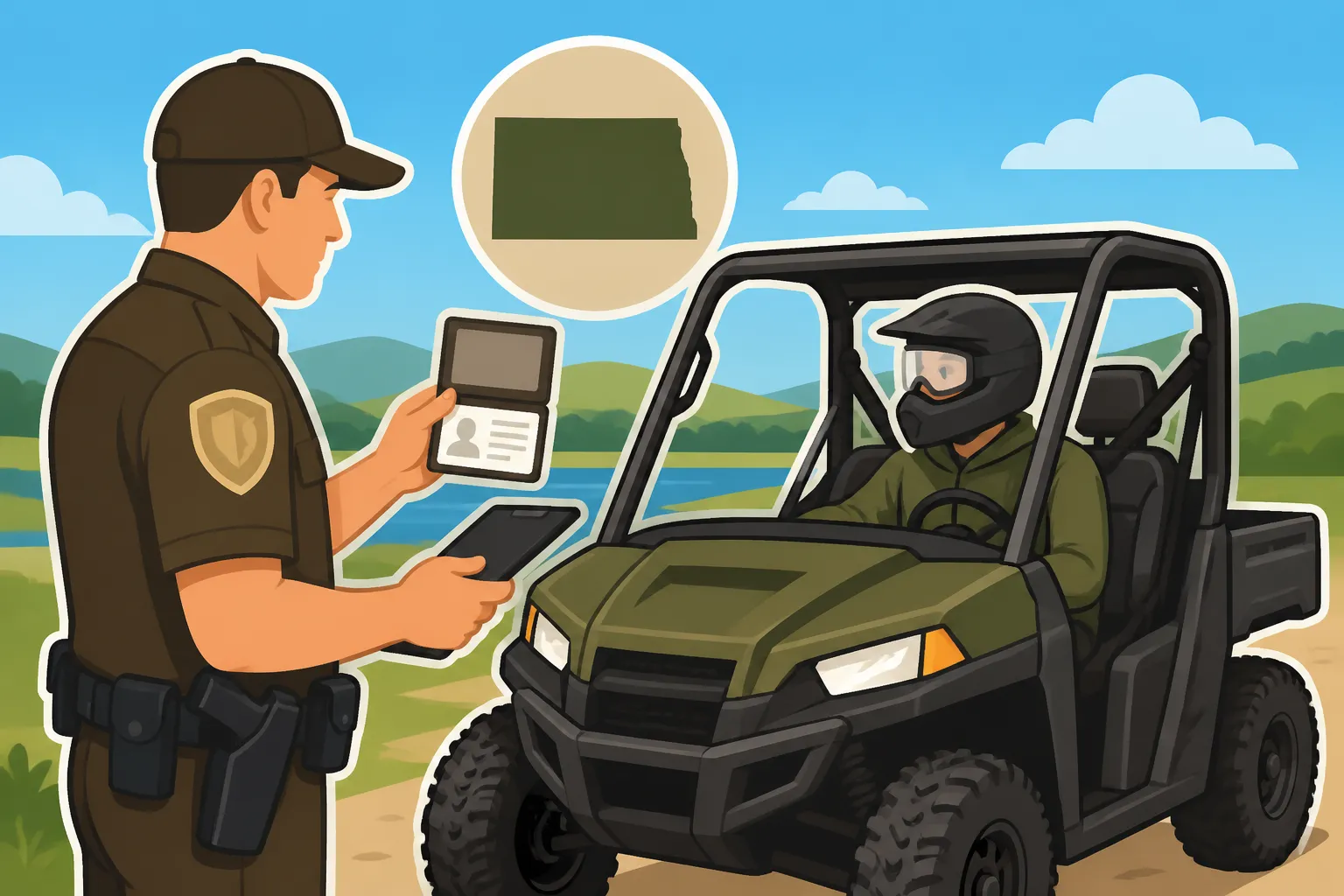
When an officer stops you, one of their first requests will be for your identification. Just like driving a car, operating an OHV, especially on public lands or roads, requires you to be able to identify yourself. This typically means presenting a valid driver's license or a state-issued identification card. This isn't just a formality; it allows the officer to verify who you are, check for any outstanding issues, and confirm you're of legal age to operate the machine in that particular setting.
For younger riders, particularly those under the age of 16, an officer will also likely ask to see an OHV Safety Certificate. North Dakota has specific age and certification requirements for minors operating these machines, and having that certificate handy proves you've met the state's safety education mandates. While an officer generally needs a reasonable suspicion or probable cause to initiate a stop, once that stop has been made, they have the authority to ask for your identification to ensure you're legally operating the vehicle. Refusing to provide identification can escalate the situation unnecessarily, so it's always best to be cooperative and prepared.
Essential Documents You Must Carry and Present
Preparing for a ride isn't just about checking your tire pressure and filling the tank; it's also about ensuring you have all your paperwork in order. Just like your driver's license for your car, there are specific documents you should have on hand when operating an ATV or UTV in North Dakota. Being organized can make a huge difference in the outcome of an interaction with law enforcement.
Proof of Registration and Trail Tax
When an officer approaches your machine, their eyes will almost certainly go straight to your registration decal or plate. This is the first visual indicator that your OHV is legal to operate. North Dakota requires nearly all ATVs and UTVs to be registered, and that registration includes a fee that supports trail maintenance. You'll typically have the choice between a decal or a plate, as outlined in [North Dakota OHV Plate or Decal: Your Choice]. Beyond the visible decal, the officer will likely ask for your physical registration card. This card serves as official proof that the machine is currently registered in your name and that you've paid the necessary fees, including the $15 trail tax which is a part of the overall registration cost. You can learn more about this in [North Dakota Charges $5 Registration Plus $15 Trail Tax].
If you're visiting North Dakota from another state, the rules shift slightly. You might be required to carry a non-resident permit instead of a North Dakota registration, especially if you plan to stay and ride for an extended period. This permit essentially grants you temporary riding privileges within the state, assuming your home state registration meets certain criteria. Always make sure your permit is current and accessible.
Proof of Ownership and Identification
Beyond registration, officers often ask for proof of ownership. While you might not always be legally required to carry your physical title with you every time you ride, having documentation that proves you are the rightful owner is incredibly important. This could be your vehicle's title, which shows legal ownership, or a bill of sale if you've recently purchased the machine. Think of it as the deed to your machine; it establishes your legitimate claim to it. Details on obtaining a title can be found in [Titling an ATV in North Dakota].
A bill of sale, especially for a recent purchase from a private party, is also excellent proof of ownership. This document details the transaction and transfers ownership from the seller to you. Services like LawDepot offer user-friendly templates for creating a robust bill of sale, which can be invaluable for documenting your purchase and providing proof if ever needed. A well-crafted bill of sale, even if not a formal title, helps to verify that the machine isn't stolen and belongs to you. Always keep this sort of documentation in a safe, yet accessible, place, perhaps a waterproof bag tucked securely in your storage compartment, to prevent it from getting lost or damaged on the trail.
Safety Certificates and Permits
For many riders, particularly our younger enthusiasts, a safety certificate is a non-negotiable item. In North Dakota, riders under the age of 16 are generally required to complete an OHV safety course and carry their certificate when operating an ATV or UTV on public lands. This ensures they have a foundational understanding of safe riding practices and the rules of the trail. The requirements for this are detailed in [North Dakota Safety Certificates at Age 12]. If a young rider is stopped, an officer will almost certainly ask to see this certificate to ensure compliance with youth riding laws.
There are also specific permits for certain types of machines. For instance, if you're riding a tracked dirt bike, North Dakota requires a special permit in addition to standard registration. This permit helps the state manage and track these unique machines, which can have different impacts on trails and land. Information about this can be found in [North Dakota Tracked Dirt Bike Permit at $25]. While North Dakota generally does not require OHV riders to carry insurance for all types of riding, it becomes a necessity if you plan to operate your machine on public roadways. In such cases, an officer may ask for proof of insurance, so it's wise to be aware of when and where these requirements apply to your specific riding plans.
Machine-Specific Requirements and What Officers Check
It’s not just about the paperwork you carry; your ATV or UTV itself needs to meet certain specifications and equipment requirements depending on where and when you’re riding. Officers perform visual checks and sometimes more detailed inspections to ensure your machine is compliant with North Dakota law. This protects not only you but also other riders and the environment.
Visible Registration and Decal Placement
The most immediate thing an officer will look for on your machine is a valid, visible registration decal or plate. This is the state's way of knowing your OHV is properly accounted for and that you've contributed to the trail system through the required fees. The decal should be prominently displayed in a way that allows it to be easily read, typically on the front or rear fender, or in another designated spot. [North Dakota Decal Placement Rules] will give you the exact guidelines on where it needs to be.
A common issue riders encounter is a faded or obscured decal. Over time, sunlight, mud, and general wear and tear can make your decal hard to read. If an officer can't clearly see your registration, they might stop you to verify it manually, which could lead to a delay or even a citation if the decal is unreadable or missing. It’s always a good idea to periodically check the condition of your decal and replace it if it's no longer clear. This simple check can save you from an unnecessary stop.
Required Equipment for Road and Trail Use
Your OHV isn't just a toy; it's a vehicle, and as such, it must meet certain equipment standards, especially when operating on public roads or at night. For any nighttime or low-light riding, adequate lighting is crucial. Officers will check for functional headlamps and taillamps to ensure you can see and be seen. If you plan on riding on public roadways, the requirements become even stricter. [North Dakota Lighting Rules on a Quad] outlines the standards for visibility.
For road use, your machine will also need specific safety features, such as mirrors that provide a clear view to the rear and an audible horn. These aren't just suggestions; they are legal requirements designed to make OHVs safer when sharing paved or gravel roads with other vehicles. Furthermore, almost all OHVs operating on public lands must be equipped with a spark arrester to prevent wildfires and a compliant muffler to keep noise levels within legal limits. Lastly, for riders under 18, a helmet meeting DOT standards is mandatory, as detailed in [North Dakota Helmet Law for Riders Under 18]. Officers routinely check for these safety items, as they are critical for both rider safety and public consideration.
Classifications and Area-Specific Restrictions
North Dakota categorizes OHVs into different classes, and each class has specific rules regarding where and how it can be operated. Officers are well-versed in these classifications – Class I, Class II, and Class III machines – and will evaluate your machine based on its characteristics. For example, a Class I machine is typically an ATV designed to be straddled, while Class II machines are side-by-sides with a steering wheel and a width limit. You can delve into the definitions in [North Dakota Class I Machines Defined], [North Dakota Class II Width and Weight Limits], and [North Dakota Class III Machines Under 8,000 Pounds].
Crucially, some trails or riding areas have width restrictions. Pembina Gorge, a popular OHV destination, for instance, has a 60-inch width cap for many of its trails. If your side-by-side is wider than that, an officer might stop you to ensure you're aware of or adhering to these limits. Check [North Dakota's 60-Inch Trail Width Cap] if you plan to ride there. Additionally, if you're operating on a road, your machine must meet minimum engine size and speed capabilities, such as the [North Dakota's 350cc Minimum for Road Riding] and the requirement to be capable of traveling at least 30 mph. Officers are trained to identify these distinctions and enforce the corresponding regulations, so knowing your machine's class and capabilities is key to staying compliant.
Common Scenarios and How to Handle an OHV Stop
Even the most experienced riders can find themselves pulled over. It's a moment that can feel a bit tense, but by understanding the process and acting appropriately, you can ensure the interaction is as smooth and quick as possible. Being prepared mentally and with the right documentation is half the battle.
The Professional and Respectful Interaction
When you see those lights flash, the first and most important step is to safely pull your OHV over to the side of the trail or road in a clear, visible, and safe location. Don't make any sudden or aggressive movements. Turn off your engine, if it’s safe to do so, and keep your hands visible on the handlebars or steering wheel. This immediately signals to the officer that you are cooperative and not a threat.
When the officer approaches, remain calm and polite. Answer their questions truthfully and provide any requested documents promptly. This includes your driver's license, OHV registration card, and any permits or safety certificates. Remember that an officer's job is to enforce the law and ensure safety; a respectful attitude from your side can go a long way. If you have questions about why you were stopped, you can ask for clarification, but always do so respectfully and without arguing. A calm, cooperative demeanor helps ensure a professional interaction for everyone involved.
What Happens if You Don't Have the Required Items
Life happens, and sometimes you might find yourself without a required document or with an equipment issue you weren't aware of. The outcome of such a situation can vary widely based on the specific violation, the officer's discretion, and your prior record. For minor infractions, an officer might issue a verbal warning, giving you an opportunity to correct the issue or produce documents later. For example, if your registration decal is simply faded, they might advise you to order a replacement.
However, for more serious offenses, or if you consistently lack proper documentation, you could face citations and fines. Riding an unregistered machine, for instance, can lead to penalties, as detailed in [North Dakota Penalties for Riding Unregistered]. These fines can vary, and legislative changes, such as the [North Dakota Fine Increase in 2025], mean penalties can become more significant over time. In extreme cases, like operating under the influence or with a stolen machine, your OHV could be impounded. It’s always best to rectify any known issues before you ride to avoid these potential headaches and legal consequences.
Documenting Important Information
In any interaction with law enforcement, it's wise to gather some basic information for your own records, especially if you receive a citation. Make a mental note, or if safe, jot down the officer's name (or badge number), their agency, and the exact time and location of the stop. If you are issued a citation, read it carefully to understand the charges and any deadlines for action, such as appearing in court or producing documents.
Sometimes, an officer might give you a grace period to produce a missing document, like a safety certificate you simply forgot at home. Understand the deadline for this and make sure you follow through. If you need to create any legal documents for your OHV, such as a bill of sale for a private sale, resources like LawDepot can provide reliable templates to ensure your paperwork is accurate and legally sound. Having a clear record of your interactions and any citations can be helpful if you need to contest a ticket, deal with insurance, or simply ensure you've resolved the issue correctly. Preparedness and good record-keeping are your best allies for stress-free riding.
Disclaimer
This article is for general informational purposes only and does not constitute professional advice. Laws, prices and regulations vary by location and change over time. Consult a qualified professional for guidance on your specific situation.