North Dakota Riders Under 16 Without a License
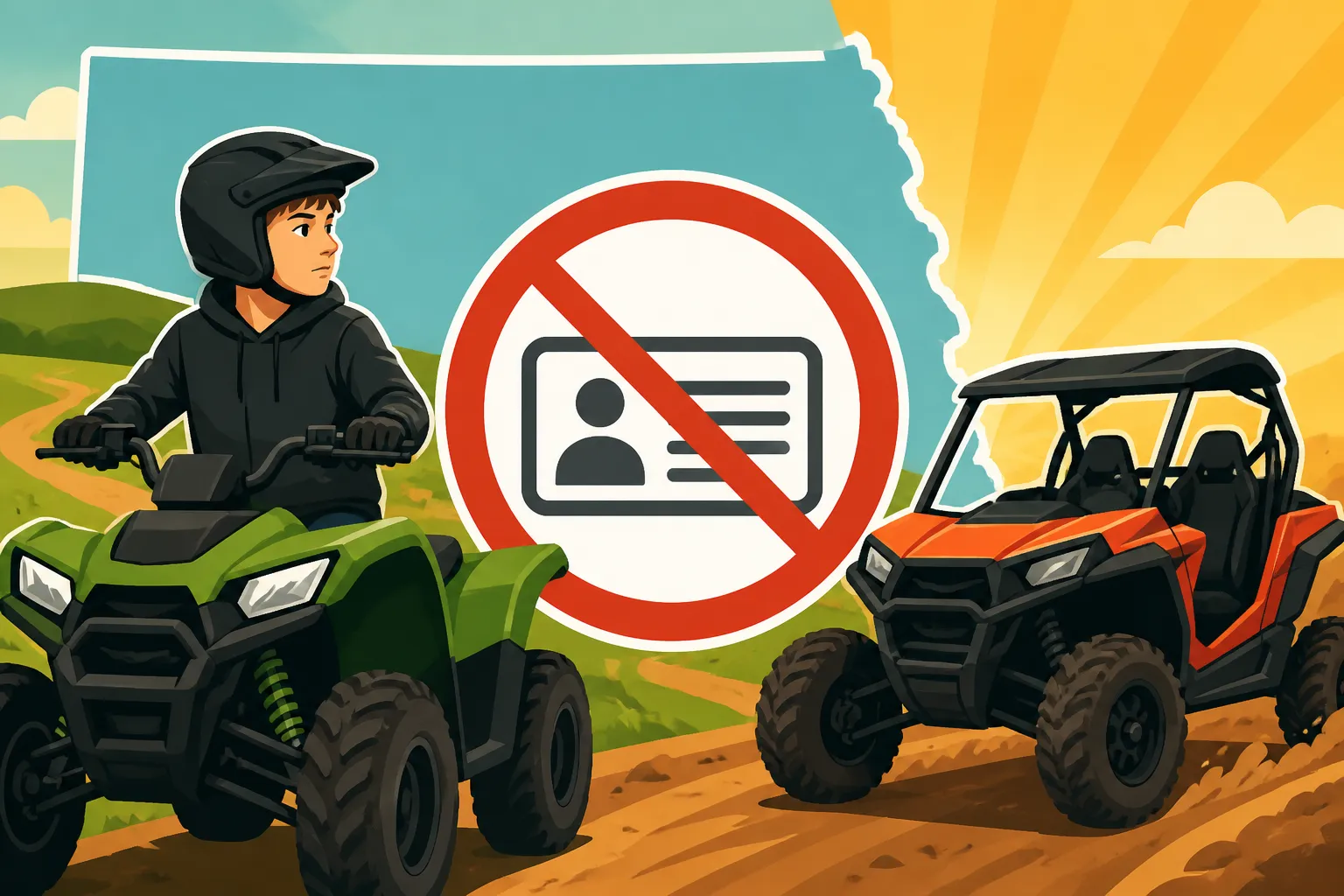
A child can ride an ATV or UTV in North Dakota without holding a driver’s license in some off-road settings. That does not mean every ride is allowed: the rider’s age, safety-certificate status, land access and route all matter. The key distinction is between riding off-road and operating on a roadway, where separate rules apply.
A driver’s license is not the same as permission to ride
A driver’s license and an OHV safety certificate serve different purposes. A driver’s license is relevant to certain roadway operation; a safety certificate is an age-related requirement for some young riders on public land. Having one does not automatically replace the other.
For a rider under 16 who has no license, the practical starting point is location. Riding on private property, using a designated public trail, and traveling along a roadway are not interchangeable situations. A youth may be allowed to ride off-road without a driver’s license while still being too young to operate on a public roadway.
| Where the youth rides | Is a driver’s license the main question? | What else to check |
|---|---|---|
| Private property | Usually not the central requirement for off-road use | Landowner permission, the child’s age, supervision, and any applicable exception |
| Public off-road trail or riding area | Not necessarily | Safety-certificate requirements, registration or permit rules, and site rules |
| Public roadway or roadway ditch | Yes; roadway qualifications are separate from off-road rules | Whether the rider meets the operator requirements for that route and whether the machine can legally use it |
North Dakota’s roadway rules are not a general extension of trail riding. A rider without a valid driver’s license should not assume that being accompanied by an adult makes roadway or ditch operation legal. Check North Dakota Ditch Riding: The Legal Right Explained and North Dakota ATV Road Rules by Surface Type before planning a route that uses a ditch, road, or crossing.
A motorcycle-style learner’s permit, an adult’s supervision, or an OHV safety certificate should not be treated as a substitute for a required driver’s license. If the ride requires operating on a public roadway, confirm the applicable qualifications before leaving the trailer or property.
Safety certificates and riders under 16
North Dakota has a state OHV safety-certificate requirement for young riders in certain circumstances. For riders ages 12 through 15, a certificate is generally required when operating an OHV on public land, subject to applicable exceptions. That requirement is separate from whether the rider holds a driver’s license.
The certificate is proof that the rider completed the required safety training. It is not a license to drive on public roads, a registration document, or permission to use every public trail. Check North Dakota OHV Safety Certificates at Age 12 for more on the course and certificate.
A rider who is under 12 cannot simply take the course early to bypass age-related rules: the state course has an age floor. That does not mean every child under 12 is automatically barred from all riding. The location and any specific statutory exception matter. If the child is too young to hold a certificate, confirm that the planned ride falls within an applicable exception rather than assuming an adult’s presence is enough.
What to check before a public-land ride
Before taking a rider under 16 onto a public trail or riding area, check:
- The rider’s age and certificate status. Confirm whether the youth needs a safety certificate for that location and activity.
- Any claimed exception. Exceptions can depend on where the machine is operated or the type of event. Do not assume one exception applies everywhere.
- The site’s access rules. A safety certificate does not substitute for registration, a required permit, or a riding area’s own rules. For visitors, North Dakota’s Non-Resident OHV Permit explains a separate permit issue.
- How proof must be carried or shown. Keep the certificate available in the form required for the ride, and check what an officer or site official may ask to see. See Showing a Certificate on Demand.
- The route. A trail that is open to OHVs does not automatically make the connecting road or ditch legal for a rider under 16.
The certificate question is easy to confuse with the minimum age for riding. A young rider can be old enough for a course but still need to meet other rules. Conversely, being too young to take the course does not create unrestricted permission to ride without one.
Where a rider without a license may be able to ride
Private property
Off-road riding on private property is different from riding on public land or a public roadway. A child may fall under a specific exception when operating on a parent’s or guardian’s land, but the details matter. Permission from the landowner is essential, and permission does not turn a public road into private property.
A family should verify whose land the machine is on and whether the route crosses public access areas, neighboring property, or a public right of way. A ride that begins in a yard can enter a different legal setting as soon as it leaves the property. For the land-related distinction, see North Dakota Riders on a Parent’s Land.
Even when a certificate exception applies, it does not remove basic safety responsibilities. The adult responsible for the ride should consider the child’s ability, the machine’s size and power, passenger limits, protective gear, and the terrain. A child should not be placed on a machine simply because the location makes the ride permissible.
Designated trails and public riding areas
Public trails can be a practical option for off-road riding, but access does not erase youth requirements. Confirm that the rider meets any certificate rule and that the machine is registered or permitted as required. Also check trail-specific restrictions, including width limits, closures, and whether the area allows the type of ATV or UTV being used.
A non-resident permit, where required, is not a safety certificate. Nor does either document authorize roadway operation. These requirements answer different questions: one may establish access, another may document training, and a driver’s license may be relevant to roadway use.
Roads, ditches, and crossings
The roadway issue is where a rider without a license needs to be especially cautious. North Dakota permits certain OHV travel on some roads or in certain roadside areas only when the statutory conditions are met. Those conditions can include operator qualifications and machine requirements. A youth who cannot meet the roadway requirements should not ride that segment, even if the machine is registered or the rider has completed safety training.
A legal trail route may also involve a road crossing. Do not assume that a rider can cross or travel along a road under the same rules that apply on the trail. Plan a route that avoids unauthorized roadway travel, and check North Dakota Rules for Crossing a Highway if a crossing is part of the trip.
A practical pre-ride check for families
Use this sequence before a rider under 16 operates an ATV or UTV:
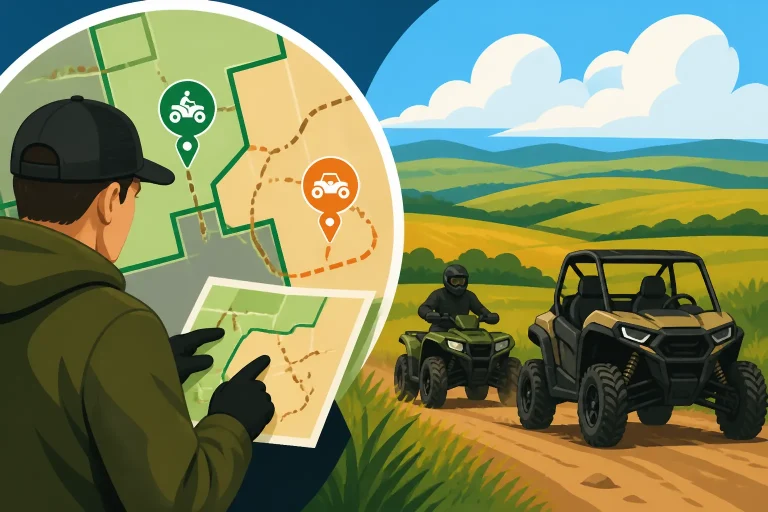
- Identify the exact route. Mark private property, public trails, roadways, ditches, and crossings separately. Do not rely on a map label that simply says “trail.”
- Confirm the rider’s age and documents. Determine whether a safety certificate is required and whether the rider has the appropriate proof. A driver’s license and OHV certificate are not interchangeable.
- Check the machine. Make sure its class and equipment suit the planned location. A machine suitable for an off-road trail may not meet roadway requirements.
- Verify registration and permits. Check whether the machine needs North Dakota registration or a visitor permit for the intended ride. See North Dakota Permit for a Visiting Machine for the visitor-specific question.
- Check local and site restrictions. A public area may have operating limits or temporary closures. Private-land permission also needs to cover the actual route, not just the starting point.
- Choose a route the rider is legally allowed to use. If a road or ditch segment requires a license the rider does not have, take a different route rather than relying on supervision.
The safest short answer is: a rider under 16 may not need a driver’s license for every kind of off-road ride, but that does not make the rider eligible for all routes. Check the safety-certificate rule for public land, confirm any exception carefully, and keep unlicensed young riders off roadways unless they meet the applicable legal requirements.
Disclaimer
This article is for general informational purposes only and does not constitute professional advice. Laws, prices and regulations vary by location and change over time. Consult a qualified professional for guidance on your specific situation.