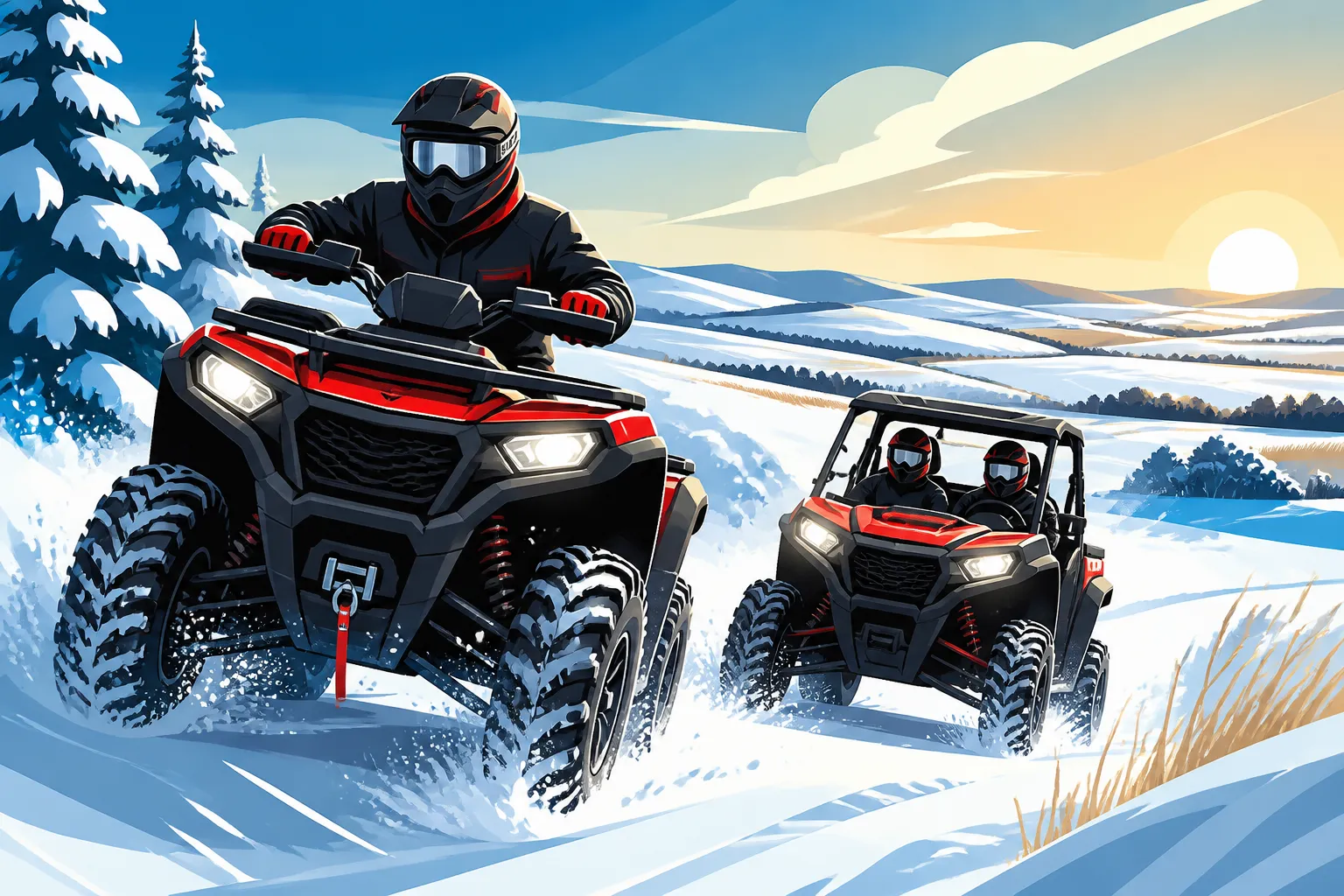
North Dakota Riding in Winter Snow
A fresh snowfall can make North Dakota look like one big riding area, but a white landscape can hide closed trails, deep ditches, ice, and private boundaries. This guide explains how to plan a safer winter ATV or UTV ride, check whether a route is actually open, prepare your machine for cold, and avoid confusing snowmobile access with OHV access.
Plan a Legal Winter Route Before You Unload
Snow does not automatically open a trail
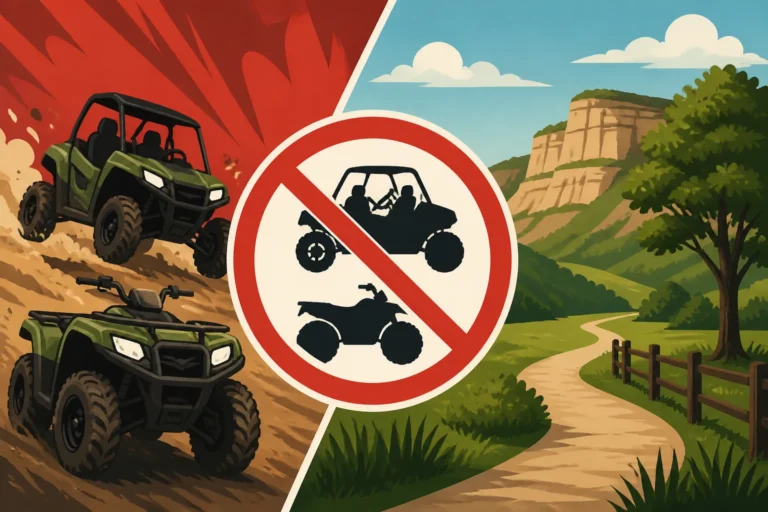
Snow changes the surface, not the rules. A route that is open to OHVs in summer is not necessarily open in winter, and a trail groomed for snowmobiles does not automatically allow ATVs or UTVs. Access depends on the land manager, posted rules, local restrictions, and current conditions. If you are unsure, check with the agency or property owner responsible for that specific route before riding.
This matters around popular areas such as Pembina Gorge, Turtle Mountain, Roughrider OHV Trail, and Kimball Bottoms. Winter conditions, maintenance, flooding, and local closures can affect access differently from one riding area to another. Check the latest official status before you leave home, rather than assuming that a trail is open because it was rideable on your last visit. For background on the state’s riding areas, see North Dakota OHV Trails: All Four Riding Areas and North Dakota Trails Closed by Wet Weather.
Also distinguish between an OHV trail and a snowmobile trail. Some corridors may cross similar public land, but their permitted uses can differ. North Dakota snowmobile trails have their own seasonal rules, and that does not make them an automatic substitute for an OHV route. Review [Snowmobile Trails Closed April to November] for the snowmobile-season distinction, then confirm current OHV access with the relevant land manager.
Check land status and route details carefully
Winter makes it harder to recognize landmarks. A snow-covered two-track can look like a public trail even when it crosses private property, ends at a farmstead, or passes through a closed area. Before setting out, identify where the route begins and ends, which land it crosses, and whether you need permission. A landowner’s summer permission may not cover every season or every route, so ask directly if you plan to ride private ground.
Mapping apps can help you prepare, but they are not proof of permission or a substitute for official closure notices. onX Offroad can be useful for reviewing mapped routes and land boundaries before a trip; use it as one planning aid, then confirm access with official maps, signs, or the land manager. Download maps for offline use if your route may pass through an area with weak cell service. Around remote Badlands routes, cell coverage can be unreliable, and snow can make a wrong turn harder to correct.
A short pre-trip checklist helps prevent a frustrating drive to a closed trailhead:
- Confirm that the specific route allows your type of OHV.
- Check for seasonal restrictions, temporary closures, and weather-related notices.
- Verify trailhead parking and any required park or visitor permits.
- Ask for permission before entering private land.
- Save an offline map and share your route with someone who is staying behind.
For broader guidance on route access and public-land rules, see North Dakota Grassland Motor Vehicle Use Maps and North Dakota Posted Land Rules for Riders.
Read Winter Conditions Before They Catch You Out
Snow depth, crust, and drifting can change the ride
A light layer of packed snow can feel manageable, while a deeper drift can stop a machine quickly. Wind can move snow across open prairie roads and build drifts in low spots, approaches, and cuts. A crust that supports the ATV on one section may break under it a few yards later, leaving the wheels spinning in soft snow. On a UTV, the heavier machine may float differently from a quad, but its extra weight can also make recovery more difficult.
Do not judge the route only by how it looks from the road. Check recent weather, wind, and temperature changes, and speak with someone familiar with the area if possible. A route that was passable yesterday can be blocked after blowing snow. In terrain with trees or steep slopes, snow may conceal ruts, rocks, roots, and drainage channels that were easy to see in warmer weather.
If conditions are uncertain, choose a short, familiar route with a clear turnaround point. Avoid pushing deeper just because the trail looks open ahead. When the snow gets deeper, visibility drops, or the machine begins struggling, turning back early is good judgment—not a failed ride. For terrain-specific preparation, North Dakota Riding in Winter Snow is a useful companion topic, along with [North Dakota Trails Closed After a Storm].
Thaw and freeze cycles create hidden hazards
Winter riding is not always about snow. A warm afternoon can soften the surface, while an overnight freeze creates slick ruts and hard, uneven tracks. Near rivers and low-lying areas, frozen ground or ice can look solid without being safe to cross. Do not assume that a frozen waterway, drainage, or wetland can support an ATV or UTV. If a route requires crossing questionable ice or water, choose another route.
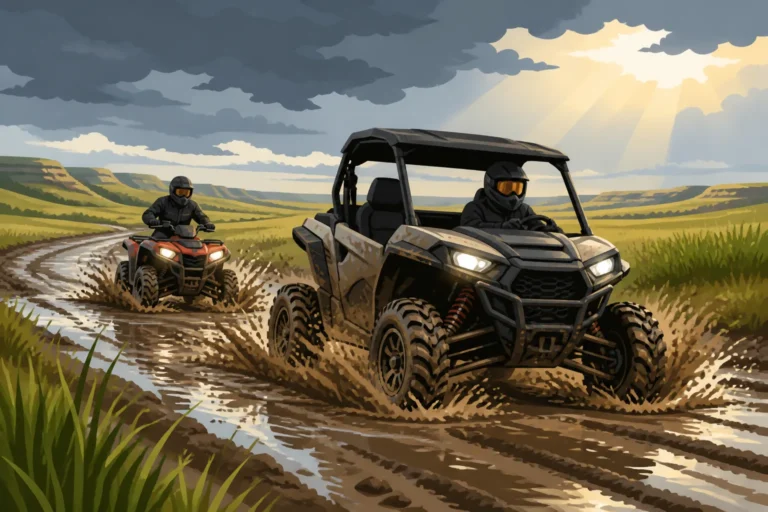
Mud under snow is another common problem. A thin white layer can conceal gumbo or wet clay, and spinning tires can quickly dig a machine into the ground. Riding when the underlying soil is soft can also damage trails and create ruts that remain after the snow disappears. If tires begin breaking through the surface, stop before repeated attempts turn a small loss of traction into a long recovery.
Pay special attention to approaches, culverts, ditch edges, and shaded corners. Snow can hide abrupt changes in grade and obstacles that are difficult to spot at riding speed. Reduce speed where the route narrows or sightlines are limited, and do not follow tire tracks blindly: the person ahead may have used a different machine or may have crossed a hazard that is unsafe for yours.
Prepare Your ATV or UTV for Cold Weather
Inspect the machine and cold-weather basics
Cold can make a machine harder to start, reduce battery performance, and make controls less comfortable to use. Before leaving, check the battery, tires, brakes, lights, fluids, and the condition of belts or other key components according to your owner’s manual. Confirm that your tires are appropriate for the expected surface and properly maintained. If your ATV or UTV has a winch, test it at home and check the cable or rope before relying on it in a drift.
Carry recovery equipment that matches your machine and your group’s experience. A tow strap, suitable shackles, gloves, and a compact shovel can be more useful than bulky gear that stays buried under cargo. Keep recovery points and the winch control accessible, not packed beneath spare layers and food. If you ride with a group, agree on safe recovery signals and keep people clear of a loaded strap.
Cold-weather clothing should keep you warm without restricting your ability to steer, brake, or operate controls. Use layers that can be adjusted during the ride, eye protection that does not fog easily, insulated gloves that still let you work the controls, and a helmet appropriate for the conditions. Pack dry backup gloves and socks in a sealed bag. Wind on an open prairie route can make a short stop feel much colder than the ride itself.
Carry supplies for delays, not just the planned ride
A winter trip can take longer than expected if a route is blocked or a machine needs attention. Bring water, food, a first-aid kit, a charged phone, and a power bank kept warm inside your clothing or bag. A paper map is a sensible backup in places where a phone loses signal or battery life. Tell someone where you are going, who is riding, and when you expect to return.
A practical packing plan should account for the possibility of waiting outdoors. Include extra warm layers, a headlamp, basic tools for your machine, and a way to contact help. Keep essential supplies in a dry, secure location, and make sure every rider knows where they are. If you are traveling far from a staffed area, be conservative about the group’s fuel range and turnaround time.
Use onX Offroad or another mapping tool to save your planned route in advance, but do not depend on a live signal to navigate. Review the route with your group before unloading, agree on a meeting point if riders get separated, and decide who will lead and who will sweep. For more practical preparation, see North Dakota Trail Etiquette Locals Expect and [North Dakota Prairie Wind and Long Rides].
| Winter concern | What to check before riding | Safer response |
|---|---|---|
| Route access | OHV permission, closures, posted signs, and land boundaries | Confirm with the land manager or landowner |
| Deep or drifting snow | Recent wind, snowfall, and route reports | Choose a shorter route and set a turnaround point |
| Ice or frozen water | Whether the route requires crossing water or questionable ice | Do not cross if safety is uncertain |
| Soft ground under snow | Thaw, wet clay, and tire break-through | Turn around before tires dig in |
| Cold or weak phone service | Battery, offline maps, and emergency plan | Carry backup navigation and tell someone your itinerary |
| Stuck machine | Recovery points, strap, winch, and group plan | Recover carefully or call for help rather than risking injury |
Ride Conservatively and Know When to Turn Back
Adjust speed and spacing to the surface
Winter traction can change within a few feet. Packed snow, loose powder, bare gravel, and glare ice each behave differently, so use a speed that lets you respond to what you can see. Leave more space between machines than you would on dry ground. If the lead rider brakes suddenly or becomes stuck, the following rider needs room to stop without sliding into them.
Avoid sudden steering inputs and abrupt acceleration, especially on slick slopes or uneven tracks. A UTV may feel stable, but its size and weight can make a slide more difficult to control. On an ATV, standing or shifting body weight may help in some conditions, but only when it is appropriate for the terrain and your machine. Follow the manufacturer’s operating guidance, and do not attempt a maneuver that exceeds your experience.
Ride with a partner whenever possible and agree on a simple regrouping plan. Keep the group together at turns and trail junctions, and stop where everyone can pull off safely. If one rider is cold, tired, or uncomfortable with the conditions, take that seriously. Fatigue makes it easier to miss a drift, overlook a boundary marker, or misjudge a slippery approach.
Treat roads, ditches, and public land as separate questions
A snow-covered road or ditch may look like a convenient connection between two riding areas, but appearance does not establish legal access. Road rules can depend on the road’s surface, posting, speed limit, machine type, and local requirements. Ditch riding also has specific legal boundaries; snow does not make closed portions of a right of way available. Review North Dakota ATV Road Rules by Surface Type and North Dakota Ditch Riding: The Legal Right Explained before planning a route that includes roads or ditches.
Public land is not one uniform category either. A state park, wildlife area, national grassland, and designated OHV trail can each have different rules. Check the rules for the exact parcel and route rather than assuming that a public label means motorized travel is allowed. In grassland areas, for example, designated roads and motor vehicle use maps matter; cross-country travel may be prohibited even when the land appears open.
Give yourself permission to change the plan. If signs conflict with your map, a trailhead is blocked, weather worsens, or the route becomes unsafe, stop and verify before continuing. The best winter ride is not the longest one. It is the one where the group returns with enough daylight, fuel, warmth, and energy to unload safely and get home.
Disclaimer
This article is for general informational purposes only and does not constitute professional advice. Laws, prices and regulations vary by location and change over time. Consult a qualified professional for guidance on your specific situation.