North Dakota Riding After Heavy Rain
Heavy rain can turn a North Dakota riding day into a mess of gumbo, slippery clay, hidden washouts, and trails that are better left alone. The hard part is knowing whether a route is merely wet or too vulnerable to ride. This guide explains how to assess conditions, protect trails and machines, and choose a safer plan after a storm.
Why heavy rain changes North Dakota riding conditions
Gumbo and clay can stay difficult after the rain stops
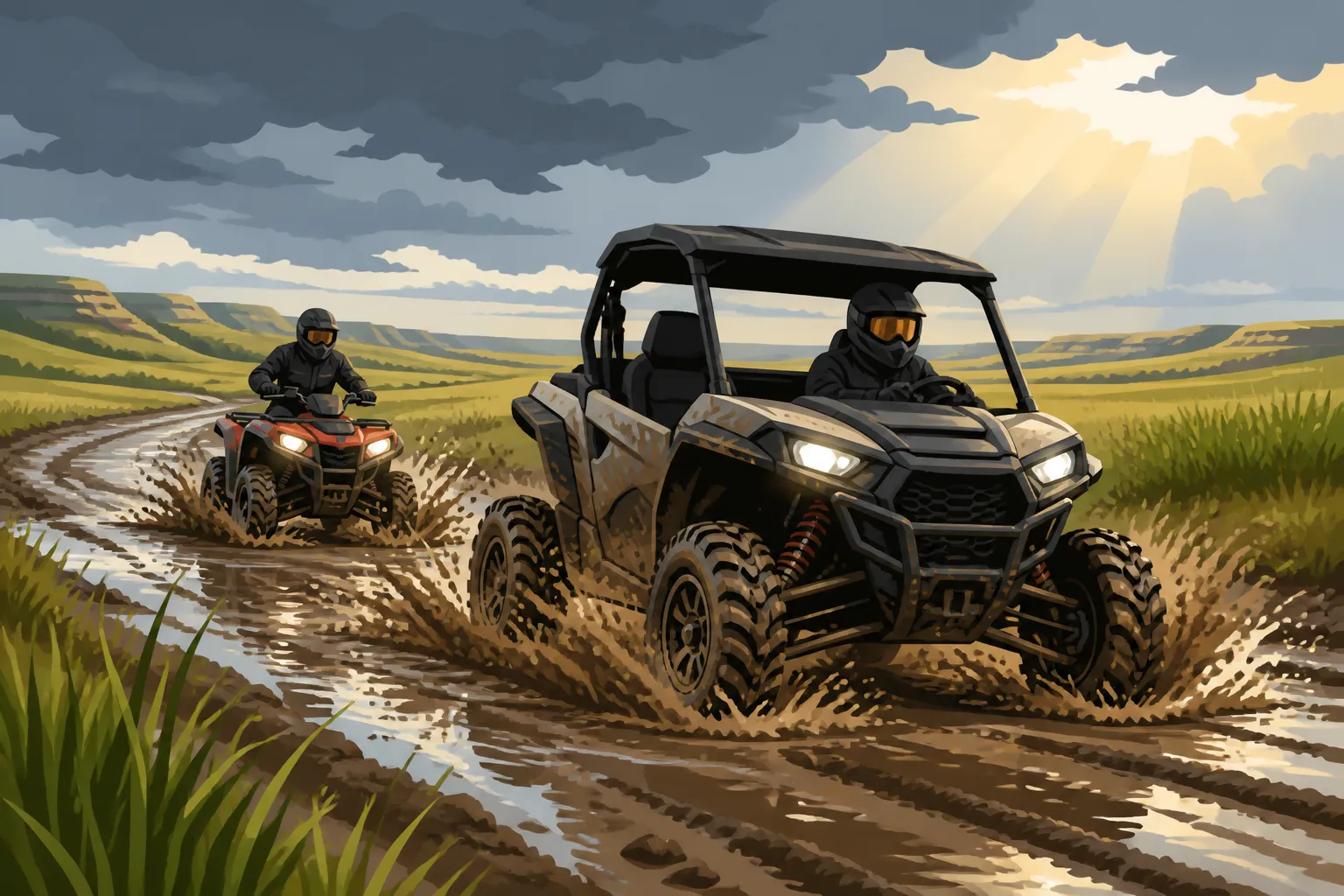
A blue sky does not necessarily mean a trail is ready. North Dakota soils can hold moisture, and some clay-heavy routes remain slick or soft long after rain has moved through. The surface may look firm at the entrance but turn greasy in shaded areas, low spots, or places where water collects.
Gumbo is especially frustrating because it can cling to tires, fenders, and undercarriages until the machine feels heavier and less responsive. It may also pack into tread and reduce traction. Trying to power through can make ruts deeper, spin tires, and turn a small muddy patch into a damaged section of trail. For more on the local challenge, see [North Dakota Gumbo Mud and What It Does].
Even if your machine can keep moving, that does not mean the ground can handle the traffic. Deep tire marks can channel later rainfall, widen the muddy section as riders go around it, and make the route harder for everyone who follows. If you are leaving pronounced ruts or sliding rather than steering predictably, turn around.
Wet conditions can hide hazards
Rain can cover holes, loose rocks, branches, washouts, and damaged trail edges with shallow water. A puddle that looks harmless may be hiding a rut deep enough to catch a wheel or shift a side-by-side off line. Approaches and drainage crossings deserve extra caution because water can carry debris or undermine the surface.
Visibility can also be worse than it first appears. Overcast skies, spray from other vehicles, and muddy goggles or windshields make it harder to see changes in the trail. On a familiar route, it is tempting to ride from memory and keep the same pace. Slow down instead, leave more room between machines, and stop where you can check an obstacle safely.
Conditions can change over a short distance. A higher, well-drained section may be manageable while a low stretch nearby is saturated. That is why “it only rained a little at home” is not enough to judge a riding area. Check the route and the ground where you plan to ride, not just the weather outside your door.
How to decide whether to ride or wait
Check access and local trail conditions first
Before loading the trailer, look for updates from the agency or land manager responsible for the specific riding area. A route may be closed after rain, have a temporary restriction, or be open only in certain sections. Do not assume that a map showing a trail means the trail is currently open or suitable to ride.
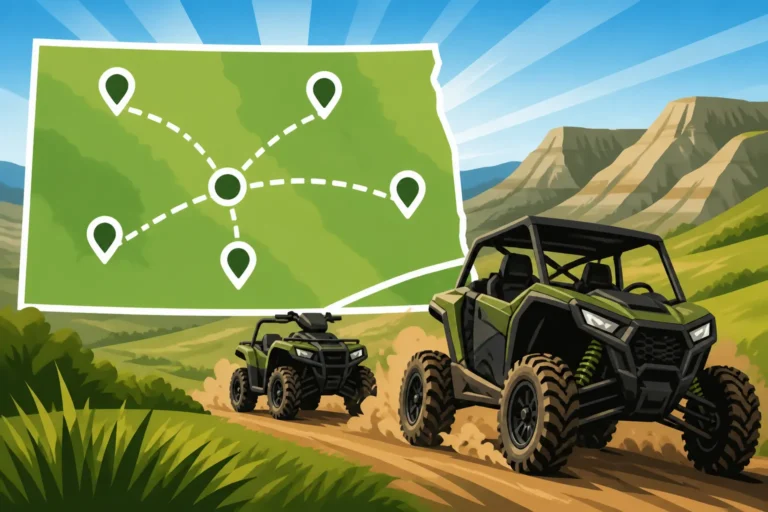
For named areas such as Pembina Gorge, the Roughrider OHV Trail, Turtle Mountain, or Kimball Bottoms, conditions can vary by location and management. Check the relevant area information before traveling, and follow posted signs at the trailhead. [North Dakota Trails Closed by Wet Weather] and [North Dakota Trail Status by App and Phone] offer related guidance on checking conditions and closures.
A mapping app such as onX Offroad can help you understand where routes and trailheads are in relation to your planned ride, but treat it as a navigation aid rather than proof that a route is open. Confirm access through the responsible manager, especially after a storm or when traveling a long distance. A route visible on a map may not reflect a recent closure, muddy section, or temporary change on the ground.
Use the ground as your final decision point
If a trail is officially open, take a careful look at the entrance and the first section before committing the group. Check whether the surface supports your tires, whether water is flowing across the route, and whether previous vehicles have left deep ruts. If the first few hundred feet are already slick or unstable, conditions farther in are unlikely to be easier.
Use this simple guide as a starting point, not a substitute for posted rules or sound judgment:
| What you see | What it may mean | Safer response |
|---|---|---|
| Firm surface with little tire movement | The route may be draining adequately | Proceed slowly and reassess as conditions change |
| Tires leave deep, soft ruts | The surface is vulnerable to damage | Turn around rather than widening or deepening the ruts |
| Standing water hides the trail surface | Obstacles or holes may be concealed | Do not enter unless you can clearly assess a safe route |
| Water is flowing across the trail | The crossing or trail edge may be unstable | Avoid the crossing and check for another legal route |
| Machines slide or lose steering control | Traction is too poor for predictable travel | Stop in a safe place and head back |
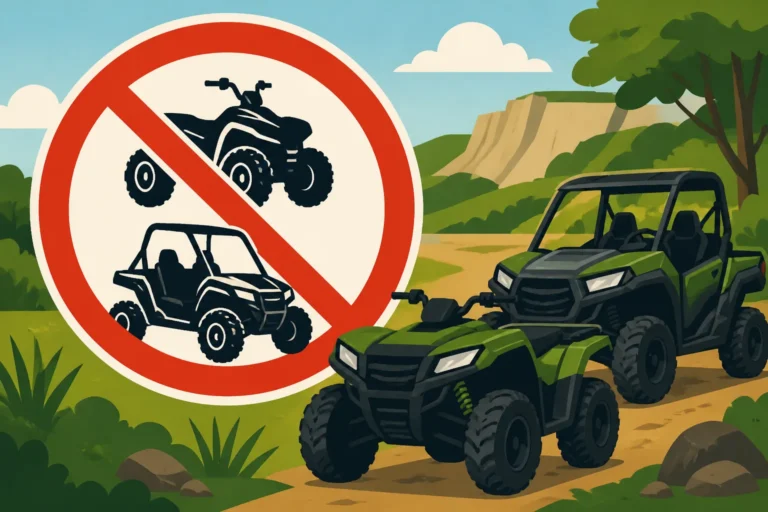
| A closure sign or manager notice is posted | Access is restricted | Do not ride through or around the closure |
Avoid testing a questionable section by accelerating into it. If you need to stop and inspect, park where you are visible and do not block the route. A short walk may reveal the depth and firmness of a muddy patch, but never step into moving water or onto a visibly undermined edge.
Riding responsibly when a route is open
Reduce pressure on wet ground
When conditions are damp but a route remains open and reasonably firm, ride gently. Smooth throttle and gradual turns are less likely to break up the surface than sudden acceleration, hard braking, or spinning in place. Give the rider ahead enough space that you are not forced to brake abruptly in a soft section.
Stay on the established route. Going around a muddy patch can widen the trail, damage vegetation, or create a second track that later channels water. If the only way through requires aggressive wheelspin or leaves deep marks, the better choice is to turn around. [North Dakota Trail Etiquette Locals Expect] covers broader habits that help keep shared riding areas usable.
Avoid riding along the edge of a trail where the ground may be saturated or undermined. Keep a controlled speed, use suitable gear for the terrain, and do not tow another machine through a section unless you can do so without dragging or tearing up the surface. A winch or tow strap may help with recovery, but recovery equipment does not make a closed or fragile route appropriate to enter.
Keep the group together without crowding
Wet conditions can stretch out a group ride. A lead rider may see a muddy turn before the last machine does, while dust is replaced by spray and splatter that reduce visibility. Agree on a simple plan before departing: where to stop, how to signal a turnaround, and who will check that the last rider is accounted for.
Keep enough distance to avoid another machine’s spray and to give yourself time to react to a sudden stop. At the same time, do not leave large gaps that make it difficult to communicate or assist someone safely. If a rider gets stuck, pause the group in a stable, visible area rather than having several machines crowd the muddy spot.
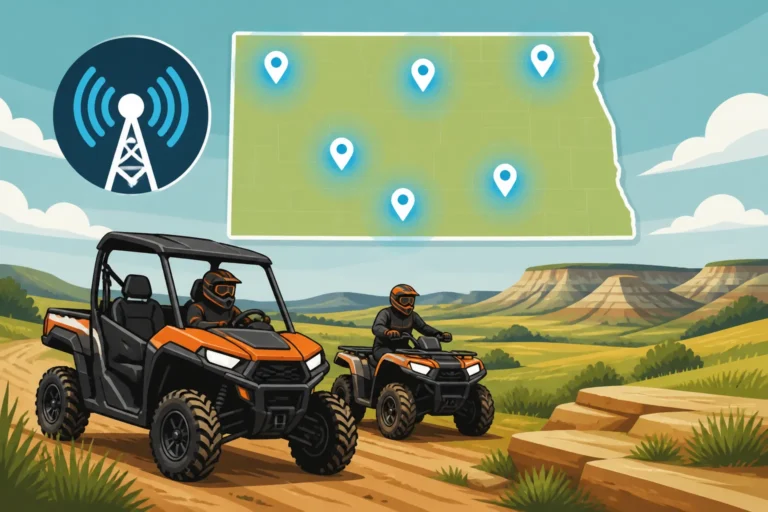
Carry basic recovery and first-aid gear, and make sure riders know the route and the plan for returning. In remote areas, a phone may not have reliable service, so download or carry usable navigation information before leaving. onX Offroad can help riders orient themselves along a planned route, but the group should still follow posted restrictions and confirm access before setting out.
What to do after the ride or when conditions are poor
Clean and inspect the machine before mud hardens
Gumbo is much easier to manage before it dries and hardens around the machine. Rinse carefully, paying attention to the undercarriage, suspension, brakes, radiator area where applicable, and places where mud can collect around moving parts. Follow the manufacturer’s cleaning guidance, and avoid directing high-pressure water at seals, electrical connections, or bearings.
After cleaning, inspect tires for packed mud, cuts, and embedded debris. Check that lights, mirrors, and other required equipment are clear and functioning, particularly if you plan to travel on a roadway where riding is allowed. A muddy machine can also conceal damage, so look for loose components, bent guards, and leaks before loading it for the drive home.
If you used a public riding area, clean equipment before moving to another site when practical. Mud and plant material can be carried between places, and cleaning also prevents one outing’s debris from becoming a problem during the next. For advice on removing stubborn local soil, see [Washing Gumbo Off Before It Sets].
Choose a better plan than forcing a muddy ride
If the route is closed, deeply rutted, or unsafe, change the plan rather than trying to find an unofficial way around the restriction. A closure may protect both riders and the land while water drains and the surface recovers. Riding around a sign, fence, or blocked entrance can damage property and create safety problems for other visitors.
A useful backup may be a different area with better-drained conditions, a non-riding day, or a later trip after the responsible manager confirms the route is ready. Check the specific destination before driving there; rainfall can be uneven, and one area may be wet while another is comparatively dry. [North Dakota Trail Closures After a Storm] and [North Dakota OHV Trails: All Four Riding Areas] can help you think through trail status and alternative destinations.
A little flexibility saves more than a set of tires. It can spare you a stuck machine, a damaged trail, a long recovery, or a ride where every muddy turn feels like a gamble. When the ground is too soft, waiting is part of responsible riding—and it often makes the next outing much better.
Disclaimer
This article is for general informational purposes only and does not constitute professional advice. Laws, prices and regulations vary by location and change over time. Consult a qualified professional for guidance on your specific situation.