Whether a Safety Certificate From Another State Counts
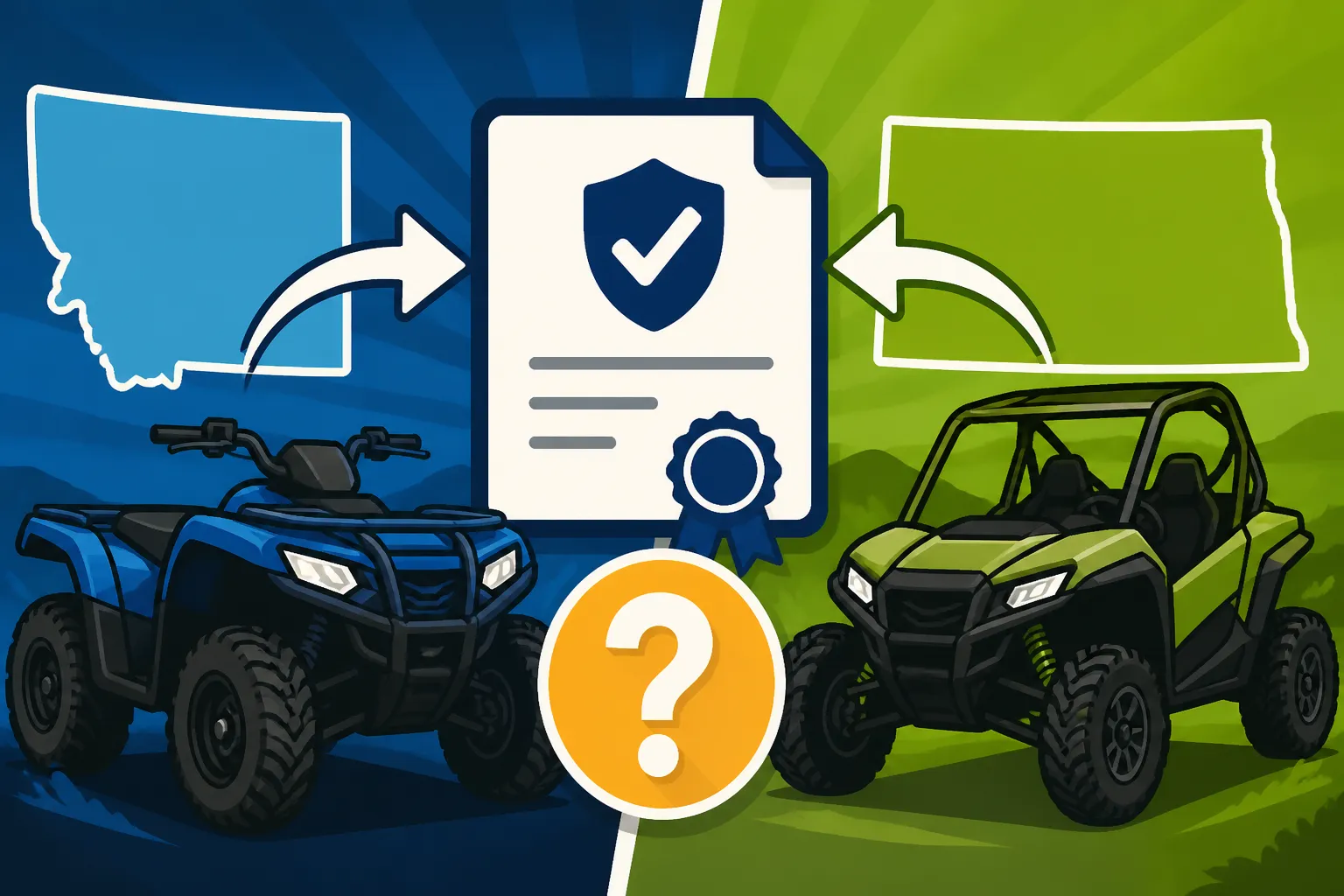
A safety card from your home state may look like the right paperwork for an North Dakota ride, but course certificates and riding permits are not interchangeable. The key question is whether North Dakota recognizes your specific certificate for a rider who must meet its safety-training rules. Here’s how to check before you travel, and what to do if the answer is no.
The short answer: do not assume another state’s card counts
A safety certificate issued elsewhere is not automatically proof that a rider meets North Dakota’s OHV safety-certificate requirement. Treat the card as unconfirmed until the North Dakota agency responsible for the certificate verifies that it is accepted for your rider and situation.
That distinction matters most for younger riders. North Dakota has safety-training requirements for certain riders under 16, and the certificate is evidence that the rider has met the applicable requirement. The rules can depend on the rider’s age and where or how the machine is being operated. Check the requirements that apply to the specific child rather than relying on a general statement that they “have a safety card.”
A certificate from another state may show that the rider completed useful training. That does not necessarily make it the North Dakota certificate, or guarantee that an officer will accept it as satisfying North Dakota law. Before riding, ask North Dakota Parks and Recreation whether the exact document qualifies. Be ready to provide the issuing state, the course or program name, and a photo or copy of the certificate.
| What you have | What it proves | What it does not prove by itself |
|---|---|---|
| An OHV safety card from another state | The rider completed the course or requirement shown on that card | That North Dakota recognizes it for its own safety-certificate requirement |
| A North Dakota-issued safety certificate | The rider has the certificate issued through North Dakota’s process | That the machine is registered or that a visitor has any required permit |
| A home-state registration or decal | The machine may be registered under the home state’s rules | That the rider holds a required safety certificate or North Dakota visitor permit |
| A North Dakota nonresident permit | The visiting machine has the required permit, where applicable | That the operator has completed safety training |
For the practical process and the state’s course options, see North Dakota Safety Course Age Floor of 12, North Dakota Online Safety Course Option, and North Dakota Certificates Issued by the Director. Those details help distinguish a North Dakota certificate from a card issued by another state.
The safest takeaway is simple: an out-of-state certificate may be useful documentation, but do not count on it as a substitute unless North Dakota confirms that it qualifies. If you cannot get a clear answer before the ride, arrange for the rider to meet North Dakota’s own requirement rather than risking a preventable problem at a trailhead or during a stop.
Keep safety certificates separate from permits and reciprocity
“Reciprocity” can refer to different things, and that is where riders often get mixed up. Whether a state recognizes another state’s machine registration or permit is a separate question from whether it accepts another state’s safety certificate.
For example, a visitor may need to check North Dakota’s rules for a nonresident machine, even if that machine is properly registered at home. That question is covered in North Dakota’s Non-Resident OHV Permit and North Dakota Permit for a Visiting Machine. Neither topic answers whether the operator’s safety card is accepted.
Similarly, a safety certificate does not register the ATV or UTV. It also does not replace a visitor permit, prove ownership, or authorize riding on land where the machine is not allowed. Think of the documents as separate pieces of the ride plan:
- Safety certificate: evidence that the rider met an applicable training requirement.
- Registration: paperwork for the machine under the relevant registration rules.
- Nonresident permit: a separate requirement that may apply to a visiting machine.
- Land access: permission or authorization to ride on the particular trail, road, or property.
North Dakota is described as having no reciprocity with other states for OHV permits in North Dakota Has No Reciprocity With Any State. That does not automatically settle the safety-certificate question. Permit reciprocity and course-certificate recognition involve different requirements, so do not use a rule about one as proof of the other.
This is especially important when a family has several machines or riders. One person’s permit does not cover everyone’s training requirement, and a child’s safety certificate does not cover the machine’s paperwork. Make a separate check for each rider and each machine. For visitors, North Dakota Permits for Visiting Riders explains the permit side of the trip; for training, verify the certificate directly.
How to check whether your specific certificate qualifies
Do not rely on the card’s appearance or on a retailer, forum, or informal social media answer. The useful question is not simply, “Does North Dakota accept out-of-state certificates?” It is: “Does North Dakota accept this specific certificate for this rider under these circumstances?”
Use this process before the trip:
- Identify the rider’s age and riding situation. Note the rider’s age, whether the machine will be used on public land or elsewhere, and whether the rider will be operating or riding as a passenger. The applicable rule may differ with those details. North Dakota Rules for Riders Under 16 is a useful starting point.
- Read the certificate. Record the issuing state or agency, the course name, the completion date if shown, and any certificate or student number. Check whether it identifies the training as an OHV or ATV course rather than a different type of safety course.
- Ask the North Dakota agency responsible for OHV safety certificates. Provide the details above and ask directly whether the card satisfies North Dakota’s requirement for this rider. If the answer is conditional, ask what extra document or step is required.
- Request a clear answer you can keep. If the response is by phone, write down the date, the office or representative you spoke with, and the guidance given. If possible, use an official written response or save the relevant official instructions.
- Carry the required proof while riding. If North Dakota says the card is accepted, keep the card or accepted proof accessible. If the rider needs a North Dakota certificate, complete that requirement before heading out.
A few details can change the answer. A state may issue different cards for different vehicle types, offer classroom and online courses, or use a certificate that is valid only for a particular age group. A hunting-safety card, boating card, or general youth-safety course should not be treated as an OHV safety certificate unless North Dakota specifically says it qualifies.
If an official answer is difficult to obtain, check North Dakota’s current safety-course instructions and contact the agency again with the exact certificate information. Avoid relying on an assumption such as “the course was more advanced,” “the card has a state seal,” or “the neighboring state recognizes North Dakota’s card.” Course content and cross-border recognition are not necessarily the same thing.
What to do if North Dakota does not accept the card
If North Dakota confirms that the other state’s certificate is not accepted, the practical fix is to complete the North Dakota-recognized safety process before riding in circumstances where the certificate is required. Check the course’s eligibility rules and format; a course can have an age floor, and not every child may be able to enroll immediately. The state’s options are covered in North Dakota Online Safety Course Option and North Dakota Classroom Safety Classes.
Do not wait until the day of the ride to solve this. A child who is not yet eligible for the course may need to wait, ride only in circumstances permitted without the certificate, or have a qualified adult supervise where the rules allow it. Confirm those conditions rather than assuming that supervision replaces training in every situation. North Dakota Riders on a Parent’s Land addresses a distinct private-property situation; it should not be read as permission to ignore requirements on public riding areas.
Once the rider has the required certificate, keep it with the trip paperwork. A phone photo can be a useful backup, but it may not replace the official proof required by the agency. Check whether the rider must carry the certificate or whether another form of proof is accepted. Showing a Certificate on Demand and North Dakota Safety Certificate Lookup cover related proof questions.
Before leaving, do a final check of the whole ride plan:
- Confirm the certificate status for every rider who may need one.
- Confirm the machine’s registration or visitor-permit status separately.
- Check that the planned riding area is open and allows the machine.
- Carry the certificate or accepted proof, along with the machine’s required documents.
- Recheck current agency instructions if the trip is planned well ahead, since requirements and processes can change.
A little advance checking avoids a frustrating situation where the ATV is ready, the trail is open, and the rider’s paperwork is the one thing that is not settled. The reliable approach is to get North Dakota’s answer for the exact card, then keep the confirmation and required proof with the rider.
Disclaimer
This article is for general informational purposes only and does not constitute professional advice. Laws, prices and regulations vary by location and change over time. Consult a qualified professional for guidance on your specific situation.