OHV Safety Classes Held at North Dakota State Parks
North Dakota OHV safety classes held at state parks can be a practical way to get instruction close to home, but a class date, location, and certification requirement are not the same thing. Find out how to check for a session, what to confirm before registering, and how a safety certificate fits alongside permits, registration, and trail access.
What North Dakota State Park OHV classes cover
OHV safety classes held at North Dakota state parks are scheduled learning opportunities, not a service you should assume is available at every park throughout the year. A park may host a class on a particular date, while another park may have no session listed. The North Dakota Parks and Recreation Department’s current safety-training information is the best place to start; check the relevant park’s information as well before making travel plans.
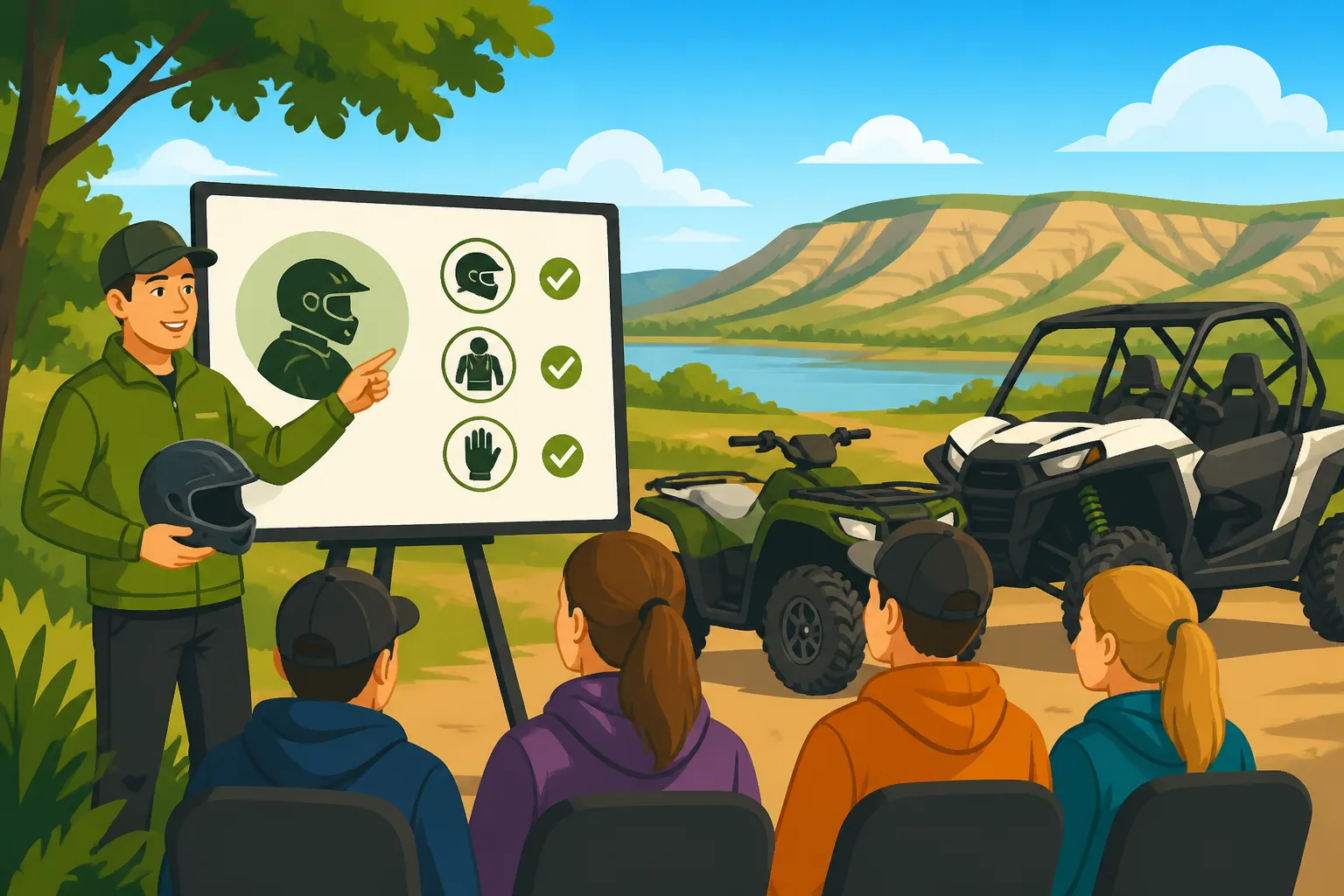
The course is intended to help riders understand safe operation and the rules that apply to off-highway vehicles. Depending on the class, instruction may cover topics such as basic controls, protective equipment, riding behavior, and the responsibilities that come with operating around other people. Treat the course as both a safety resource and a chance to ask questions about riding, not as a substitute for checking the rules for your particular machine and destination.
The state’s course is associated with an OHV safety certificate. That certificate is separate from an OHV registration, a nonresident permit, and a state park entrance permit. Completing a class does not automatically register a machine, authorize riding on land where OHVs are prohibited, or replace a permit that applies to a visiting rider.
It is useful to keep those pieces separate:
| Item | What it addresses | Does a safety class replace it? |
|---|---|---|
| OHV safety course or certificate | Rider training and applicable safety-certification requirements | The class may provide a path to a certificate, but confirm the course and certification process |
| OHV registration | Whether a machine is registered for use as required | No |
| Nonresident OHV permit | Permit requirements for eligible visitors and machines | No |
| State park entrance permit | Access to a state park with a vehicle | No |
| Land permission or trail access | Whether you may ride on a particular property or route | No |
The state’s safety-course program may schedule in-person classes at selected parks or arrange instruction in other ways. A course listing can change, so confirm that the class is specifically an OHV safety course, that the location and date suit your plans, and that the course meets the certification need you have. The overview in North Dakota Safety Training Run by the State can help explain the role of the state program.
Finding a class and preparing to attend
Start by looking for current course information through the state agency responsible for OHV safety training. If a listing names a state park, read the full details rather than relying on a brief calendar entry. Confirm whether enrollment is open, where participants should meet, what time to arrive, and whether the session is classroom-based, practical, or a combination. Do not assume that a park’s regular visitor information includes every course detail.
If you cannot find a suitable date, contact the program or the park directly and ask whether additional classes are scheduled or whether instruction can be arranged for a group. Some training is organized around particular locations and dates rather than offered as a drop-in service. A group should ask how many participants can attend, what information is needed to enroll, and whether there are prerequisites or equipment requirements. The class schedule may not line up with a planned weekend ride, so arrange training well ahead of a trip when possible.
Before registering, check these details:
- The course name and purpose. Make sure the listing is for OHV safety training, not a general park program or another type of outdoor class.
- The participant’s age and certification goal. If the class is for a young rider, confirm the applicable age rules and whether completing that specific session leads to the certificate needed.
- The date and location. Verify the meeting point, arrival time, and whether the course will take place at the park named in the listing.
- Enrollment requirements. Ask whether participants must register in advance, provide identifying information, or bring anything to class.
- The class format. Find out whether participants should expect classroom instruction, hands-on learning, or both.
- The certificate process. Ask when and how a certificate is issued or recorded, and what proof the rider should keep.
- Weather or schedule changes. If travel is involved, check how a cancellation or location change will be communicated.
A class may be advertised as a four-hour session, but use the current listing or the organizer’s confirmation for the actual schedule. Do not plan a tight return trip around an assumed end time. Allow extra time for check-in and any course requirements, especially when traveling with children.
Bring whatever the course organizer requests. If no equipment list is provided, ask before showing up with a machine, helmet, or riding gear. A classroom session may not require the same equipment as practical instruction. If a rider will be using their own machine, confirm whether that is allowed and what condition or safety equipment is expected.
Protective equipment is still worth planning for even when a class does not require participants to ride. A helmet that meets applicable standards is an important part of responsible OHV use, and fit matters as much as having one. Local powersports dealers and retailers such as Amazon may carry helmets and other gear, but check the product’s certification label, sizing, and suitability for the rider rather than choosing by appearance alone. Follow the class organizer’s instructions if it specifies what to bring.
For more detail on age-related course questions, see North Dakota Safety Course Minimum Age and North Dakota Safety Course Age Floor of 12. If the rider is approaching the minimum age, do not assume that being allowed to attend automatically means the certificate can be issued immediately. Ask the state program how age is handled for enrollment, testing, and certification.
Who may need a safety certificate
The course matters most when a rider’s age and planned riding situation bring North Dakota’s safety-certification rules into play. Those rules are not a blanket statement that every person on every OHV must take the same class before riding. The details can depend on the rider, where the machine will be operated, and whether an exception applies.
For families, the practical question is not only “Can my child take the class?” but also “Will this course satisfy the requirement for the riding we plan to do?” Confirm the current rule for the rider’s age and circumstances before relying on a certificate or an exception. North Dakota Rules for Riders Under 16 is a useful companion when checking the broader age rules.
A certificate is evidence of completing a required safety step; it is not a license to ignore other operating rules. A trained rider still needs to use a machine appropriate to their size and ability, follow passenger limits, wear suitable protective equipment, and stay within places where riding is allowed. Training also cannot replace adult judgment when children ride. A certificate does not make an unsuitable machine safe for a young operator or make unsupervised riding appropriate.
If a participant is taking the course for a specific compliance reason, ask the organizer what completion means in practice. Confirm whether the state issues a certificate, whether the information is recorded, and what form of proof the rider should carry. The process for completing a class and the process for showing proof later are related but not identical. North Dakota Certificates Issued by the Director explains the certificate record in more detail, and Showing a Certificate on Demand addresses why it is sensible to know how to produce proof when asked.
The course may also be worthwhile for riders who are not required to obtain a certificate. New riders can benefit from instruction before their first trip, while experienced riders may use a refresher to revisit safe practices and local requirements. Adults should not assume that having years of experience means they know the current rules for a different machine, a new riding area, or a route that includes public roads.
A class is not permission to ride
Completion of a class does not grant access to a trail, private parcel, ditch, roadway, or state park area. It also does not settle whether a machine is registered correctly or whether a visitor needs a permit. Before riding, check the rules that apply to the actual destination and route.
For example, a North Dakota state park may require an entrance permit for a vehicle entering the park. That is separate from any OHV requirement. Check North Dakota State Park Entrance Permits for the difference between park entry and OHV access. A park entrance permit should not be read as blanket approval to ride an OHV anywhere within the park; follow the park’s posted rules and designated access information.
Likewise, a safety certificate does not replace a machine’s registration. North Dakota residents should check the registration rules for their machine, while visitors should verify whether a nonresident permit applies. The state’s visitor requirements are covered in North Dakota Non-Resident OHV Permit. If a rider assumes that a safety course covers all paperwork, they may arrive with training complete but still lack the required authorization for the machine or the location.
Visitors, reciprocity, and state park logistics
An out-of-state rider may be interested in a North Dakota class for training, but course completion and visitor eligibility are separate issues. Do not assume that a certificate from another state automatically satisfies North Dakota requirements, or that taking a North Dakota class removes the need for a visitor permit. Check both questions independently: what certification the rider needs, and what permit the machine needs for the intended stay.
North Dakota does not offer broad, automatic reciprocity with every neighboring jurisdiction for OHV requirements. A home-state registration or sticker may not be enough for a visit, and a safety certificate is not a substitute for an applicable nonresident permit. Before crossing the state line with a machine, review North Dakota Has No Reciprocity With Any State and the details in North Dakota Permits for Visiting Riders. Confirm the rules for the specific machine and length of stay rather than relying on what applied on a previous trip.
A state park class can be a convenient reason to visit a park, but plan for the park visit as well as the course. Check whether the vehicle bringing the participant needs a park entrance permit, where course participants should park, and whether the event has a designated meeting area. If the rider is bringing an OHV, ask whether it should be transported on a trailer or whether there is an approved way to bring it to the instruction area. Do not unload and ride simply because the class is on park grounds.
When traveling with children, build in time to get checked in and settle before instruction starts. Confirm whether a parent or guardian must remain present, whether the participant needs an adult to sign forms, and whether the course is suitable for the child’s experience level. These questions are especially important if the class is several hours from home or if a family is coordinating with a planned trail outing.
A simple pre-trip check can prevent the most common mix-ups:
- Confirm the class is still scheduled and enrollment is complete.
- Save the organizer’s contact details and the meeting location.
- Check what proof of registration, permit, or certificate the rider should bring.
- Confirm whether park entry requires a separate permit.
- Ask whether the participant needs protective gear or a machine for the class.
- Review the riding area’s rules for the planned trip after class.
- Check local weather and road conditions before leaving.
If a class is full or no date works, ask whether the state offers an online option or another approved way to complete training. Do not assume that a general online safety video, a course from a different provider, or a certificate from another state will be accepted for a specific North Dakota requirement. North Dakota Online Safety Course Option provides more information on the online pathway, while the official program can confirm whether it fits the rider’s situation.
After the class: certificates, records, and next steps
Once the rider completes a class, make sure they understand what they received. If the course leads to a state certificate, keep the certificate or its identifying information in a place where it can be retrieved. For a child, a parent or guardian should know where the record is stored and how to show it if needed. Ask the instructor or program whether proof is issued at the class, delivered later, or maintained in a state record.
Do not leave the next step to memory. Write down the rider’s name as it appears on the certificate, the date of completion, and any instructions for replacing or verifying the document. If a rider takes the class before a trip, check that the certificate is available before departure rather than assuming that course attendance alone will serve as proof.
Then handle the remaining requirements independently. Confirm that the machine is properly registered, that a nonresident permit is in place if required, and that the planned riding area allows OHVs. If the route includes a road or public right of way, check the applicable equipment and operating rules. If it crosses private land, get permission rather than treating a training credential as access authorization.
For young riders, revisit the safety conversation after the course. A class gives a useful foundation, but riding decisions still depend on the machine, terrain, weather, visibility, and supervision. Set clear limits about speed, passengers, riding alone, and where the child may go. Discuss how to stop and ask for help if the route or conditions become confusing. A certificate is a milestone, not a substitute for practical judgment.
If the class was taken as a group, have each participant confirm their own completion record. One person’s certificate does not cover other riders, and a group organizer should not assume that attending the same session produces identical paperwork for everyone. For a family or club, a short checklist of participants and records can help avoid a last-minute scramble before a ride.
The most reliable approach is to treat the class as one part of preparation. Use it to build knowledge and meet any applicable training requirement, then verify the machine’s paperwork, visitor permits, park entry, and access rules separately. That separation makes it much easier to arrive prepared and avoid confusing rider training with permission to ride.
Frequently Asked Questions
Are OHV safety classes offered at every North Dakota state park?
No. Classes are scheduled at selected locations and dates, and availability can change. Check current state training information and confirm details with the organizer or park before traveling.
Does completing a class register my OHV?
No. Safety training and vehicle registration are separate requirements. A class also does not replace a visitor permit, park entrance permit, or permission to ride on a particular property.
Can an out-of-state safety certificate be used in North Dakota?
Do not assume it will be accepted for every situation. Check with the state program about the rider’s circumstances, and separately confirm any nonresident permit requirements.
Should I bring an OHV to a park safety class?
Only if the course organizer says one is needed and explains how it should be brought to the instruction area. Confirm equipment requirements and parking or unloading instructions before the class.
What should a rider do after earning a certificate?
Keep the certificate or proof of completion accessible, then check registration, permit, park-entry, and riding-area rules separately before operating the machine.
Disclaimer
This article is for general informational purposes only and does not constitute professional advice. Laws, prices and regulations vary by location and change over time. Consult a qualified professional for guidance on your specific situation.