Tread Lightly on Wet Clay
After rain, North Dakota’s gumbo clay can cling to tires, pack into fenders, and turn a familiar trail into a slick, rutted mess. The safest response is often to pause, check the route, and wait for better conditions—not push through. This guide explains how to judge wet ground, protect trails and your machine, and make a sensible ride plan.
Why wet clay is hard on North Dakota trails
Gumbo changes quickly when it gets wet
North Dakota’s clay-rich soils can go from firm to tacky after rain, then become slippery or deeply rutted as more tires pass over them. That combination is frustrating: your machine may feel as if it has plenty of traction one moment and start sliding or struggling the next. When clay sticks to the tread, the tires can lose their ability to grip and clear themselves.
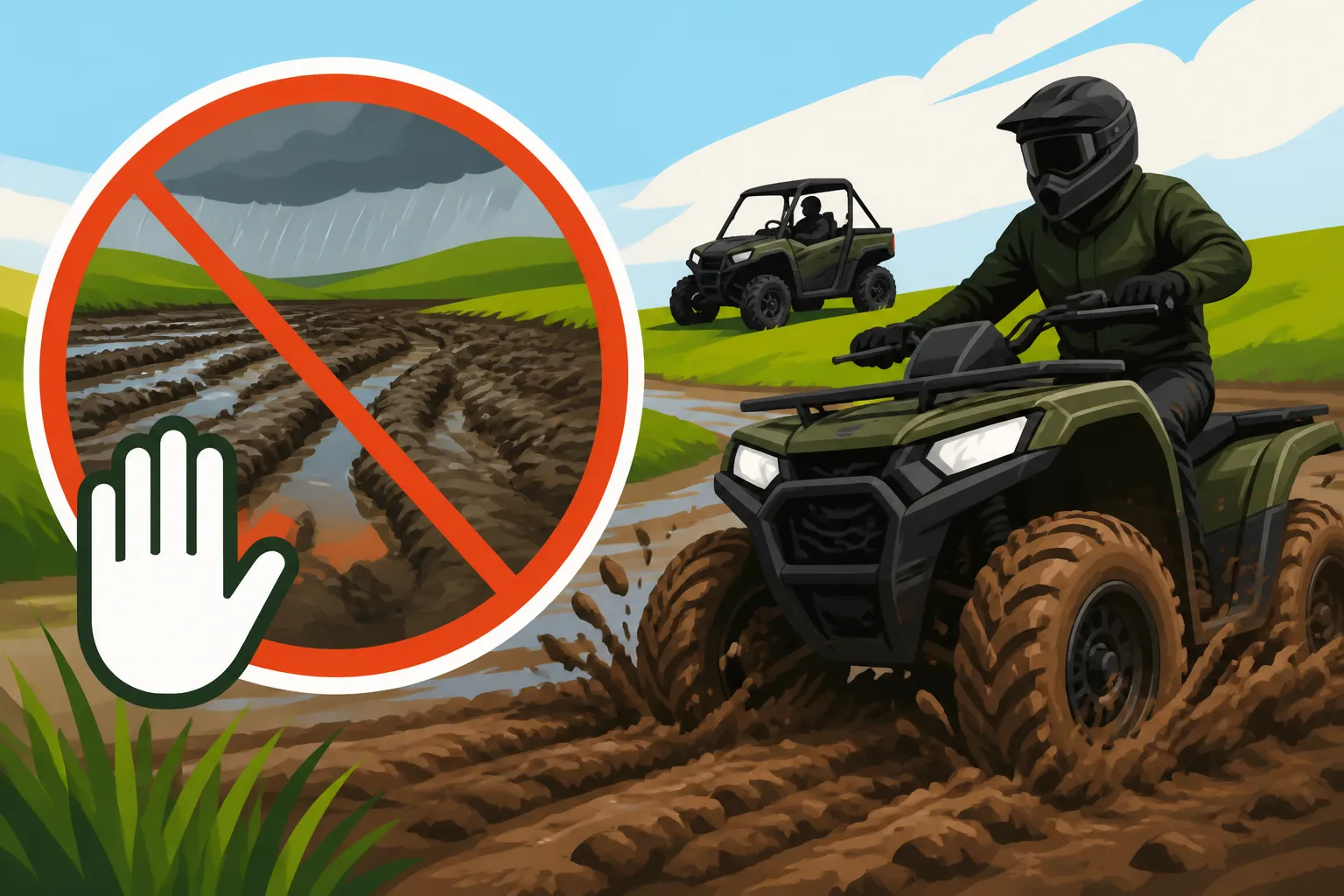
The trouble is not limited to getting stuck. A spinning tire can dig a hole, push mud off the trail, and leave ruts that hold water. Those ruts may make the route harder for the next rider and can take time to dry and recover. The practical takeaway is that a muddy trail can be damaged even when your machine makes it through.
If you are new to prairie mud, North Dakota Gumbo Mud and What It Does explains why this soil behaves differently from loose sand or dry dirt. The conditions also vary with rainfall, shade, drainage, and traffic, so a trail that seemed manageable on a previous trip may not be rideable today.
A wet trail can be both slippery and fragile
Slippery ground makes it harder to steer, stop, and hold a line. Clay stuck to tires can also add weight and affect how the machine handles. On a side-by-side, passengers and cargo add more weight; on an ATV, a quick change in direction can cause the tires to slide across the surface rather than follow the turn.
At the same time, the ground may be soft enough to deform easily. Spinning in place, making repeated attempts through the same bog, or driving around a muddy spot can widen the route and damage plants along its edges. A detour may look like the gentler choice, but it can create a new track where none is meant to be.
That is why “I made it through” is not the only measure of a successful ride. If a route is getting rutted, a machine is sliding unpredictably, or the trail is officially closed, turning around is a better decision than forcing your way onward. For wider context on responsible riding, see North Dakota Trail Etiquette Locals Expect.
Wet-weather closures are a signal to stay off the trail
Trail managers may close an area when wet ground is likely to rut or when continued riding would cause damage. Follow posted notices and check the managing agency’s updates before leaving home and again before unloading. A trailhead sign, temporary barrier, or closure notice takes precedence over an old trip report or a route shown in a mapping app.
This matters at places such as Pembina Gorge, where rain can affect trail conditions and access. Do not assume that every loop is open just because the parking area is accessible, or that a route is ready because it looks dry near the entrance. Conditions can change farther along the trail. Check Pembina Gorge Closing After Rain and North Dakota Trails Closed by Wet Weather when planning a trip.
A mapping tool such as onX Offroad can help you review and organize a route, but a mapped line does not confirm that the ground is dry or that the trail is open. Use it alongside current official trail information, signs, and on-the-ground judgment—not as permission to ride through a closure.
How to decide whether to ride after rain
Check conditions before you load the machine
Start with the location you plan to ride, not just the weather in your hometown. Rainfall can vary across the state, and a trail may receive more water than a nearby town. Look for recent precipitation, official trail updates, and any closure notices from the land manager. If you cannot find a reliable update and the route is known to get muddy, consider choosing a different activity or postponing the trip.
Think about the full route as well as the trailhead. A firm gravel road leading to a parking area does not prove that the riding area is firm. If you are headed toward Pembina Gorge, Turtle Mountain, or another riding area, confirm the current rules and access conditions for that specific place. North Dakota Trail Status by App and Phone offers another useful starting point for checking how to look for updates.
You can also use onX Offroad to review your planned route and note a turnaround point before you go. Keep the official source in view for closures and access status; a route line or saved map is not a substitute for those updates. If your group has different machines or experience levels, agree in advance that anyone can call a stop when the ground looks unsafe or fragile.
Use a simple field check without damaging the trail
At the trailhead, look for signs of standing water, soft shoulders, deep tire marks, and mud already packed into the tread of other machines. Pay attention to the ground just outside the parking area too. If your boots sink easily or the surface pulls at them, the trail may be too soft for responsible riding. Do not drive farther in just to “see how bad it gets.”
If the route is open and the surface appears firm enough, approach uncertain patches slowly and assess them from a safe, permitted spot. Avoid driving onto vegetation or making a new path to test the ground. If you see deep ruts, a water-filled hole, or a section where riders are spinning, turn around rather than adding another pass.
A short walk from a safe stopping place can sometimes reveal a slick section ahead, but never block the route or step into an area where other riders cannot see you. When in doubt, the least damaging choice is to stop before entering the soft stretch. North Dakota Riding After Heavy Rain covers the broader judgment calls that come up after a storm.
Choose a different ride when the ground is not ready
There is no prize for riding on the muddiest day. If a trail is closed, visibly soft, or likely to rut under tires, postpone the ride or select a route and activity that are open and suitable for the conditions. North Dakota has different types of riding areas and access routes, and conditions are not uniform statewide; check the specific location rather than assuming one area represents them all.
A backup plan helps keep a disappointing forecast from becoming a rushed decision at the trailhead. You might save another legal route, plan a shorter ride on a firm surface, or reschedule for a drier day. When you use onX Offroad to organize options, verify access and current conditions separately before committing to a route.
For general seasonal preparation, North Dakota Riding in Spring Mud is a useful companion to this guide. The key is not simply to find a place where a machine can move. It is to choose ground that can handle the ride without creating damage or putting your group in a difficult recovery situation.
| What you notice | What it may mean | Safer response |
|---|---|---|
| A posted closure or barrier | The route is not open for riding | Do not enter; check for an official update |
| Tires quickly fill with sticky clay | The surface may be too wet for dependable traction | Stop somewhere safe and turn back |
| Deep, fresh ruts or standing water | The trail may be soft and vulnerable to more damage | Avoid the section and do not make a new route around it |
| Your machine slides when steering or braking | Control is reduced | Slow down, avoid abrupt inputs, and reassess whether to continue |
| Firm ground near the entrance but soft ground ahead | Conditions may vary along the route | Do not treat the trailhead as proof that the entire route is ready |
Ride gently, protect your machine, and know when to turn back
Reduce the chance of losing control
On a permitted, open route that is firm enough to ride, use a controlled pace and leave room to stop. Sudden acceleration can spin the tires; sharp steering or hard braking can make a machine slide on slick clay. Smooth, gradual inputs give you a better chance of keeping control. Maintain enough space between machines to see the trail and avoid piling into a muddy section when the rider ahead slows down.
Do not let a group’s momentum make the decision for you. If the lead rider discovers that the ground is too soft, the rest of the group should stop in a safe place rather than follow into the same rut. Agree on a hand signal or another clear way to communicate “stop” and “turn around,” especially when engines and helmets make conversation difficult.
Use tires and equipment suited to the machine and the conditions, but do not assume aggressive tread makes a closed or fragile route acceptable. Tires That Work in Gumbo can help with tire considerations, while North Dakota Trails With Width Limits is worth reviewing if your machine may not fit a particular trail.
Avoid turning one muddy patch into a bigger problem
If you encounter a soft spot, resist the instinct to make repeated runs at it. Spinning wheels can dig deeper, and a recovery attempt can damage the trail further. If you can safely stop before the problem area, do so. Turn around using an established, permitted place rather than widening the route or driving over vegetation.
If a machine is already stuck, pause before adding throttle. Check that everyone is safe, look for hazards, and make a recovery plan that will not put people near moving wheels or a loaded strap. Use recovery equipment only in a controlled way and follow the equipment maker’s instructions. If the machine cannot be recovered without further damage or risk, seek appropriate assistance instead of escalating the situation.
Mud also affects visibility and comfort. Clay thrown from tires can coat goggles, lights, and bodywork. Keep a safe following distance, protect your eyes, and stop in a suitable place if you cannot see clearly. Do not continue simply because the group is eager to reach the next section.
Clean up carefully and plan for next time
Before leaving the riding area, remove heavy mud where washing is permitted and appropriate. Clay left packed around wheels, brakes, suspension parts, and underbody areas can be difficult to remove once it dries. Choose a designated wash area when available, and avoid letting dirty runoff flow into waterways or onto neighboring land. Washing Gumbo Off Before It Sets has more practical cleanup guidance.
After the ride, check the machine for packed mud, damaged components, and anything that could affect safe operation on the next trip. Follow the owner’s manual for cleaning and inspection, particularly around braking and moving parts. If you noticed a closure, deep rut, or hazardous section, report it to the appropriate trail manager rather than posting a route around it as a suggested workaround.
A wet-weather ride is successful when the trail remains in good shape and everyone gets home safely. Check the status before you go, be willing to turn around, and treat soft ground as a reason to slow down—or stay off it altogether. For more on responsible trail use in damp conditions, read Tread Lightly on Wet Clay, North Dakota Riding in Spring Mud, and North Dakota Trail Etiquette Locals Expect.
Disclaimer
This article is for general informational purposes only and does not constitute professional advice. Laws, prices and regulations vary by location and change over time. Consult a qualified professional for guidance on your specific situation.