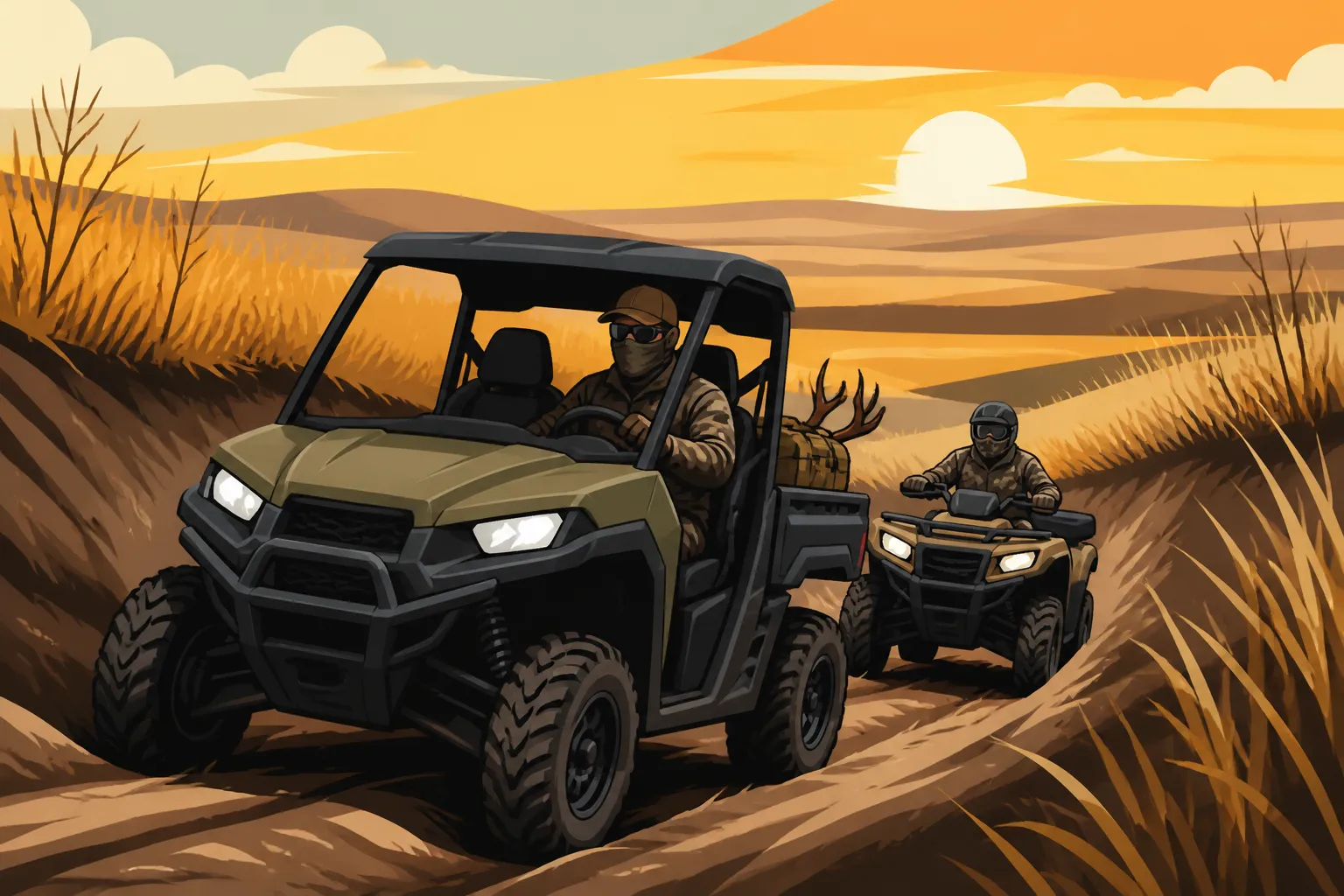
North Dakota Ditch Riding to a Hunting Spot
A North Dakota ditch can look like the shortest route to a hunting spot, but the shoulder, ditch bottom, and neighboring field are not interchangeable places to ride. This guide explains how to plan a legal route, respect land boundaries, prepare your ATV or UTV for prairie conditions, and avoid turning a convenient ride into a trespass, safety, or access problem.
Check the route before you ride
Know which part of the right-of-way you are using
North Dakota allows certain off-highway vehicle travel in highway ditches, but that does not mean every part of the roadside is open to riding. The ditch bottom and back-slope are different from the inslope and shoulder, and riding in a closed area can put you in the path of traffic or violate the rules. Review [North Dakota Ditch Riding: The Legal Right Explained] and [North Dakota Back-Slopes and Ditch Bottoms] before planning a route.
A simple roadside description can be misleading. Someone may say, “Take the ditch along County Road 12,” without knowing whether they mean the bottom of the ditch, a steep bank, the road shoulder, or a farm approach. Those details matter. Don’t treat the entire strip between pavement and fence as one continuous trail.
The safest approach is to identify the roadside features before you set out. If the route appears to put you on the inslope or shoulder, choose another way or stop and confirm what is allowed. [North Dakota Inslopes and Shoulders Are Closed] explains why these areas should not be treated as alternate riding lanes.
Check for local restrictions and road conditions
A route that appears usable on a map may be affected by a county or city restriction, road work, a damaged culvert, or water in the ditch. Check the rules for the specific area, not just the statewide rules. If your route passes near a town, contact local law enforcement or the relevant county office if you are uncertain whether that section is restricted. The broader rules are covered in [North Dakota ATV Road Rules by County] and [North Dakota Counties That Restrict Riding].
Weather can change a ditch route quickly. Heavy rain may soften the bottom, hide a washout, or leave standing water over ruts. Tall grass can conceal culverts and approaches, while snow can mask the ditch edge. A route that was passable on a dry scouting trip may be unsafe after a storm or during spring thaw.
Before leaving, look at the route as a series of short, checkable segments rather than one uninterrupted line. Note where you can safely turn around, where a crossing may be needed, and where the ditch narrows or meets a bridge. A paper map or offline map in a tool such as onX Offroad can help you keep your bearings, but it does not establish that a route is legally open or that you have permission to enter adjacent land.
| Route question | What to check | Why it matters |
|---|---|---|
| Is ditch travel allowed here? | State rules and any county or city restrictions | A legal route in one area may be restricted in another |
| Which roadside area would you ride? | Ditch bottom and back-slope versus inslope and shoulder | These areas are not interchangeable |
| Does the route cross private land? | Property lines, signs, and landowner permission | A public roadside route does not grant access across a field |
| Is the ground passable today? | Rain, snow, standing water, washouts, and soft soil | Conditions can conceal hazards or damage land |
| Can you turn around safely? | Culverts, approaches, fences, and narrow sections | A blocked route should not force an unsafe detour |
Confirm hunting access separately from riding access
A ditch route does not give you permission to enter a hunting parcel
This is one of the easiest mistakes to make: assuming that because you can ride along a road ditch, you can leave the ditch wherever it is convenient and continue toward a hunting spot. Riding in the right-of-way and entering adjoining property are separate issues. You need to know where the parcel boundary is and have permission for the land you intend to enter, unless another specific access rule applies.
Posted signs and electronic posting can make a difference, and boundaries are not always obvious in open country. A fence, shelterbelt, field edge, or farm track may look like a natural route, but it does not necessarily show where you may travel. Read [North Dakota Posted Land Rules for Riders] and check [North Dakota Electronic Posting and Riders] before crossing or leaving the roadside.
Mapping tools, including onX Offroad, can help you review property lines and mark a planned approach. Treat those lines as a planning aid, not as a substitute for verifying access. If a boundary is unclear, ask the landowner or hunting access contact before riding onto the property. Keep a written permission record if that helps prevent confusion later.
Plan where the machine will stop
Think through the last part of the trip before you ride. If the ditch ends well short of the hunting location, don’t assume you can cross a field, ride through a shelterbelt, or follow a farm trail to make up the distance. Arrange an authorized parking or drop-off spot, walk the remaining distance where permitted, or use another access route.
A useful plan identifies the stopping point, the direction you will walk, and the way you will return without disturbing crops, livestock, or other hunters. If you are meeting someone on the property, confirm the location in advance rather than riding around looking for their vehicle. That is especially helpful where several field approaches look alike.
For land access considerations, see [North Dakota Hunting Access by OHV] and [North Dakota Landowner Permission Forms]. Permission to hunt and permission to drive are not always the same thing, so ask specifically whether you may bring an ATV or UTV onto the property and where it may be parked.
Prepare for a safe ride to the hunting spot
Make the machine and load fit the route
A hunting load changes how an ATV or UTV handles. A full fuel can, pack, game-retrieval equipment, tools, and a passenger add weight and can affect braking, turning, and stability. Secure everything before leaving and make sure nothing can slide, snag vegetation, or interfere with controls. Keep the load within the machine manufacturer’s limits and avoid stacking gear where it blocks your view.
Use a route that matches the machine and conditions. A narrow, uneven ditch may be difficult for a wide UTV, while a compact ATV may still struggle with deep mud, steep banks, or concealed washouts. Don’t use speed to power through an obstacle you can’t see clearly. Stop at a safe point, inspect the ground on foot if appropriate, and turn back if the route is uncertain.
Carry practical essentials for rural travel: water, a charged phone, basic tools, a tire-repair option suited to your machine, and a way to communicate if service is poor. A tow strap can help with a manageable recovery, but avoid attempting a pull that could overturn a machine or injure someone. For remote routes, tell another person where you plan to go and when you expect to return.
Ride with traffic, weather, and other people in mind
Ditch riding often means sharing space with farm approaches, culverts, road crossings, and vehicles entering or leaving fields. Reduce speed when visibility is limited, especially in tall grass, blowing dust, or snow. Watch for drainage structures and approach crossings; an opening that looks like a shallow dip may conceal a sharp drop or unstable edge.
Make yourself visible and give road users room. Don’t assume a driver can see you below the road surface, and don’t suddenly climb onto the shoulder to get around an obstacle. If you must stop, choose a location that does not block an approach or create a hazard. Be prepared to yield and wait rather than forcing a tight pass.
Hunting season brings its own considerations: other hunters may be walking, vehicles may be parked near approaches, and people may be carrying firearms. Keep your machine under control, avoid unnecessary noise near occupied hunting areas, and follow all rules for transporting firearms and equipment. If anyone in your group is unsure about safe firearm handling around the vehicle, pause and sort it out before moving.
Use a practical pre-ride routine
Walk through the route in order
Before loading up, trace the trip from start to finish. Confirm the legal roadside section, identify each point where the route changes, and mark the intended stopping place. If you use onX Offroad or another mapping app, save the area for offline use when possible and set a clear return route. Apps can be useful when cell service drops, but they cannot confirm that a road ditch is open today or that a landowner has approved access.
Then match the plan to the day’s conditions. If recent rain has made the ditch soft, choose a different route instead of making deep ruts or risking a stuck machine. If snow covers the ground, remember that it can hide fences, culverts, and sharp changes in slope. When a segment is uncertain, leave it out of the plan until you can check it safely.
A quick pre-ride checklist helps catch the small things that cause frustrating delays:
- Confirm the roadside route and any local restrictions.
- Verify property boundaries and get permission for any private-land travel.
- Check the forecast and recent conditions along the route.
- Inspect tires, brakes, lights, fuel, and securely fastened cargo.
- Tell someone your route and expected return time.
- Agree on a turnaround point and a plan if the route is blocked.
Know when to turn around
Turning around is the right call when the route is posted, the boundary is unclear, the ditch is flooded, or the ground is too soft to cross without damage. It is also the right call when visibility is poor or the only apparent way forward requires riding on the shoulder, entering a field without permission, or taking a risky line around an obstacle.
A map may show a continuous route, but the ground can tell a different story. A missing bridge, washed-out bank, or newly installed fence can make a planned segment unusable. Don’t let the effort already spent getting there push you into an unsafe shortcut. Mark the problem spot, backtrack carefully, and choose a legal alternative.
After the ride, check the machine for packed mud, damaged tires, loose cargo, or bent components. If you encountered a problem area, update your route notes so you don’t repeat the same mistake on the next trip. For the larger picture of roadside travel, [Can You Ride an ATV in the Ditch in North Dakota?] is a useful companion read. For shared-use etiquette, see [North Dakota Trail Etiquette Locals Expect].
Disclaimer
This article is for general informational purposes only and does not constitute professional advice. Laws, prices and regulations vary by location and change over time. Consult a qualified professional for guidance on your specific situation.