North Dakota Riding in Spring Mud
Spring mud can turn a pleasant North Dakota ride into a stuck machine, damaged trail, or long walk back to the trailer. Thawing ground, lingering snow, and sticky clay can change conditions quickly, even when a route looks passable from the road. This guide explains how to judge spring conditions, choose a safer route, prepare your ATV or UTV, and know when to turn around.
Why spring mud is different in North Dakota
Thawing ground can hide weak spots
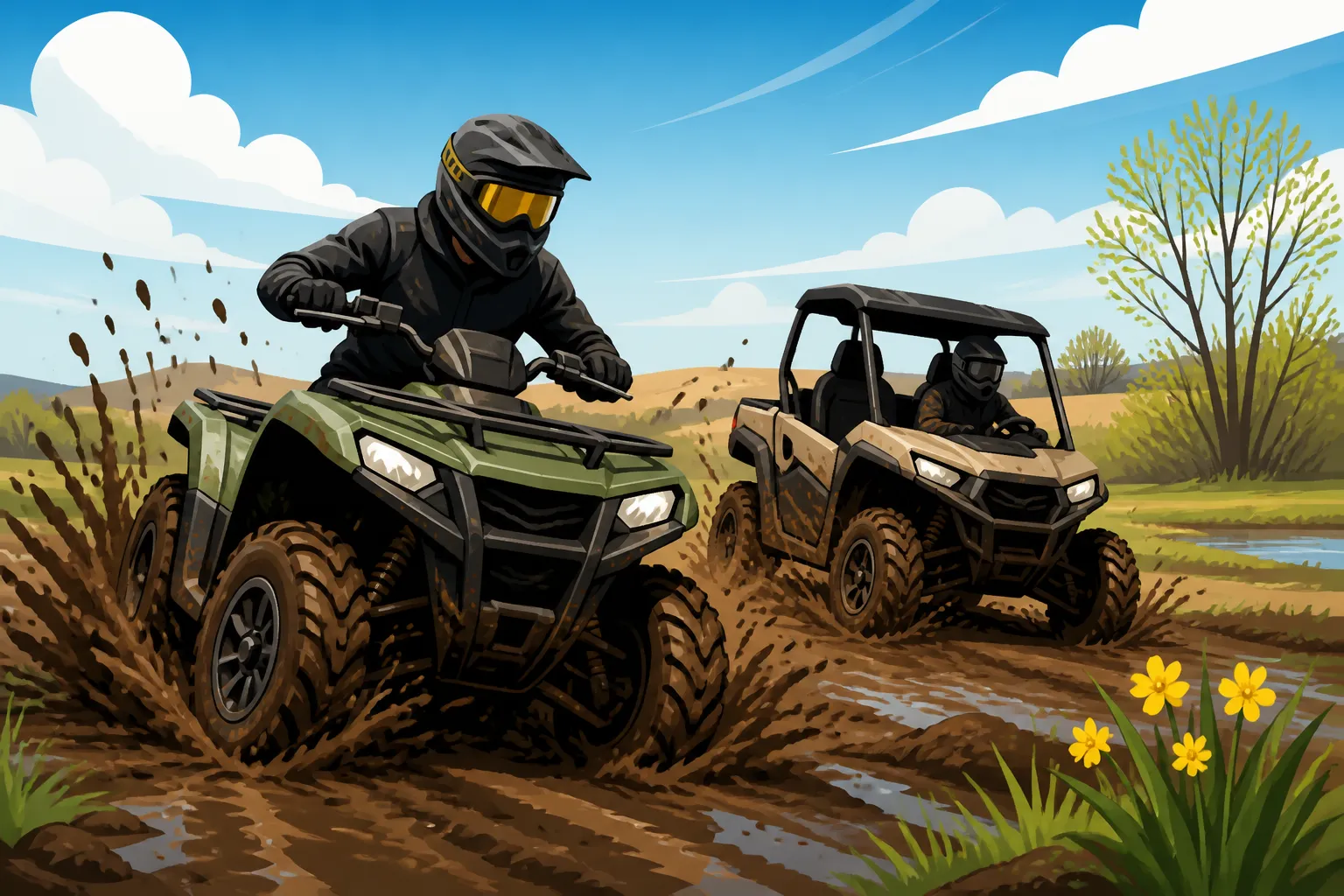
In spring, the surface may look firm while the soil underneath is still saturated or partly frozen. Snowmelt and rain soak into low areas, shaded stretches, and places where water collects. A quad can cross a patch without trouble in the morning, then sink into the same spot after more thawing or traffic.
North Dakota’s clay-heavy ground can be especially frustrating. Gumbo may cling to tires, pack into wheel wells, and make steering feel unpredictable. A shallow puddle is not always the main risk: the soft ground around it can be just as difficult to read. If you can’t tell whether a rut has a firm bottom, don’t assume it does.
Spring conditions also vary across the state. A route near Pembina Gorge may have different drainage, shade, and surface conditions from an open route in the Badlands or along the Missouri River. Even on one riding area, sunny slopes and exposed sections can dry sooner than shaded draws. Check the specific area rather than relying on a general impression that “the trails should be open.”
Before planning a destination, review [North Dakota Trails Closed by Wet Weather] and [North Dakota Trail Closures After a Storm]. An open trail on a map is not necessarily a dry trail on the ground. Follow posted closures and local instructions, and don’t ride around a closure to reach the next section.
Mud can damage trails long after the ride
Riding wet ground can deepen ruts and push soil off the trail. When several machines follow the same soft line, the damage adds up quickly: a rut becomes a channel, water collects in it, and the route may take longer to recover. A rider may feel they are only making one pass, but the trail can carry the effects of repeated traffic after the ground is already saturated.
That matters on designated OHV routes and shared-use areas, where other riders, hikers, equestrians, or land managers may be affected. It also matters on grassland roads and other public routes, where leaving the established track can harm surrounding ground. North Dakota does not treat open land as permission to travel cross-country. Check [North Dakota Cross-Country Travel Is Banned] and [North Dakota Trail Etiquette Locals Expect] before setting out.
A good rule is simple: if your tires are cutting deep grooves, the soil is moving in clumps, or you need repeated throttle to crawl through a short section, conditions may be too wet for responsible riding. Turning around is not overcautious. It can spare your machine, protect the route, and keep a short outing from becoming a recovery job.
How to decide whether a route is rideable
Check the route and local conditions first
Start with the riding area’s official status information, not just a social media post or an old map. Closures can change after rainfall or thawing, and reports from earlier in the week may no longer reflect what you’ll find. If a site or trailhead lists a phone number or status page, check it before loading the machine.
Use a map to understand the route, access points, and possible return options. onX Offroad can help you review mapped routes and plan where you intend to ride, but a digital line cannot show whether the ground is soft today. Download map information before leaving areas with weak cell service, and carry a backup way to navigate. For additional trip planning, see [North Dakota OHV Trail Map Downloads] and [North Dakota Trail Status by App and Phone].
Ask yourself whether you have a way to turn around before committing to a muddy section. A narrow trail between trees, a steep cut, or a waterlogged low spot can leave little room to reverse direction. If you are riding with a group, agree in advance that anyone can call off a route when conditions feel unsafe. That removes the pressure to keep going just because the trailer is already parked.
Use what you see on the ground
At the trail entrance, take a moment to look at the surface and the surrounding vegetation. Standing water, fresh tire tracks filled with water, soft edges, and deep ruts all suggest that the ground may not support more traffic. Watch for areas where snow is still melting into the route or where runoff crosses it.
If the first stretch is already soft, don’t treat it as a challenge to conquer. Mud can get deeper beyond the visible section, and turning around is easiest before your machine is buried or boxed in by other riders. When in doubt, stop on firm ground and reassess rather than charging forward to “see what happens.”
Use this quick guide as a starting point:
| What you find | A sensible response |
|---|---|
| Firm surface with shallow, dry tire marks | Continue cautiously, while watching for softer sections |
| A few wet patches with firm ground around them | Stay on the established route and avoid widening it |
| Standing water, soft edges, or deepening ruts | Turn back or choose a different route |
| A posted closure or official wet-weather warning | Do not enter, even if the trail looks passable |
| A route that requires repeated wheelspin | Stop before you worsen the rut or lose control |
These are practical observations, not a substitute for posted rules or local closures. Conditions can change over a short distance. A route that begins firm may become soft in a shaded hollow, near a drainage, or where several machines have already churned the surface.
Prepare your ATV or UTV for muddy conditions
Inspect the machine before leaving home
A spring ride is a poor time to discover a weak battery, damaged tire, or loose strap. Check tire condition and pressure against the manufacturer’s guidance, and inspect the machine for leaks or parts that could be affected by packed mud. For a UTV, check that the tires, steering, and brakes are in good shape and that the cargo area is secured.
Mud adds weight and can collect in places you may not notice from the seat. It can obscure lights, cover reflectors, and build up around moving parts. Carry basic tools, gloves, drinking water, and a way to contact someone if your group becomes separated. Bring recovery gear only if you know how to use it safely; a winch or tow strap can create serious hazards when attached incorrectly or used without a clear plan.
Dress for changing weather rather than the temperature at the trailhead. Spring wind can make a damp ride uncomfortable, and splashes can leave riders cold even when the day starts mild. Pack an extra layer in a dry bag, and bring footwear that can handle wet ground. If children are riding, plan shorter stretches and make sure their protective gear fits properly.
Keep traction and recovery decisions cautious
Avoid aggressive throttle that spins the tires. Wheelspin can dig the machine into soft ground, deepen the rut, and reduce your ability to steer. Smooth inputs are generally easier to control. If you lose traction, pause and assess your position rather than repeatedly accelerating.
Do not assume that a larger UTV will float over mud better than an ATV. Its weight and width can make a soft section more difficult, and some routes have width limits. Before choosing a route for a side-by-side, check [North Dakota Trails That Allow Side-by-Sides] and [North Dakota’s 60-Inch Trail Width Cap]. A machine that fits on a route when the ground is dry may still be a poor choice when the surface is saturated.
If you become stuck, keep the group at a safe distance from the machine and any tensioned recovery line. Don’t stand in line with a strap or cable under load. Avoid trying to pull a machine from unstable ground if the recovery point, anchor, or attachment is uncertain. When the situation is beyond your experience, it is safer to seek appropriate help than to turn a difficult recovery into an injury.
Ride responsibly and make a better spring plan
Protect the land and respect access rules
Stay on the route that is open and intended for motorized use. Riding around mud by creating a new path can widen the damaged area and may take you onto land where you do not have permission. This is especially important near private property, agricultural ground, and posted areas. Review [North Dakota Posted Land Rules for Riders] before traveling near land boundaries, and get permission where required.
Keep noise, speed, and spacing considerate. In soft conditions, following too closely can leave you with no room to stop if the rider ahead gets stuck or turns around. Give other groups time to clear a narrow stretch, and don’t pressure someone to continue through a section they consider unsafe.
If you see damage or a closure notice, respect it rather than treating it as a temporary inconvenience. A route that stays intact through a wet spring is more likely to be enjoyable when it dries. Checking [North Dakota Trails Closed by Wet Weather] again before a return trip is worthwhile, since a trail’s condition and status may differ from your first visit.
Build flexibility into your outing
A spring ride goes more smoothly when the destination is not the only plan. Choose a primary route and a backup, tell someone where you expect to ride, and decide what conditions would make you turn back. If the first trailhead is too wet, having another option can keep the day from becoming a frustrating drive home.
Leave extra time for loading, checking the machine, and cleaning up afterward. Wet clay can cling to tires and undercarriage, and driving onto a trailer with packed mud can make footing slippery. Once home, remove mud before it hardens, paying attention to areas where it can hide wear or interfere with moving components. Follow the owner’s manual for cleaning and maintenance rather than blasting sensitive parts with high-pressure water.
A simple spring checklist can help:
- Check official trail status and weather conditions before loading.
- Confirm that your machine is allowed on the route and fits its restrictions.
- Pack warm, dry layers, water, basic tools, and a navigation backup.
- Inspect the first stretch of trail before committing to a longer route.
- Turn around if the ground is saturated, ruts are deepening, or traction is unreliable.
- Clean and inspect the machine after the ride.
Spring mud is part of riding in North Dakota, but it does not have to dictate the whole day. A flexible plan, careful observation, and willingness to skip a route when it is too wet can protect both your machine and the places you want to ride again. If the ground is soft enough to leave deep tracks, wait for it to dry and choose a firmer option in the meantime.
Disclaimer
This article is for general informational purposes only and does not constitute professional advice. Laws, prices and regulations vary by location and change over time. Consult a qualified professional for guidance on your specific situation.