North Dakota Rules for Riding in Williston
Trying to figure out where you can legally ride your ATV or UTV in and around a specific city like Williston, North Dakota, can feel like navigating a legal maze with constantly shifting walls. It's frustrating when you just want to enjoy your machine but are worried about breaking a rule you didn't even know existed. This guide aims to cut through that confusion, breaking down the general state laws for off-highway vehicles (OHVs) and explaining how those interact with, or are sometimes superseded by, local ordinances, giving you a clearer picture of how to ride responsibly in the Williston area.
Understanding North Dakota's General OHV Road Rules
Before we dive into the specifics of Williston, it’s absolutely essential to grasp the foundational rules that apply statewide in North Dakota. Think of these as the baseline, and then local city ordinances can add further restrictions on top. Many riders assume that if a road or ditch is open in one part of the state, it's open everywhere, and that's just not the case, especially when you enter city limits.
The Statewide Framework for ATVs and UTVs
North Dakota has a pretty comprehensive set of laws governing where and how you can operate an ATV or UTV. Generally speaking, state law allows for OHVs to be ridden on the back-slope or ditch bottom of a highway, provided they are registered and adhere to certain equipment requirements. This is a huge benefit for many rural residents and hunters who use these machines for practical purposes, not just recreation. However, there are distinctions between surface types. You'll find specific details in our guide on [North Dakota ATV Road Rules by Surface Type]. Gravel roads are often more lenient than paved roads, for instance, and interstates are almost always off-limits.
For any kind of public road or ditch riding, your machine needs to be properly registered with the North Dakota Department of Transportation. This isn't just a suggestion; it's a legal requirement. We've got a detailed breakdown on [How to Register an ATV in North Dakota] that walks you through the process. Without current registration, even if your machine meets all other criteria, you're looking at potential fines and legal trouble. Many riders are surprised to learn that even if they just ride on their own land, once they hit a public ditch, that registration becomes mandatory. The state also dictates speed limits for OHVs on these public rights-of-way, generally restricting them to the posted speed limit for the adjacent road, but never exceeding 30 mph unless it's a Class III machine on a paved road posted 55 mph or higher, where it might go up to 65 mph. However, this is rarely applicable within city limits.
Key Equipment Requirements for Road Use
Just like any other vehicle sharing public rights-of-way, your ATV or UTV needs to meet certain safety equipment standards when you're operating it off your own private land. This isn't about making your machine street-legal in the traditional sense of a car, but rather about ensuring it's visible and controllable. For instance, you'll need at least one mirror, a horn audible from a specified distance, and working headlamps and taillamps if you're riding after dark. Checking out [North Dakota Mirror and Horn Requirements] and [North Dakota Headlamp Distance Standards] can give you a more precise understanding of these standards.
Many riders find that stock equipment might not always meet these specs, especially for older machines or those primarily used off-trail. You might need to invest in some aftermarket accessories to get compliant. For example, if your UTV didn't come with an adequate rearview mirror, you might look at a universal fit mirror kit from a brand like SuperATV to ensure you can see what's behind you. Similarly, if your stock headlamps feel a bit dim for night-time ditch cruising, a brighter LED setup could be a worthwhile upgrade, not just for compliance but for your own safety. It's not just about avoiding a ticket; it's about making sure you can see and be seen, especially during those low-light hours or in dusty conditions common on the prairie.
Williston's Specific OHV Ordinances and What They Mean for Riders
This is where things can get a bit tricky and where local knowledge becomes incredibly valuable. While state law provides the general framework, cities like Williston have the authority to enact their own ordinances that can further restrict or permit OHV operation within their municipal boundaries. This means that rules that apply in a rural township outside of Williston might not apply once you cross into the city limits.
Navigating City Limits and Designated Areas
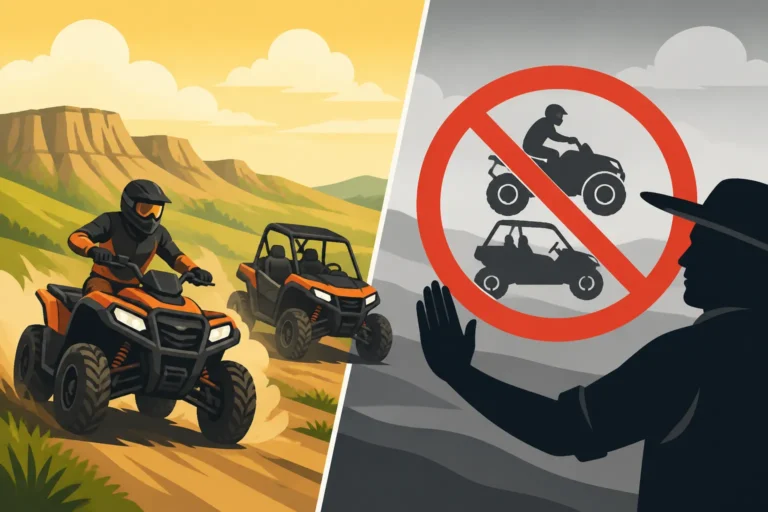
The most common frustration for OHV riders in North Dakota cities is the disconnect between state-level ditch riding allowances and city ordinances. Many cities, including Williston, often have ordinances that prohibit the operation of ATVs and UTVs on public streets, sidewalks, and even within the ditches and rights-of-way inside the city limits, unless specifically designated otherwise. The logic is usually centered on public safety, noise concerns, and managing traffic flow. While the state allows you certain freedoms on county roads or state highway ditches, cities often view their own infrastructure differently. You can learn more about this general concept in [North Dakota City Ordinances on OHV Riding].
It's highly unlikely that you'll be able to casually ride your ATV or UTV through residential neighborhoods or down main thoroughfares in Williston for recreational purposes. Cities are generally concerned about the interaction of OHVs with cars, pedestrians, and cyclists in more congested areas. The "back-slope and ditch bottom" rule that applies statewide often has a silent asterisk: "outside of incorporated city limits." Therefore, if your plan is to use your OHV to get around town, run errands, or simply cruise through city parks, you'll almost certainly find that restricted, if not outright illegal. The best advice here is always to assume restrictions are in place until you've verified otherwise directly with city authorities.
Permitted Routes and Special Exceptions
Despite general restrictions, many cities do carve out specific exceptions for OHV use within their boundaries. These aren't typically for recreational riding, but rather for practical or essential purposes. Common examples include:
- Direct Access to Private Property: If you live within Williston and need to move your OHV directly from your residence to a trailer, or access a specific portion of your property that's only reachable by an OHV, there might be provisions for short-distance, direct routes. This is not for joyriding, but for transit.
- Agricultural Use: For farmers or those involved in agricultural work within or immediately adjacent to the city, there might be allowances to operate OHVs on city rights-of-way for legitimate farm business, such as accessing fields or managing livestock. This is similar to what's covered in [North Dakota Farm Use on a Road], but again, city rules often add layers of permits or specific routes.
- Utility Work or Emergency Services: Utility companies, law enforcement, or emergency services often have exemptions for operating OHVs as part of their official duties.
- Designated Routes/Events: Very occasionally, a city might designate specific routes or allow OHV use for special permitted events, like parades or charity rides, but this would be a specific, temporary allowance.
It's paramount to understand that these exceptions are usually very narrow. They don't open the floodgates for general riding. If you believe your use case falls under an exception, you need to verify it with the City of Williston directly. Don't rely on hearsay or what a friend "thinks" is allowed. Get definitive guidance from the Williston Police Department or the City Clerk's office.
Practical Advice for Riding Your OHV Around Williston
Navigating OHV rules, especially in urban environments, requires diligence and a proactive approach. It's better to ask questions and be sure than to risk a ticket, or worse, an accident.
Before You Ride: Research and Preparation
The golden rule for riding an OHV anywhere is: Know before you go. This is especially true when you're near or within Williston's city limits.
- Contact City Offices: Your first and most important step should be to directly contact the Williston Police Department or the City Clerk's office. They are the authoritative sources for local ordinances regarding OHVs. Ask specific questions: "Can I ride my UTV in the ditch along X Street?", "Are there any designated routes for OHVs within the city?", "What are the rules for accessing my agricultural land within city limits?". Don't be afraid to ask for copies of relevant ordinances.
- Check Posted Signs: Always be on the lookout for official signage. If an area is clearly marked "No OHVs" or "Private Property," respect those signs. Similarly, if a specific route is designated for OHV use, there will likely be signage indicating that. Remember, [North Dakota Posted Land Rules for Riders] are important whether you're in the city or out in the country.
- Ensure State Compliance: Even if you find a permissible route or exception within Williston, your machine still needs to meet all statewide requirements. This means current registration, as detailed in [What North Dakota's OHV Law Requires of Owners], and all necessary safety equipment (mirrors, horn, lights, etc.). Double-check your machine's condition. For instance, if you're relying on a winch for farm work, ensure it's in top shape. You might even consider upgrading certain components, such as heavy-duty axles or a full skid plate kit from SuperATV, if your work involves rough terrain, ensuring durability wherever you ride.
- Insurance: Don't forget liability insurance. While North Dakota does not mandate OHV insurance for off-road use, if you're operating on any public roadway or ditch, you really should have it. Some private landowners might even require it if you're riding on their property. [North Dakota Insurance Requirements at Registration] offers more context.
Staying Legal and Safe
Once you've done your homework and understand where you can ride, the next step is to ensure you're riding safely and legally within those boundaries.
- Carry Your Paperwork: Always have your OHV registration and proof of insurance with you when riding on public land or rights-of-way. This makes any interaction with law enforcement much smoother.
- Helmet Use: Remember North Dakota's helmet law: riders under the age of 18 are required to wear a helmet. This is a non-negotiable safety rule that protects our younger riders. Find out more about this in [North Dakota Helmet Law for Riders Under 18]. Even if you're over 18, wearing a helmet is always a good idea for your own safety, especially when operating heavy machinery.
- Respect Private Property: Whether inside or outside Williston, never trespass. Always assume land is private and requires permission unless it's clearly marked as public access. This is fundamental to responsible riding and maintaining good relationships with landowners.
- No Impaired Riding: Just like driving a car, operating an OHV under the influence of alcohol or drugs is illegal and incredibly dangerous. [North Dakota DUI Rules for OHV Riders] apply to OHVs just as they do to other motor vehicles, and the penalties can be severe. Your judgment is impaired, reaction times slow, and the risk of serious injury or fatality skyrockets. Keep our trails and ditches safe for everyone by never riding impaired.
To summarize, here's a quick comparison of general state guidelines versus what you might expect within Williston city limits:
| Feature | North Dakota State Law (General) | Williston City Limits (Potential) |
|---|---|---|
| Registration Required? | Yes, for public land/ditch use | Yes, if any operation is permitted |
| Ditch Riding Allowed? | Generally, on back-slope/ditch bottom of highways | Highly restricted or prohibited; exceptions for specific purposes/routes may exist. Always verify with city. |
| Paved Roads Allowed? | Limited, often for direct crossings or Class III machines | Generally prohibited for recreational use; limited to direct access/farm use by ordinance. |
| Gravel Roads Allowed? | Often permitted if registered and equipped | Generally prohibited for recreational use; limited to direct access/farm use by ordinance or specific designated routes. |
| Equipment Required? | Mirror, horn, lights for public use | Same state requirements apply, plus any additional local safety requirements. |
| Helmet Law (Under 18)? | Yes | Yes |
| DUI Laws Apply? | Yes | Yes |
| Primary Use Permitted | Recreation, utility, hunting, farm work on approved routes | Typically limited to specific utility, farm, or access purposes; recreational use largely restricted. |
| Source of Authority | ND Century Code | ND Century Code and Williston City Ordinances (local ordinances often supersede state law within city limits for OHV operation) |
The key takeaway for riding in Williston is caution and verification. Do your homework, speak directly with city officials, and always prioritize safety and legality. Enjoy your machine responsibly, and make sure your adventures are in line with both state and local expectations.
Disclaimer
This article is for general informational purposes only and does not constitute professional advice. Laws, prices and regulations vary by location and change over time. Consult a qualified professional for guidance on your specific situation.