North Dakota Riding in Summer Heat
A North Dakota summer ride can turn uncomfortable quickly when direct sun, prairie wind, dusty trails, and long distances from services all come together. The machine may be ready, but riders can still run low on water, overheat, or lose their bearings. This guide explains how to plan around the heat, what to carry, and when it’s smarter to shorten or postpone a ride.
Plan a North Dakota ride around heat and exposure
Choose your route with shade and distance in mind
North Dakota riding areas can feel very different in hot weather. A route beneath tree cover near Turtle Mountain may offer more shade than an exposed stretch of prairie or badlands. Even so, shade can be intermittent, and a wooded section doesn’t guarantee cool conditions. Think about how long you’ll be out in direct sun, how far you’ll travel between stopping places, and whether there’s a straightforward way to turn back.
The same planning matters at established riding areas such as Pembina Gorge, Roughrider OHV Trail, and Kimball Bottoms. Their terrain and surroundings differ, so don’t assume one area’s shade, services, or escape options will be available at another. Check the location’s current trail information, access rules, and facilities before loading up. For a broader look at where to ride, see [North Dakota OHV Trails: All Four Riding Areas].
Build a shorter route than you might choose on a mild day. For example, if your group planned a long loop, pick a nearby turnaround point and agree that anyone can call for an early return without having to justify it. That small decision can prevent a tired rider from feeling pressured to keep going just because the rest of the group wants to finish.
Check weather, trail conditions, and local restrictions
A temperature reading is only one part of the day’s conditions. Sun exposure, wind, humidity, physical exertion, riding pace, and the amount of gear you’re wearing all affect how quickly you tire. North Dakota’s wind can make a ride feel cooler while you’re moving, but it doesn’t replace water or protect you from sun. When the machine stops, the heat may feel very different.
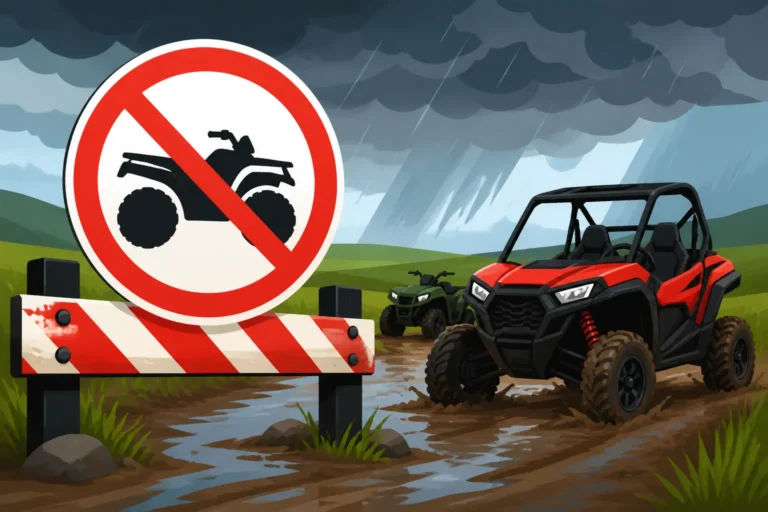
Before leaving, check the forecast and conditions for the riding area rather than relying only on what the weather looks like at home. A clear morning can become hot and uncomfortable by midday. Dust, strong winds, storms, and recent rain can also affect visibility and trail conditions. Review [North Dakota Trail Status by App and Phone] and [North Dakota Trails Closed by Wet Weather] as part of your planning, and follow any posted closure or access information.
Make a plan for changing conditions, not just the conditions you hope for. Decide in advance what would make your group pause, shorten the route, or head back. If you’re riding in a remote area, tell someone who isn’t on the ride where you’re going and when you expect to return. A sensible turnaround time is more useful than a vague promise to “be back later.”
Start early and leave room to adjust
An early start can reduce the amount of riding you do during the hottest part of the day. It also gives you more flexibility if a machine needs attention, someone wants a longer rest, or the group discovers that the route is more exposed than expected. Don’t treat an early start as permission to skip breaks; riders can become dehydrated or fatigued before they notice how much the conditions are affecting them.
Set a realistic pace and include stops in your plan. A group that’s racing from one point to the next may miss early signs of discomfort, especially when riders are focused on keeping up. Agree that anyone can call for a stop, and check in with one another when you pause. For seasonal planning, [North Dakota Riding Season Month by Month] can help you think about how summer fits into the wider riding year.
| Planning choice | Why it helps in the heat | A practical approach |
|---|---|---|
| Start earlier | Can limit exposure during the hottest part of the day | Set a clear departure time and don’t skip preparation |
| Choose a shorter route | Leaves room for breaks or an early return | Pick a turnaround point before you start |
| Check current conditions | Helps identify closures, weather issues, or access changes | Review the riding area’s latest information before driving out |
| Tell someone your plan | Gives a person off the ride a way to notice a delayed return | Share your route, group details, and expected return time |
| Agree on a stop signal | Makes it easier to speak up before someone is exhausted | Let any rider request a pause or turnaround |
Pack for water, sun, and a remote stop
Carry more water than you expect to need
Water is easy to underestimate when you’re planning around mileage instead of time. A delayed group, a wrong turn, a mechanical problem, or a slower-than-expected trail can stretch a short ride into a much longer outing. Carry drinking water for every rider, keep it reachable, and bring extra for the possibility that the ride doesn’t go exactly to plan.
Avoid relying on a single shared container that’s difficult to reach or that could be lost with a machine. Give each rider their own supply, and keep backup water secured separately. Make regular drinking part of the group’s routine rather than waiting for someone to announce they’re thirsty. If a rider has individual health needs, they should plan hydration with guidance suited to their circumstances.
Consider what happens if you have to stop for a while. Water left in direct sun can become unpleasant to drink, and a small personal bottle may not be enough for a long delay. Pack supplies in a way that makes them easy to access while parked safely, not buried under tools and riding gear. For routes with long distances between services, read [Fuel Range Between Small Towns] alongside your water and fuel planning.
Protect riders from sun and wind
Wear protective riding gear, but think about comfort and ventilation as well as coverage. A helmet, gloves, eye protection, and suitable clothing are important riding equipment; sun protection should fit safely with that gear. Use sunscreen on exposed skin and reapply it as directed on the product label, especially after sweating. A neck covering or lightweight layer can help protect areas that may otherwise be exposed, as long as it doesn’t interfere with helmet fit, vision, or safe operation.
The prairie wind can complicate things. It may dry sweat quickly, making it harder to notice how much fluid you’re losing, and dust can irritate eyes and skin. Eye protection should be appropriate for the conditions and kept clean enough for clear vision. Take a moment to check that everyone’s gear is still comfortable after a break; a rider who is overheated or struggling to see clearly should not feel pressured to continue.
Keep clothing choices practical for the ride rather than assuming that less fabric will always feel better. Sun-exposed skin can become painful, and loose items can create a safety problem around moving equipment. Secure scarves, straps, and layers, and follow your machine’s safety guidance. If someone is uncomfortable in their gear, stop somewhere safe and make adjustments before riding again.
Carry a simple emergency kit
A summer kit should account for both routine needs and the possibility of a delay. Pack a charged phone, a backup way to contact help if appropriate for the area, a first-aid kit, basic tools, and enough food and water to manage an unexpected stop. Keep essential supplies secured and protected from dirt, vibration, and direct sun where possible.
Navigation deserves special attention in places where cell service may be unreliable. Download maps or route information before leaving coverage, and don’t assume a phone will provide directions everywhere along the ride. onX Offroad can be one navigation tool to consider when you’ve checked that the maps you need are available for offline use. Carry a backup navigation method and let your group know how you’ll recognize key turns or the route back.
Before the group sets out, make sure every rider knows where the emergency supplies are and who is carrying them. A first-aid kit is only helpful if someone can reach it. A map is only useful if riders can read it, and a phone is less useful if its battery is nearly empty. For additional preparation ideas, see [First Aid on a Remote Loop] and [North Dakota Riding Areas With Cell Service].
Spot heat trouble early and respond safely
Watch for changes in a rider’s behavior
Heat-related trouble doesn’t always begin with a dramatic collapse. A rider may first become unusually tired, irritable, distracted, unsteady, or slow to respond. They might complain of feeling weak or develop a headache, nausea, dizziness, or heavy sweating. These signs can be easy to miss when everyone is focused on the trail, which is why riders should check on one another during breaks rather than asking only, “Are you okay?”
Pay attention to changes from that person’s normal behavior. Someone who usually keeps up but is suddenly falling behind may need a break, water, or a decision to end the ride. Don’t assume that a rider is merely out of shape or being difficult. Stop in a safe place, get them out of direct sun if possible, and take the situation seriously.
If a rider seems confused, faints, has a seizure, or appears seriously ill, treat it as an emergency. Contact emergency services and follow their instructions. Move the person to a safer, cooler place if you can do so without creating another hazard, and don’t leave them alone. When in doubt about severe symptoms, seek urgent medical help rather than trying to push through the ride.
Take breaks that actually help
A quick stop beside the trail may not be enough if everyone remains in direct sun with helmets and gear on. Choose a safe place to park, switch off the machines, and give riders a chance to rest in shade when available. Remove or loosen gear only when it’s safe to do so, and keep riders away from traffic or moving equipment. The goal is to make the break restorative, not simply to pause the odometer.
Use stops to look at the group, not only the machines. Ask riders whether they feel well, check that everyone has water, and decide together whether the planned route still makes sense. If a person needs more time than the rest of the group, the group should wait or make a safe plan for returning together. Leaving someone behind to catch up is a poor choice when heat, fatigue, and navigation problems may already be building.
Give yourself permission to end the ride early. People often keep going because they’ve driven a long way to reach the trail or because they don’t want to disappoint the group. But arriving home safely matters more than completing every planned mile. A shorter ride is still a good day out if everyone returns in good shape.
Keep navigation and group communication simple
Before you start, identify the person leading, the person bringing up the rear, and a way to regroup if the group gets separated. Agree on what to do if someone stops, how long the group will wait at a turn, and who makes the call to head back. These small decisions reduce confusion when riders are tired or visibility is poor.
Use navigation as a backup to good group habits, not as a substitute for them. If you use onX Offroad, save the relevant map or route information before leaving service and make sure everyone understands the planned route. Don’t rely on one rider’s phone as the group’s only navigation plan. Devices can lose power, become difficult to use in bright light, or be separated from the group during a mechanical issue.
Keep conversations brief and clear when conditions are tiring. At each stop, confirm the next destination, check that all riders are present, and remind the group of the turnaround plan. For useful expectations around sharing space and looking out for others, read [North Dakota Trail Etiquette Locals Expect].
Decide when to ride, shorten the route, or stay home
Use a simple go-or-no-go check
Before unloading, consider the forecast, the riding area’s condition, the experience and health of the group, and the length of the route. Ask practical questions: Is there enough water for the planned ride and a delay? Does everyone have suitable gear? Can the group shorten the route? Is there a way to contact help if something goes wrong? If several answers are uncertain, change the plan before you leave.
A ride can also be a no-go when conditions create problems beyond heat alone. Strong wind can make communication and visibility harder, while dust or smoke may affect breathing or sight. Recent rain can leave some riding surfaces vulnerable to damage or closure. Check access information instead of assuming a favorite route will be open just because it was open on your last visit.
A useful plan has three versions: the ride you hope to take, a shorter option, and a clear decision to postpone. That way, scaling back doesn’t feel like a failure. If the forecast or conditions worsen, you can switch plans without negotiating from scratch at the trailhead.
Make the ride easier on the whole group
If children, newer riders, or people with different comfort levels are coming along, plan around the person who needs the most support. Choose a route and pace that give everyone room to rest, and make sure younger riders understand how to ask for help or report feeling unwell. Don’t let group enthusiasm push a less experienced rider into continuing when they’re struggling.
For a larger group, identify a few planned regrouping points and keep the ride manageable. Separate machines can throw dust at one another, and gaps can grow when the leader rides faster than the rest of the group. Pause often enough to maintain contact and make sure nobody has been left behind. Follow local trail rules, posted instructions, and any instructions from land managers or staff.
Navigation apps can help riders understand a route, but they don’t replace checking access rules or conditions. If onX Offroad is part of your planning, use it alongside current trail information and a group plan that everyone understands. The best summer ride isn’t the one with the longest track on a screen; it’s the one where the group has enough flexibility to enjoy the day without ignoring warning signs.
Disclaimer
This article is for general informational purposes only and does not constitute professional advice. Laws, prices and regulations vary by location and change over time. Consult a qualified professional for guidance on your specific situation.