Gates on a Grassland Road
A gate across a North Dakota grassland road can make a ride feel uncertain: is the route closed, is livestock loose, or are you expected to open it? The safest approach is to check that the road is open to your machine, read every sign, and treat the gate as part of the route—not an obstacle to get around. This guide explains what to do before and after you reach one.
Check that the grassland road is open
A gate does not tell the whole story
A gate may be there to manage livestock, protect a road during wet conditions, or mark a boundary. Its presence alone does not always tell you whether public motorized travel is allowed. Look for posted signs, closure notices, and other restrictions before deciding to ride through. If a sign says the route is closed or prohibits your type of vehicle, do not proceed—even if the gate is open.
The reverse is true, too: an open gate is not automatically an invitation to ride. A route can still be closed to motor vehicles, restricted to certain users, or unavailable because of a temporary order. In the Little Missouri National Grassland and other managed areas, check the designated motorized routes rather than assuming that every visible two-track is open. North Dakota Grassland Motor Vehicle Use Maps explain why the map matters, while Reading a Grassland Vehicle Use Map can help you interpret the routes shown there.
This distinction is particularly useful when a road appears to continue across open prairie. A visible track might be an authorized grassland road, a private access lane, or a route that is not open to wheeled cross-country travel. Stay on routes designated for motorized use, and do not make a new path around a gate or across grassland to get where you are going. North Dakota Cross-Country Travel Is Banned covers why riding off designated routes can create trouble for both the land and the rider.
Read signs and check for temporary closures
Pause before the gate and read every sign you can see. Pay attention to wording about vehicle types, seasonal restrictions, private property, road closures, or livestock access. A restriction may apply to the road beyond the gate, not just the gate itself. If the sign is damaged or hard to read, do not guess based on what other riders appear to be doing.
Road conditions can change quickly. Rain may make clay or gumbo surfaces vulnerable to deep ruts, and agencies may close routes to prevent damage. A road that was passable on a previous trip may not be open or suitable today. Check the relevant grassland information and route map before leaving, then reassess when you arrive. For wet-ground considerations, see North Dakota Trails Closed by Wet Weather and Tread Lightly on Wet Clay.
If you use a navigation app, treat it as a planning aid rather than the final word on access. onX Offroad can help you review mapped routes and orient yourself, but you should still compare what you see in the field with posted signs and the applicable motor vehicle use map. App coverage, route status, and ground conditions are not substitutes for current closure information.
What to do when you reach a gate
Stop, look, and give the area a moment
Slow down well before the gate. Stop in a place where you are not blocking the road, and look for cattle, horses, wildlife, other riders, or vehicles approaching from the opposite direction. Dust, tall grass, or a bend can hide what is on the other side. Give animals room and avoid revving the engine or sounding a horn unnecessarily; startling livestock can cause them to scatter or crowd the road.
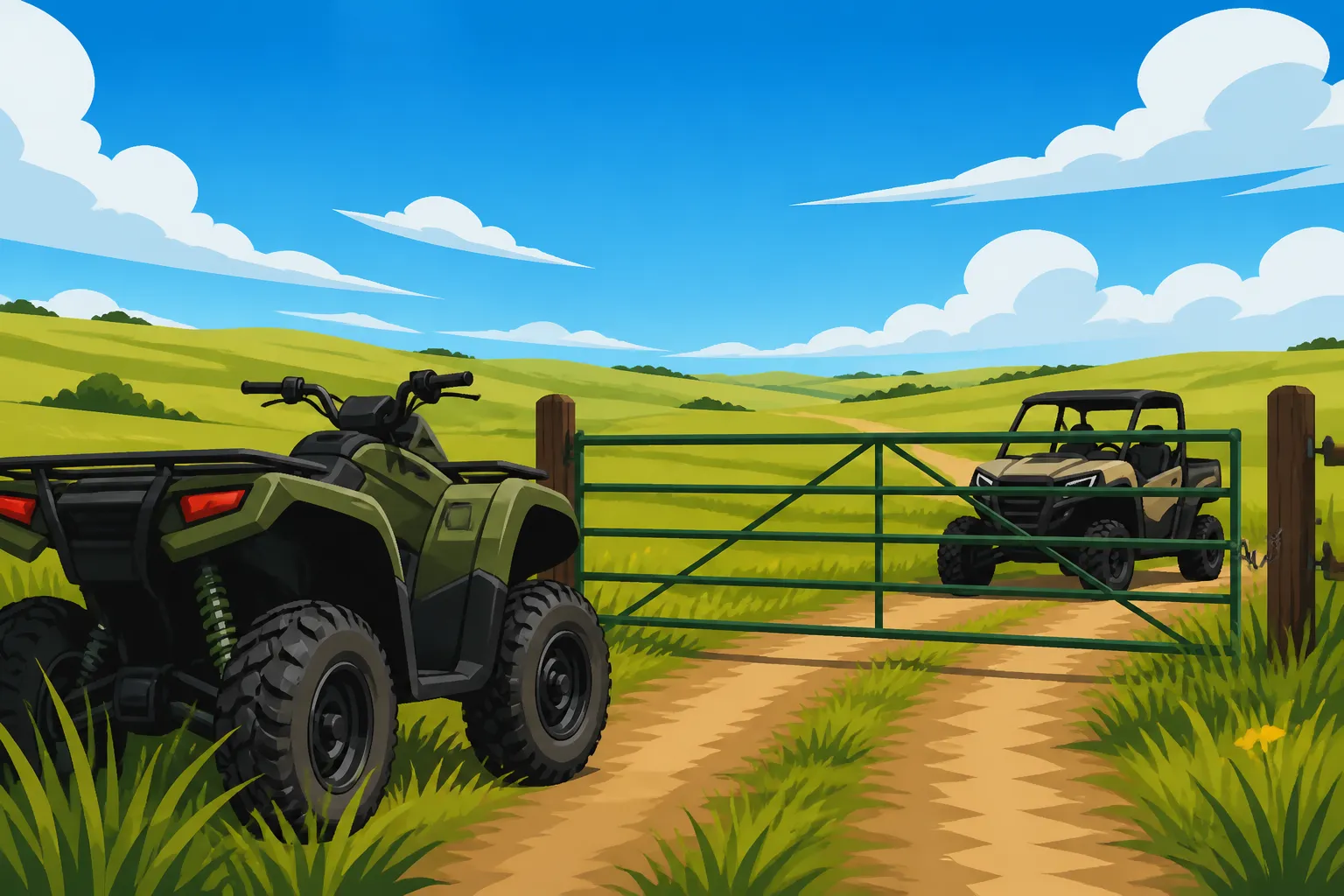
Before touching the gate, check whether there is a sign, latch, chain, or instruction. Do not climb over it, force it, cut a lock, or squeeze your ATV or UTV around the side. A gate may be protecting livestock or marking property access, and bypassing it can cause damage or put you on a route you are not allowed to use. If it is locked or clearly marked as closed, turn around and choose an authorized route.
A cattle guard is different from a gate, but it still calls for care. Approach slowly, ride straight across, and avoid sharp turns or stopping on the bars. If livestock are immediately beside it, wait for them to move away rather than pushing through the group. Cattle Guards and Open Range offers more context for sharing a route with livestock.
Follow the gate’s position and posted instructions
When a gate is clearly intended for public passage and there are no signs or locks indicating otherwise, the practical rule is to leave it as you found it. If it was closed, open it only as needed to pass, then close and secure it behind you. If it was open, leave it open unless a sign or instruction says otherwise. A gate left open or closed in the wrong position can let animals out—or trap them away from where they need to be.
For a UTV, have one person operate the gate while the other riders wait in a safe place. Keep the machine stable, avoid blocking the road longer than necessary, and make sure the latch is secure before moving on. For an ATV, dismount only if it is safe to do so and you can keep the machine under control. Don’t leave a running vehicle unattended on a slope or where it could roll.
| What you find | Sensible next step |
|---|---|
| Gate is closed, route is open, and passage is clearly permitted | Open it carefully, pass through, and close and secure it behind you |
| Gate is open and passage is permitted | Leave it open unless posted instructions say otherwise |
| Gate is locked or marked closed | Do not bypass it; turn around |
| Signage is unclear or missing | Stop, avoid forcing the gate, and confirm access before proceeding |
| Livestock are crowding the gate or crossing | Wait at a safe distance until the animals move clear |
Share the route responsibly
Keep livestock and land in mind
A gate is a reminder that a grassland road may serve more than one purpose. Ranchers, land managers, and other visitors may depend on it for access, while livestock may move freely across the area. Keep your speed low near animals, give them space, and avoid chasing or splitting a herd. If cattle are blocking the route, waiting a few minutes is usually safer than trying to push through.
Be especially cautious when the route runs past open range or through a gate that leads into a large pasture. Livestock can be difficult to see in grass or around a bend, and young animals may react unpredictably to an approaching machine. If you are traveling in a group, keep the group compact enough to manage the gate but leave room for animals and other road users. North Dakota Trail Etiquette Locals Expect is also useful when planning how to share riding areas respectfully.
After rain, keep an eye out for soft shoulders and damaged surfaces near gates. Repeatedly driving around a muddy spot can widen the road and damage vegetation. If the route is too soft to cross without making ruts, turn around rather than forcing your way through. Carrying a tow strap can be sensible on remote rides, but recovery gear is not a reason to enter a closed or fragile route. North Dakota Riding After Heavy Rain explains why conditions deserve extra attention.
Avoid assumptions about roads, trails, and property boundaries
A road on a grassland map is not necessarily the same thing as a recreational trail. Follow the route designation and any machine-specific restrictions, including width limits where they apply. A side-by-side that physically fits through a gate may still be too wide for a designated route or prohibited by a posted restriction. Check the map and signs before setting out, especially if your group includes different machine types.
Property boundaries can be hard to recognize on open prairie. A gate, fence, or cattle guard may mark an access point, but it does not by itself establish that the road beyond is open to public riding. Use designated-route information and posted instructions together. Do not cut across a field, follow an unmarked track, or treat an unlocked gate as proof of permission.
For trip planning, onX Offroad may help you compare your intended route with mapped roads and identify nearby alternatives. Carry an offline map or another navigation option as well, since cell service can be limited in parts of the Badlands. If a gate or sign on the ground contradicts what you expected from a digital map, stop and follow the posted restriction while you verify the route.
A practical gate-by-gate routine
Before you ride
Start by identifying the area and the road you plan to use. Check the relevant motor vehicle use map and look for current closure information. Make sure your machine is allowed on the route, and note any width or seasonal restrictions. If you are unsure whether a route is public or open, choose a confirmed route rather than relying on a guess.
Plan a turnaround option before you leave. Grassland routes can be remote, and a closed gate may mean you need to retrace your route rather than take a nearby track. Share your general plan with someone, bring water and basic recovery supplies, and keep navigation available if your phone loses signal. Use onX Offroad or another mapping tool to prepare, but verify access with official route information and signs where you ride.
If the route is muddy, visibility is poor, or a storm has changed the ground, reconsider the trip. North Dakota prairie weather can shift quickly, and wind, dust, and wet clay can make a simple ride more demanding than expected. A short delay or a different riding area is better than damaging the route or getting stranded beyond a gate.
At every gate
Use the same routine each time, even if the first gate was straightforward:
- Slow down and stop clear of the gate.
- Read all signs and check for locks, chains, and instructions.
- Look for livestock, other riders, and approaching vehicles.
- Confirm that the route is open to your machine.
- Pass only if access is clearly permitted.
- Leave the gate in the position you found it, unless posted directions say otherwise.
- Check the latch and make sure the gate is secure before continuing.
If something does not add up—a locked gate on a mapped route, conflicting signs, or livestock that cannot be moved safely—do not force a solution. Turn around or contact the appropriate land manager or local authority for clarification. It may be inconvenient to change plans, especially after hauling your ATV or UTV a long way, but a gate is never worth damaging property, risking an animal’s safety, or riding into a restricted area.
The simplest habit is also the most reliable: confirm the road, obey the sign, and leave the gate exactly as the land manager or livestock operation expects. That makes the route safer for the next rider, the people working the land, and the animals that call it home.
Disclaimer
This article is for general informational purposes only and does not constitute professional advice. Laws, prices and regulations vary by location and change over time. Consult a qualified professional for guidance on your specific situation.