North Dakota HB 1346 and the 2025 Penalty Increase
You got pulled over on a gravel road outside Mandan, or a deputy waved you out of a ditch near Minot, and the number on the citation is not what your buddy told you it would be. That surprise is exactly what the 2025 penalty increase created for a lot of riders. This guide walks through what House Bill 1346 changed, what a ticket costs now, and how to stay out of trouble in the first place.
What House Bill 1346 Actually Changed
When North Dakota lawmakers met for the 2025 session, off-highway vehicle enforcement was not a headline issue. Most riders never heard the bill number until somebody at the coffee shop started complaining about a bigger fine. But the change matters, because for years a basic OHV violation in this state was cheap enough that some people treated it as a cost of doing business. HB 1346 was the Legislature’s way of saying that era is over.
The Short Version for Busy Riders
The core of the bill is simple: the standard fee for a basic off-highway vehicle violation went up to $50. That covers the everyday stuff that used to draw a small fee, like riding without current registration, operating where the machine is not allowed, or missing required equipment on a roadway. The site has a dedicated breakdown in A Basic OHV Violation Now Costs $50 if you want the citation-by-citation detail.
The second piece that most riders like is the registration incentive. If you get cited for riding an unregistered machine and then go register it, the penalty is cut in half. Lawmakers built that in on purpose. The goal is not to squeeze money out of farmers riding to a field; the goal is to get machines onto the books so the trail tax gets paid and the state knows who owns what. The mechanics of that discount are covered in Half Price If You Register Afterward.
The third piece is less about dollars and more about attitude. Officers and county state’s attorneys now have a fee that is large enough to actually get attention, and that changes how often warnings turn into written citations. Several riders I have talked with in the western part of the state said the warning culture faded noticeably after the new amount took effect.
Why the Legislature Bothered
North Dakota has an unusual riding situation. Unlike Minnesota, with its huge network of grant-funded trails, North Dakota has only a handful of dedicated OHV areas, so most riding happens in road ditches, on section lines, on gravel roads and on private ground. That means riders and motorists share space constantly, and every complaint about a quad tearing up a back-slope or running a stop sign lands on a county commissioner’s desk.
Before the change, the basic fee was small enough that it did very little to discourage repeat behavior. Sheriffs in counties like Burleigh, Ward and Williams heard the same complaints season after season. Raising the fee was a low-drama fix that did not require rewriting the ditch-riding rules, the road-legal equipment list, or the registration system itself. If you want to see the broader picture of what else moved that session, North Dakota Rules That Changed With HB 1346 gathers the related changes in one place.
There is also the money side. Registration in this state is a $5 registration fee plus a $15 trail tax, paid every two years, and that trail tax is what funds the trail system and OHV safety programs. Every unregistered machine is $15 missing from that pot per cycle. A half-price deal for registering after a ticket nudges those riders back into the system, which is why lawmakers paired the higher fee with the discount instead of just raising the number.
What Did Not Change
It is worth being clear about what HB 1346 left alone, because rumors spread fast in rural communities. The bill did not ban ditch riding. The legal right to ride the ditch bottom and back-slope is still there, and the inslope and shoulder are still closed to OHVs. The bill did not change the 350cc minimum for road-legal machines, did not change the helmet requirement for riders under 18, and did not touch the rule that interstates are never open to OHVs.
It also did not turn serious offenses into small ones. Drunk riding, reckless operation, and trespass on posted land are still handled under their own criminal statutes. A $50 fee is the floor for routine violations, not a ceiling for everything you can do wrong on a machine.
Finally, the bill did not change who can write you a ticket. County deputies, city police, highway patrol troopers and game wardens all still have authority depending on where you are riding. A warden checking hunters near Devils Lake can cite an OHV violation just as easily as a deputy on a county road.
How the Penalty Structure Works Now
Understanding a North Dakota OHV citation means understanding that there are really three tiers. Most riders only ever see the bottom one, but you should know where the lines are, because a bad afternoon can move you up a tier quickly.
Noncriminal Fees Versus Criminal Charges
The basic OHV violation is handled as a noncriminal offense with a set fee. You can typically pay it without appearing in court, the same way you would handle a minor traffic ticket. That is the $50 tier, and it is where the vast majority of OHV enforcement lands.
Above that sits the criminal tier. Some OHV-related conduct is charged as a misdemeanor instead of a fee. Reckless operation, operating while impaired, and certain trespass situations fall into this category. A Class B misdemeanor in North Dakota carries a maximum of 30 days in jail and a $1,500 fine, and a Class A misdemeanor carries up to 360 days and $3,000. Our explainer What a Class B Misdemeanor Means in North Dakota walks through what a record like that does to you long after the fine is paid.
The third piece is everything attached to the citation itself. Court costs, administrative fees and, for some offenses, points or license consequences can stack on top of the base amount. A $50 fee is rarely the full amount a rider ends up paying once those extras are included.
A Side-by-Side Look at Common Violations
Here is a practical way to think about what typically happens with the most common situations riders run into. Exact outcomes depend on the officer, the county and the facts, so treat this as a map of the territory rather than a promise.
| Situation | Usual Category | What Typically Follows |
|---|---|---|
| Riding with expired or no registration | Noncriminal fee | $50 basic fee, halved if you register afterward |
| Missing required road equipment like a mirror or horn | Noncriminal fee | $50 basic fee and a fix-it expectation |
| Riding on the inslope or shoulder | Noncriminal fee | $50 basic fee |
| Riding a paved road posted above the allowed limit | Noncriminal fee | $50 basic fee, possibly more if speed is involved |
| Rider under 18 without a helmet | Noncriminal fee | $50 basic fee, often a conversation with parents |
| Operating on an interstate right of way | Noncriminal fee or more | $50 basic fee at minimum, more if traffic was endangered |
| Reckless operation | Criminal misdemeanor | Court appearance and possible jail time |
| Riding impaired | Criminal offense | Same consequences as a vehicle DUI |
| Riding posted land without permission | Criminal trespass in many cases | Court appearance and possible civil liability |
The thing to notice is how many everyday mistakes land in that first category. Most riders are not reckless or impaired. They are just missing a mirror, running a registration that lapsed last December, or drifting onto a shoulder to dodge a culvert. Those mistakes now carry a real price.
Court Costs and the Real Total
When people complain that their ticket cost far more than $50, they are usually right, and court costs are the reason. Depending on the county and whether the case is contested, administrative and court fees can add a meaningful amount to what you pay. The clerk of the court named on your citation can tell you exactly which charges apply in that county.
If you contest a citation and lose, the costs typically climb, because now there is a hearing involved. That is not a reason to roll over on a ticket you believe is wrong, but it is a reason to think carefully before you fight a citation for something you actually did.
There is also the time cost. A rider from Williston who gets cited at Kimball Bottoms south of Bismarck and decides to contest it may be looking at a long drive for a hearing. Many people decide, reasonably, that paying the fee and fixing the problem is the cheaper option.
Registration Violations and the Half-Price Fix
Registration is where the new law bites most often, and it is also where the law is most forgiving if you respond the right way. Here is how that plays out in practice.
Why Unregistered Riding Is So Common
North Dakota registrations run on a two-year cycle and expire on even years, which surprises plenty of owners. You buy a machine in March of an odd year, you register it, and then less than a year later it expires because the whole state rolls over at once. A lot of people get cited not because they were dodging the system, but because they had no idea the cycle ended.
Then there is the farm problem. Thousands of quads in this state never leave the home place, and machines used only on private land are exempt from registration. But the moment that machine runs down a section line or crosses a gravel road to reach a neighbor’s field, it is on public right of way and the exemption no longer applies. If you are not sure where your machine stands, Do You Need to Register an ATV in North Dakota? lays out who has to register and who does not.
Visitors are a third source of trouble. Out-of-state riders who stay longer than 30 days, or who ride without the required non-resident permit, get cited in places like Pembina Gorge and the Turtle Mountains every season. The state has no reciprocity with neighboring states, so a Minnesota or Montana sticker is not a substitute for a North Dakota permit.
How the Half-Price Discount Works in Practice
The idea behind the discount is straightforward: if you get cited for operating an unregistered OHV and then bring the machine into compliance by registering it, the penalty is reduced by half. On a $50 basic fee, that means $25. Combined with the $20 you pay for a two-year registration, you end up in roughly the same financial spot as if you had registered in the first place, minus a little hassle.
Here is the practical sequence most riders follow after a registration citation:
- Read the citation carefully and note the deadline for responding or paying.
- Gather your title or proof of ownership, since you will need it at the branch.
- Visit a motor vehicle branch or use the state’s online system to register the machine and pay the $5 registration fee plus the $15 trail tax.
- Keep the registration receipt, because it is your proof that you came into compliance.
- Follow the instructions on the citation or contact the court listed on it to ask how to submit proof of registration for the reduced amount.
- Pay the reduced fee before the deadline so it does not turn into a missed-payment problem.
The key detail is timing. Do not wait until the day before your response deadline to start the registration process, especially if your title paperwork is incomplete. A machine with a missing title or a VIN problem can take far longer to register than a simple renewal.
When the Discount Will Not Save You
The half-price fix only applies to the registration piece. If you were cited for multiple things at once, such as an unregistered machine plus riding on a shoulder plus a passenger without a helmet, registering afterward reduces only the registration penalty. The other violations stand on their own.
The discount also does not help if you cannot actually register the machine. Homemade machines, machines with no paperwork, and machines with a damaged or missing VIN all need extra steps before they can be titled and registered. Our guide to North Dakota Penalties for Riding Unregistered covers what happens when compliance is not quick.
And of course, if the officer finds something more serious during a stop, like an open container or evidence that the rider is impaired, the registration discount becomes the least of your worries.
Road-Legal Equipment and the Stops It Triggers
A large share of OHV stops in North Dakota start with an equipment problem. The officer sees a machine on a gravel road at dusk without a working headlamp, or a quad on a paved county highway with no mirror, and that is all the reason needed to pull it over. With a $50 fee now attached, equipment shortcuts are expensive.
What a Machine Needs to Be on a Roadway
North Dakota’s road-riding rules require more than just registration. To operate on a roadway, an OHV generally needs equipment that makes it visible and controllable around traffic. The full list is in North Dakota Equipment Required on a Roadway, but the items that come up most often at stops are these:
| Equipment | What North Dakota Expects |
|---|---|
| Engine size | At least 350 cubic centimeters for road operation |
| Speed capability | Able to reach at least 30 mph |
| Mirror | At least 10 square inches of reflective surface |
| Horn | Audible from at least 200 feet |
| Headlamp | Visible from at least 300 feet |
| Brake light | Working brake light at the rear |
| Speedometer and odometer | Reading in miles per hour |
| Muffler | Working muffler in good condition |
Most stock utility quads and side-by-sides sold by dealers in Fargo or Bismarck come with headlights and taillights, but many do not come with a horn, a mirror, or a speedometer that reads in miles per hour. That gap is exactly where riders get caught.
The 350cc Floor and Why It Trips People Up
The 350cc minimum is one of the most misunderstood rules in the state. A small youth quad or a 250cc sport machine can be perfectly legal on a trail or in a ditch, but it cannot legally run down a roadway. That matters for families who send a teenager on a smaller machine to the neighbor’s place.
There is no conversion path either. You cannot bolt on mirrors and lights and make a 250cc machine road-legal. If the motor is under the floor, the machine stays off the roadway. The full explanation is in North Dakota’s 350cc Minimum for Road Riding, and it is worth reading before you buy a smaller machine with plans to use it on gravel roads.
Picture a common scenario. A family near Grand Forks buys a used 300cc quad for their 16-year-old to use on the farm and in the ditches. One afternoon, the teen takes the gravel road to a friend’s place half a mile away. A deputy sees it, stops it, and the teen ends up with a citation for operating on a roadway with a machine below the engine minimum. Under the new fee structure, that one shortcut costs real money and an awkward conversation at the kitchen table.
Upgrading Your Machine Without Overspending
If you have a machine above 350cc that can hit 30 mph, getting it road-ready is usually a matter of adding a few parts. Aftermarket companies like SuperATV sell mirrors, horn kits and lighting upgrades designed to fit popular utility quads and side-by-sides, and checking their fitment guides for your exact model saves a lot of trial and error. Prices vary by kit and model, so compare current listings before you order.
When you add equipment, think about how it will survive North Dakota conditions. Gumbo mud, gravel dust and January cold are hard on cheap mirrors and wiring. A mirror mount that vibrates loose on a washboard section road is not much help during a traffic stop. Many riders pick up a heavier-duty mount from SuperATV or a similar supplier rather than relying on a universal clamp from a discount bin.
Here is a simple pre-season checklist for getting a machine road-ready:
- Confirm the engine displacement is at least 350cc using your owner’s manual or the manufacturer’s spec sheet.
- Test top speed on private ground to make sure the machine can reach 30 mph.
- Install a mirror with at least 10 square inches of reflective surface, positioned so you can actually see behind you.
- Add a horn and test it from 200 feet away with a helper.
- Check that your headlamp is aimed properly and visible from 300 feet at dusk.
- Confirm the brake light works every time you apply the brakes, and if the stock unit is weak, consider a brighter replacement such as the lighting kits SuperATV sells for many side-by-sides.
- Make sure the speedometer reads in miles per hour, not just kilometers per hour.
- Inspect the muffler for holes, rust-through or a missing spark arrester.
Where You Can Ride and Where Tickets Happen
North Dakota is unusual because so much legal riding happens along public roads. That means the line between legal and illegal is often just a few feet of grass. Knowing exactly where that line sits is the cheapest way to avoid a $50 fee.
Ditch Bottoms, Back-Slopes and the Closed Zones
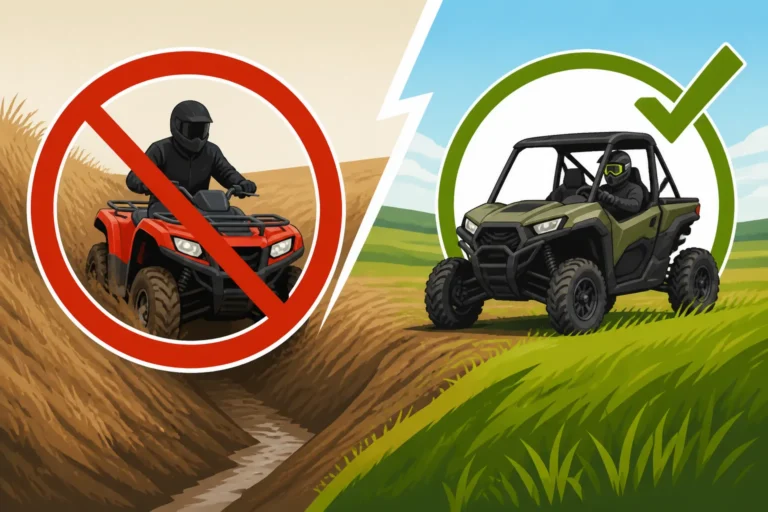
The basic rule is that OHVs may operate in the ditch bottom and on the back-slope of a road right of way, but not on the inslope or the shoulder. The inslope is the slope that runs from the edge of the road down into the ditch; the back-slope rises from the ditch bottom up toward the fence line.
The exception is obstruction. If the ditch is blocked by water, a culvert, a field approach or something else that makes it impractical to keep riding, you may briefly cross onto the shoulder or roadway to get around it, then return to the ditch. The key word is briefly. A rider who uses a flooded ditch as an excuse to run a mile down the shoulder is going to have a hard time explaining that to a deputy.
Here is a quick comparison of the common right-of-way zones:
| Zone | Open to OHVs? | Notes |
|---|---|---|
| Ditch bottom | Yes | The main legal riding area in the right of way |
| Back-slope | Yes | Open, but watch for fences and approaches |
| Inslope | No | Closed except for brief obstruction crossings |
| Shoulder | No | Closed except for brief obstruction crossings |
| Interstate right of way | No | Never open, except in emergencies |
| Railroad bed | No | Closed to OHV riding |
Gravel and Paved Roads
Registered, road-legal machines may operate on many gravel roads, and on paved roads posted at 55 mph or less. Class III machines, which are the larger side-by-sides with steering wheels, have additional allowances on roads posted up to 65 mph in some situations. The details for each surface are laid out in North Dakota ATV Road Rules by Surface Type.
The trap riders fall into here is assuming that because a gravel road is legal, every road in the county is legal. Counties and cities can restrict OHV operation on roads they control, and some do. A route that is fine in one county might be closed the moment you cross into the next one.
Picture a rider leaving a farm near Hazen and heading toward Lake Sakakawea. The first several miles are county gravel roads that are open. Then the route meets a paved state highway posted above 55. Crossing that highway at an intersection is generally permitted when done correctly, but riding along it is not. That single stretch is where a ticket happens.
Interstates, Railroad Beds and Night Riding
Interstates are never open to OHV riding. That includes the right of way along I-94 and I-29, not just the travel lanes. Unless there is a real emergency, there is no reason for an OHV to be anywhere in that corridor. Railroad beds are also closed, which matters for riders who see an abandoned-looking grade and assume it is open.
Night riding brings its own rules. After dark, riders in the ditch are expected to travel in the same direction as the adjacent lane of traffic. That way, drivers coming toward you are not blinded by your headlamp shining at them from the ditch. A rider going the wrong way after dark is not just risking a ticket; they are creating a real hazard.
Riding at night also magnifies equipment problems. A headlamp that is barely adequate at dusk becomes inadequate in full darkness, and a missing brake light is invisible to the truck behind you. Many of the equipment stops I hear about happen between sunset and 10 p.m. during harvest season.
Helmets, Passengers and Young Riders
Families make up a big share of North Dakota’s riding community, and youth riders account for a lot of citations. The rules are not complicated, but they are strict, and the new fee makes them harder to ignore.
The Under-18 Helmet Rule
North Dakota requires riders under 18 to wear a helmet. The helmet needs to meet the DOT standard, which rules out the cheap novelty helmets you sometimes see at farm stores. Adults are not required to wear one under state law, but most experienced riders do anyway. The details are in North Dakota Helmet Law for Riders Under 18.
The fee for a helmet violation is now the same $50 basic fee. Some deputies use helmet stops as a chance to talk with parents, especially in rural areas where everyone knows each other. But do not count on a warning, especially in counties where youth injuries have been in the local news.
The practical answer is to make the helmet non-negotiable. Keep a properly fitting helmet hanging on the machine or right next to the shop door. Kids grow quickly, so check fit every spring. A helmet that fit a 12-year-old last year might be dangerously loose or uncomfortably tight this year.
Passenger Rules
Passengers are only allowed when the manufacturer designed the machine to carry one. Most single-rider utility quads are not built for passengers, and putting a second person on the rear rack is both a safety problem and a citation waiting to happen. Two-up quads and side-by-sides with passenger seats are fine when the passenger is in an actual seat.
This is one area where the fee is the least of the risk. A single-rider quad with a passenger behaves very differently on a slope, especially on a ditch back-slope. The center of gravity shifts back, steering gets lighter, and rollovers become much more likely.
Safety Certificates and Age Thresholds
North Dakota offers OHV safety certification starting at age 12, and young riders without a driver’s license need that certificate for many types of riding off their family’s land. The rules shift at different ages, and the interaction between the statute and agency guidance can be confusing. Kids who are 16 and have a driver’s license have more freedom than younger riders.
If a young rider is stopped without a required certificate, that can be cited as well. Carrying the card on the machine is the easy fix, since an officer may ask to see it. The online course is available for families who cannot easily make it to a classroom session in Bismarck or Fargo.
Insurance, DUI and the Higher-Stakes Violations
Not every OHV violation lands in the $50 tier. Some carry consequences that can follow a rider for years, and it is worth understanding them before you are ever in that position.
Insurance Off Your Own Land
When you ride an OHV off your own property, North Dakota expects you to carry liability coverage. The minimum limits commonly cited are 25/50/25, meaning $25,000 for one person’s injuries, $50,000 for all injuries in one accident, and $25,000 for property damage. Our guide to North Dakota ATV Insurance Requirements covers what proof to carry and how coverage typically works.
Riding uninsured is not just a fee issue. If you hit a vehicle at a field approach or cause an injury, you are personally on the hook for the damages. That can mean tens of thousands of dollars or more, which makes a $50 fee look like nothing.
Insurance pricing varies widely depending on the machine, where you keep it, your record and the carrier, so get quotes from a few agents. Many farm policies cover some OHV use on the property but not on public roads, so confirm before you assume you are covered.
Riding Impaired
Operating an OHV while impaired is treated seriously in North Dakota. The same blood alcohol thresholds and implied consent rules that apply to cars generally apply to OHVs on public roads and rights of way. A DUI on a quad can affect your driver’s license just as a DUI in a pickup would. The details are in North Dakota DUI Rules for OHV Riders.
This is where riders sometimes make a costly assumption. Riding a ditch home from the bar or a neighbor’s party feels different from driving a truck, but legally it often is not. And because OHVs offer so little crash protection, an impaired rider is far more likely to be seriously hurt.
The practical takeaway is simple. If you have been drinking, leave the machine where it is and get a ride. Picking it up the next morning costs nothing compared to the consequences of a DUI arrest.
Trespass and Posted Land
North Dakota has strong posted-land laws, and riding on posted land without permission is one of the quickest ways to move from a $50 fee into criminal territory. Land can be posted with physical signs or electronically, and riders are expected to check before they cross. Written permission from the landowner is the safest proof.
Trespass also has a civil side. A landowner who loses crops or fencing because of an OHV can pursue damages beyond whatever the criminal fine is. In farm country, that can mean a seed crop, a fence line, or damage to a shelterbelt that took decades to grow.
Practical Steps to Avoid a Citation
The best way to deal with the higher fee is never to pay it. Most citations are completely avoidable with a little planning and a few minutes of checking before you ride.
A Pre-Ride Compliance Routine
Before every riding season, and ideally before every road trip, run through a simple routine:
- Check your registration expiration and renew early if the cycle is ending this year.
- Confirm the registration decal or plate is clean, visible and properly placed.
- Confirm liability insurance is active and keep proof on the machine or your phone.
- Test all road-required equipment, including the mirror, horn, headlamp, brake light and speedometer.
- Make sure every rider under 18 has a DOT helmet that fits.
- Carry safety certificates for young riders who need them.
- Check county and city ordinances for every jurisdiction on your route.
- Look up posted land along your route before you leave home.
That routine takes maybe 20 minutes and can save you $50 or more per violation. It also makes riding less stressful, because you are not watching every pickup that passes to see if it is a deputy.
Talking to Local Law Enforcement
One of the most underused tools riders have is simply calling the local sheriff’s office before a big ride. Deputies generally appreciate riders who ask, and they can tell you about local ordinances, seasonal issues and spots that are drawing complaints. That kind of local knowledge is not always written down anywhere.
This is especially valuable if you are riding in an unfamiliar county or near a city. Some cities restrict riding hours or certain streets, and some counties have restrictions that are not obvious from the state rules. A short call beforehand beats an argument on the side of the road.
Handling a Stop the Right Way
If you do get stopped, the way you handle it matters. Pull over completely, turn the machine off, take your helmet off if the officer asks, and keep your hands visible. Have your registration, insurance proof and driver’s license or safety certificate ready.
Be honest about what happened. If you drifted onto a shoulder to avoid a washout, say so. If your registration lapsed because you did not realize the cycle ended, say that too. Officers have discretion, and a calm, honest explanation sometimes makes a difference in whether you leave with a warning or a citation.
If you do receive a citation, read it carefully before you leave. Check the deadline, the court listed, and the instructions for payment or contesting. If it is a registration violation, start the registration process right away so you can qualify for the reduced fee.
Staying Current as Rules Change
The bigger lesson of HB 1346 is that OHV rules in North Dakota can and do change. A fee that was trivial for years can jump in a single session. Riders who keep up with changes avoid surprises, and riders who rely on what their uncle told them twenty years ago get caught.
Check the North Dakota Parks and Recreation Department and the Department of Transportation for official guidance, read the bill text if you want the exact wording, and follow local news in your county. Riding clubs are another good source, since they often hear about changes before the general public does. Combine that with a good working relationship with your local deputies, and you will rarely be surprised at a roadside stop.
Disclaimer
This article is for general informational purposes only and does not constitute professional advice. Laws, prices and regulations vary by location and change over time. Consult a qualified professional for guidance on your specific situation.