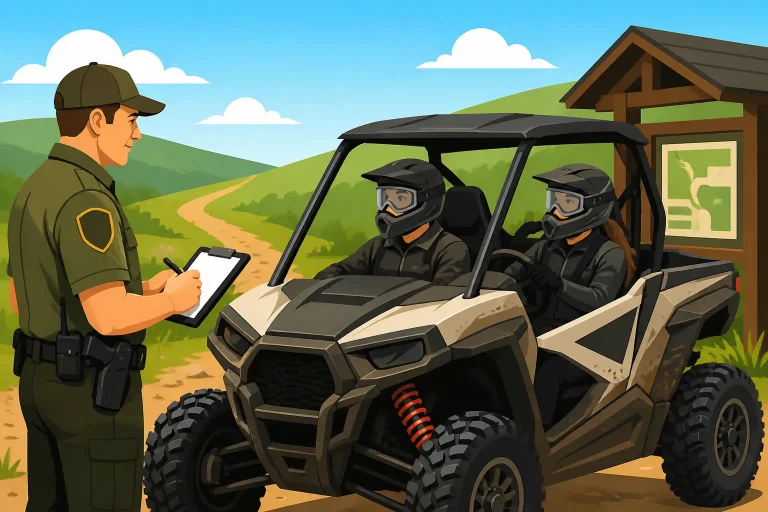
Booking a Four-Hour OHV Class for Your Crew
Putting several riders through an OHV safety class takes more than finding an open date. Ages, course eligibility, class format, travel and certificate records can all affect the plan. For a North Dakota crew, the practical approach is to confirm who needs training first, ask about group scheduling, and make sure everyone knows what to bring and what the course does—and does not—authorize.
Start by checking who needs a class
Before you reserve seats, make a rider list with each person’s age, experience and intended riding plans. A crew may include adults who want a refresher, young riders who need a safety certificate, and people whose requirements depend on the machine or where they will ride. Treat those as separate questions rather than assuming the whole group has the same obligation.
North Dakota’s age rules make it especially important to check each young rider’s situation. The state offers safety training, and riders may need to meet training requirements before operating an OHV in circumstances covered by state law. The details can depend on age and operating conditions, so use the official requirements for the rider—not a blanket rule based on the oldest or youngest person in the group. See North Dakota Rules for Riders Under 16 and North Dakota Safety Course Minimum Age before booking.
A class may be useful even when a rider is not required to take it. First-time operators can benefit from learning about safe handling, terrain, other trail users and basic pre-ride decisions. Experienced riders may also appreciate a shared foundation if the crew plans to ride together. But a training class is not a substitute for checking registration, access, equipment or local riding rules. A certificate does not automatically open every trail or make every roadway legal to ride.
Build a simple rider roster
A short roster helps you ask the provider the right questions and prevents a last-minute surprise. Record:
- Each rider’s name and age
- Whether the rider already has a North Dakota safety certificate
- Whether the rider has a certificate from another state
- The rider’s experience level
- The type of machine the rider expects to operate
- Any accessibility, language or other accommodation needs
Do not assume an out-of-state card will automatically satisfy a North Dakota requirement. Ask the course provider or the agency responsible for the certificate whether the rider needs North Dakota training or whether an existing credential is accepted. For additional context, see Whether a Safety Certificate From Another State Counts.
If a rider is approaching an age threshold, check the timing directly rather than relying on a friend’s interpretation. The rules may distinguish between being eligible to take a course and being required to hold a certificate before riding. North Dakota Riders Turning 12 Within Six Months can help identify the question to resolve, but confirm the rider’s eligibility and requirement with the official program before committing to a date.
Separate training from the rest of the ride plan
A safety course handles training and certification according to the program’s rules. It does not replace the administrative steps for a particular machine. Before planning a trip, confirm any needed registration, permit, land access and equipment requirements separately. A useful starting point is North Dakota Safety Training Run by the State, followed by North Dakota Permits for Visiting Riders if people in your crew are coming from outside North Dakota.
This distinction matters for a mixed group. A visitor may have permit questions while a young resident has a safety-course question. Someone else may already have a certificate but still need to confirm registration or trail access. Listing those needs individually is faster and more reliable than trying to solve everything through one class reservation.
Ask about group availability and course format
A four-hour class can be a convenient way to train several people in one session, but do not assume every scheduled course has enough seats for your crew or that a private group session is always available. Course dates, locations, registration steps and the number of available places can change. Check the current official course listing and ask how group requests are handled.
North Dakota offers more than one way to approach safety training. Depending on current availability and the rider’s circumstances, options may include in-person instruction or an online course. A classroom session can make it easier for a group to ask questions together, while an online option may suit individuals whose schedules do not line up. Not every option necessarily works for every age or certification need, so verify eligibility before choosing. The state’s North Dakota Classroom Safety Classes and North Dakota Online Safety Course Option pages are useful starting points.
What to ask before reserving
When you contact the course provider or follow the registration instructions, ask direct questions. That saves time and makes it easier to coordinate a crew rather than handling several individual registrations at the last minute.
| Question | Why it matters |
|---|---|
| Is the course open to the ages in our group? | Eligibility can vary, especially for young riders. |
| Does this session provide the certificate we need? | A class and a particular certification requirement are not always interchangeable. |
| Can the group register together? | The provider may require individual registrations even when riders attend as a crew. |
| How many seats are available? | A date that works for one or two people may not fit a full group. |
| Is the session in person, online or a combination? | The format affects travel, attendance and what participants need to complete. |
| What should riders bring? | The provider may have specific instructions for identification, registration or course materials. |
| What happens if someone misses part of the session? | Ask whether the rider can complete the course later or must register again. |
| How are certificates issued or recorded? | Riders should know how to access proof after completing the course. |
Use the official registration process rather than assuming a phone conversation alone reserves seats. If the provider asks each participant to register separately, give the crew one deadline for completing registration and have one person check that everyone is confirmed.
Choose between a public class and a group request
A scheduled public class is often simplest if the date, location and remaining seats suit your crew. Each participant follows the published registration steps, and you avoid arranging a separate session. The trade-off is less control: your preferred date may not be available, and the group may have to split across sessions.
A group request may be worth asking about when you have several riders, a narrow date window or a group that would benefit from attending together. It is a request, not a guarantee. The agency may need to consider instructor availability, location, class size and scheduling. Do not advertise a private class to your group until the provider confirms it.
For state park offerings, check the current details for OHV Safety Classes Held at North Dakota State Parks. A park location can be convenient if your group is also planning a ride, but a class reservation and permission to ride a specific area are separate matters. Confirm trail status, access rules and any needed permits before turning the training day into a riding day.
Prepare the crew for the four-hour session
Once the date is confirmed, give participants one clear message with the time, location, registration status and provider instructions. Four hours is long enough that late arrivals or missing paperwork can disrupt the whole plan. Ask everyone to arrive with time to spare and to contact the provider in advance if they have a scheduling, accessibility or other practical concern.
Do not guess what equipment participants need. The provider’s instructions should control. A course may be classroom-based, may include practical elements, or may use a different format, so the right preparation depends on the specific session. Confirm whether participants need to bring a machine, safety gear, writing materials or any form of identification. If the instructions do not say, ask rather than hauling unnecessary equipment or arriving without something required.
A coordinator can reduce confusion by handling a few tasks:
- Confirm the date, location and course format with the official provider.
- Share the registration instructions and deadline with each rider.
- Check that every participant is registered, not merely interested.
- Collect questions about age, prior certificates or accommodations and send them to the provider.
- Circulate the final arrival and equipment instructions.
- Check what proof of completion participants will receive and how they can access it.
Avoid collecting sensitive personal information unless the official registration process requires it. Participants should enter their own details through the designated process whenever possible. The group organizer can track who has completed registration without keeping copies of identity documents or other unnecessary records.
Make the class useful for mixed experience levels
A crew may include brand-new riders alongside people who have operated OHVs for years. That is not a reason to skip training; it is a reason to set expectations. Ask experienced riders to participate seriously rather than treating the class as a formality. They may know how their own machine behaves, but newer group members still need a common understanding of safe decisions and communication.
Before class, encourage participants to note questions they want answered. Useful topics might include safe conduct around other riders, preparation before a ride, what to do when someone becomes separated, or how the group should respond to changing trail conditions. Let the instructor address course content rather than promising that a particular topic will be covered.
After the session, share practical information with the whole crew, but do not treat one rider’s recollection as a replacement for official instructions. Each participant should keep or access their own certificate as directed. If proof needs to be shown later, the rider should know where it is and how to retrieve it. See Showing a Certificate on Demand for the importance of being able to produce proof when required.
Keep the riding plan within the rules
Completing a class does not decide where a crew may ride. Before setting a route, check each site’s access rules and the rules for the type of roadway or trail involved. A class certificate does not authorize trespass, override a closure or replace a required permit. Riders from out of state should check their status separately; North Dakota’s visitor rules are not simply the same as a resident’s registration requirements.
If training is followed by a group ride, appoint a lead and a sweep, agree on regrouping points, and make sure every rider understands the route. North Dakota Group Ride Planning offers additional planning considerations. For a first outing after class, choose a route that suits the least experienced participant rather than building the day around the fastest or most confident rider.
Confirm completion and handle changes promptly
After the class, each participant should follow the provider’s instructions for receiving or accessing proof of completion. Keep the confirmation or certificate somewhere it can be found later. If the record does not arrive when expected, or a rider’s name or other information is incorrect, contact the course provider or the responsible agency rather than waiting until the next ride.
Plans change, and a crew booking can be affected by weather, illness, work schedules or a vehicle problem. Check the provider’s cancellation, transfer and rescheduling process before the session. Do not assume a place can be transferred to another rider or that a missed class can be completed online. Those details are specific to the program and session.
If one person cannot attend, decide whether the rest of the group should continue or move the date. That choice depends on seat availability, the provider’s rules and the reason for gathering. For young riders whose certification is needed before a planned outing, do not let the group’s schedule pressure them into riding before they meet the applicable requirement. Rescheduling a ride is better than treating a course reservation as proof of completion.
A successful booking comes down to a few checks: identify who needs training, confirm each rider’s eligibility, reserve seats through the official process, prepare everyone using the provider’s instructions, and keep certification separate from permits and riding access. That approach gives your crew a better chance of arriving ready and makes the class one useful part of a safe North Dakota ride plan.
Disclaimer
This article is for general informational purposes only and does not constitute professional advice. Laws, prices and regulations vary by location and change over time. Consult a qualified professional for guidance on your specific situation.