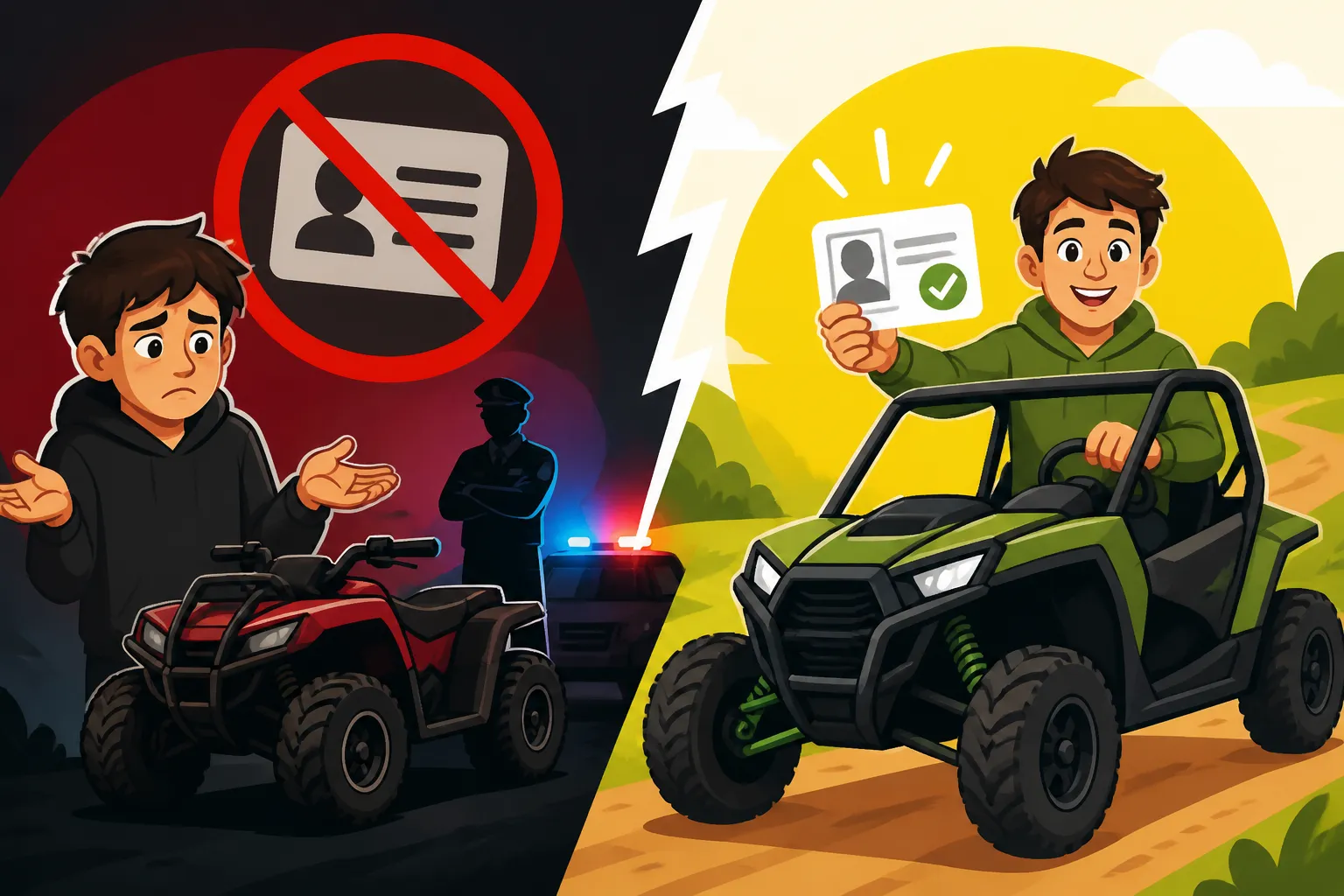
What Happens Without the Card
A young rider may have completed North Dakota’s OHV safety course but still be stopped without the certificate card in hand. That creates a practical problem: proving course completion is not always the same as carrying the required proof. Here’s what may happen, who needs a certificate, and what to do before riding if the card is missing.
What the card proves and who may need it
The “card” means proof that a rider completed an approved off-highway vehicle safety course. It is different from an OHV registration plate or decal, a non-resident permit, and a driver’s license. Having one of those documents does not automatically prove that a rider has the required safety certification.
North Dakota’s youth safety rules are especially important for riders under 16. The exact requirement can depend on the rider’s age, where the machine is being operated, and the circumstances of the ride. A parent’s supervision may matter, but it should not be treated as a substitute for a certificate unless the applicable rule specifically allows it. Review North Dakota Rules for Riders Under 16 and North Dakota OHV Safety Certificates at Age 12 when checking a young rider’s situation.
The certificate is about rider training, not ownership of the machine. A child can be riding a parent’s ATV or UTV and still be responsible for meeting the rules that apply to the person operating it. Likewise, a registered machine does not make an uncertified rider compliant.
| Document or item | What it generally shows | What it does not replace |
|---|---|---|
| OHV safety certificate | The rider completed qualifying safety training | Registration, a required permit, or permission to ride |
| Registration plate or decal | The machine has been registered as required | A rider’s safety certificate |
| Non-resident permit | A visiting rider has obtained a permit when one is required | A safety certificate or landowner permission |
| Driver’s license | The holder has driving privileges for applicable vehicles | OHV safety training or registration |
| Course-completion record | Training may be verifiable through the issuing program | The need to carry or show proof if the rule requires it |
The rules may apply differently on private land than on public riding areas, and organized events can have their own requirements. Do not assume that a certificate is unnecessary just because the rider is with an adult, is on a family property, or is attending a sanctioned activity. Check the conditions that apply to the specific ride.
This is also worth sorting out before traveling. A visiting rider should not assume that a home-state card automatically satisfies North Dakota’s requirements. Recognition can depend on the course and the issuing authority. See Whether a Safety Certificate From Another State Counts before relying on an out-of-state credential.
What can happen if the rider cannot show the card
If an officer or other authorized official asks for proof and the rider cannot produce it, the immediate issue is that the rider may not be able to establish compliance during the stop. North Dakota’s rules treat failure to carry or show required proof seriously: not having the card available can be treated as evidence that the rider does not hold the required certificate.
That distinction matters. A rider may have completed the course and simply left the card at home, but the person checking compliance may not be able to confirm that on the spot. The missing card can therefore create a problem even when the rider believes the training requirement has already been met. Carrying proof is the simplest way to avoid turning a completed course into a roadside dispute.
Possible consequences depend on the facts and the applicable rule. An officer may investigate whether the rider is certified, direct the rider to stop operating, or issue a citation if the requirements have not been met. A missing card does not guarantee that any one outcome will occur, and the response may differ based on the rider’s age, location, and whether the certificate can be verified. Do not count on being given time to retrieve the card or on a verbal explanation being enough.
There are two situations to separate:
- The rider completed the course, but the card is not available. The rider may still have trouble proving compliance at the time of the check. Ask the issuing program how to replace or verify the credential, and avoid riding in a situation where proof is required until the issue is resolved.
- The rider has not completed an accepted course. A parent’s assurance, an application for a course, or a plan to take one later is not the same as holding a certificate. The rider should complete the required training before operating where the rule applies.
A lost card also does not become irrelevant because the machine has the correct registration. Registration addresses the machine; the certificate addresses the rider. Keep those questions separate when preparing for a ride. If you need to check which documents apply to the machine itself, North Dakota Permit for a Visiting Machine and North Dakota Has No Trail Permit for Residents cover separate permit and registration issues.
What to do before the next ride
If a rider is missing the card, take a few simple steps before heading back out. The goal is to confirm that the rider is qualified, obtain usable proof, and make sure the trip does not depend on an assumption about what an officer will accept.
- Confirm whether the rider needs a certificate. Check the rider’s age, the type of machine, where it will be operated, and any supervision or event conditions. When the rider is under 16, do not rely on a general rule of thumb; check the specific age requirements.
- Find out whether the course was completed and accepted. If the rider took a course in North Dakota, contact the organization that issued the certificate or check the available state verification process. The North Dakota Safety Certificate Lookup topic can help you understand the verification question.
- Request replacement proof if the card is lost. Ask the issuing program what it accepts as proof while a replacement is being arranged. A course receipt or a parent’s record of the class may help with follow-up, but do not assume it substitutes for the required card in the field.
- Carry the certificate as directed. Put it somewhere it will stay with the rider and remain legible. If the issuing authority confirms that an electronic record is acceptable, keep access to it available; otherwise, carry the physical credential.
- Wait to ride if the requirement is unresolved. If the rider has not completed the course or you cannot confirm that an out-of-state certificate counts, postponing the ride is safer than risking a violation.
For a certificate that was never earned, the straightforward fix is to complete an approved course before riding in circumstances that require it. North Dakota provides safety-training options, including online instruction where available; review North Dakota Safety Course Online and North Dakota Safety Training Run by the State for details about training and certification. Course availability, eligibility, and the steps for receiving a card should be checked with the program administering the course.
For a card that is already earned but misplaced, keep a record of the rider’s full name, date of birth, course provider, and approximate completion date when contacting the issuer. Those details can make it easier to locate the record. If the rider completed training in another state, ask whether the certificate is recognized before treating it as valid for a North Dakota ride.
Storage is a small but useful part of preventing repeat problems. Keep the card in a secure, dry place, but make sure it is accessible when the rider is operating. A document sleeve can protect it from water and wear; a simple waterproof sleeve, including one available through Amazon, may be sufficient. Do not put a child’s only copy somewhere in a vehicle that may be left at the trailhead while the rider goes out on the machine.
How to prepare for a stop or a group ride
A quick pre-ride document check can prevent confusion, particularly when children are riding, when the group includes visitors, or when several machines are being used. Each rider should know which documents belong to them and which belong to the machine. Do not rely on one adult carrying every rider’s proof unless the applicable rules and event organizer allow that arrangement.
Before leaving, confirm:
- The rider has the certificate or approved proof required for their situation.
- The machine has the registration or permit required for the trip.
- Any out-of-state safety credential has been confirmed as acceptable.
- The rider can explain where the certificate is stored and how to show it.
- The group understands that a permit or registration decal does not replace safety training.
If an official asks for the card and it is unavailable, stay calm and answer accurately. Do not claim that a rider completed a course if that is uncertain. If the course was completed, explain that plainly and ask what verification is available. Follow any direction to stop riding while the issue is checked. Arguing that the card is only at home does not establish that the rider meets the requirement.
If a citation or warning is issued, read it carefully and follow the instructions for responding. Keep any course records, replacement-card request, and related correspondence. If you dispute the result or need advice about a specific case, contact the appropriate agency or a qualified professional rather than relying on a general account of how another rider’s stop ended.
The safest approach is simple: confirm the rule before the ride, complete the required training, and carry the proof the rider may be asked to show. A completed course is valuable, but an unavailable card can still leave a rider unable to demonstrate compliance when it matters.
Disclaimer
This article is for general informational purposes only and does not constitute professional advice. Laws, prices and regulations vary by location and change over time. Consult a qualified professional for guidance on your specific situation.