Thirty Days and the Exemption Ends
A short North Dakota visit can make an out-of-state ATV or UTV’s paperwork seem straightforward. The complication is the 30-day threshold: an exemption from North Dakota registration does not necessarily excuse a visitor from every permit or riding rule. Here’s how to think about the limit, what can change after a longer stay, and what to check before riding.
What the 30-day exemption does and does not mean
North Dakota’s 30-day rule is a limited exemption for qualifying out-of-state machines. In general, a nonresident machine properly registered in its home jurisdiction may be operated in North Dakota without North Dakota registration for up to 30 consecutive days. The key conditions are that the machine qualifies for the exemption and that its home-state registration is valid.
That is different from saying a visitor can ride anywhere without additional paperwork. Registration and a nonresident OHV permit serve different purposes. Registration identifies the machine under the applicable registration system; a nonresident permit may be required for a visitor to ride in North Dakota even when the machine is temporarily exempt from North Dakota registration. The North Dakota Registration Versus a Non-Resident Permit explains why one document does not automatically replace the other.
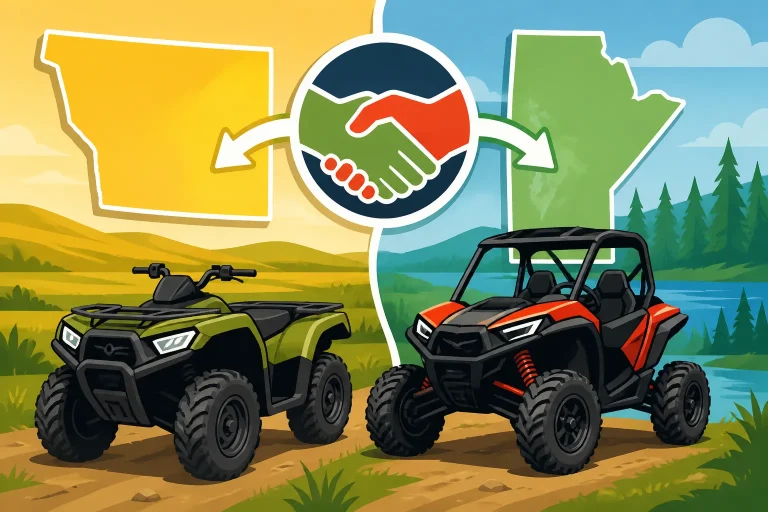
North Dakota does not have broad registration reciprocity with other states for this purpose. A home-state plate or decal may help establish that the machine is properly registered where it belongs, but it should not be treated as a universal substitute for North Dakota’s visitor requirements. Check North Dakota Has No Reciprocity With Any State for the distinction between an out-of-state registration exemption and reciprocity.
A practical way to separate the questions is:
| Question | What to check |
|---|---|
| Is North Dakota registration temporarily unnecessary? | Whether the machine and its home-state registration qualify for the 30-day exemption |
| Is a visitor permit still required? | The current nonresident permit rules for your machine and riding plans |
| Does the exemption still apply after a longer stay? | How North Dakota counts the consecutive days and what registration is then required |
| Where may the machine be ridden? | The rules for the specific trail, road, public land, or private property |
The 30 days are not a general allowance to ignore rules until the calendar runs out. Other requirements can apply from the first ride. You still need to follow land-access rules, use a machine that is legal for the place you intend to ride, and carry any required permits or proof. An out-of-state registration does not give you permission to ride on closed land or bypass local restrictions.
The precise details can depend on the machine’s classification, where it is registered, and how it will be used. Before leaving home, review North Dakota’s 30-Day Out-of-State Rule and the current requirements for North Dakota’s Non-Resident OHV Permit. If you are unsure whether a home-state registration counts, ask the relevant North Dakota agency before relying on it.
How the 30 consecutive days affect a longer visit
The threshold matters most when a trip becomes an extended stay. The rule is framed in consecutive days, so do not assume that taking the machine out of North Dakota for a short break automatically resets the clock. Plan around the actual dates and get confirmation from the relevant agency if your travel involves leaving and returning, storing the machine in the state, or using it across multiple visits.
Keep a simple record of when the machine first enters North Dakota and when it is operated here. That can help you avoid guessing as the trip progresses. If your plans change and the stay may pass the threshold, contact the state before the exemption ends rather than waiting until a stop or registration application forces the issue.
Once the 30-day exemption no longer applies, you should expect to deal with North Dakota registration requirements rather than relying only on the out-of-state paperwork. The details of getting a machine registered can depend on whether it is titled, how it was acquired, and what documents you have. North Dakota Visitors Staying Over 30 Days covers the longer-stay issue, while North Dakota Registration for a New Resident is relevant if the person’s situation changes from visiting to establishing residency.
A visitor who is only in North Dakota briefly should still think ahead if the machine will remain here. For example, a person might leave a quad at a seasonal property, make several trips over the year, or lend it to someone while away. Do not assume that a machine is exempt simply because its owner is not physically riding it every day. The important questions are how the rule applies to the machine’s North Dakota use and whether it continues to meet the conditions for the exemption.
If the stay is likely to exceed 30 consecutive days, use this checklist before the deadline:
- Confirm the machine’s home-state registration is current and keep proof with it.
- Check whether the machine needs a North Dakota nonresident permit for the planned riding.
- Ask the state what North Dakota registration steps apply after the exemption period.
- Gather ownership and machine-identification documents before applying.
- Do not wait until after the threshold to find out whether missing paperwork will delay registration.
A title or registration from another state may not answer every question involved in North Dakota registration. If the machine has no title, has a mismatched identification number, or was bought recently, resolve that paperwork issue early. The pages on North Dakota Registration Without a Title and North Dakota Registration and Proof of Residency can help identify what documentation may matter, though a visitor should confirm which requirements apply to their particular case.
Permits, proof, and riding access are separate checks
The most common planning mistake is treating the 30-day exemption as a complete riding pass. It addresses a registration question; it does not necessarily cover the nonresident permit, access permission, or location-specific rules. A visitor should check all of these separately.
Start with the permit. North Dakota’s nonresident OHV permit requirements are distinct from whether an out-of-state machine is temporarily exempt from state registration. Find out whether a permit is needed for your machine and intended use, how to obtain it, and what proof to carry. The North Dakota Permit for a Visiting Machine and How to Buy a North Dakota OHV Permit address the visitor process. Permit availability, conditions, and current instructions can change, so confirm them with the official provider before traveling.
Next, confirm access. A permit does not open every road, trail, or parcel to OHVs. Public riding areas may have their own boundaries, closures, or machine restrictions, and private land requires the appropriate access permission. If you are heading to a designated riding area, check its current status and any machine-width or trail rules. For roadside riding, review the rules for the particular road type rather than assuming an out-of-state registration makes the route legal.
Finally, carry evidence that answers the questions an officer or land manager may reasonably ask. Depending on your situation, that could include:
- Current home-state registration or other proof that the machine is properly registered there
- The required North Dakota nonresident permit, if applicable
- Proof of ownership, such as a title or purchase paperwork
- The machine’s identification information
- Any required safety certificate or other rider documentation
- Written permission when riding on private land
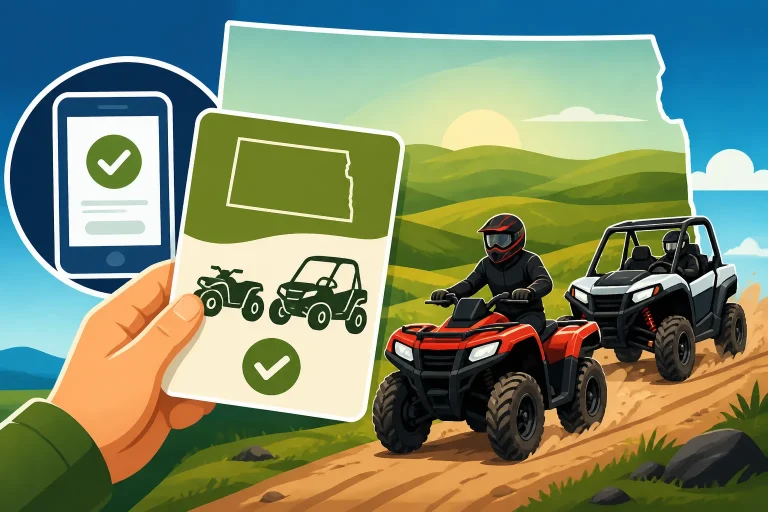
Keep documents accessible and make sure the machine’s identifying details match the paperwork. A photo of documents on a phone can be useful as a backup, but it is not a safe substitute for any original or physical document the rules require you to carry. Check the current directions for what must be displayed on the machine and what must be available to show.
Do not confuse a trail permit with a state park entrance permit, either. A permit that applies to one kind of access may not cover another. If your itinerary includes both OHV riding and a state park visit, confirm each requirement independently. North Dakota Registration and Trail Access can help clarify the difference between registration status and where a machine may be used.
A practical plan for out-of-state riders
The easiest way to avoid a paperwork surprise is to check the machine before packing it, not at the trailhead. Start by identifying the state where it is registered and confirming that its registration will remain valid throughout the trip. If it is not registered, or if the home state does not require the same paperwork, ask North Dakota whether the 30-day exemption applies to that machine. Do not assume that a bill of sale, dealer document, or temporary tag is equivalent to a valid registration.
Then decide whether your trip is clearly within 30 consecutive days or could extend beyond it. If you expect a longer stay, confirm the next steps for North Dakota registration before you arrive. If you will make repeat visits, ask how the state treats the timing rather than presuming each visit begins a fresh period.
A simple pre-trip sequence looks like this:
- Identify the machine’s class and check that it meets North Dakota’s definition of an OHV.
- Verify the home-state registration and gather ownership documents.
- Confirm whether the 30-day exemption applies to your machine and circumstances.
- Check current nonresident permit requirements, even if registration is temporarily exempt.
- Confirm the rules for each riding area, route, and parcel on your itinerary.
- Track the machine’s North Dakota dates and follow up before a stay exceeds the exemption period.
If you are crossing the border for a weekend, the paperwork may be relatively simple, but the same distinctions still matter: temporary registration exemption, nonresident permit, and legal access are separate issues. For an extended stay or a machine left in North Dakota, a short call to the relevant state office can prevent a much larger problem later.
The safest takeaway is straightforward: treat 30 days as a limited registration exemption, not as permission to ride without checking anything else. Confirm that the machine qualifies, determine whether a visitor permit is needed, and make a plan to register in North Dakota if the stay will outlast the exemption. When the details are unclear, get an answer from the official source before the machine is used.
Disclaimer
This article is for general informational purposes only and does not constitute professional advice. Laws, prices and regulations vary by location and change over time. Consult a qualified professional for guidance on your specific situation.