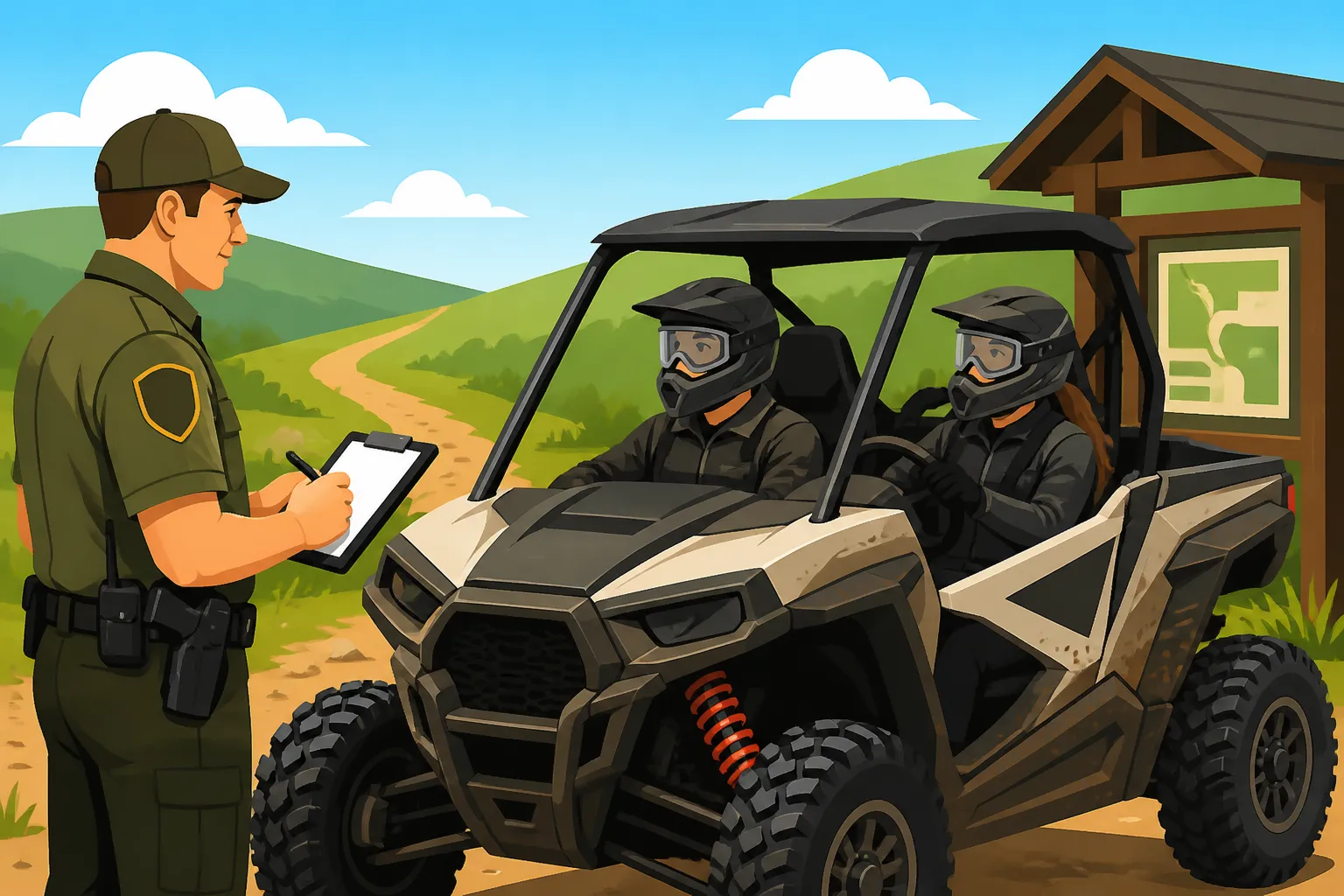
North Dakota Officer Checks at a Trailhead
A trailhead stop can be routine, but it is easier when you know which paperwork applies to your ATV or UTV before unloading. North Dakota requirements differ for residents and visitors, and an out-of-state registration may not replace the state’s visitor permit. Here’s what an officer may ask to see, what to keep accessible, and how to avoid common permit and reciprocity mix-ups.
What an Officer May Check
A trailhead check can involve more than one question. An officer may want to confirm that the machine is registered or has the required visitor permit, that the rider meets applicable safety rules, and that the group is using land where riding is allowed. The details depend on the rider, machine, location, and circumstances.
| Check | What to have ready | What it helps establish |
|---|---|---|
| North Dakota registration or visitor permit | The required plate or decal and any associated proof you have | That the machine meets the applicable registration or visitor requirement |
| Rider’s safety certificate, if required | The certificate or other accepted proof | That a rider subject to the training rule has completed it |
| Machine identification | The vehicle identification number, if requested | Which machine is being operated and whether its paperwork matches |
| Land access | A route map, posted-land permission, or other relevant information | Whether the route is open and the rider has permission to be there |
| State park vehicle permit, if applicable | The required park entrance permit for the towing vehicle | That the vehicle meets park entrance requirements, separate from OHV access |
An officer may ask to see the permit or registration information associated with the machine. Make sure the plate or decal is attached where required and is easy to see, clean, and legible. If you have a paper confirmation or registration record, keep it somewhere accessible rather than buried in a trailer or packed under riding gear. For display details, see North Dakota OHV Plate or Decal: Your Choice and North Dakota Decal Placement Rules.
A check does not necessarily mean that anything is wrong. Trailheads bring together local riders, visitors, families, and machines with different paperwork histories. A quick check can clarify whether a permit is in order before someone rides farther into the area.
The officer may also ask about the machine’s identification if its paperwork is unclear or a vehicle number is hard to read. Before traveling, compare the number on the machine with your paperwork and take a clear photo for your records. A photograph is a useful backup, but it should not be treated as a substitute for required registration or permit documents. If the number is missing or difficult to locate, review North Dakota VIN Inspection Requirements before setting out.
Residents, Visitors, and Reciprocity
The first thing to establish is whether the machine is registered in North Dakota or is visiting from somewhere else. The paperwork path is different, and a home-state sticker does not automatically mean a visitor can ride in North Dakota without an additional permit.
If the machine is registered in North Dakota
North Dakota residents generally need the applicable North Dakota OHV registration for a machine that is subject to registration. The registration is more than a receipt: it is part of the state’s system for identifying machines and supporting trail-related administration. A plate or decal may serve as the visible sign of registration, but keep any associated documentation available in case an officer needs to clarify the record.
If you are unsure whether your machine is covered, start with Do You Need to Register an ATV in North Dakota?. For the broader steps, see How to Register an ATV in North Dakota. Registration, title paperwork, and trail access are related but not interchangeable: having a title does not by itself prove that a machine is currently registered for use.
A resident should check that the plate or decal belongs to the machine being ridden and has not been damaged, obscured, or moved to another vehicle. If you have recently bought the machine, changed its ownership, or moved to North Dakota, do not assume the seller’s paperwork settles your own requirements. See North Dakota Ownership Transfer in 15 Days or North Dakota Registration for a New Resident for those situations.
If the machine is registered outside North Dakota
North Dakota does not offer general reciprocity that lets an out-of-state OHV registration stand in for the state’s visitor permit requirement. A visitor should check the permit rules before arriving, rather than assuming that a registration sticker from home is enough. The key topic is covered in North Dakota Has No Reciprocity With Any State.
A short visit and a longer stay may be treated differently. The visitor rules include a time threshold, so someone leaving a machine at a cabin, returning for repeated visits, or staying in the state for an extended period should verify what applies to their situation. See North Dakota’s 30-Day Out-of-State Rule and North Dakota Visitors Staying Over 30 Days. Do not rely on a friend’s experience from a different year or a different type of machine.
A visitor should make sure the required permit is obtained for the machine being ridden, and that any required display instructions are followed. A permit for one machine should not be assumed to cover a second ATV or UTV. The permit is also not a substitute for permission to ride on a particular trail or parcel. For the practical buying steps, see How to Buy a North Dakota OHV Permit.
| Your situation | What to check before the trailhead |
|---|---|
| North Dakota resident with a registered machine | Registration status, correct plate or decal, and any paperwork that helps resolve a question |
| Visitor with a machine registered elsewhere | Whether a North Dakota non-resident permit is required, how it must be displayed, and whether it covers this machine |
| Visitor staying for an extended period | Whether the visitor time limit changes which registration or permit rules apply |
| Rider under 16 | Whether the rider needs a safety certificate or has a specific exception |
| Group with several machines | Whether each machine has its own required registration or permit |
One practical way to avoid confusion is to sort paperwork by machine. Put each machine’s confirmation or record in a separate sleeve, and label it with the vehicle’s make or identification details. A waterproof document sleeve from Amazon can help protect paper records from mud and rain, but it is only a storage aid; it does not replace the official permit, display, or certificate.
Rider Safety, Park Permits, and Access Are Separate Questions
A permit check is only one part of being ready to ride. Riders should also consider age-related safety requirements, the rules for the riding area, and whether any state park entrance permit is required for the vehicle bringing the machine to the trailhead.
Safety certificate checks
North Dakota has OHV safety training and certificate rules for certain younger riders. The rules can depend on age and the circumstances of the ride, so do not assume that every child is treated the same way. If a rider is in an age group that may need a certificate, check the requirements before the trip and keep the certificate or accepted proof accessible. North Dakota OHV Safety Certificates at Age 12 and North Dakota Rules for Riders Under 16 explain the related rules.
A parent or group leader should not wait for an officer to raise the issue. Confirm in advance who needs a certificate, whether an exception applies, and what proof the rider should carry. If a card is stored at home, a rider may have trouble demonstrating completion during a trailhead check. For questions about where the certificate comes from, see Who Issues North Dakota’s OHV Safety Certificate.
Other rules can apply to the way a machine is operated, including passenger restrictions and equipment requirements. A machine that is properly registered is not automatically legal for every road, rider, or passenger. Check the rules for the route you intend to use, especially if your plan includes riding beyond an off-road trail area.
State park vehicle permits
A state park entrance permit for a truck or other vehicle is not the same thing as an OHV registration or visitor permit. The towing vehicle may have its own park entrance requirement, while the ATV or UTV may have separate paperwork and riding rules. At a trailhead, it helps to be clear about which vehicle each permit belongs to.
Likewise, a park entrance permit does not automatically open every trail to OHVs. A machine may be allowed only on designated routes, or riding may be prohibited in a particular park area. Review North Dakota State Park Entrance Permits and North Dakota Park Rules for OHVs before traveling. If you are heading to a specific riding area, confirm that it is open to your type of machine and that any temporary closure has been lifted.
Permission and the route itself
A valid registration or visitor permit does not give a rider permission to cross private land. It also does not turn a closed route into an open one. Officers may ask about where you have ridden or plan to go, particularly when access depends on posted boundaries, a designated trail, or landowner permission.
Before riding, check maps and signs at the site. If a route crosses posted land, get permission from the landowner rather than relying on a trailhead conversation or an assumption that a visible track is open. See North Dakota Posted Land Rules for Riders and North Dakota Electronic Posting and Riders. For public land, use the applicable map and local information; a map intended for one area may not show restrictions in another.
How to Prepare for a Trailhead Check
A little preparation makes a stop simpler and can prevent a paperwork issue from becoming a wasted trip. Use this sequence before leaving home:
- Identify each machine’s status. Note whether it is North Dakota registered or visiting under another state’s registration. Do not treat the truck’s registration as the OHV’s registration.
- Check the correct permit path. Residents should confirm that the machine’s registration is current. Visitors should verify the non-resident permit requirement and any time limit that may apply to their stay.
- Match the paperwork to the machine. Check that the vehicle identification information and the machine’s permit or registration records correspond. For a new or used purchase with incomplete records, see North Dakota Registration Without a Title.
- Check who is riding. Confirm whether younger riders need safety training or a certificate, and make sure any required proof is available.
- Confirm the riding area is open. Look at the trailhead signs and current status information. A permit does not override a closure, a width limit, or a landowner’s posting.
- Keep documents accessible. Place records in a dry, easy-to-reach spot. Do not leave them in a locked truck if the group may be questioned away from the parking area.
- Make the machine easy to identify. Keep the required plate or decal visible and make sure its number is readable. If a vehicle identification number is difficult to see, find and photograph it before the trip.
- Answer questions calmly and directly. Show the requested information and ask politely if you do not understand what is being checked. If you believe the paperwork is correct but the record cannot be confirmed at the trailhead, note what follow-up is needed and contact the appropriate agency before riding again.
If a permit is missing, do not assume that showing a receipt from another state or explaining that the machine is only visiting will resolve the issue. Pause and verify the current North Dakota requirement before unloading or continuing onto the riding area. The same caution applies if a decal is damaged or the displayed information does not match the machine.
For visitors, buying a permit before travel can reduce delays, but the important point is to use the official process and follow its display instructions. For residents, checking registration status ahead of a group ride is easier than trying to resolve a paperwork question with several machines waiting at the trailhead. When several people are traveling together, assign one person to confirm each machine’s paperwork and another to check the destination’s access rules.
A smooth check comes down to keeping separate questions separate: Is the machine properly registered or permitted? Does the rider meet the applicable safety requirements? Is the route open, and does the group have permission to use it? Being ready to answer all three is more useful than carrying a stack of unrelated documents.
Disclaimer
This article is for general informational purposes only and does not constitute professional advice. Laws, prices and regulations vary by location and change over time. Consult a qualified professional for guidance on your specific situation.