Why There Is No Conversion Path
It’s a common scenario across North Dakota: you’ve got a perfectly good ATV or UTV, you use it for farm work, hunting, or just tearing up the trails, and you start wondering, "Can I just slap a license plate and some turn signals on this thing and drive it to town?" Many riders dream of the convenience of taking their off-highway vehicle (OHV) on regular roads, but the reality in North Dakota, and most states, is that there simply isn't a straightforward "conversion path" to make an ATV or UTV truly street legal in the same way a car or motorcycle is. This guide will dive deep into why that's the case and what North Dakota's laws do allow for OHV road access.
Understanding North Dakota's Vehicle Classifications
Before we can even begin to talk about making an OHV street legal, we first need to grasp how North Dakota defines and categorizes these machines, and how those definitions fundamentally differ from highway vehicles. It's not just a matter of what features a machine has; it's about its core design, intended use, and the regulatory framework it was built under.
What Defines an Off-Highway Vehicle (OHV)?
In North Dakota, an Off-Highway Vehicle (OHV) is a broad category that includes all-terrain vehicles (ATVs), utility vehicles (UTVs), and certain types of off-highway motorcycles. The state further breaks these down into Class I, II, and III machines, each with specific characteristics that define them. For instance, a [North Dakota Class I Machines Defined] is typically what we think of as a traditional ATV: it has three or more wheels, uses non-highway tires, is designed for off-highway use, and has a seat designed to be straddled by the operator. It's built for rough terrain, not the smooth pavement of I-94.
Class II machines are your side-by-sides or UTVs, designed to carry more passengers or cargo, often with a steering wheel and bucket seats, similar to a small car but, again, equipped with [What Non-Highway Tires Means] and built for off-road conditions. Class III machines are primarily off-highway motorcycles. The key here is "off-highway." These machines are not manufactured to meet the rigorous safety and emissions standards required for vehicles that operate on public roads with conventional traffic. Their suspension, braking, lighting, and structural integrity are all designed with a different purpose in mind, making a true conversion incredibly complex, if not impossible, from a legal and engineering standpoint.
How Motor Vehicles Differ
Contrast an OHV with a "motor vehicle" as defined for highway use in North Dakota. This includes cars, trucks, motorcycles, and commercial vehicles. These machines are manufactured to comply with a host of federal and state regulations known as Federal Motor Vehicle Safety Standards (FMVSS). These standards cover everything from crashworthiness, occupant protection, lighting, brakes, emissions, and even specific tire types. A car, for example, undergoes extensive crash testing and has airbags, crumple zones, and specific chassis designs to protect occupants in a high-speed collision. An ATV or UTV, even one equipped with roll-over protection (ROPS) or seatbelts, simply isn't engineered to withstand these types of impacts or meet those safety thresholds.
Beyond safety, there are emissions standards, noise regulations, and even requirements for a Vehicle Identification Number (VIN) structure that specifically denotes a "highway legal" machine. The titling and registration processes are also distinct. While you must register your OHV in North Dakota to ride on public lands or utilize designated road access, this is distinct from the registration and title a car receives, which signifies its legal status for unrestricted highway operation. Simply put, an OHV is an entirely different class of vehicle in the eyes of the law and the Department of Transportation. [Titling an ATV in North Dakota] follows a different path because it's a different kind of machine.
Road Access for OHVs in North Dakota
Now, just because you can't make your ATV or UTV "street legal" doesn't mean it's entirely banned from North Dakota roads. The state has specific provisions that allow for conditional and limited road access for registered OHVs, but it's crucial to understand that this is not the same as full street legal status. This limited access is often misunderstood, leading riders to believe they can treat their OHV like any other vehicle on the highway, which can lead to hefty fines and dangerous situations.
Conditional Road Use, Not Street Legal Status
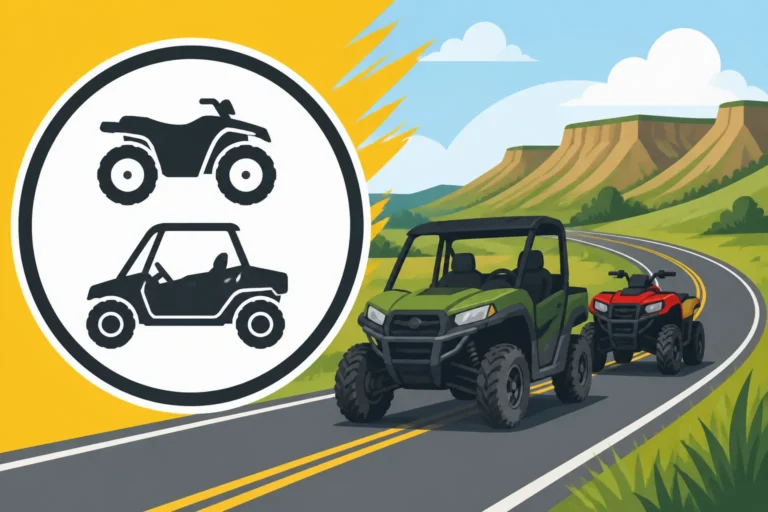
North Dakota's laws allow OHVs to operate on certain public roads under very specific circumstances. This is often referred to as "ditch riding" or utilizing certain unpaved roads. For instance, [North Dakota Ditch Riding: The Legal Right Explained] allows registered OHVs to operate in the ditch bottom, back-slope, and foreslope of state highways, county roads, and township roads, unless specifically prohibited by local ordinance or signage. However, there are strict rules: you must ride with the flow of traffic, keep to the far right, and yield to all other traffic. This is not about using the road itself as a primary travel route, but rather using the shoulder and ditch areas for access.
Similarly, [North Dakota Gravel Roads Open to Registered Machines] allows registered OHVs to operate on unpaved roads or aggregate surfaced roads unless otherwise prohibited. On paved roads, the rules become even stricter. OHVs may generally operate on paved roads posted at 55 mph or less, provided they meet certain equipment requirements and maintain a minimum speed. However, [North Dakota Paved Roads Posted at 55] typically restrict Class I and II machines, while [North Dakota Class III Machines at 65 mph Roads] (off-highway motorcycles) may have slightly different provisions. It's critical to check local ordinances as cities and counties often have their own restrictions. The main point remains: these are specific exceptions for limited access, not a blanket approval for highway use.
Required Equipment for Road Access
If you intend to use your registered OHV on any of North Dakota's approved road access areas, you must ensure it's equipped with certain safety features. This is where companies like SuperATV come into play, offering aftermarket accessories that help riders meet these specific requirements. While these additions are vital for compliance, they do not transform your OHV into a street-legal vehicle for general highway use.
According to North Dakota law, any OHV operating on a public roadway must be equipped with:
- Headlamps: Capable of illuminating objects at least 300 feet ahead.
- Taillamps and Brake Lamps: Clearly visible from the rear.
- Mirrors: At least one mirror that provides a clear view of the roadway behind the machine. Many riders opt for wide-angle rearview mirrors or side mirrors, like those available from SuperATV, to improve visibility.
- Horn: An audible warning device.
- Muffler: Designed to prevent excessive or unusual noise.
- Speedometer: Clearly visible to the operator and indicating speed in miles per hour.
- Tires: Non-highway tires are still permitted for this conditional use, as the machine is not truly "street legal."
These requirements, detailed further in [North Dakota Equipment Required on a Roadway], are aimed at making your OHV more visible and audible to other traffic when operating in shared spaces. However, even with all this equipment installed, your ATV or UTV is still classified as an OHV, and its operation on public roads is limited to the conditions and areas specified by North Dakota statutes and local ordinances. It's a fine line, and understanding the distinction is key to staying out of trouble.
The Regulatory Hurdles to Full Street Legality
The reason there's no conversion path isn't just about a few missing lights or a horn. It's rooted in the fundamental regulatory framework that governs vehicle manufacturing and safety. Off-highway vehicles and highway-legal vehicles are built to entirely different standards, and attempting to bridge that gap with aftermarket parts is simply not recognized by the law.
Federal Motor Vehicle Safety Standards (FMVSS)
The most significant hurdle lies in the Federal Motor Vehicle Safety Standards (FMVSS). These are a set of minimum performance requirements for motor vehicles and equipment, established by the National Highway Traffic Safety Administration (NHTSA) to ensure the safety of vehicles sold in the United States. They cover everything from crash protection, braking performance, lighting configurations, tire construction, fuel system integrity, and much more. Cars, trucks, and motorcycles sold for highway use are designed and manufactured from the ground up to meet these stringent standards.
ATVs and UTVs, by their very nature and design, are exempt from most FMVSS because they are intended for off-road use. They don't have the crashworthiness, precise braking characteristics at highway speeds, or sophisticated emissions control systems required of road-going vehicles. For example, the frame of a UTV, while robust for trail riding, isn't designed to absorb impact energy in the same way a car's chassis is for highway collisions. No amount of bolt-on accessories from SuperATV or any other manufacturer can magically transform a vehicle's fundamental structural integrity or bring it into compliance with these federal safety standards. This fundamental difference in manufacturing and regulatory compliance is why states like North Dakota cannot simply allow a "conversion kit" to make an OHV street legal.
State Titling and Registration Differences
Even at the state level, the distinction is clear. When you go through the process of [Do You Need to Register an ATV in North Dakota?], you're registering it as an off-highway vehicle. This process is distinct from how you register a car or truck, which is categorized as a "motor vehicle" for highway use. The title you receive for your ATV or UTV typically identifies it as an OHV, and this designation remains. There's no mechanism within the North Dakota Department of Transportation (NDDOT) to "reclassify" an OHV title as a highway vehicle title based on modifications.
The intent of OHV registration is to track ownership, collect fees (like the [North Dakota's Off-Highway Trail Tax]), and ensure compliance for off-road or limited road access, not to pave the way for general highway use. Changing the status of a vehicle from an OHV to a highway-legal vehicle would require a comprehensive inspection process that verifies compliance with all FMVSS, a process that is virtually impossible for a vehicle not originally manufactured to those specifications.
No "Kit" Solves the Fundamental Issue
Many riders search for "street legal kits" or "conversion kits" hoping for a quick solution. While these kits, which often include turn signals, mirrors, horns, and sometimes DOT-approved tires, are excellent for meeting the conditional road access requirements in North Dakota, they do not change the underlying legal classification or manufacturing compliance of your OHV.
Think of it this way: putting a red hat on a cat doesn't make it a dog. Similarly, adding highway-style accessories to an OHV doesn't make it a highway-legal vehicle. The vehicle's original manufacturer certification and design intent dictate its legal standing. Even if you meticulously add every single component a highway vehicle has – windshield wipers, specific lighting patterns, advanced braking systems, etc. – you still haven't addressed the core FMVSS compliance issues. There is Why There Is No Conversion Path primarily because the regulatory bodies understand that these machines are fundamentally different in their construction and safety profile from vehicles intended for primary highway use.
Implications for Riders
Understanding that there's no true "conversion path" for street legality in North Dakota is not just a technicality; it has very real consequences for riders. Misinterpreting the law can lead to significant legal troubles and put your safety, and the safety of others, at risk.
Legal Consequences of Misunderstanding
Operating your ATV or UTV on public roads outside of North Dakota's specific conditional access rules can lead to serious repercussions. You might think you're just "driving to the gas station," but if you're on an unauthorized road or lack the required equipment, you could be cited for operating an unregistered or uninsured vehicle on a highway. [North Dakota Penalties for Riding Unregistered] can range from fines to impoundment of your machine. Depending on the severity and circumstances, operating an OHV outside of its legal parameters could even escalate to a [What a Class B Misdemeanor Means in North Dakota] if deemed reckless or dangerous.
Beyond the immediate legal trouble, there are insurance implications. Your OHV insurance policy is likely written specifically for off-road use and limited road access as allowed by state statutes. If you're involved in an accident while operating your OHV on a highway where it's not legally allowed, your insurance company could deny coverage, leaving you personally liable for damages, injuries, and legal fees. This financial risk alone should be a strong deterrent against attempting to stretch the limits of North Dakota's OHV road access laws.
Prioritizing Safety and Compliance
The safest and most responsible approach for any OHV owner in North Dakota is to thoroughly understand and strictly adhere to the state's specific laws regarding OHV operation. This means:
- Know Your Machine's Classification: Understand whether you have a Class I, II, or III machine and what specific rules apply to it.
- Register Your OHV: Ensure your machine is properly registered with the NDDOT, which is a prerequisite for any public land or road access.
- Equip for Conditional Use: If you plan to utilize conditional road access, invest in the necessary equipment (mirrors, horn, lights, speedometer) as required by North Dakota law. Retailers like SuperATV offer a variety of accessories that can help you meet these requirements, making your machine safer and more compliant for the ditch or gravel roads.
- Understand Local Ordinances: Always check with local county and city authorities about any specific restrictions or closures in the areas where you plan to ride. [North Dakota County and City ATV Ordinances] can vary greatly.
- Utilize Designated Areas: Focus your riding on designated OHV trails, private land with permission, and the specific conditional road access areas where OHVs are permitted. [North Dakota OHV Trails: All Four Riding Areas] offers a great starting point for finding legal places to ride.
By respecting the regulations and understanding the distinct differences between an off-highway vehicle and a true street-legal machine, you can enjoy your riding experience safely and without legal worries in North Dakota. The laws are designed to keep everyone safe, and operating within them is crucial for a positive experience.
Here’s a comparison to help clarify the fundamental differences:
| Feature | Off-Highway Vehicle (OHV) in North Dakota | Highway-Legal Motor Vehicle (Car/Truck) in North Dakota |
|---|---|---|
| Primary Design | Off-road recreation, utility, farm work | On-road transportation, highway travel |
| Regulatory Body | State OHV laws, some federal land use regulations | Federal Motor Vehicle Safety Standards (FMVSS), state traffic laws |
| Titling/Registration | OHV-specific title and registration; [North Dakota OHV Registration Cost] involves a trail tax. | Standard motor vehicle title and registration; yearly fees. |
| Safety Standards | Roll-Over Protective Structures (ROPS), seatbelts (some models), minimal crashworthiness | Extensive crash testing, airbags, crumple zones, specific lighting patterns, advanced braking systems |
| Emissions | Generally less stringent than highway vehicles | Strict federal and state emissions requirements |
| Tires | [What Non-Highway Tires Means], knobby or aggressive tread | DOT-approved highway tires, specific load and speed ratings |
| Road Access | [North Dakota ATV Road Rules by Surface Type] are conditional and limited (ditches, gravel, specific paved roads) | Unrestricted access on all public highways unless specifically prohibited (e.g., private roads) |
| "Street Legal" Status | No "conversion path" to become truly street legal | Manufactured as street legal from the outset |
Disclaimer
This article is for general informational purposes only and does not constitute professional advice. Laws, prices and regulations vary by location and change over time. Consult a qualified professional for guidance on your specific situation.