Why a Road-Legal Mirror Needs 10 Square Inches
It's incredibly frustrating when you're trying to do the right thing and make your off-highway vehicle (OHV) legal for certain road use in North Dakota, only to hit a brick wall of specific, seemingly arbitrary rules. One of the most common head-scratchers for many riders is the requirement for a road-legal mirror to have at least 10 square inches of reflective surface. Why such a specific number? What does it truly mean for your ATV or UTV? This guide is here to demystify this particular regulation, explaining its purpose, its practical implications, and how you can ensure your machine is compliant and safe for North Dakota's diverse roadways.
Understanding North Dakota's Road-Legal Requirements for OHVs
Hitting the road on your ATV or UTV in North Dakota isn't quite as simple as just adding a license plate. The state has specific regulations in place, all designed with safety in mind. These aren't just bureaucratic hurdles; they're genuinely aimed at protecting you, your passengers, and everyone else sharing the road. It's about making sure that when you transition from the trail to a gravel road, you're equipped to handle the different demands of public thoroughfares.
The Core Idea: Safety and Visibility for All Road Users
Think about it this way: when you're out on the trails or tearing up the dunes, your primary concerns are often about the terrain directly ahead and the immediate surroundings. But on a public road, you become part of a much larger, faster-moving system. Drivers in cars and trucks expect certain things from other vehicles, and chief among them is the ability to see what's behind you and to the sides. This isn't just for changing lanes; it's about anticipating hazards, understanding traffic flow, and making safe decisions at intersections or when slowing down.
OHVs, by their very nature, are designed differently from passenger cars. They often have open cabs, different seating positions, and can be narrower or wider than typical road vehicles. These design differences can create unique challenges for visibility. North Dakota's laws, including the mirror rule, are a direct response to these challenges. They ensure that even with these design differences, you have a baseline level of awareness that other road users expect. It's about creating a common standard of safety that applies to all vehicles legally operating on public roads. Without these rules, the chances of unexpected maneuvers or blind spots leading to accidents would increase significantly. [North Dakota Equipment Required on a Roadway] goes into more detail about the full list of gear you'll need.
Decoding the 10 Square Inch Mirror Rule
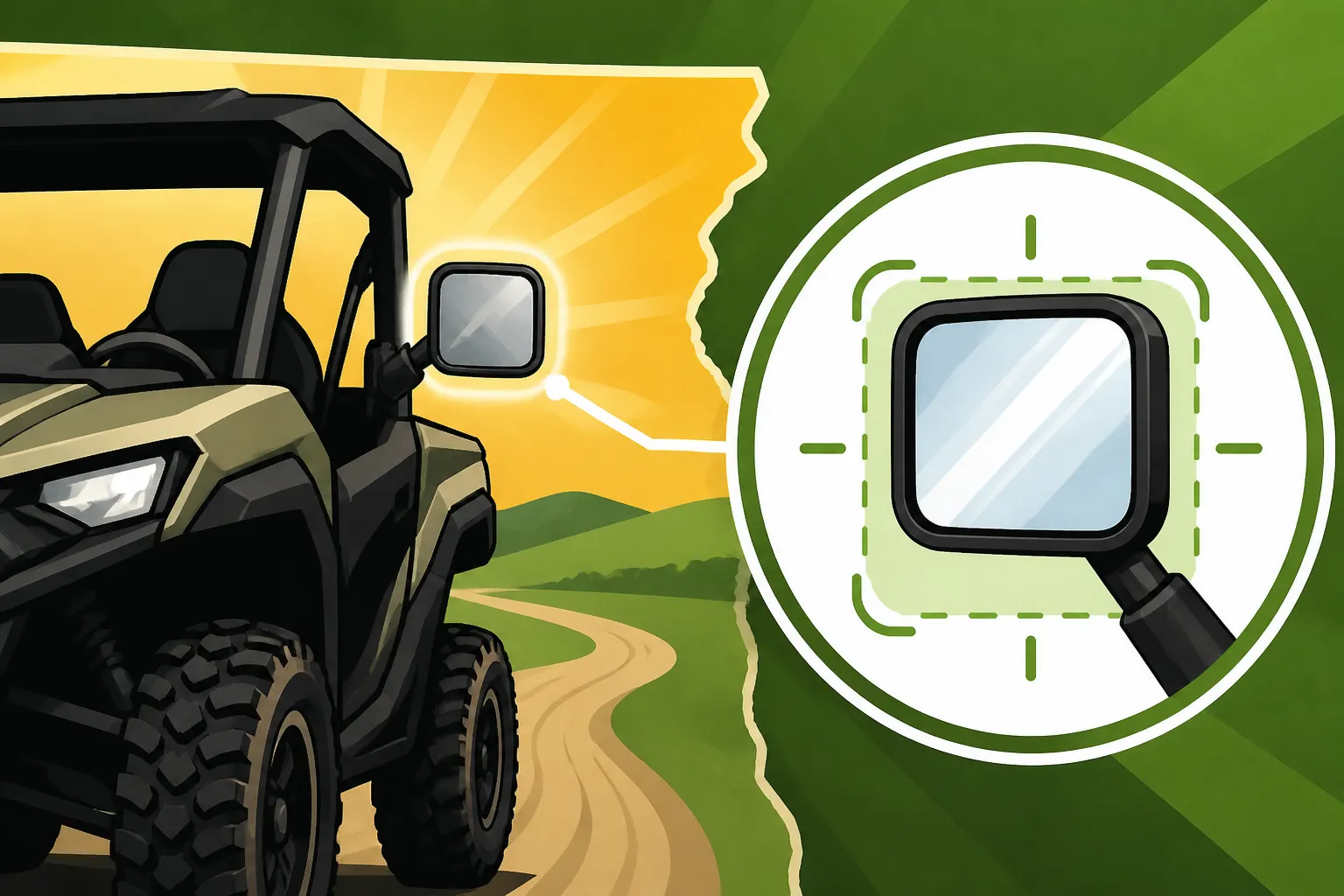
So, what exactly does "10 square inches of reflective surface" mean in real-world terms? It's not the entire mirror housing, just the actual glass or reflective material itself. For example, a mirror that's 2 inches wide by 5 inches tall would be exactly 10 square inches. A square mirror would need to be approximately 3.16 inches by 3.16 inches to meet the minimum. This isn't a massive mirror by any stretch, but it's a specific size designed to provide a minimal, yet functional, field of view.
Many riders, especially those coming from states with less stringent rules, might wonder why North Dakota specifies this exact measurement. It often feels like a nitpicky detail. However, this precision eliminates ambiguity. It ensures that a tiny "buddy mirror" or a minimalist off-road mirror, while perhaps sufficient for spotting a friend behind you on a dusty trail, isn't considered adequate for monitoring traffic on a county road. The frustration is understandable; you might have a mirror that feels big enough, but if you actually measure the reflective surface and it falls short, you're technically not compliant. This rule is particularly important because it sets a floor for visibility, preventing riders from using mirrors that are simply too small to be effective in a road environment. For a complete picture of your visibility requirements, you might also want to read up on [North Dakota Mirror and Horn Requirements].
Why 10 Square Inches? The Science of Rearview Visibility
Understanding the rationale behind the 10 square inch rule can help you appreciate its importance, even if it feels a bit restrictive at times. It boils down to fundamental principles of optics and human perception, all geared towards making your ride safer on shared roadways.
Minimizing Blind Spots and Maximizing Awareness
The primary goal of any rearview mirror is to provide a view of what's behind you that you otherwise couldn't see. For OHVs, particularly ATVs where you straddle the seat, your head movements are often restricted, and your peripheral vision is focused forward. A mirror that is too small might show you a sliver of the road directly behind, but it won't give you enough width or height to truly understand the traffic situation. The 10 square inch minimum is designed to capture a wider field of view, helping to reduce those notorious blind spots that can hide approaching vehicles.
Imagine trying to merge onto a paved road from a gravel shoulder. A tiny mirror might show you a car in the distance, but it won't give you enough information about its speed, your relative position, or if there's another vehicle rapidly approaching in the lane next to it. That 10 square inch surface aims to provide enough context so you can make a more informed decision. It’s a compromise between having a full-sized car mirror and something so small it's effectively useless. It forces you to have a mirror large enough to encompass a reasonable segment of the road, whether you're dealing with traffic on a paved road or kicking up dust on a [North Dakota Rules for Riding a Gravel Road]. This minimum size helps ensure that what you're seeing isn't just a tiny snapshot, but a more comprehensive picture of your surroundings.
Practical Implications for Riders on North Dakota Roads
This mirror requirement isn't just a theoretical number; it has very real implications for your day-to-day riding in North Dakota. Picture yourself driving down a section line road, ready to turn onto a busier township road. With a properly sized mirror, you can quickly glance and see if there’s a pickup truck gaining on you, or if a semi-trailer is approaching from a side road. If your mirror is too small, you might miss these critical details, forcing you to turn your head excessively, which momentarily takes your eyes off the road ahead—a risky move when you're trying to navigate.
The state's Department of Transportation and local law enforcement understand that OHVs are often used for a mix of recreational and practical purposes. When you're using your machine to get to a hunting spot, check fence lines, or simply travel between trails, you're sharing the road with other motorists. The 10-square-inch mirror ensures that you have the same basic visual tools that other drivers rely on to operate safely. If you don't meet this standard, you're not just risking a ticket; you're genuinely increasing the danger for yourself and others. An officer stopping you for a routine check will be looking for this specific compliance, among other things. They aren't trying to ruin your day, but they are ensuring everyone's safety on the public byways. Knowing [What an Officer Can Ask to See] can help you be prepared.
Choosing the Right Mirror for Compliance and Performance
Now that we understand why the 10 square inch rule exists, let's talk about how to meet it without compromising your riding experience. There are plenty of options out there, but it pays to be selective.
Types of Mirrors and What to Look For
When you're outfitting your ATV or UTV for road-legal status, you'll generally look at two main types of mirrors: side mirrors and rearview mirrors.
- Side Mirrors: These are typically mounted to your handlebars for ATVs, or to the roll cage/frame for UTVs. They are crucial for lateral visibility. For ATVs, handlebar-mounted mirrors often attach via a clamp. For UTVs, they might clamp to the cage or bolt directly to the door frame.
- Rearview Mirrors: More common on UTVs, these mount in the center, usually to the top of the roll cage, providing a broad view directly behind you. While beneficial, remember that North Dakota's law is primarily focused on providing a view of traffic approaching from the rear and side, which often necessitates side mirrors even if you have a center rearview.
When choosing, don't just grab the cheapest option. Look for mirrors that explicitly state their reflective surface area or are clearly large enough to exceed the 10 square inch minimum. Beyond size, consider:
- Adjustability: Can you easily adjust it to your riding position? This is crucial for different riders or changing terrain.
- Durability: Off-road machines vibrate, get splashed with mud, and sometimes take a hit from a stray branch. You need mirrors built to withstand this abuse. Brands like SuperATV offer a range of robust mirrors designed for the demanding environment of ATV and UTV riding, often with breakaway features or sturdy construction to handle the bumps and jostles of prairie life.
- Mounting System: Is it easy to install? Will it stay put? Clamps should be secure, and bolt-on options should feel solid.
- Clarity: The reflective surface should offer a clear, undistorted image.
- Breakaway Feature: Some mirrors are designed to fold in or break away upon impact, protecting the mirror itself and potentially preventing injury.
Here's a quick comparison of mirror types for OHVs:
| Mirror Type | Mounting Location | Pros | Cons | Compliance Focus |
|---|---|---|---|---|
| Handlebar Side | ATV handlebars | Excellent for ATVs, clear side view, easily adjustable | Can be vulnerable to branches, may obstruct gauges if too large | Primary for meeting the 10 sq. inch requirement for ATVs |
| Roll Cage Side | UTV roll cage/door | Robust, stable, provides good lateral visibility, less prone to vibration | Requires specific cage diameter or mounting points, fixed position | Essential for UTVs to meet side/rear view requirements |
| Center Rearview | UTV roll cage (top) | Wide, unobstructed view directly behind, useful for spotting passengers | Doesn't eliminate side blind spots, not sufficient alone for all | Augments side mirrors, but typically not enough on its own |
Installation Tips and Common Pitfalls
Once you've got your compliant mirrors, proper installation is key. A mirror that wobbles or constantly shifts is as bad as having no mirror at all.
- Read the Instructions: Every mirror is a bit different. Take the time to understand the manufacturer's recommendations.
- Secure Mounting: For handlebar mounts, ensure the clamps are tight but don't overtighten to the point of stripping threads or damaging your handlebars. For roll cage mounts, use all provided hardware and make sure bolts are snugged down. SuperATV often includes clear instructions and sturdy mounting hardware with their mirror kits, making the process straightforward.
- Positioning is Everything: Sit on your machine in your normal riding position. Adjust the mirror so you have a clear view of the road directly behind you and to the side, without having to crane your neck significantly. You should be able to see enough of your own machine to gauge its position, but primarily, you need to see the road and traffic.
- Check Stability: Take your OHV for a short spin on a bumpy path. Does the mirror hold its position? If it vibrates excessively or moves, it needs to be tightened or re-mounted. Excessive vibration can render even a compliant mirror useless at speed.
- Double-Check the Reflective Surface: Before you hit the pavement, use a measuring tape to confirm the actual reflective glass meets or exceeds that 10 square inch minimum. Don't just eyeball it. It might sound like overkill, but it saves you headaches down the road. This small step ensures you're fully compliant with [North Dakota Equipment Required on a Roadway].
Beyond the Mirror: Other Essential Road-Legal Gear
While the mirror requirement is a significant piece of the puzzle, remember that it's just one part of making your OHV truly road-legal and safe in North Dakota. State law requires several other items, and understanding them all will give you peace of mind and keep you on the right side of the law.
A Quick Look at Other Mandatory Roadway Equipment
Think of your OHV as a miniature car when it comes to road use; it needs many of the same basic features that other vehicles do. Beyond your properly sized mirror, here are some other crucial components:
- Horn: You need a horn that's audible for at least 200 feet. This isn't just a novelty; it's a critical safety device for alerting other drivers or pedestrians to your presence. [North Dakota Horn Rules on a Quad] gives you the specifics.
- Headlamps: When riding after dark, or in conditions of reduced visibility, functional headlamps are non-negotiable. They must illuminate objects at least 300 feet ahead.
- Tail Lamps and Brake Lights: A tail lamp needs to be visible from 500 feet to the rear, and a brake light must be visible from 100 feet when activated. These are vital for signaling your presence and intentions to traffic behind you.
- Speedometer and Odometer: While many off-road machines have basic speed readouts, for road legality, North Dakota typically requires a speedometer that measures in miles per hour and an odometer.
- Muffler: Your OHV needs a functional muffler to prevent excessive noise. This is about being a good neighbor and respecting noise ordinances.
- Tires: If you're going to be on paved roads, your tires need to be appropriate for highway use, meaning they shouldn't be excessively aggressive or designed solely for off-road traction.
All these components work together to ensure that your OHV can be seen, heard, and operated predictably by other road users. Neglecting any of these, just like neglecting your mirror, can lead to dangerous situations and legal repercussions. For more details on what you need, check out [North Dakota Lighting Rules on a Quad] and [North Dakota Speedometer Rules on a Quad].
Staying Compliant and Riding Responsibly
Ultimately, making your OHV road-legal in North Dakota is about more than just checking off boxes; it's about embracing responsible riding. The state's regulations are designed to facilitate safe coexistence between OHVs and traditional vehicles on shared roadways.
Here are a few final thoughts on staying compliant and riding responsibly:
- Regular Equipment Checks: Before every ride that involves public roads, do a quick walk-around. Check your lights, test your horn, make sure your mirrors are clean, secure, and properly adjusted. A loose wire or a cracked mirror isn't just an inconvenience; it's a potential safety hazard.
- Know Your Local Ordinances: While North Dakota has state-wide rules, remember that cities and counties can also have their own ordinances regarding OHV use on public roads. What's legal in one township might be restricted in another. Always check with local authorities if you're unsure. [North Dakota County and City ATV Ordinances] is a good starting point for understanding these variations.
- Understand Penalties: Riding an unregistered or non-compliant OHV on public roads can result in fines. These penalties are there to encourage adherence to safety standards. Don't let a small oversight turn into a costly ticket. [North Dakota Penalties for Riding Unregistered] outlines potential repercussions.
- Prioritize Safety: The rules might sometimes feel like a hassle, but they are there to protect you. A properly equipped and legally operated OHV is a safer OHV. When you're compliant, you can ride with confidence, knowing you've done your part to ensure a safe experience for everyone on the road.
Riding your ATV or UTV in North Dakota is an amazing experience, offering access to beautiful landscapes and practical utility. By understanding and adhering to the road-legal requirements, including that crucial 10 square inch mirror rule, you ensure that you can enjoy those rides safely and without unnecessary worries.
Disclaimer
This article is for general informational purposes only and does not constitute professional advice. Laws, prices and regulations vary by location and change over time. Consult a qualified professional for guidance on your specific situation.