Returning to the Ditch After Passing
It's happened to every North Dakota ATV and UTV rider who loves exploring the state's vast network of ditches: you're cruising along, enjoying the ride, when suddenly a fence, a deep culvert, or a waterlogged section blocks your path. That moment of hesitation, where you wonder if you can legally pop out onto the shoulder or even the roadway to get around it, can be a real head-scratcher. This guide is here to walk you through exactly how North Dakota law allows you to navigate these temporary obstructions and, crucially, how to safely and legally return to the ditch without risking a ticket or an accident.
Understanding North Dakota's Ditch Riding Rules
North Dakota is somewhat unique in its embrace of ditch riding for ATVs and UTVs. For many of us, these ditches and section lines aren't just an option; they're the primary trail system, connecting us to hunting spots, fishing lakes, or just offering a scenic route through the prairie. However, with this freedom comes responsibility, and a clear understanding of the rules is paramount. It’s not a free-for-all, and knowing the specifics of what’s allowed can prevent a lot of headaches, especially when you encounter the unexpected.
The "Obstruction Exception" Explained
The key to understanding how to navigate around a temporary blockage lies in what the state calls the "obstruction exception." This isn't just a polite suggestion; it's a specific provision in North Dakota law that acknowledges the reality of ditch riding. It recognizes that ditches aren't always perfectly clear paths and that sometimes, for safety or necessity, you need to briefly leave the designated riding area. This exception is critical because without it, any deviation from the ditch bottom or back-slope would technically be a violation. It’s designed to allow for sensible, temporary movements to maintain a safe and continuous journey without being penalized. This is covered in more detail in [North Dakota's Obstruction Exception].
What constitutes an "obstruction" can sometimes feel like a gray area, but generally, it refers to anything that physically blocks your path in the ditch bottom or on the back-slope that cannot be safely bypassed within the ditch itself. This could be standing water that’s too deep, heavy snowdrifts, an impassable natural feature, or even man-made structures like a poorly placed fence or a washed-out culvert. It's not an excuse to just decide you'd rather ride on the shoulder because the ditch is bumpy; it's specifically for those moments where continuing in the ditch is genuinely impossible or unsafe. The spirit of the law here is about practicality and safety, not convenience.
Why Ditch Riding Is So Popular
For North Dakota residents, ditch riding is more than just recreation; it's a way of life and an essential part of accessing vast tracts of land. With limited dedicated OHV trail systems compared to some other states, the ditches often serve as crucial connectors, allowing landowners to travel between fields, hunters to reach remote parcels, and recreational riders to simply enjoy the expansive landscape. This tradition runs deep, making the legal framework around it incredibly important. It's truly a unique aspect of riding in our state, and something many of us cherish.
The appeal also lies in the sheer accessibility. Almost anywhere you go, you can find a ditch to ride, connecting towns, farms, and natural areas. This makes impromptu rides possible and means you don't always have to trailer your machine for hours to find a designated trail. This widespread access, however, means that riders must be acutely aware of the rules governing where and how they can ride, especially when those rules involve temporary excursions onto the roadway or shoulder. The rules about [North Dakota Ditch Riding: The Legal Right Explained] are fundamental to this freedom.
Navigating Obstructions Safely and Legally
Encountering an obstruction requires quick thinking and adherence to the law. Your primary goal is to bypass the obstruction safely, with minimal impact on other traffic, and then return to the ditch as soon as it's practical and legal. This isn't a license to joyride on the paved highway; it's a specific, limited allowance to deal with real-world barriers.
Identifying a Legitimate Obstruction
Before you even think about leaving the ditch, you need to confirm that what you're facing is indeed a legitimate obstruction under North Dakota law. As mentioned, this isn't about avoiding a bit of mud or rough terrain because you prefer a smoother ride. It’s about actual impassable barriers. Think about a farmer’s temporary fence crossing the ditch, a large drainage pipe blocking the path, or perhaps significant erosion that creates a dangerous drop-off. If you could safely navigate it but it's just a bit uncomfortable, it's probably not an obstruction.
Consider the example of deep, standing water. If it's a puddle you can easily splash through, it's not an obstruction. But if it's a stretch of water that's chest-deep, hiding unseen hazards, or deep enough to potentially flood your airbox and kill your engine, then that absolutely qualifies. The same goes for snowdrifts. A light dusting or a small drift might be fun to power through, but a towering, packed drift that your machine simply can't climb over or push through without getting stuck, or risking a roll, is an obstruction that warrants a brief departure from the ditch. Always err on the side of caution and safety in your assessment.
Briefly Using the Shoulder or Roadway
Once you've determined you're facing a genuine obstruction, the law allows for "transitory operation" past it. This means you can temporarily move your ATV or UTV onto the inslope, the shoulder, or even the main traveled portion of the roadway, but only for the shortest distance necessary to clear the obstruction. This is where many riders get into trouble, thinking they can stay on the shoulder for an extended period. That's not how the rule works. The emphasis is on "briefly" and "shortest distance necessary."
When you move onto the shoulder or roadway, you immediately become subject to additional rules. You should always travel in the same direction as traffic, stay as far to the right as possible, and be extra vigilant for vehicles, pedestrians, or cyclists. This isn't your usual relaxed ditch cruise; it's a high-alert situation. You may also be subject to certain equipment requirements, like mirrors and a horn, if you're operating on the main roadway. Think of it as a brief, necessary intrusion into vehicle traffic, not an extension of your off-road adventure. For a refresher on general road rules, check out [North Dakota ATV Road Rules by Surface Type].
Prioritizing Safety During the Maneuver
Your personal safety and the safety of others must be your absolute top priority. When leaving the ditch, do so slowly and predictably. Check for traffic coming from both directions before merging even slightly onto the shoulder. Utilize your mirrors if your machine is equipped with them (and it should be for any road-adjacent riding) and always be ready to react to unexpected movements from other vehicles. Communication is key: hand signals can be helpful if you don't have turn signals, letting drivers know your intentions.
The terrain can also be tricky. The edge of the ditch where it meets the shoulder or roadway can sometimes be steep or uneven. Take it slow, ensuring your machine maintains stability. Accelerate smoothly and maintain control. Remember, even if you’re legally allowed to be there for a moment, you are still operating a machine that handles very differently than a car and is much less visible to larger vehicles. Being seen and being predictable are your best defenses against an accident.
| Do's for Navigating Obstructions | Don'ts for Navigating Obstructions |
|---|---|
| ✅ Identify a True Obstruction: Only bypass if truly impassable. | ❌ Use for Convenience: Don't leave the ditch just because it's rough. |
| ✅ Travel Shortest Distance: Get back to the ditch ASAP. | ❌ Extended Roadway Travel: Don't ride on the road longer than needed. |
| ✅ Stay Right: Keep to the far right side of the shoulder/roadway. | ❌ Abrupt Movements: Avoid sudden turns or stops. |
| ✅ Be Visible: Wear bright colors, use lights (if applicable). | ❌ Assume Right-of-Way: Yield to all other traffic. |
| ✅ Check Traffic: Look for vehicles, pedestrians, cyclists. | ❌ Bypass Illegally: Don't cross private land without permission. |
| ✅ Proceed Slowly & Safely: Prioritize control and stability. | ❌ Leave Equipment at Home: Always carry required safety gear. |
The Legal Return: Getting Back to the Ditch
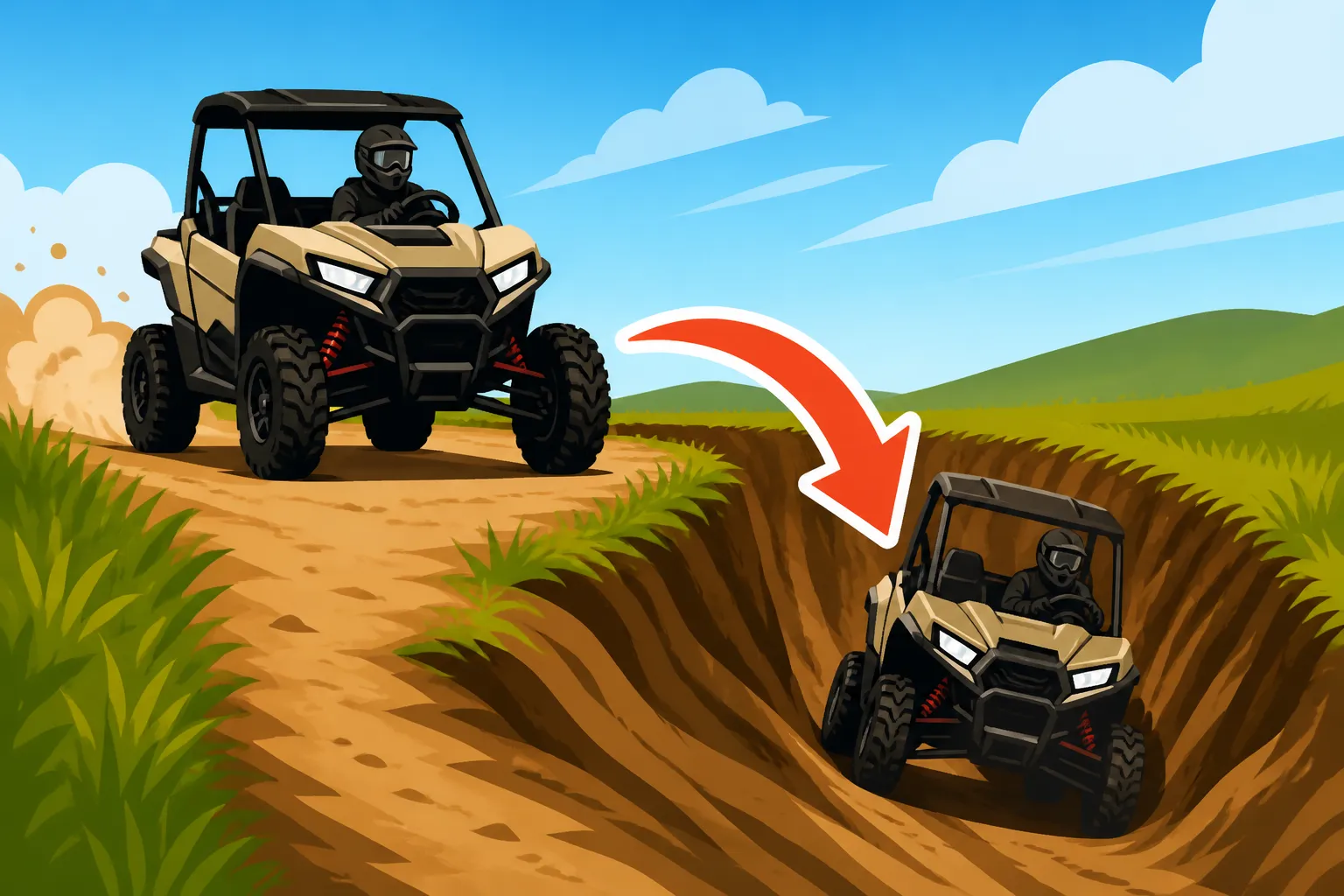
Once you've successfully bypassed the obstruction, the next crucial step is to legally and safely return to your designated ditch riding area. This isn't a suggestion; it's a requirement of the "transitory operation" rule. You must re-enter the ditch as soon as the obstruction is cleared and it is safe to do so. Lingering on the shoulder or roadway after the obstacle is gone can lead to a citation for illegal operation.
When and Where You Can Re-enter
The law is pretty clear here: you must return to the ditch bottom or back-slope "as soon as it is safe and practical to do so." This means the instant you are clear of the barrier, and there's a safe point to drop back down into the ditch, you should make your move. Don't wait until the next driveway or section line. The point of re-entry should be free of hazards, relatively level, and allow you to smoothly transition your machine back into the ditch without abruptly cutting off traffic or losing control.
Look for a spot where the ditch isn't too deep, or where there's a gentle slope. Sometimes, the spot where the obstruction ends might be immediately suitable, but if not, continue just a few feet until you find a safe point. Remember, the goal is minimal travel on the shoulder or roadway. If you end up riding a quarter-mile on the shoulder after passing a small culvert, you're likely extending your transitory operation beyond what's legally allowed.
Minimizing Roadway Travel
As we've emphasized, the entire point of the obstruction exception is to allow for temporary, short-distance travel on surfaces not typically open to ATVs and UTVs. Therefore, once you've cleared the obstruction, every effort should be made to minimize any further travel on the roadway or shoulder. This means actively looking for the earliest safe opportunity to return to the ditch. Think of it like this: your machine is only on the shoulder or road out of necessity, not choice.
This is a key area where riders sometimes misinterpret the rules. It's easy to get comfortable on the smooth shoulder after a bumpy ditch, but resisting that temptation is vital for staying legal. The very next safe spot means the very next. Don't pass up multiple opportunities to re-enter the ditch because the shoulder is simply a more pleasant ride. Law enforcement officers are well aware of this provision and will be looking for riders who abuse it by extending their roadway travel unnecessarily.
Signaling Your Intentions
Communication with other road users is paramount during any maneuver that involves leaving or returning to the ditch. If your ATV or UTV is equipped with turn signals, by all means, use them! Signal your intent to move from the ditch onto the shoulder, and then signal again when you intend to move back into the ditch. This provides a clear indication to drivers behind you about your next move, allowing them to adjust their speed or position accordingly.
If your machine doesn't have factory turn signals – which is common for many ATVs and UTVs – then hand signals become your best friend. A clear, deliberate hand signal indicating a right turn (for moving into the ditch) or a left turn (if you needed to move left briefly to get around a very wide obstruction before returning) can make a world of difference. Even a simple arm out, pointing to where you're going, can alert drivers. Making eye contact with other drivers, if possible and safe, also helps ensure they've seen your intentions. Being predictable on the road is a huge safety factor, especially when you're on an OHV that's less visible than a full-sized vehicle.
Practical Tips for Smooth Transitions
Navigating these transitions can be smooth and safe with a bit of practice and preparation. It's about being observant, understanding your machine, and respecting the shared space on and near the road. Think of every ditch ride as a dynamic experience where conditions can change rapidly.
Assessing the Ditch Before Re-entry
Before you even start your move back into the ditch, take a moment to quickly assess the re-entry point. Is the slope too steep? Are there any hidden rocks, branches, or soft spots that could cause you to lose control? Is there a narrow culvert immediately ahead that you didn't see from the road? A quick visual scan can prevent a lot of trouble. You want a clear, stable path to ease your machine back into the ditch bottom or onto the back-slope.
Sometimes, the ideal re-entry point might be a few feet past where you initially thought. Don't rush it. It's far better to travel an extra ten feet on the shoulder to find a truly safe and stable re-entry point than to attempt a dicey maneuver and risk a rollover or getting stuck. This is especially true after heavy rains when ditch banks can be soft and slippery, or after a snowmelt when the ground is saturated. Having the right tires, perhaps a good all-terrain set from SuperATV, can make these transitions much easier.
Visibility and Other Road Users
When you're briefly on the shoulder or roadway, you are sharing space with vehicles that are much larger, faster, and often less aware of OHVs. Your machine is smaller, lower profile, and can be harder to see, especially at dawn, dusk, or in adverse weather. Make yourself as visible as possible. This means wearing bright, high-contrast clothing, using your headlights and taillights even during the day, and perhaps even adding reflective tape to your machine.
Always assume that other drivers haven't seen you. Drive defensively. Anticipate that cars might not slow down or move over. Keep a safe distance from other vehicles, and be particularly cautious around blind curves or hillcrests where visibility is limited for everyone. If you're riding in a group, try to stay together and maintain a predictable pattern of movement. For more on safety, consider [North Dakota Helmet Law for Riders Under 18] and general [North Dakota Insurance Requirements at Registration].
Gear and Machine Preparedness
Being prepared isn't just about knowing the rules; it's about having the right gear and a well-maintained machine. A good set of tires, properly inflated, will give you the traction and stability you need for these transitions. A sturdy winch can be a lifesaver if you misjudge a ditch re-entry and get stuck in soft ground – a scenario all too common in North Dakota's gumbo mud. Companies like SuperATV offer a wide range of accessories that can enhance both safety and capability for ditch riding.
Always ensure your brakes are in excellent working order, your steering is tight, and all your lights are functional. Carry a basic toolkit, a first-aid kit, and enough water and snacks, especially on longer rides. Your machine needs to be ready for whatever the ditch, or a brief stint on the shoulder, throws at it. A minor mechanical issue during a tricky transition can quickly escalate into a dangerous situation. Think about it: if you're pulling out onto a paved road to avoid a fence, you absolutely need your machine to perform flawlessly for that brief, critical moment.
Disclaimer
This article is for general informational purposes only and does not constitute professional advice. Laws, prices and regulations vary by location and change over time. Consult a qualified professional for guidance on your specific situation.