Why Landowner Permission Lapses Off Season
A landowner’s yes to riding can be easy to misunderstand: it may cover a particular trail, activity, or season, not every visit for as long as you own your ATV or UTV. In North Dakota, seasonal closures and changing land-use agreements matter. Here’s how to tell when permission may no longer apply and what to confirm before riding.
Permission is limited to what the landowner agreed to
North Dakota does not give riders a general right to cross private land just because a route is familiar, a gate is open, or a machine is registered. You need permission from the landowner or someone authorized to give it. That permission might be spoken or written, but its scope depends on what was actually agreed.
A landowner may allow access for a specific purpose, such as retrieving game, reaching a field, or using a marked route during an organized season. Permission for one purpose does not automatically cover another. For example, access to hunt does not necessarily include permission to take a recreational ride, bring a group, or use a different route.
The same principle applies to time. A landowner might say yes for a weekend, for a hunting season, or while a particular trail agreement is active. Unless the permission clearly grants broader access, do not treat it as permanent. A previous yes is not a reliable substitute for checking whether access is still allowed.
| What you were told | What it may cover | What to confirm |
|---|---|---|
| “You can use this trail” | A particular route, possibly for a limited time | Which route, dates, machines, and riders are included |
| “You can ride during the season” | The season named by the landowner or trail agreement | When the season begins and ends, and whether closures apply |
| “You can cross to the field” | A specific crossing or destination | Whether you may continue beyond it or make a recreational loop |
| “You can ride here” | Access subject to the landowner’s conditions | Whether the permission is still current and can be withdrawn |
| A gate is open | No permission by itself | Whether access has been granted at all |
If you have written permission, read it for dates, route limits, permitted vehicles, and any conditions about guests or groups. A form can help make the agreement clear, but it does not make access unlimited. North Dakota Landowner Permission Forms and North Dakota Posted Land Permission cover useful ways to document and understand landowner access.
Permission may also be withdrawn. A landowner could close a route because of crop work, livestock, erosion, hunting activity, repairs, or a change in the access arrangement. If you hear that access has ended, or you see a new closure, do not assume that an older agreement overrides the change. Stop and verify before entering.
Why a seasonal yes may not apply off season
Some access arrangements exist only for a defined riding season. A trail may cross private parcels with the owners’ consent, and that consent may be tied to a particular trail program, maintenance schedule, or period of use. When the season ends, the permission may end with it. It is the terms of the arrangement—not the fact that riders used the trail before—that determine whether access continues.
Snowmobile trails are a useful example of why dates matter. A route established for snowmobile use is not automatically an ATV or UTV trail once snow is gone. Seasonal trail access can involve landowner agreements and operating conditions that do not extend to other machines or other months. North Dakota’s snowmobile trail network has seasonal closures; check the current trail information and the landowner or managing organization before assuming a route is open. See Snowmobile Trails Closed April to November for more on that distinction.
Off-season use can also cause practical problems even where a route was previously open. Thawing ground, wet soil, growing crops, livestock movement, or maintenance work may make travel damaging or unsafe. A route that handles snowmobiles in winter may be especially vulnerable when the ground is soft. Riding there without fresh approval can damage property and jeopardize future access for everyone.
Do not interpret silence as an extension of permission. If an owner allowed use last season and has not contacted you, that does not necessarily mean the arrangement remains active. Likewise, permission from one landowner does not cover adjoining property. A route across several parcels may require approval from each owner or participation in a specific access agreement.
Off-season permission can be explicit. A landowner may tell you that access continues year-round or may grant permission for a separate date or activity. If so, follow the exact limits given. Clarify whether the agreement includes your type of machine, the intended route, passengers, guests, and any requirement to stay on a marked track. Do not broaden a narrow yes into permission for general riding.
A permit does not replace landowner permission
A North Dakota registration or visitor permit addresses a different question from private-land access. It does not grant permission to cross private property, reopen a closed seasonal route, or override a landowner’s conditions. Before riding, check both sides of the issue: whether your machine and permit requirements are in order, and whether you have permission to use the ground or route.
This distinction is particularly important for visitors. A permit may be required for a nonresident machine, but buying one does not create access rights on private land. North Dakota does not offer broad reciprocity that turns another state’s registration or sticker into permission to ride any route in North Dakota. Check North Dakota Non-Resident OHV Permit and North Dakota Has No Reciprocity With Any State if you are bringing a machine from elsewhere.
The same caution applies to public land. A landowner cannot authorize access to land they do not control, and a private agreement does not replace rules set by a land manager. For example, a route on national grassland may be limited to roads shown as open to motor vehicles. Use the applicable map and current restrictions rather than assuming that a road or track is open because it crosses land that looks unoccupied. North Dakota Grassland Motor Vehicle Use Maps explains how to check designated routes.
Before a ride, think through the access in separate steps:
- Identify the land and route. Work out which parcel or managing agency controls each part of your planned route.
- Check the season and current status. Look for closures, wet-ground restrictions, trail notices, and dates on any permission or agreement.
- Confirm the machine is covered. Permission for a snowmobile, for example, does not automatically include an ATV or UTV.
- Ask about the exact use. State where you plan to ride, when, with whom, and whether you intend to stop, make a loop, or cross to another parcel.
- Follow any conditions. Stay on the allowed route, respect gates and signs, and leave if the owner or manager closes access.
A visitor permit can also have its own time period and use limits. Do not confuse its validity dates with a landowner’s access dates. A valid permit may let you satisfy a state requirement while still leaving you without permission to ride a particular trail.
How to confirm permission before riding
When the permission was informal or seasonal, ask again before using the route off season. A brief, clear question is better than guessing. Explain that you have ridden there before, identify the route, and ask whether access is still allowed for your machine and planned dates. If the owner sets conditions, write them down or ask for them in writing so that everyone in your group understands the limits.
If several parcels are involved, confirm access for the full route, not just the starting point. Permission to enter one property does not extend across a neighbor’s land. If the route belongs to a club, trail operator, or organized event, check with that organization about its current agreement and closure information. The existence of trail markings or a route on an older map does not prove that access remains open.
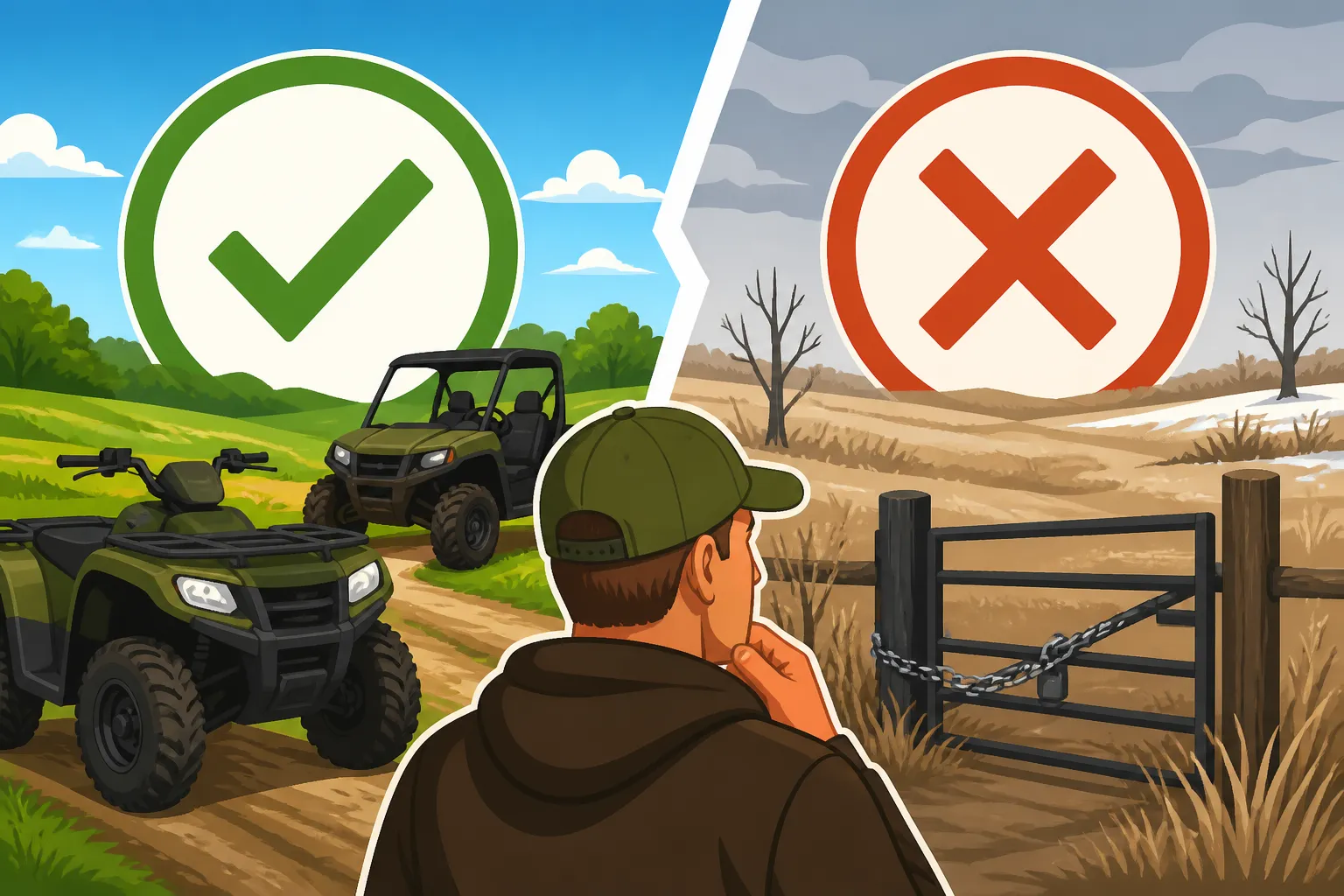
Watch for signs, gates, and other restrictions. A gate that is open may be open for livestock, farm equipment, or another authorized user; it is not a standing invitation to ride through. A closed gate should be left as found, and a posted closure should be respected. When access is unclear, stop and contact the landowner or responsible manager rather than entering to ask from inside the property.
If the owner cannot be reached, choose a route where access is clearly allowed. Do not rely on another rider’s recollection, an old social media post, or last year’s trail map as proof that a seasonal agreement remains in force. Trail conditions and permissions can change independently of registration requirements.
For group rides, make sure every participant knows the boundaries. One person’s permission does not automatically cover a larger group, extra guests, or a different route. Share any restrictions before setting out, and have a plan to turn around if a gate or closure blocks the route. Respectful use helps maintain relationships with landowners and keeps future access possible.
The practical rule is straightforward: treat permission as specific, seasonal when stated, and subject to confirmation when the season changes. A new season, a different machine, or a changed route is a good reason to ask again. Having the right registration or permit is important, but it never substitutes for permission to use land you do not control.
Disclaimer
This article is for general informational purposes only and does not constitute professional advice. Laws, prices and regulations vary by location and change over time. Consult a qualified professional for guidance on your specific situation.