North Dakota OHV Plate or Decal: Your Choice
Navigating the ins and outs of off-highway vehicle (OHV) registration in North Dakota can feel like trying to find your way through a gumbo mud pit after a spring thaw – confusing, a little messy, and with plenty of spots where you might get stuck if you don't know the terrain. One common head-scratcher that pops up for many riders is the choice between an OHV plate and a decal. You've heard whispers, perhaps seen different machines with different identifiers, and it leaves you wondering: which one do I need? And why is there even a choice in the first place? This comprehensive guide is here to clear the mud, explain the options, and help you understand the nuances of North Dakota's OHV identification system so you can ride with confidence and compliance.
Understanding North Dakota's OHV Registration Basics
Before we dive deep into the plate versus decal debate, it's crucial to grasp the fundamental requirements for OHV registration in North Dakota. This isn't just about sticking a sticker on your fender; it's about being a responsible owner and ensuring you're legally permitted to enjoy the incredible riding opportunities this state offers, from the Pembina Gorge to the sprawling grasslands. Ignoring these basics can lead to unnecessary fines and a big headache, which no one wants when all they're trying to do is hit the trails.
Who Needs to Register an OHV in North Dakota?
The vast majority of off-highway vehicles operating on public lands or trails in North Dakota are required to be registered. This includes your ATVs, UTVs, dirt bikes, and even those tracked dirt bikes that are becoming more popular for year-round fun. Think of it this way: if it's motorized, designed for off-road use, and you plan to take it anywhere other than strictly private property you own or have explicit, documented permission for, you probably need to register it.
There are a few narrow exceptions, of course. For instance, if your machine is used exclusively for agricultural purposes on private farmland, or if it's strictly for organized racing events on a closed course, you might be exempt. However, the minute that farm machine touches a public road shoulder or that race quad goes for a casual spin down a county section line, those exemptions typically vanish. It's always best to err on the side of caution and ensure your machine is properly registered to avoid any awkward conversations with local law enforcement. For a deeper dive into specific scenarios, you might want to read up on [North Dakota Registration Exemptions Explained].
The Two-Year Registration Cycle Explained
North Dakota operates on a predictable two-year registration cycle for its OHVs. This means you're not scrambling to renew every single year, which is a nice little convenience for busy riders. The current cycle, for example, might run from January 1, 2024, through December 31, 2026. All registrations, regardless of when you initially apply within that cycle, expire at the end of the two-year period. So, if you register your brand-new side-by-side halfway through the cycle, say in July 2025, it will still expire on December 31, 2026, alongside everyone else's.
This uniform expiration date simplifies things for the state, but it's important for you to remember. You'll receive a renewal notice, but keeping track yourself is key. Missing the renewal deadline means riding unregistered, which can come with penalties. The registration period is fixed, so you're essentially paying for a spot in that two-year window, regardless of your purchase date within it. You can explore this further in [North Dakota's Two-Year Registration Cycle].
The Breakdown of North Dakota's Registration Fees
Let's talk numbers, because that's often where the rubber meets the road. The cost to register your OHV in North Dakota is pretty straightforward. You're looking at a base registration fee, which covers the administrative side of things, and then a trail tax, which is absolutely vital for maintaining the trails we all love to ride.
Currently, the total amount you'll pay for that two-year registration is a combination of these two components. The registration fee is generally quite modest, while the trail tax makes up the larger portion. This trail tax is specifically earmarked for the development and maintenance of North Dakota's OHV trail system, so every dollar contributes directly to keeping those riding areas open and in good shape. It's a small investment that pays dividends in accessible, well-maintained trails for everyone. If you're curious about the specifics of where that trail money goes, [Where the Trail Tax Actually Goes] offers a good explanation.
Here's a simplified look at the cost components:
| Fee Type | Purpose | Frequency |
|---|---|---|
| Registration Fee | Administrative processing of your OHV | Every 2 years |
| Off-Highway Trail Tax | Funding for OHV trail maintenance and development | Every 2 years |
| Total Cost | Your Two-Year OHV Registration |
Note: Specific fee amounts can change, so always check the North Dakota Department of Transportation (NDDOT) website for the most current figures.
The Great Debate: Plate Versus Decal in North Dakota
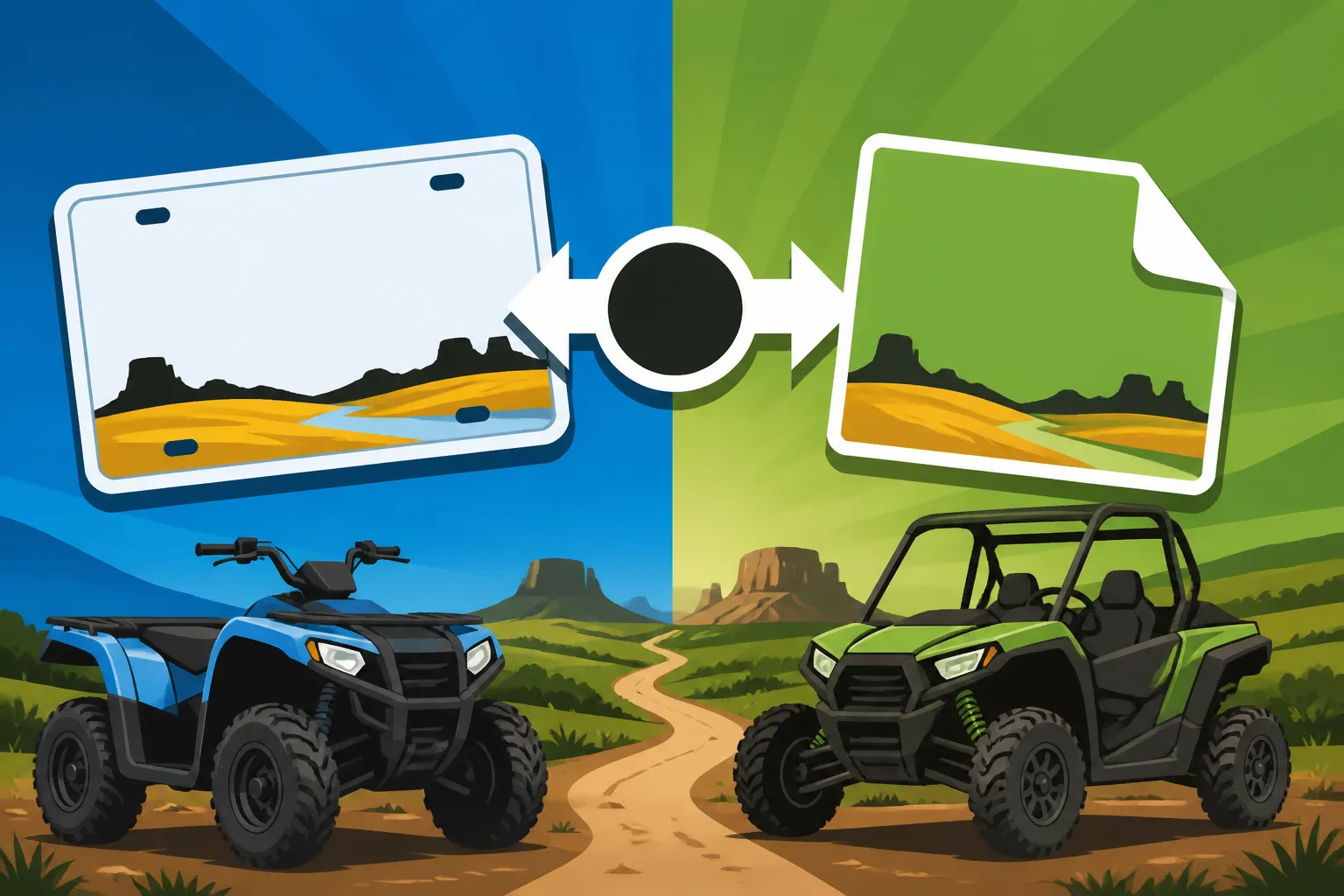
Now, for the main event: the choice between an OHV plate and a decal. It's not a trick question, and neither option is inherently "better" in a universal sense. Instead, North Dakota gives you the flexibility to choose what best suits your machine and how you use it. This decision often boils down to the type of OHV you own and personal preference regarding visibility and mounting.
What a North Dakota OHV Plate Signifies
If you opt for an OHV plate, you'll receive a physical, typically metal, license plate that looks much like a smaller version of what you'd see on a car or truck, but designed for your off-road machine. This plate will have your registration number clearly displayed, along with the "North Dakota" identifier. The main benefit of a plate is its durability and often, its visibility. It's a solid, permanent fixture that's hard to miss.
Plates are often a popular choice for larger OHVs like side-by-sides (UTVs) that have dedicated flat mounting points, typically on the rear. Many UTVs come from the factory with a space designed to accommodate a license plate, making installation straightforward. The plate acts as a clear, unmistakable identifier of your registered status, which can be particularly helpful if you frequently ride on roadways where OHVs are permitted, as it makes your compliance easily verifiable by law enforcement. You can even get [North Dakota Personalized OHV Plates at $25] if you want to add a unique touch to your machine.
The Purpose and Placement of a North Dakota OHV Decal
Alternatively, you can choose a decal. A North Dakota OHV decal is a heavy-duty, adhesive sticker that also displays your unique registration number, along with the year of expiration. These decals are designed to withstand the rigors of off-road riding – mud, water, sun, and abrasive brush.
Decals are frequently chosen for machines like ATVs and dirt bikes, where a traditional metal plate might be cumbersome or difficult to mount securely without modification. Dirt bike fenders, for example, often don't have a flat, protected area suitable for a plate. The decal allows for placement on a visible, relatively flat surface, such as a rear fender, a side panel, or even the front cowl, as long as it's clearly visible. The key here is visibility and secure adhesion, ensuring it doesn't peel off after a few adventurous rides. The law is pretty specific about proper [North Dakota Decal Placement Rules] to ensure your registration is always evident.
Making the Right Choice for Your Riding Style
The decision between a plate and a decal truly comes down to practicality and aesthetics for your specific machine and your typical riding.
- For UTVs/Side-by-Sides: Many UTV owners lean towards the plate. These machines often have dedicated rear bumpers or tailgate areas that are perfect for mounting a plate, keeping it secure and visible. If you're frequently on gravel roads or crossing highways, a plate provides a very clear visual cue of your registration.
- For ATVs/Quads: This is often where the choice becomes more personal. Some ATVs have flat rear fender areas that can accommodate a plate, but many riders prefer the decal for its less intrusive nature and lower risk of getting snagged or damaged. The decal blends more seamlessly with the machine's body lines.
- For Dirt Bikes: Decals are almost universally the preferred choice for dirt bikes. The dynamic nature of dirt bike riding and the lack of suitable flat mounting surfaces make a physical plate prone to damage or loss. A well-placed decal on a fender or side panel is usually the most practical solution.
Ultimately, North Dakota offers this choice because they understand that not all OHVs are built the same, and what works for a large UTV might not work for a nimble dirt bike. The goal is clear identification of a registered machine, and both options accomplish that effectively when properly displayed. You can read more about why this flexibility exists in [Why North Dakota Lets You Pick a Plate or Decal].
Applying for Your North Dakota OHV Registration
So, you've decided on your plate or decal, and you're ready to get your machine registered. The application process itself is fairly standard, whether you're titling a brand-new machine straight from the dealership or getting paperwork in order for a used quad you picked up in a private sale. Don't worry, it's not designed to be an obstacle course, but it does require attention to detail and the right forms.
Required Documents for Registration
Gathering your documents before you head to the NDDOT office or mail in your application will save you a lot of time and frustration. The core documents you'll typically need include:
- Application for Certificate of Title & Registration (SFN 2872): This is the foundational form that starts the whole process. You'll fill in all the details about your machine, including its make, model, VIN, and your personal information as the owner. Pay close attention to every field to avoid delays. You can find detailed information about [What the Title Application SFN 2872 Asks For].
- Proof of Ownership: This is critical. For a new machine, this will be your Manufacturer's Statement of Origin (MSO) or Certificate of Origin (MCO). For a used machine, it's typically a properly assigned title from the previous owner, or in some cases, a bill of sale, especially if the machine was from a state that doesn't title OHVs. If you're buying from a private seller, ensure you get a robust bill of sale. Sometimes, a [North Dakota Bill of Sale Form SFN 2888] can be helpful.
- Proof of Identity: You'll need a valid form of identification, such as a driver's license.
- Payment for Fees: Be prepared to pay the registration fees, trail tax, and any applicable titling fees or excise taxes. The payment methods accepted can vary, so it's wise to check beforehand.
If you're buying a used machine and there's any ambiguity about the ownership history, or if it's from a state without titles, you might need additional documentation like a [North Dakota Statement of Ownership Form SFN 2903] or even a VIN inspection. It's always a good idea to call ahead to your local NDDOT branch if your situation is unique.
Where to Submit Your Registration Application
You have a couple of options when it comes to submitting your registration application in North Dakota, catering to different preferences and conveniences:
- In-Person at an NDDOT Branch Office: This is often the quickest and most direct way, especially if you have questions or a complex situation. There are NDDOT branch offices located throughout the state, for example, in cities like Bismarck, Fargo, Grand Forks, Minot, and Williston. Going in person allows a clerk to review your documents, answer questions on the spot, and process your application efficiently. You can walk out with your temporary registration, and sometimes even your decal, on the same day. This is generally the recommended route for a new registration. You can find more on [Registering at a Motor Vehicle Branch].
- By Mail to the Central Office: If visiting a branch office isn't feasible, you can mail your completed application and supporting documents, along with payment, to the NDDOT's central office in Bismarck. While convenient, this option will naturally involve longer processing times due to mail transit and internal handling. Make sure all your paperwork is meticulously filled out and copied for your records before sending.
Regardless of the method, ensure your forms are legible and complete. Incomplete applications are a primary cause of delays, forcing the NDDOT to send them back to you for corrections.
What to Expect After You Apply
Once you've submitted your application, the waiting game begins, though it's usually not a terribly long one for registrations.
- Temporary Registration: If you apply in person, you'll often receive a temporary registration permit immediately. This allows you to legally operate your OHV while the permanent plate or decal is being processed and mailed.
- Processing Time: The NDDOT aims for efficient processing, but times can vary depending on their workload. Typically, you can expect to receive your physical plate or decal in the mail within a few weeks. If there are any issues with your application, you'll be contacted by mail or phone for clarification or additional information. You can often find current estimates for [North Dakota Registration Processing Time] on the NDDOT website.
- Plate vs. Decal Delivery: If you chose a decal, it will arrive ready to be affixed to your machine according to the placement rules. If you opted for a plate, it will arrive with instructions for mounting. Remember, the goal is always clear visibility, so ensure your chosen identifier is free from obstructions and easily seen.
It's a good practice to keep a copy of your application and any temporary permits with you when you ride until your permanent registration arrives. This way, if an officer asks to see your documentation, you have proof that your process is underway.
Beyond the Initial Registration: What Comes Next
Getting your OHV registered is just the first step. Like any vehicle, your off-road machine will have ongoing requirements, from renewing that two-year registration to updating information or transferring ownership. Staying on top of these administrative tasks ensures continuous compliance and a smooth ownership experience.
Renewing Your North Dakota OHV Registration
As the end of that two-year cycle approaches, you'll need to renew your registration to keep your OHV legal on public lands. The good news is that the NDDOT typically sends out renewal notices to the address on file, often several weeks before your registration is due to expire. These notices usually include clear instructions on how to renew.
- Online Renewal: Many owners find renewing online to be the most convenient option. You'll usually need your current registration number or VIN and a payment method.
- Mail-In Renewal: You can also send your renewal application and payment through the mail.
- In-Person Renewal: As with initial registration, you can visit a local NDDOT branch to renew in person.
It's vital to renew on time. Riding with an expired registration is the same as riding unregistered, and it can lead to citations. Even if you're not riding your machine during the winter months, if you plan to use it once the snow melts, you need to ensure its registration is current. For more detailed steps, check out [North Dakota ATV Registration Renewal].
Transferring Ownership of a Registered OHV
When it's time to sell your registered OHV, or if you've purchased one from a private seller, transferring ownership is a crucial step that legally changes who is responsible for the machine. This process involves the seller properly signing over the title (if one exists) and the buyer applying for a new title and registration in their name.
- Seller's Responsibilities: As a seller, you're responsible for signing the title over to the buyer and, in most cases, notifying the NDDOT of the sale within a specific timeframe. You'll typically remove your plate or decal from the machine.
- Buyer's Responsibilities: As the buyer, you must apply for a new title and registration in your name within 15 days of the purchase. This involves submitting the signed-over title (or other proof of ownership), your application forms, and paying the necessary fees, including the [North Dakota Excise Tax on a Private Sale]. Failing to transfer ownership promptly can lead to penalties and complicate future transactions.
Always complete a bill of sale, even if you have a title. This protects both parties by documenting the sale price, date, and condition of the machine. Online services like LawDepot offer customizable bill of sale templates that can help ensure you cover all the necessary details, preventing misunderstandings down the road.
Replacing a Lost or Damaged Plate or Decal
Accidents happen. Your OHV plate might get bent or fall off on a rough trail, or your decal could fade significantly or get torn. If your plate or decal becomes unreadable, lost, or stolen, you'll need to apply for a replacement.
This process is usually straightforward: you'll fill out a specific form (often the same title and registration application form, but indicating you need a replacement), pay a small fee, and submit it to the NDDOT. It's important to do this promptly because riding with an unreadable or missing identifier is, again, considered operating an unregistered vehicle. Always verify the current [North Dakota Plate Replacement Cost] or duplicate decal fees. Having a clear and current identifier is not just about compliance; it's also about safety and accountability if your machine is ever involved in an incident or recovered after theft.
Titling Your OHV in North Dakota: A Related but Distinct Process
While often done concurrently, registration and titling are actually two distinct processes for your OHV in North Dakota. Registration allows you to operate the machine legally on public lands, while titling establishes legal ownership. Think of it this way: registration is like getting a temporary permit to use public facilities, while a title is the deed to your property.
When a North Dakota OHV Title is Required
Not every OHV is required to have a title in North Dakota, but most are. Generally, if your OHV is a Class I, II, or III machine (which covers most ATVs, UTVs, and dirt bikes as defined by North Dakota law), and it's being registered for public use, it will need a title. The title is the definitive document proving you are the legal owner. This is particularly important when buying or selling an OHV, as a clean title ensures a clear chain of ownership and prevents issues with stolen vehicles.
A title is almost always required for any new OHV purchased from a dealership. For older machines or those brought in from states that don't title OHVs, there might be specific procedures to establish ownership and get a North Dakota title, which could involve a VIN inspection and other documentation. It's always best to inquire with the NDDOT if you're unsure about your specific machine's titling requirements. Learn more about [Titling an ATV in North Dakota] and [Titling a Dirt Bike in North Dakota].
The North Dakota Title Application Process
The title application process often goes hand-in-hand with your initial registration. In North Dakota, you typically use the same [North Dakota Form SFN 2872 Explained] (Application for Certificate of Title & Registration) for both. On this form, you'll provide detailed information about your OHV, including the Vehicle Identification Number (VIN), make, model, and year, along with information about any liens if you financed the purchase.
Key steps in the titling process include:
- Completing SFN 2872: Fill out all sections accurately.
- Submitting Proof of Ownership: This could be an MSO from a dealer, a properly assigned title from a previous owner, or a bill of sale for an untitled machine.
- VIN Inspection (if required): For out-of-state machines without titles, or those with salvaged titles, a VIN inspection might be necessary to verify the machine's identity. This helps prevent fraud and ensures the machine isn't stolen.
- Paying the Title Fee: There is a one-time [North Dakota Title Fee of $5] associated with issuing the physical title document.
Once processed, you'll receive your Certificate of Title, usually by mail from the central NDDOT office, separate from your registration plate or decal. This document should be kept in a safe place, as it's your ultimate proof of ownership.
Understanding Excise Tax and Other Titling Fees
When you title your OHV in North Dakota, you'll also encounter the state's excise tax. This isn't a "sales tax" in the traditional sense, but it functions similarly for motor vehicles and OHVs.
- North Dakota's 5 Percent Excise Tax: North Dakota imposes a 5 percent motor vehicle excise tax on the purchase price of your OHV, whether you bought it from a dealer or a private seller. This tax is typically collected at the time of titling. So, if you bought a UTV for $10,000, you'd pay $500 in excise tax when you apply for the title.
- Dealer Safety Fee: If you purchased your OHV from a licensed North Dakota dealer, you might also see a small [North Dakota Dealer Safety Fee of $5] on your invoice, which is remitted to the state.
- Other Potential Fees: Depending on your situation, there could be other minor fees, such as a lien recording fee if you financed your purchase.
It's important to understand that the excise tax is based on the fair market value or purchase price, whichever is higher, to prevent undervaluing vehicles to avoid tax. If you buy a machine at a really low price, the NDDOT might ask for an appraisal or other proof of value. This excise tax is a one-time payment when the ownership is transferred and a new title is issued. For more details on this, you can look into [North Dakota Excise Tax on an ATV Purchase].
Common Questions and Clarifications for North Dakota OHV Owners
Even with all the rules laid out, specific situations can still throw a wrench into things. It's natural to have lingering questions about exemptions, what happens when visitors come to ride, or how to keep your paperwork in order. Let's tackle some of those common points of confusion.
Exemptions from North Dakota OHV Registration
While most OHVs need to be registered, there are indeed a few specific scenarios where your machine might be exempt. It's crucial to understand these precisely, as misinterpreting an exemption can lead to fines.
- Private Land Use: If your OHV is exclusively operated on private property owned by you or for which you have explicit written permission, it generally doesn't need to be registered. This is the most common exemption. However, the moment that machine rolls onto a public road, trail, or even a public ditch right-of-way, this exemption no longer applies. Read more at [North Dakota's Exemption for Machines Used on Private Land].
- Organized Events: Machines used exclusively in organized races or other competitive events on a closed course are typically exempt from registration. Again, this is only for the event itself.
- Government-Owned Machines: OHVs owned and operated by government agencies for official duties are usually exempt.
- Out-of-State Visitors (for a limited time): This is a big one for our neighbors. If you're visiting North Dakota from another state and your OHV is properly registered in your home state, you can ride here for up to 30 consecutive days without needing a North Dakota registration. Beyond that, you'll need to get a non-resident permit. This is covered in [North Dakota's 30-Day Out-of-State Rule].
If you believe your machine falls under an exemption, ensure you have documentation to prove it. For instance, if you're on private land, carry proof of ownership or written permission. Never assume an exemption applies without verifying the specific conditions.
Rules for Non-Resident OHV Riders
North Dakota welcomes visitors, and its OHV trails are a draw for many riders from surrounding states and even Canada. As mentioned, there's a grace period for out-of-state registered machines.
- The 30-Day Rule: If your OHV is legally registered in your home state or province, you can ride in North Dakota for up to 30 consecutive days without needing a North Dakota registration. This is perfect for a weekend trip or a longer vacation.
- Non-Resident Permit: If you plan to stay and ride for longer than 30 consecutive days, you will need to purchase a North Dakota Non-Resident OHV Permit. This permit costs a small fee and is valid for a calendar year (January 1 to December 31), regardless of when you purchase it. It's a way for the state to ensure that those who are frequently using its resources are contributing to their upkeep. [North Dakota Non-Resident Permit Cost] will give you the current details.
- Safety Certificates: While adults don't usually need a safety certificate, riders under the age of 16 often have specific requirements for safety training. Visitors should check North Dakota's rules regarding youth rider safety certificates, as reciprocity with other states might not always apply.
Always carry proof of your home-state registration or your North Dakota non-resident permit when riding. An officer might ask to see it, especially in popular riding areas like Pembina Gorge or the Roughrider Trail.
The Importance of Accurate Records and Forms
Keeping accurate and organized records for your OHV is not just good practice; it's essential for smooth sailing through all the administrative processes. Whether it's for initial registration, selling your machine, or dealing with an insurance claim, having all your ducks in a row can save you immense hassle.
- Maintain a File: Keep copies of your title, registration applications, bills of sale, insurance documents, and any inspection reports in a dedicated file at home.
- Digital Backups: Consider scanning important documents and keeping digital backups on a cloud service or external drive.
- Forms Availability: The NDDOT website is a primary resource for all official forms. However, sometimes you might need specific legal documents, like a more comprehensive bill of sale or an affidavit of ownership. Websites like LawDepot offer a wide range of legal document templates that can be customized to North Dakota's requirements, helping you create professional and legally sound paperwork when buying or selling, or if you encounter unique ownership challenges. This can be particularly useful for private sales where you want more protection than a simple handwritten note.
- Address Changes: If you move, promptly notify the NDDOT of your new address. Failing to do so means you might miss renewal notices or other important correspondence. This is often an overlooked detail, but it's a critical one for staying compliant. Learn more about [North Dakota Address Change Notice].
Being diligent with your paperwork ensures that your ownership is clear, your machine is properly identified, and you can quickly resolve any administrative issues that arise. It's the less glamorous side of OHV ownership, but just as important as maintaining your engine or checking your tire pressure before a ride.
Disclaimer
This article is for general informational purposes only and does not constitute professional advice. Laws, prices and regulations vary by location and change over time. Consult a qualified professional for guidance on your specific situation.