North Dakota Lodging That Welcomes Trailers
Arriving after a long tow only to find a cramped lot, a tight turn, or nowhere safe to leave your ATV trailer can spoil a North Dakota riding weekend before it starts. The best place to stay depends on your trail area, trailer length, and whether you need hookups or just a secure place to park. This guide helps you plan lodging around those real-world details.
Choose lodging near the riding area
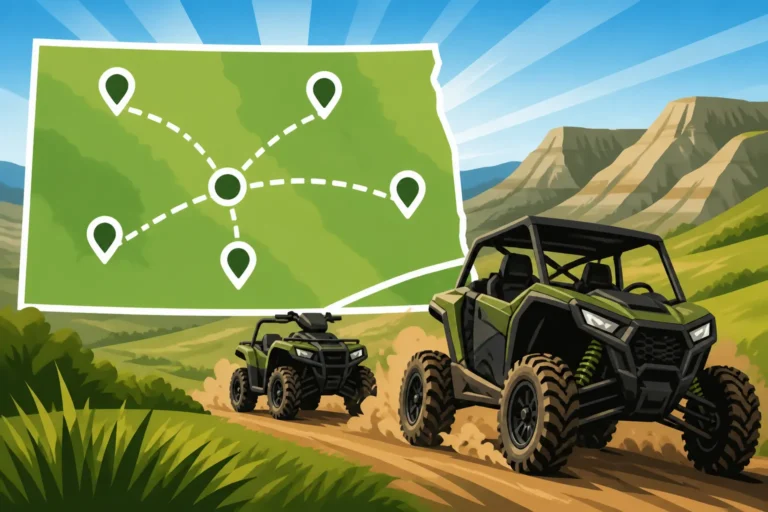
North Dakota’s riding areas are spread out, so it helps to pick your base before booking a room or campsite. Staying close can mean less towing each morning, but a nearby property is not automatically set up for long trailers. Ask about parking and access directly, and confirm the route from the lodging to the trailhead works for your truck and trailer.
Pembina Gorge and Walhalla
Walhalla is a practical base for riding at Pembina Gorge. The area’s wooded terrain and winding roads can feel very different from the open prairie, and arriving with a trailer calls for a little route planning. Check where you can park at your accommodation, then check how you’ll get from there to the trailhead at the Pembina Gorge recreation area. The details in [Pembina Gorge's Trailhead Northwest of Walhalla] can help you orient your trip.
If you want to camp, look into options in and around the Pembina Gorge area and confirm what each site can accommodate. A campsite that fits a tent or small camper may not have enough room for a truck, a large travel trailer, and an ATV trailer all at once. Ask whether the site itself can hold your full setup or whether you’ll need a separate parking space.
Walhalla can also work if you prefer to stay in town and ride during the day. Before booking, ask about the exact parking arrangement: where the trailer sits overnight, whether you can leave it hitched, and whether there is room to turn around without backing into traffic. For local trip planning, [Walhalla as a Riding Base] is a useful companion to your lodging search.
Bismarck, Mandan, and the Roughrider OHV Trail
For the Roughrider OHV Trail, Bismarck and Mandan offer more lodging and supply options than a remote trailhead. That convenience can be helpful if you’re travelling with a group, need groceries or fuel, or want a regular hotel room. The trade-off is that an urban property may have a busy lot and little room for a long rig. Don’t assume a standard parking stall is enough.
Look at your riding plan before choosing a property. The Roughrider corridor connects riding areas near Fort Abraham Lincoln and Fort Rice, so your preferred starting point matters. Read [Roughrider OHV Trail Links Fort Abraham Lincoln and Fort Rice] and [Roughrider's New Trailhead at Fort Abraham Lincoln State Park] to understand how the trail fits into your itinerary. Then ask your lodging provider whether you can park the trailer there overnight or need to stage it elsewhere.
If you’re staying near Mandan or Bismarck, ask about more than parking dimensions. Check whether the property allows trailer parking overnight, whether the lot is paved or gravel, and whether there are posted height or vehicle restrictions. If you plan to unhitch, make sure you can park the truck and trailer separately without blocking a driveway or taking up spaces intended for other guests.
Bottineau and Turtle Mountain
Bottineau is a convenient town to consider for a Turtle Mountain riding trip. The area draws visitors for more than OHV riding, so lodging and campground availability can depend on the wider travel season. Reserve early when you can, and explain that your vehicle combination includes a truck and an ATV trailer. A property may have room for one vehicle but not a second long unit.
The Turtle Mountain riding area has shared-use considerations and trail access details worth checking before you choose where to stay. Use [Turtle Mountain Northwest of Bottineau] and [Finding the Sjule Road Entrance to Turtle Mountain] to plan the approach. If your route includes narrow local roads or a specific trail entrance, make sure your lodging location won’t force an awkward trailer maneuver at the end of the day.
Campgrounds and cabins can be appealing if you want outdoor space, but verify how the booking handles vehicle parking. Ask whether the trailer can remain at the site, whether the truck must fit beside it, and whether you can leave the trailer there while riding. A photo of the site or a clear description from the host can prevent a stressful arrival.
Compare lodging styles for your trailer setup
A room, cabin, and campsite can all work for an ATV trip, but they solve different problems. The right choice depends on the trailer you’re towing, how much equipment you’re bringing, and whether you want to spend your evenings cooking outdoors or walking to a restaurant.
| Lodging option | Potential advantages | Trailer questions to ask |
|---|---|---|
| Hotel or motel | A bed, bathroom, and often easy access to town services | Is there a designated place for a truck and trailer? Can you leave the trailer overnight? |
| Campground | Outdoor space and a natural fit for a riding trip | Does the site fit the truck, trailer, and ATV? Are hookups or separate parking available? |
| Cabin or rental | More room to relax, often useful for groups | Is trailer parking allowed on the property? Can you turn around without backing a long distance? |
| Private RV park | May be designed for larger vehicles and longer stays | Can the site handle your complete setup, and is there room to unload the ATV? |
Hotels and motels
Hotels can be a comfortable choice after a dusty or muddy day, especially when you want a shower, laundry, and a place to eat nearby. But large parking lots are not guaranteed, and spaces can fill quickly. When you call, describe your rig plainly: truck length, trailer length, and whether you’ll be towing the trailer or parking it separately.
Try to get specific answers rather than relying on “there should be room.” Ask whether the trailer can stay in the lot overnight, whether it must be parked in a particular area, and whether the property has any restrictions on unattended trailers. If you arrive late, ask what to do if the suggested parking area is full.
For a trip with several riders, identify one person to coordinate lodging questions and share the answers with the group. A hotel that can fit one short trailer may not have room for three trucks and trailers arriving together. If you’re travelling in a convoy, ask whether the group can park in one area or whether some vehicles need a separate arrangement.
Campgrounds, cabins, and private rentals
Camping can make it easier to keep riding gear and machines close, but the site’s dimensions matter. A reservation for a “large” site doesn’t necessarily mean it can fit your whole combination. Confirm the total space for the truck, trailer, and any camper, and ask whether you can unload the ATV without blocking a road or neighbouring site.
Cabins and private rentals can offer a quieter stay, but they may have narrow driveways, soft ground, or limited turning space. If you’re considering one, ask for the property entrance details and whether guests regularly bring trailers. A driveway that looks roomy for a car may be difficult to manage with a long trailer behind a full-size truck.
Think through your evening routine, too. If you want to secure the ATV overnight, confirm whether the machine can be parked near your room or campsite and whether the property has rules about vehicle storage. If you need to leave the trailer while riding, get permission in advance rather than assuming it is included with your stay.
Confirm trailer parking before you book
A few direct questions can save you from arriving tired and discovering that the only available space is a narrow lane or a sloped patch of grass. Lodging descriptions often focus on rooms, amenities, and views, while trailer parking is treated as an exception. Make it part of the booking conversation, not a last-minute detail.
Describe your complete setup
When you contact a property, describe every part of the vehicle combination. Include the truck, trailer, and any camper or second vehicle. If you plan to unhitch, say so. “I have a trailer” can mean a small utility trailer or a long enclosed trailer, so details help the host give you a useful answer.
Ask about the route from the property entrance to the parking spot. Is there a sharp turn, low branch, gate, steep slope, or narrow drive? If the property is in a small town or rural area, ask whether the approach is suitable for a long trailer. You can also check the route on a map, but remember that a map does not show every tight turn or parking constraint.
Before setting off, save the lodging address and the trailhead location. An app such as onX Offroad can help you review riding routes and nearby trail information, but it is not a substitute for asking the lodging provider about its private lot or driveway. Use it to plan the riding day, then confirm the parking arrangement with the person responsible for the property.
Plan for unloading, security, and changing conditions
Consider where you’ll unload the ATV and whether you’ll need to leave the trailer connected to the truck. Some properties may allow overnight parking but not unloading in a shared lot. Others may have room for the vehicle combination but no secure place to leave the machine. Clarify both points if you’re carrying expensive equipment or riding gear.
Weather can change the parking situation. Rain can make an unpaved site soft, while snow or muddy conditions can make a tight turn harder to manage. Ask whether the trailer parking area is paved, gravel, or grass, and whether there is a level place to park. If you’re travelling during a wet spell, check trail conditions as well; [North Dakota Trail Closures After Rain] and [North Dakota Riding in Spring Mud] offer useful reminders about how conditions can affect a ride.
Keep a simple backup plan. Save the phone number for your lodging, arrive with enough daylight to ask for help, and know whether there is another place nearby where you can legally stage the trailer. When your trip includes a group, agree in advance on where everyone will meet and park. That small bit of coordination can prevent a crowded arrival from turning into a parking puzzle.
Build your stay around trail access
Choosing lodging is only one part of a smooth riding weekend. You’ll also want to understand what the trail area allows, how you’ll reach it, and what your group needs each day. A little preparation helps you avoid unnecessary towing and keeps the trip from becoming a series of last-minute decisions.
Match the lodging base to your itinerary
If you’re staying for multiple nights, choose one base that makes sense for the riding area you most want to explore. Moving between towns can add packing and towing time, while staying farther away may mean more driving to and from the trailhead each morning. Compare that travel time with the benefits of a more convenient room, campsite, or grocery stop.
Use trail information to decide what’s realistic for your group. [North Dakota OHV Trails: All Four Riding Areas] provides a broader view of the state’s riding options, and [North Dakota Trailheads With Trailer Parking] can help you consider access and staging. Check the details for your specific destination before you go, since parking available at a trailhead may not be suitable for every trailer.
For some trips, staying close to town makes more sense than staying closest to the trail. A group with children, riders who want a comfortable evening, or people bringing a camper may value facilities and services over a shorter morning drive. The best base is the one that works for your actual group, not simply the one that looks closest on a map.
Leave room for local rules and courtesy
Lodging parking is private property, and trail access can involve public land, private land, and local restrictions. Follow the property’s instructions and don’t assume that an open road or nearby field is available for trailer storage. If you’re unsure about a route or access point, check the relevant local information before unloading.
Be considerate in shared lots and campgrounds. Keep the trailer within the space you’ve been assigned, avoid blocking service access, and secure loose straps and equipment. If you need to start early, load as much as possible the night before while observing quiet hours. A little courtesy matters when other guests are trying to sleep.
Before departure, confirm the machine and riding requirements for your destination. The guide [North Dakota OHV Trails Have No Season] can help you understand that riding access and trail conditions are not always the same thing; a trail may be available in principle but unsuitable after weather or a closure. Check the trail status, lodging instructions, and your parking plan again before you tow.
Disclaimer
This article is for general informational purposes only and does not constitute professional advice. Laws, prices and regulations vary by location and change over time. Consult a qualified professional for guidance on your specific situation.