North Dakota Equipment Checks at a Stop
Riders in North Dakota often wonder what an officer might look for when they get pulled over, especially when navigating ditches or gravel roads. It’s natural to feel a bit nervous about whether your machine is up to snuff. This guide will walk you through the common equipment checks law enforcement might perform during an OHV stop, helping you understand the regulations and ride with confidence across our beautiful state.
The Reality of an OHV Stop in North Dakota
It’s a beautiful day, you're enjoying a ride through a scenic section line or cruising down a permitted gravel road, and suddenly you see flashing lights in your rearview mirror. Your heart might sink a little, wondering what you could have possibly done. This scenario, while hopefully rare, is a real possibility for any OHV rider, and knowing what to expect can make all the difference between a quick chat and a more complicated situation.
An officer isn't always pulling you over because you've committed a major infraction. Sometimes, it's a routine check to ensure safety and compliance, especially in areas known for OHV activity like Pembina Gorge or around the Little Missouri Grasslands. They want to make sure everyone is riding responsibly and that machines meet the minimum requirements for public land or road access. Our wide-open spaces invite exploration, but with that freedom comes the responsibility to adhere to state and local laws.
Why an Officer Might Pull You Over
There are several reasons an officer might initiate a stop, and many of them have nothing to do with your riding skills. They might have noticed something seemingly minor about your machine, or perhaps you're in an area where OHV use is restricted or subject to specific rules. For example, if you’re riding a paved road not specifically posted for 55 mph, or if your machine appears to be lacking some crucial safety equipment, it could warrant a stop. Sometimes, it's just a general presence check to ensure riders are registered and aware of local ordinances.
An officer might also be looking for specific violations such as speeding, reckless operation, or operating on private land without permission. They may also be on the lookout for riders who appear to be under the influence, as North Dakota has strict [North Dakota DUI Rules for OHV Riders]. But often, it boils down to visible compliance: Are your lights working? Is your helmet on (if required)? Does your machine simply look like it's ready for the public roads you're on? These visual cues are often the first things that catch an officer's eye, leading to a closer inspection.
What to Expect During an OHV Stop
If you are signaled to stop, the best thing you can do is respond promptly and safely. Pull over to the side of the trail or road in a safe manner, turn off your engine, and keep your hands visible. Just as with any vehicle stop, courtesy and cooperation go a long way. The officer will likely approach and explain the reason for the stop, then begin asking for your identification, registration, and potentially proof of insurance.
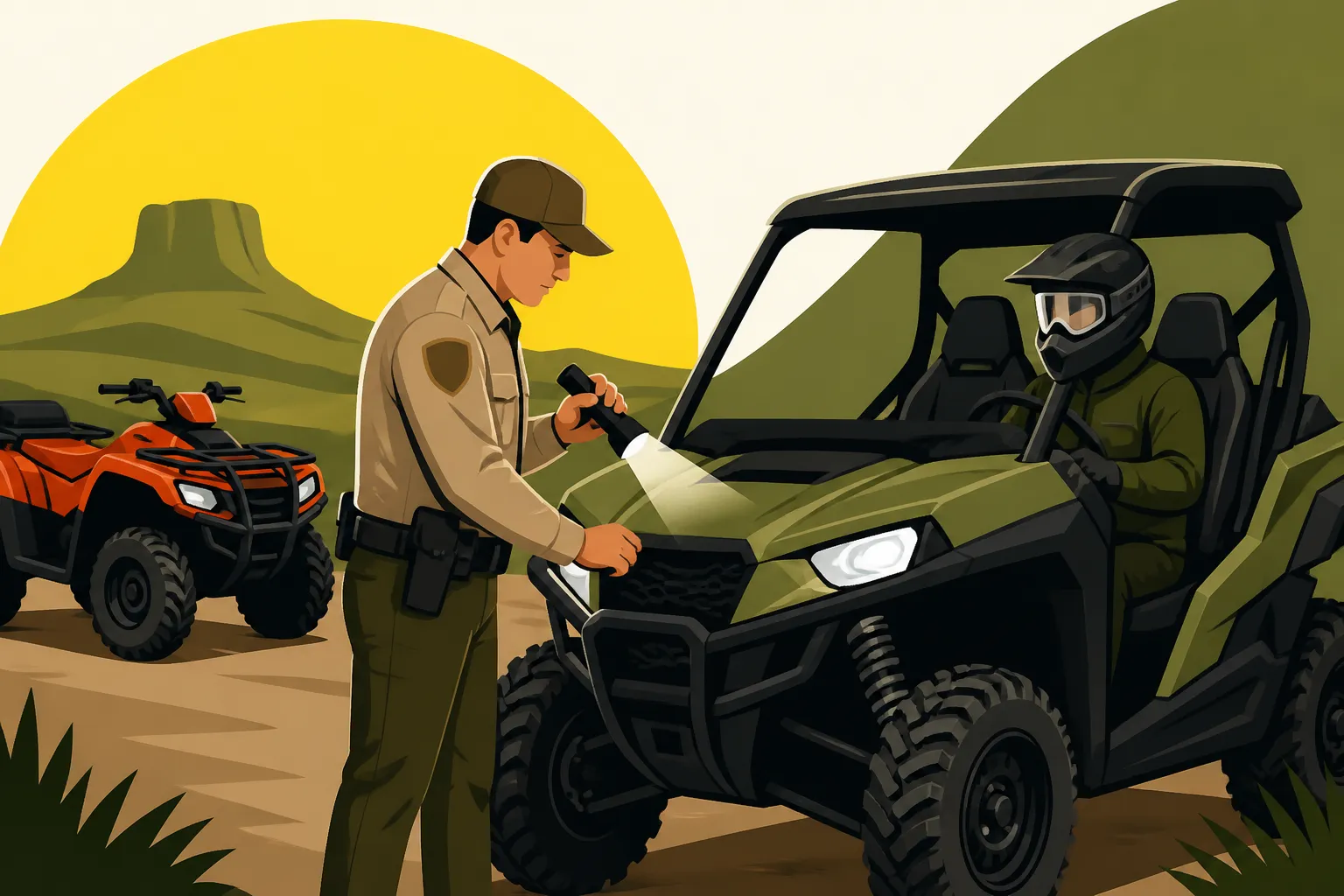
Following this, they'll often conduct a visual inspection of your machine's equipment. This isn't usually an exhaustive mechanical check, but rather a verification of obvious safety features and legal requirements. They'll look for things like proper mirrors, functioning lights, and an audible horn. If your machine is used for farm work, they might also inquire about that, as [Farm Machines and North Dakota Paperwork] have some specific considerations. They might ask you to demonstrate certain functions, like honking your horn or flashing your headlights. Being prepared and knowing your machine meets the standards can ease any tension and make the interaction much smoother.
Essential Equipment an Officer Will Scrutinize
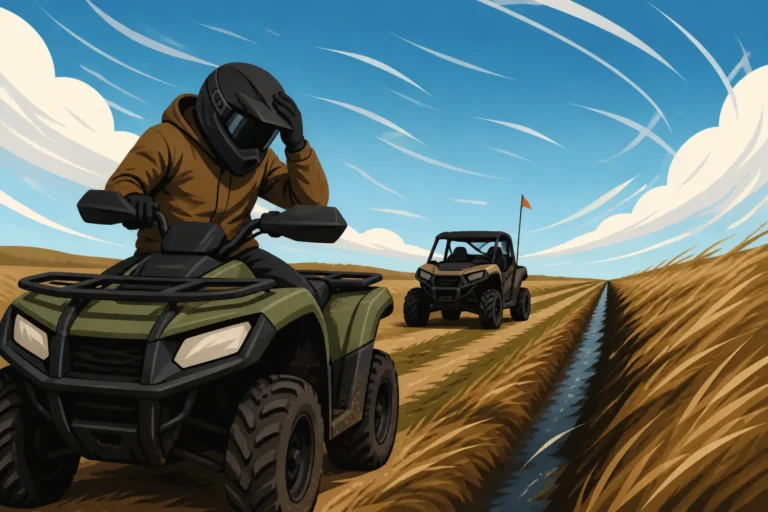
North Dakota has specific requirements for OHVs that are operated on public roads or rights-of-way, including ditches and section lines. These aren't arbitrary rules; they're designed for the safety of all road users, including you! An officer stopping you will primarily be looking for the physical equipment mandated by state law. If you're riding a Class I or Class II machine on a gravel road, or a Class III on a paved road, these checks become particularly relevant.
The key is to ensure your machine is not only functional but also compliant with the letter of the law. This means regular checks are crucial, not just before a big trip to [Pembina Gorge: North Dakota's OHV Trail Park], but every time you head out. These checks are for your safety as much as they are for legal compliance.
Mirrors: Your Eyes Behind You
When riding on public roads or designated rights-of-way in North Dakota, your OHV needs to be equipped with at least one rear-view mirror. This isn't just any mirror; it must provide a clear view of the highway directly to the rear of the machine for a distance of at least 200 feet. The mirror also needs to be firmly attached and provide a reflective surface of at least 10 square inches. This requirement is critical for situational awareness, especially when sharing gravel roads with other vehicles like farm equipment or cars.
An officer will check to see if your mirror is present, properly mounted, and offers the required field of vision. They'll likely check its size and if it's broken or obscured. Many aftermarket options exist, and brands like SuperATV offer robust mirrors designed to withstand off-road use while meeting road-legal requirements. Remember, having a mirror that's too small or constantly vibrating out of position isn't going to cut it. For more detailed information, check out [North Dakota Mirror Rules on a Quad].
Horn: Making Your Presence Heard
An audible warning device, typically a horn, is another essential piece of equipment for OHVs venturing onto public roads. The law specifies that this horn must be capable of emitting a sound that's audible under normal conditions from a distance of at least 200 feet. This isn't just for emergencies; it's a crucial tool for communicating with other drivers, pedestrians, or even wildlife that might unexpectedly cross your path. Imagine coming around a blind corner on a section line and needing to alert an oncoming vehicle; a reliable horn is indispensable.
During a stop, an officer will simply ask you to activate your horn. If it doesn't work, or if it produces a weak, barely audible sound, you'll be out of compliance. Ensure your horn is wired correctly, has a strong, clear tone, and is easily accessible while riding. Replacing a faulty horn is usually a straightforward repair, and it's a small investment for a big safety benefit. The specifics can be found under [North Dakota Horn Rules on a Quad].
Lighting: Seeing and Being Seen
Proper lighting is non-negotiable for any vehicle operating on public roads, and OHVs are no exception. North Dakota law requires specific lighting configurations, especially when riding after dark. Your machine must have at least one headlamp that emits a white light visible from a distance of 300 feet to the front. Additionally, it must have at at least one tail lamp emitting a red light visible from 500 feet to the rear. If you're towing a trailer, that trailer will also need appropriate lighting. For daytime use, your lights still need to be functional, even if not strictly required to be on, as they serve as an important safety feature for visibility.
Beyond these basic requirements, brake lights are also mandatory, clearly indicating when you are slowing or stopping. An officer will check all these lights: headlamp, tail lamp, and brake lights, both day and night. They'll confirm they are properly aimed, not excessively dim, and free from cracks or obstructions. If you ride frequently in low-light conditions or plan on extended evening rides, consider upgrading your factory lights with brighter, more durable options. For a complete rundown, refer to [North Dakota Lighting Rules on a Quad].
Speedometer and Odometer: Knowing Your Numbers
For many OHV classifications permitted on public roads in North Dakota, particularly those capable of highway speeds, a functioning speedometer is a must. This device must accurately indicate the speed of the machine in miles per hour. The purpose is twofold: to ensure you're adhering to posted speed limits and to demonstrate your machine's capability to safely integrate with road traffic. An odometer is also generally expected, even if not explicitly checked as often as the speedometer, it forms part of the machine's overall compliance.
While an officer might not test the accuracy of your speedometer, they will certainly check for its presence and apparent functionality. If your speedometer is broken, missing, or obscured, it could be grounds for a citation. If you’ve upgraded your tires or gears, it’s worth verifying that your speedometer still reads accurately, as alterations can throw it off. This helps you avoid unintentional speeding and ensures you meet the legal requirements for road-legal operation. For more details on this, you can look up [North Dakota Speedometer Rules on a Quad].
Mufflers and Spark Arresters: Respecting Noise and Nature
While not always immediately visible during a quick roadside check, mufflers and spark arresters are critical components, especially when riding on public lands, trails, or even traversing ditches near residential areas. North Dakota law mandates that OHVs must be equipped with a muffler in good working order and in constant operation to prevent excessive or unusual noise. Modifying your exhaust system to make it louder is typically illegal and can lead to citations.
Furthermore, if you're riding on public lands like those managed by the Forest Service or other designated trail systems, a U.S. Forest Service-approved spark arrester is often required. This device prevents hot carbon particles from escaping the exhaust and potentially igniting dry grass or foliage, which is a significant concern in our prairie environment. An officer might not physically inspect this during a routine stop, but if they hear an unusually loud machine or if there are fire restrictions in place, they might delve deeper. Ensuring your machine meets [North Dakota Muffler Requirements] is about being a good neighbor and protecting our natural resources.
Helmets: A Non-Negotiable for Younger Riders
While not all riders are required to wear a helmet on an OHV in North Dakota, it's absolutely mandatory for anyone under the age of 18. This is a crucial safety law designed to protect our youngest riders from severe injury. If an officer pulls over a group and observes a minor riding without an approved helmet, it will definitely be a point of concern. The helmet must be securely fastened and meet federal Department of Transportation (DOT) standards, indicating it offers sufficient protection.
An officer will visually confirm that any rider under 18 is wearing a compliant helmet. They might even check for the DOT sticker. This isn't just a suggestion; it's a legal requirement with serious implications if violated. Parents and guardians are responsible for ensuring their children comply. Even for adult riders, while not legally required, wearing a helmet is always a smart choice for personal safety, whether you're traversing a challenging trail or just riding [North Dakota Ditch Riding: The Legal Right Explained] to a fishing spot. You can find more information about this at [North Dakota Helmet Law for Riders Under 18].
Staying Compliant and Avoiding Headaches
The best defense against a stressful OHV stop is proactive compliance. Knowing the rules and ensuring your machine meets them before you even leave your driveway will save you a lot of potential headaches, fines, and wasted riding time. This means investing in the right parts, understanding the consequences of non-compliance, and making routine checks a part of your riding habit.
It’s about being a responsible rider in a state that offers incredible opportunities for off-highway vehicle recreation. Whether you're exploring [Kimball Bottoms: North Dakota's Open Play Area] or simply getting from point A to point B via a legal ditch, preparation is key.
Sourcing Compliant Parts and Upgrades
When your OHV needs new parts or you’re looking to upgrade, always prioritize compliance. For example, if you need a new mirror, horn, or lighting components, look for aftermarket parts that explicitly state they are DOT compliant or meet North Dakota's specific legal standards. Brands like SuperATV often provide excellent options for aftermarket accessories that are designed with both performance and legality in mind. Don't just grab the cheapest option; verify it meets the specifications.
Many riders modify their machines for performance or aesthetics, but it’s vital to ensure these modifications don't compromise legal requirements. For instance, a louder exhaust might sound cool, but if it exceeds noise limits, it's illegal. Always ask yourself, "Does this modification maintain or improve my machine's legal standing for public road use?" If in doubt, consult the North Dakota Department of Transportation or a reputable dealer. It’s better to spend a little extra on compliant parts than to face fines later.
The Consequences of Equipment Non-Compliance
Operating an OHV on public roads or rights-of-way without the required equipment can lead to various penalties, from warnings to fines. A basic OHV violation in North Dakota can result in a significant fine. And these aren't just minor inconveniences; they can put a dent in your wallet and your riding plans. An officer has the discretion to issue a warning, but if the violation is blatant or if you're uncooperative, a citation is much more likely.
Imagine getting a ticket for a non-compliant mirror or horn, disrupting your entire day of riding. It's not just the immediate cost; sometimes repeated violations can lead to further complications. For instance, not having proper registration or an appropriate safety certificate can also carry penalties. For specific fine amounts, it's worth noting that [North Dakota Penalties for Riding Unregistered] or other infractions can be costly. It’s always best to review [What North Dakota's OHV Law Requires of Owners] to avoid any surprises.
Performing Your Own Pre-Ride Checks
Making a pre-ride checklist a habit is one of the easiest ways to ensure compliance and safety. Before every ride, especially if you plan to access any public roads, take a few minutes to walk around your OHV and check the following:
- Mirrors: Are they securely mounted? Are they clean and clear? Do they provide the required field of vision?
- Horn: Does it work loudly and clearly?
- Lights: Test all lights – headlamp, tail lamp, and brake light. Ensure they are bright and not damaged.
- Tires: Check tire pressure and tread depth. Are they non-highway tires as required for most OHVs on rights-of-way?
- Muffler/Exhaust: Listen for unusual loudness or leaks.
- Helmet (for minors): Is it present and correctly fitted for any rider under 18?
This quick routine can catch minor issues before they become major problems or reasons for a citation. It also gives you peace of mind, knowing you’re riding legally and safely. Think of it as your personal compliance audit before hitting the trail or road.
Beyond Equipment: Other Documentation You'll Need
While equipment checks are a primary focus, an OHV stop can also involve requests for important documentation. Just like driving a car, you need to be prepared to provide proof of ownership, registration, and sometimes, specific permits or certifications. Keeping these documents organized and easily accessible is just as important as having the right mirrors or lights.
This is especially true if you’re a new resident or if you’ve recently purchased a machine. The paperwork side of things can feel daunting, but it's a critical part of being a responsible OHV owner in North Dakota.
Your Registration and Proof of Ownership
Every OHV operated on public lands or roads in North Dakota generally needs to be registered with the North Dakota Department of Transportation. This typically involves a [North Dakota Two-Year OHV Registration] and a visible decal or plate. When an officer stops you, they will ask for your registration card. This card serves as proof that your machine is legally allowed to operate and that you've paid the necessary fees, including the [North Dakota's Off-Highway Trail Tax] that helps maintain our riding areas.
You’ll also need to provide proof of ownership, usually in the form of your OHV title. Keeping a copy of your title or registration in a waterproof bag on your machine is a good practice, rather than carrying the originals which could be lost or damaged. If you've just bought your machine, make sure you understand the requirements for [North Dakota Ownership Transfer in 15 Days]. The officer will want to confirm that the person operating the machine is the registered owner, or has permission from the owner to operate it. For a comprehensive guide, check out [North Dakota Registration Before Your First Ride].
Safety Certificates for Young Riders
If you have a rider under the age of 16 operating an OHV, they are generally required to have an OHV safety certificate. This certificate demonstrates that they have completed an approved safety course, understanding the rules of the road and safe operating practices. There are some exceptions, such as riding on private land owned by a parent or guardian, but for public access, this certificate is often mandatory.
An officer might ask a younger rider to produce their safety certificate. If a minor is riding without one in a situation where it's required, it can lead to a citation for the rider or the supervising adult. Courses are available online and in classrooms throughout the state. It's a small investment of time for a lifetime of safe riding habits. You can find more information about this requirement in [North Dakota Safety Certificates at Age 12].
Insurance: Protecting Yourself and Others
While North Dakota does not require all OHVs to carry liability insurance for all types of operation, it's highly recommended, and there are specific instances where it becomes mandatory. If you are operating your OHV on a public road or highway, you are generally subject to the same liability insurance requirements as other motor vehicles. This is crucial for protecting yourself and others in the event of an accident.
An officer might ask for proof of insurance, especially if you are stopped on a public roadway. Carrying your insurance card or a digital copy on your phone is a good idea. Even if not legally required for your specific riding scenario (e.g., purely on private land), personal liability insurance is a wise investment. Accidents happen, and having coverage can save you from significant financial burden. Understanding [North Dakota Insurance Requirements at Registration] is a good first step to ensure you're covered.
| Equipment Type | Purpose | North Dakota Requirement | Officer Check Focus |
|---|---|---|---|
| Rearview Mirror | Vision behind the machine | At least one, clear view 200 ft to rear, 10 sq inches reflective surface, securely attached. | Presence, secure mounting, adequate size, clear view. |
| Horn | Audible warning to others | Capable of emitting sound audible from 200 feet under normal conditions. | Functionality, audibility. |
| Headlamp | Forward visibility and being seen | At least one, white light, visible 300 feet to front. | Presence, functionality, brightness, proper aim. |
| Tail Lamp | Rear visibility and being seen | At least one, red light, visible 500 feet to rear. | Presence, functionality, brightness. |
| Brake Light | Indicating deceleration/stop | Clearly visible and functional, indicating when brakes are applied. | Functionality. |
| Speedometer | Tracking speed for legal limits | Accurately indicates speed in miles per hour (for road-legal machines). | Presence, apparent functionality. |
| Muffler | Noise reduction | In good working order and constant operation to prevent excessive noise. | Auditory check for excessive noise, visual check for damage/modification. |
| Spark Arrester | Fire prevention | U.S. Forest Service approved for public lands (often implied by muffler check). | Visual check for presence if relevant (less common in routine road stops unless fire risk). |
| Helmet (Minors) | Head protection | Mandatory for all riders under 18 years of age, must be DOT compliant and securely fastened. | Presence on minor, proper fit, DOT sticker. |
| Registration Card | Proof of legal operation | Required for OHVs on public lands/roads. | Presence, valid date, matching VIN. |
| Proof of Ownership | Confirmation of legal possession | Title or Bill of Sale (for recent purchases). | Match with operator ID. |
| Safety Certificate | Competency for young riders | Required for riders under 16 (or 12 depending on context) on public lands/roads, with exceptions. | Presence (for relevant age group). |
| Insurance Card | Financial responsibility in accidents | Required if operating on public roads/highways (same as other motor vehicles). | Presence (if required for operation location). |
Disclaimer
This article is for general informational purposes only and does not constitute professional advice. Laws, prices and regulations vary by location and change over time. Consult a qualified professional for guidance on your specific situation.