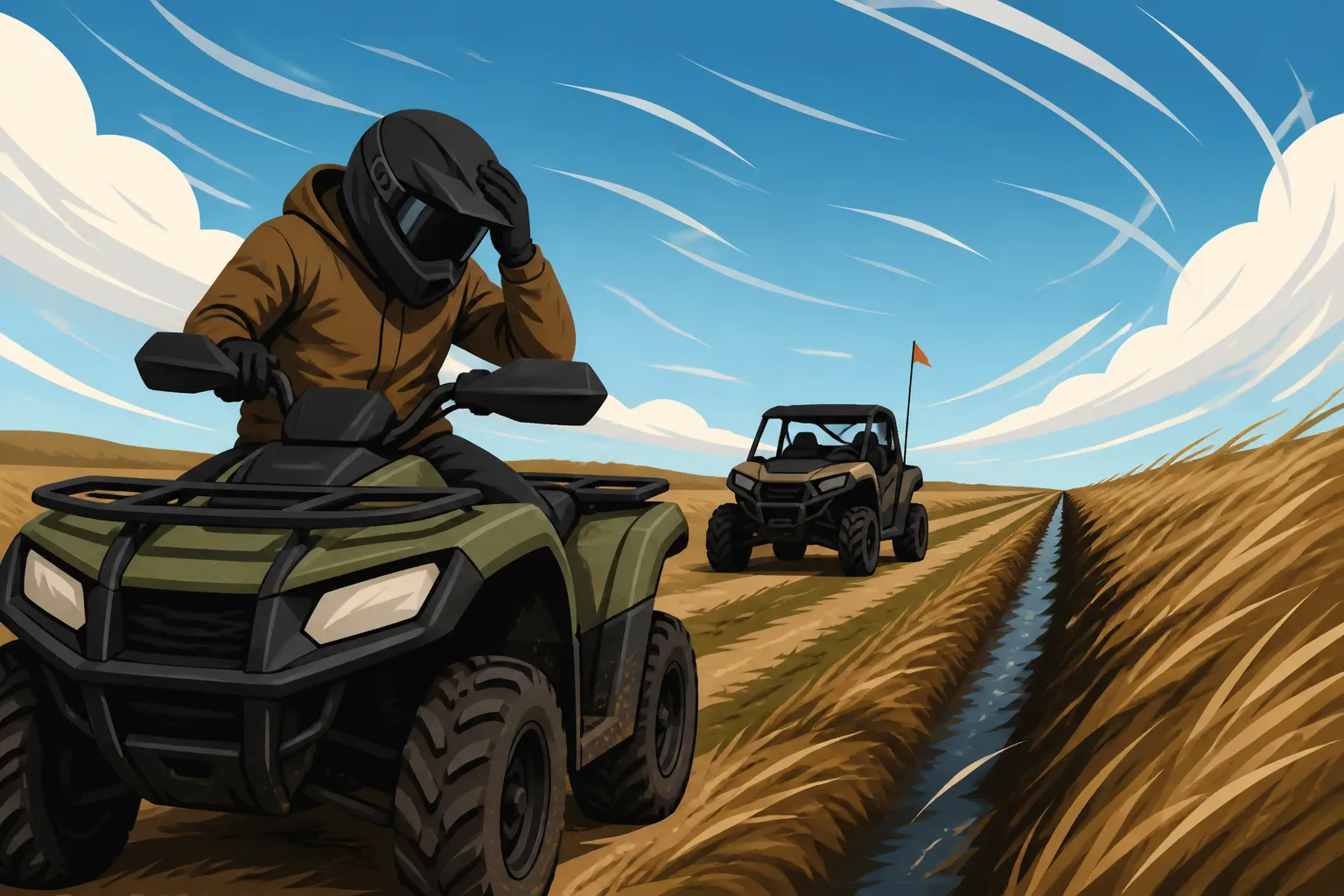
Wind and Fatigue on a Long Ditch Run
A long North Dakota ditch ride can feel manageable at the start, then become draining when prairie wind keeps pushing at your body and the route offers few sheltered breaks. Fatigue affects judgment, balance, and reaction time. This guide explains how to plan for wind, spot tiredness early, and make safer decisions before a long ride turns into a risky one.
Why wind makes a long ditch ride tiring
Wind adds effort even when you are not going fast
On an exposed route, wind can tug at your helmet and clothing, buffet your upper body, and make it harder to stay relaxed on the machine. A steady headwind may also make the ride feel longer because you are working against it for more of the trip. Gusts can be more unsettling than a consistent breeze: the machine may feel stable one moment and get pushed around the next.
The strain is not only physical. If you spend the ride bracing your shoulders, gripping the bars tightly, and continually correcting your line, your muscles and attention are working almost nonstop. That can leave you feeling worn down before you notice that your reactions have slowed. Wind noise and the concentration needed to read the ground can make it harder to hear a riding partner or notice a change in the machine.
A ditch route has its own demands, too. The surface may change, vegetation can conceal uneven ground, and approaches or culverts can interrupt an otherwise steady ride. Learn the route’s legal boundaries and terrain before you set out; [Riding North Dakota's Ditch Bottom and Back-Slope] and [North Dakota Back-Slopes and Ditch Bottoms] are useful starting points. A route that looks like a simple line on a map can require frequent attention once you are riding it.
Wind direction and route exposure change the ride
A tailwind can make one part of a trip feel easy, but that does not mean the return leg will be comfortable. If you ride out with the wind behind you, plan for the possibility of facing it on the way back. That shift can change how much effort you need to hold a steady position and how quickly fatigue builds.
Open stretches between towns, shelterbelts, and farmsteads can feel especially exposed. Wind may also behave differently near tree lines, road crossings, buildings, and dips in the terrain. Do not assume a sheltered patch will last, or that a route will remain equally comfortable in both directions. When planning, consider where you can stop safely and turn back if conditions become more demanding than expected.
Wind can also affect what you can see and how well others can see you. Dust, loose vegetation, blowing snow, and flying debris may reduce visibility. If you cannot clearly read the path ahead, maintain control, or communicate with your group, treat that as a reason to pause or shorten the ride—not as a challenge to push through.
Fatigue can sneak up before you feel exhausted
Many riders expect fatigue to announce itself as heavy soreness or obvious exhaustion. On a long ride, early signs are often subtler: a tighter grip, sore shoulders, a stiff neck, repeated small corrections, or difficulty keeping a comfortable posture. You may find yourself missing landmarks, forgetting where the group planned to stop, or reacting later than usual to bumps and turns.
Wind can make these signs harder to notice because attention is focused on staying composed and maintaining a line. Riders sometimes mistake tension for ordinary concentration and keep going until their hands, back, or legs are aching. A useful habit is to check in with yourself and your group at planned stops, rather than waiting until someone says they cannot continue.
The safest response to fatigue is not always a longer rest. If a rider is struggling to stay alert, control the machine, or communicate clearly, the ride may need to end or be rerouted. A short break can help with mild tiredness, but it does not erase the risk of riding while impaired by exhaustion.
Prepare your rider, machine, and route
Check the forecast and build a flexible plan
Before leaving, check the expected wind, temperature, precipitation, and visibility for the route and the hours you expect to be out. Conditions can feel different in an open ditch than they do in town or near a sheltered parking area. If wind is expected to strengthen, consider starting earlier, choosing a shorter route, or postponing the exposed portion of the ride.
Make a plan that includes a turnaround point and more than one safe place to stop. Tell someone who is not riding with you where you intend to go and when you expect to return. If the route is unfamiliar, identify crossings and access points ahead of time so the group is not making rushed decisions when tired. Be sure the route itself is lawful: [North Dakota ATV Road Rules by Surface Type] can help explain why the type of road or area matters, while [Checking With Local Law Enforcement First] is a sensible step when local conditions or restrictions are unclear.
Keep the plan flexible. If the wind rises, visibility falls, or the route is rougher than expected, do not treat your original distance as a commitment. Riding only part of a planned route is a better outcome than pressing onward because the group has already invested time in getting there.
Dress for wind, not just the temperature
Windproof outer layers can reduce the constant tug and chill that wear riders down. Use clothing that allows you to move freely and does not flap loosely near controls or moving parts. Gloves should help you hold the controls securely without making it difficult to operate them. A properly fitted helmet and eye protection are essential for comfort and visibility, especially when wind carries dust or debris.
Think about how your gear affects the way you ride. A windshield, hand protection, or other wind-blocking equipment may change airflow around the rider, but fit and suitability depend on the specific machine and setup. If you are comparing options, SuperATV is one manufacturer riders may encounter when researching UTV accessories. Check the product’s fitment, instructions, and compatibility with your machine rather than assuming an accessory will suit every model or riding condition.
More wind protection is not automatically better in every situation. Equipment can affect visibility, airflow, noise, or how easily you enter and exit the machine. Riders should test new gear in a familiar, controlled setting before relying on it for a long, remote ride. SuperATV can be one place to compare available accessory categories, but the important question is whether a particular item works safely with your vehicle, helmet, and usual conditions.
Prepare the machine and carry practical supplies
Before the ride, check the items that affect control and comfort: tires, brakes, steering, lights, fuel, and any visible damage. Make sure storage is secure and that straps or loose items cannot interfere with the controls. If you expect to ride near dusk or in low visibility, confirm that the machine’s lighting is working and understand the rules that apply; [North Dakota Headlamp Distance Standards] provides more detail about lighting requirements.
Carry water, a basic first-aid kit, a phone, and a way to contact the group if riders become separated. A paper route note or offline map can help if service is unreliable. Consider carrying a small repair kit appropriate to your machine and the trip. Do not overload the vehicle with gear that shifts, blocks visibility, or changes handling.
Ride at a pace that protects your attention
Set a pace for the least-rested rider
A group ride should be paced for the rider who is most affected by the wind, terrain, or distance—not the person who feels strongest. Agree on a pace and hand signals before setting out. Keep enough spacing to see the route and respond to a stop without creating a chain reaction. If one rider is repeatedly falling behind, struggling to hold a line, or asking for frequent unscheduled breaks, treat that as information about the group’s condition.
Avoid trying to make up time after a stop. Rushing can increase stress and reduce the time available to notice hazards. When the route crosses a road or changes surface, slow down and make sure every rider understands the next move. Road rules depend on the place and circumstances; [North Dakota Equipment Required on a Roadway] and [North Dakota's 30 mph Capability Rule] cover requirements riders should understand before using a roadway.
Plan regular breaks before fatigue becomes obvious. At a stop, get out of the riding position if it is safe, loosen your shoulders, drink water, and check how everyone is doing. A brief stop can be useful, but if a rider still feels unsteady, unusually foggy, or unable to focus after resting, do not assume another stretch of riding will be fine.
Use a simple check-in system
At each planned stop, ask specific questions rather than relying on “Everyone good?” For example: Can you keep a comfortable grip? Are your hands, neck, or back starting to hurt? Are you still reading the route clearly? Is anyone having trouble hearing instructions or keeping up? Clear questions make it easier for a tired rider to speak up without feeling they are holding the group back.
| What you notice | What it may signal | A safer response |
|---|---|---|
| Tight shoulders or a clenched grip | Bracing against gusts or riding tensely | Stop in a safe place, relax, and reassess the pace |
| Repeated corrections or drifting from the chosen line | Reduced concentration, fatigue, or difficult conditions | Slow down, increase spacing, and consider turning back |
| Headache, unusual thirst, or feeling faint | Possible dehydration or heat-related strain | Stop, get to a safe location, drink water, and reassess |
| Difficulty following instructions | Fatigue, noise, or communication problems | Stop the group and establish clear communication |
| Poor visibility or trouble reading the route | Conditions may exceed the group’s ability to ride safely | Pause, choose a safer route, or end the ride |
| A rider says they feel unsafe | The rider may be at their limit, even if others feel fine | Take the concern seriously and do not pressure them to continue |
Treat these signs as prompts to make a decision, not as a scorecard. A rider may be tired for several reasons, and the group does not need to diagnose the cause to respond sensibly. If someone is confused, unwell, or unable to control their machine reliably, prioritize getting them to a safe place and arranging appropriate help.
Make communication part of the plan
Wind, helmets, and engine noise can make conversation difficult. Agree on signals for slowing down, stopping, turning around, and reporting a problem. Make sure everyone knows what to do if the group becomes separated. A lead rider should not assume that silence means everyone is comfortable; a sweep rider can help notice when someone is falling behind or having trouble.
For UTV riders considering accessories to improve comfort or reduce wind exposure, SuperATV is another brand that may appear in research. Compare the actual design and installation requirements for your machine, and consider how any added equipment affects visibility and communication between occupants. Comfort features are not a substitute for taking breaks or shortening the route when conditions change.
If conditions make it hard to hear or see one another, stop somewhere safe and reset the plan. Do not rely on shouted instructions across a windy stretch, and avoid stopping in a place where other road users or approaching riders may not expect you. When anyone has been injured or there has been a crash, [North Dakota Accident Reporting for an OHV] can help clarify the reporting topic to review.
Know when to turn around or stop
Choose a clear decision point before riding
Before starting, agree on what will make the group turn back: a particular time, a change in wind or visibility, an unexpectedly rough section, or a rider’s discomfort. Deciding in advance takes pressure off the person who needs to speak up. It also prevents the group from continuing simply because the destination seems close.
A turnaround decision should account for the return trip. If the wind is pushing strongly from behind on the outward leg, the ride back could demand more effort. Leave enough time and energy for the return rather than judging the outing only by how the first half feels. If you are riding after dark, understand the applicable rules and equipment requirements before leaving; [North Dakota Rules for Riding After Dark] is a relevant reference.
Turning back is not a failure of planning. It is part of planning for an exposed route where weather, visibility, and fatigue can change. A shorter ride with everyone alert and in control is a better outcome than reaching a planned endpoint at the cost of safe judgment.
Stop safely when someone reaches their limit
If a rider is struggling, first choose a safe place to stop. Keep the group together and out of the path of traffic or other riders. Check for injury or illness, offer water if appropriate, and give the rider time to settle. If they remain disoriented, faint, unusually weak, or unable to ride safely, do not send them onward alone or encourage them to “push through.” Arrange a safer way to get the rider and machine back.
If the problem is mainly fatigue, the decision may still be to end the ride. Resting at the roadside and then continuing into worsening conditions may not be a reasonable plan. A rider who is too tired to make reliable decisions needs help from the group, not pressure to keep pace.
If the situation involves an emergency, focus on immediate safety and contact emergency services when needed. For non-emergency route or access questions, check the relevant rules and local conditions before the next trip. Keeping a trip plan, sharing it with someone at home, and building in an easy way to stop can make a long ditch run more manageable from the beginning.
Disclaimer
This article is for general informational purposes only and does not constitute professional advice. Laws, prices and regulations vary by location and change over time. Consult a qualified professional for guidance on your specific situation.