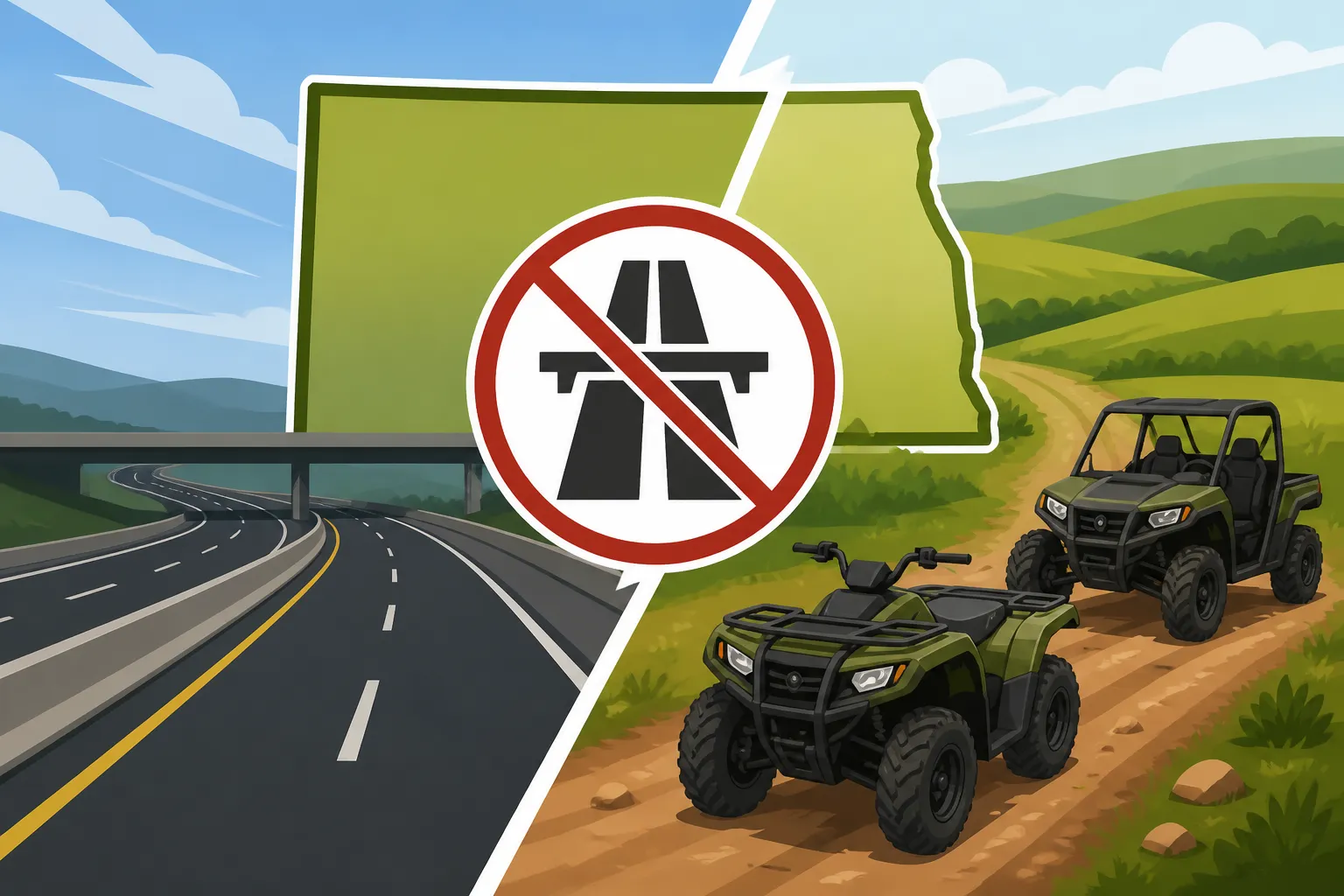
Why Interstates Fall Outside North Dakota’s Highway System
It's incredibly frustrating when you're itching to explore North Dakota's vast landscapes on your ATV or UTV, only to hit a wall when it comes to riding on certain roads. Many riders, especially those new to our state, often wonder why seemingly major thoroughfares like interstates are completely off-limits, even when other state and county roads might be fair game. This guide will dive deep into the legal and practical reasons behind why interstates fall outside North Dakota's highway system for off-highway vehicles, helping you understand the rules so you can ride safely and legally.
The Basic Legal Distinction: Highways vs. Interstates in North Dakota
When you look at a map of North Dakota, all those lines representing roads can start to blend together. But from a legal perspective, especially concerning where you can and cannot take your off-highway vehicle (OHV), there's a world of difference between a typical state highway or county road and an interstate. It's not just a matter of speed limits; it's about their fundamental purpose, design, and the laws governing their use.
What North Dakota Law Says About "Highways"
In North Dakota, the term "highway" is pretty broad in its general definition. It often refers to any public road, street, avenue, alley, parkway, or similar public way that's open to the use of the public as a matter of right for the purpose of vehicular travel. This general umbrella includes a huge swath of our state's road network, from quiet gravel section lines to bustling paved state highways. This is why you often hear about [North Dakota ATV Road Rules by Surface Type] or [North Dakota Rules for Riding a Gravel Road] – because many of these roads are considered part of the broader "highway system" that OHVs might, under specific conditions, be allowed to use.
However, just because a road is a "highway" doesn't mean it's open season for OHVs. The law then carves out specific rules for different types of highways and the vehicles that can use them. For example, a county road might have different regulations than a paved state highway posted at 55 mph. The critical distinction for OHV riders is often tied to vehicle capability, required equipment, and local ordinances, which can add layers of complexity. It's truly a patchwork, and understanding the general definition is just the first step in navigating where your wheels can legally take you.
The Federal Overlay: Interstates and Their Purpose
Interstate highways, on the other hand, operate under a different set of rules and a distinctly different philosophy. While they physically exist within North Dakota, they are fundamentally part of the Dwight D. Eisenhower National System of Interstate and Defense Highways, a network largely conceived and funded by the federal government. This isn't just a fancy name; it signifies a specific purpose: to facilitate rapid, efficient, and uninterrupted long-distance transportation of people and goods across the country. They are designed for high-speed vehicular traffic, primarily cars and trucks, and built to incredibly rigorous standards to ensure that flow.
Because of this federal overlay and their national purpose, interstate highways have strict guidelines regarding access and the types of vehicles permitted. They are "controlled-access" facilities, meaning you can only enter or exit at specific interchanges, and there are no at-grade intersections. This design philosophy, focused on high-speed through-traffic, inherently excludes vehicles that cannot maintain those speeds or would otherwise impede the flow or create significant safety hazards. This is why you'll see large commercial trucks zipping along I-94 and I-29, but never an ATV or UTV, regardless of how tricked out it might be with gear from SuperATV for other trail riding.
Why Interstates Are Never Open to OHVs
It's natural to think, "My UTV can go 60 mph, why can't I use the interstate for just a little bit?" But the reality is, the dangers involved in mixing OHVs with interstate traffic are simply too great, and the roads aren't designed for it. The state of North Dakota, like all others, prioritizes public safety on these high-speed arteries.
Safety Concerns and Speed Differentials
Imagine a situation on I-94 near Mandan, where the speed limit is 75 mph. Most cars and semi-trucks are traveling at or very near that speed. Now, picture your ATV or UTV, even one capable of decent speeds, trying to merge or keep up. The speed differential is simply massive. Even if your machine can hit 60 mph, that's still 15 mph slower than the flow of traffic, making you a dangerous obstruction. The closing speed between a vehicle traveling 75 mph and one at 60 mph is 15 mph, which quickly eats up reaction time and stopping distance. It creates a terrifying scenario for both the OHV rider and other motorists.
Furthermore, OHVs, by their very nature, are not built with the same crash protection as passenger vehicles. They offer minimal occupant protection in a collision with a multi-ton truck or even a compact car. Visibility is another huge factor; ATVs and UTVs are smaller and sit lower than most vehicles on the interstate, making them incredibly difficult to spot in fast-moving traffic, especially in adverse weather conditions common in North Dakota. While outfitting your machine with high-visibility flags and bright LED lights, perhaps from a brand like SuperATV, is excellent for trails and slower roads, it's simply not enough to overcome the inherent dangers of interstate speeds and vehicle masses. This stark reality is why [North Dakota Helmet Law for Riders Under 18] exists for other public roads – the risks are real and demand protective measures.
Design and Engineering of Interstate Roads
Interstate highways are engineered masterpieces, but they're masterpieces designed for a very specific purpose. They feature long sight lines, minimal curves, and often higher banking on turns – all to facilitate high-speed travel. What they don't have are design elements conducive to OHV travel. There are no safe pull-off areas for slow-moving vehicles, and the shoulders, if present, are strictly for emergencies, not for cruising. The on-ramps and off-ramps are built for acceleration and deceleration of heavy, fast-moving vehicles, not for the agility or lower speeds of an OHV.
Consider the steep grades you might encounter, or the numerous bridges and overpasses. These features, while allowing for unimpeded traffic flow, can create dangerous blind spots or situations where an OHV might struggle to maintain speed, becoming an instant hazard. Unlike county or township roads, where you might have ample space to navigate or pull over safely, the compact, high-speed environment of an interstate leaves virtually no margin for error for an OHV. It's a system designed for a different kind of machine, and attempting to force an OHV into it goes against every principle of its engineering.
The Practical Implications for North Dakota Riders
So, given that interstates are a hard no, what does this mean for your riding plans? It means a little extra route planning, a healthy dose of caution, and a clear understanding of your alternatives. North Dakota offers incredible opportunities for OHV enthusiasts, but you have to know where to find them.
Planning Routes That Avoid Interstates
The key to enjoying North Dakota on your OHV without breaking the law (or putting yourself in serious danger) is smart route planning. Forget the fastest way between two points if that involves an interstate. Instead, focus on the vast network of state highways, county roads, and township roads that crisscross our state. These routes, while sometimes slower, offer a much safer and legally permissible environment for OHV travel. Use detailed maps, GPS devices, or even mobile apps to identify these alternatives. Look for state highways posted at 55 mph or less, as these are more likely to be open to OHVs, provided your machine meets all the [North Dakota Equipment Required on a Roadway] criteria.
However, a word of caution: always double-check local regulations. [North Dakota County and City ATV Ordinances] can vary dramatically. What's allowed in one county or near a specific city might be strictly prohibited just a few miles down the road. It's always a good idea to call the local sheriff's department or city office if you're planning a ride through an unfamiliar area to ensure you're on the right side of the law. There's nothing worse than getting a ticket or, even worse, causing an accident because you assumed a road was open.
Crossing an Interstate: When and How It's Allowed
While riding on an interstate is completely out of the question, you might find yourself needing to cross one. This is generally permissible, provided you are doing so at a legal intersection where a public road that you are otherwise legally allowed to ride on, intersects or passes over an interstate. For instance, if you're riding legally on a county road and it has an overpass or a controlled intersection with an interstate, you can use that intersection to continue your journey on the other side.
The key here is that you are crossing or traversing the interstate's immediate right-of-way as part of your legal travel on another road, not using the interstate itself as a thoroughfare. When [North Dakota Rules for Crossing a Highway] apply, you must exercise extreme caution. Treat these crossings like any other major road intersection: stop, look both ways multiple times, yield to all traffic, and only proceed when it is absolutely safe and clear. Visibility can be tricky, especially with interstate traffic moving at high speeds on the approaches. Never assume that an oncoming vehicle sees you. Your goal is to get across as quickly and safely as possible, minimizing your time in proximity to interstate traffic.
Understanding the "Ditch Riding" Exception (and Its Limits)
North Dakota is somewhat unique in its approach to OHV access along roadsides, particularly with its well-known "ditch riding" allowance. This can often lead to confusion, with some riders mistakenly thinking it extends to interstates. It's crucial to understand where this exception applies and, more importantly, where it absolutely does not.
North Dakota's Unique Ditch Riding Culture
For many North Dakota residents, riding an ATV or UTV in the road ditch is as ingrained in our outdoor culture as ice fishing in winter. The state has specific laws that permit OHV use in road ditches alongside many public highways, serving as a practical, albeit unofficial, network of riding trails. This allows ranchers to check fence lines, hunters to access prime spots, and recreational riders to enjoy the open prairie without being on the main roadway. This flexibility is codified in our state laws and is a significant aspect of [North Dakota Ditch Riding: The Legal Right Explained]. It truly is a unique feature that sets North Dakota apart from many other states, offering extensive access that many riders appreciate.
However, this privilege comes with responsibilities and strict limitations. Ditch riding requires adherence to speed limits, rules about visibility, and respect for private property. It's designed for low-speed travel and situational use, providing an alternative to riding directly on the paved or gravel surface of many county and state roads. But this unique allowance exists within the context of specific types of public roads, not all of them.
Ditch Riding vs. Controlled-Access Rights-of-Way
Here's where the crucial distinction comes into play regarding interstates. While you might legally ride in the ditch of a county road, you absolutely cannot do the same along an interstate highway. This is precisely [Why Interstates Fall Outside North Dakota's Highway System] for OHVs. Interstate highways are designated as "controlled-access rights-of-way." This means the entire right-of-way, including the ditches, inslopes, and shoulders, is managed for the exclusive purpose of high-speed, controlled-access vehicular traffic. Any form of travel by an OHV, whether on the main lanes or within the adjacent ditch, is strictly prohibited.
The reasoning here circles back to safety and design. Even if you're technically "off" the main traffic lanes in an interstate ditch, you're still in an area of high-speed traffic, where large trucks create significant wind currents and visibility remains extremely poor. There are no safe entry or exit points designed for OHVs from an interstate ditch, and any attempt to navigate these areas would be incredibly dangerous. The ditch riding privilege in North Dakota is a fantastic benefit for OHV riders, but it is unequivocally not an interstate workaround. It is imperative that riders understand this critical difference to avoid severe penalties and, more importantly, catastrophic accidents.
| Aspect of Road Use | Typical Public Roads (State, County, Township) | Interstate Highways (I-29, I-94) |
|---|---|---|
| Main Travel Lanes | Permitted (with conditions & equipment) | Absolutely Prohibited |
| Road Ditches | Often Permitted (with specific rules) | Absolutely Prohibited (controlled-access) |
| Crossing at Intersections | Generally Permitted (with caution) | Permitted (when part of a legal crossing) |
| Speed Environment | Lower, more varied | High, uniform, fast-moving |
| Safety Risk for OHVs | Manageable (with proper gear & caution) | Extremely High |
| Law Enforcement View | Regulated access, often tolerant of legal use | Zero tolerance for OHVs |
Equipping Your OHV for Legal Road Use (Beyond Interstates)
Since interstates are off the table, let's focus on making sure your OHV is ready for the roads you can legally ride in North Dakota. Getting your machine properly equipped is not just about avoiding fines; it's about your safety and the safety of others sharing the road.
Essential Road-Legal Equipment
If you plan on riding your ATV or UTV on any public road in North Dakota (that isn't an interstate, of course!), you need to ensure it meets specific equipment requirements. This isn't optional; it's the law. Your machine must have:
- Headlights: Capable of illuminating objects at a certain distance.
- Tail Lights: Visible from the rear.
- Brake Lights: To signal when you're slowing down or stopping.
- Horn: Audible from at least 200 feet away.
- Mirrors: At least one rearview mirror, often required to be of a certain size (e.g., 10 square inches), to see traffic behind you.
- Muffler and Spark Arrester: To control noise and prevent fires.
- Speedometer: To ensure you can monitor your speed accurately, as speed limits are crucial on public roads.
Brands like SuperATV offer a wide range of accessories, from durable mirrors to bright LED light bars and robust horns, all of which can help you meet these legal requirements and improve your visibility and safety on permissible roads. Investing in quality components for these essential items is not just about compliance, but about peace of mind. Remember, meeting these standards ensures your machine is considered road-ready for designated routes, but it still doesn't grant you access to the interstate. If you're unsure about what exactly your machine needs, reviewing [North Dakota Equipment Required on a Roadway] is an excellent starting point.
Vehicle Classification and Road Access
North Dakota law also classifies OHVs into different categories, and these classifications can influence where and how you can ride. For example, [North Dakota's Class I, II and III Machines] each have specific definitions, often related to width, weight, and seating. While these classifications primarily affect registration and certain trail access, they can also indirectly impact road access. For instance, a wider Class II machine might face challenges on very narrow township roads, even if technically permitted.
Another critical factor for road legality is engine size. North Dakota requires a [North Dakota's 350cc Minimum for Road Riding] if you intend to operate your OHV on paved public roads with speed limits over 35 mph. Machines under this cubic centimeter threshold are generally restricted to roads with lower speed limits or specific designated areas. This rule is in place to ensure that OHVs can maintain a safe speed and not impede the flow of traffic on busier roads. It's a pragmatic approach to safety, acknowledging that smaller, less powerful machines might not be suitable for mixing with faster-moving vehicular traffic. Always check your machine's specifications and the specific road's requirements before you venture out.
Disclaimer
This article is for general informational purposes only and does not constitute professional advice. Laws, prices and regulations vary by location and change over time. Consult a qualified professional for guidance on your specific situation.