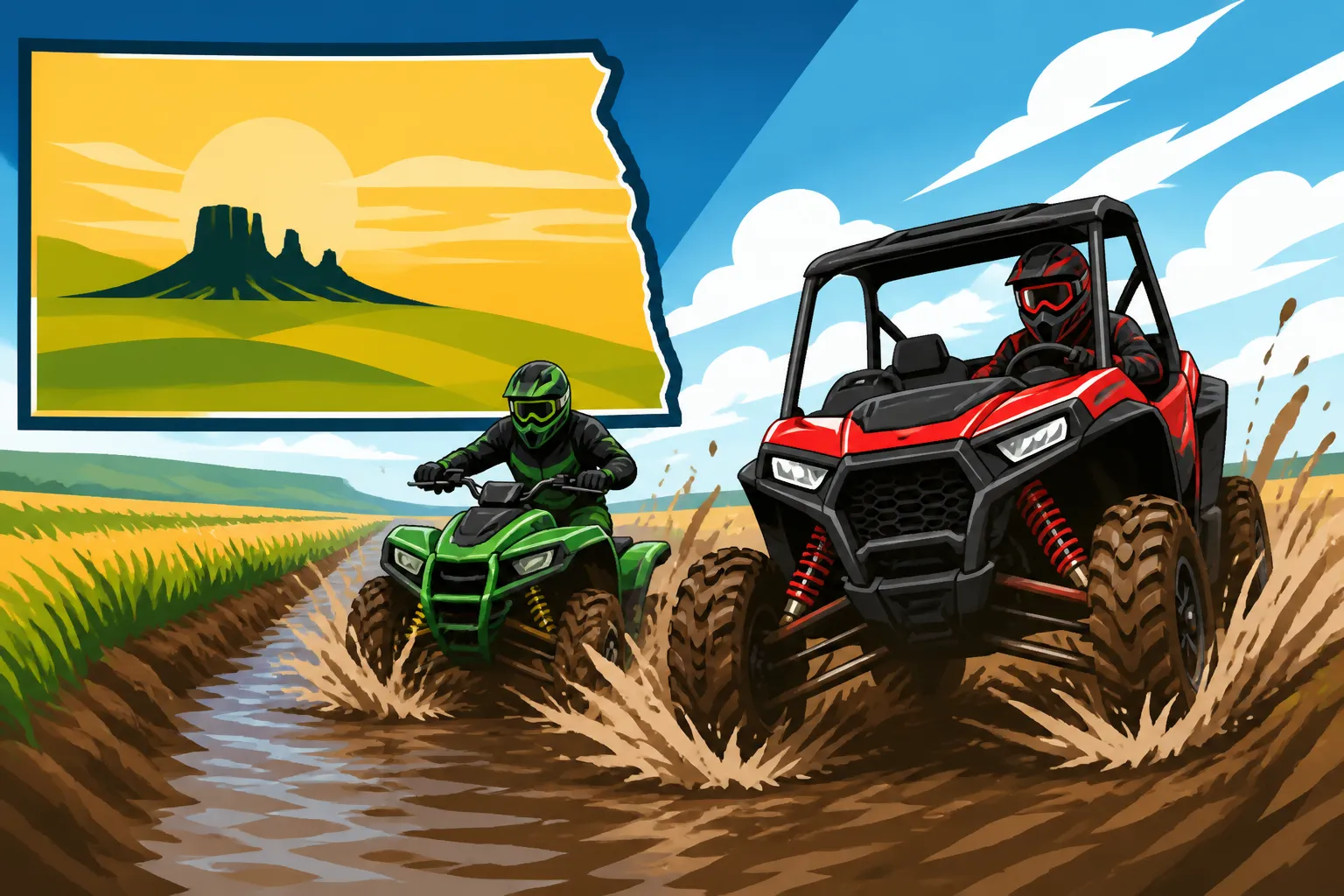
North Dakota Organized Ditch Races by Permit
If you've ever spent time tearing up the wide-open spaces of North Dakota on your ATV or UTV, you know the thrill of riding the ditches. It's practically our state's unofficial trail system. But when you start thinking about gathering a whole group of riders for an organized race in those same ditches, the rules suddenly feel a lot less straightforward. You might be wondering, "Is that even allowed? And if so, how do I get the green light?" This guide is here to untangle the complexities of organizing a ditch race in North Dakota, walking you through the permit process, safety considerations, and everything you need to know to make your event a roaring success.
Understanding North Dakota's Stance on Ditch Riding
North Dakota has a unique relationship with its ditches. For many of us, these aren't just drainage channels; they're integral to our outdoor recreation and even agricultural work. However, the distinction between casual riding and an organized event is crucial when it comes to the law.
The General Rules for OHVs in Ditches
For individual riders and small groups, North Dakota's laws are surprisingly permissive when it comes to ditch riding. It's truly a defining characteristic of OHV use here. You'll often hear us talk about [North Dakota Ditch Riding: The Legal Right Explained] because it's such a fundamental part of our riding culture. Generally speaking, registered ATVs and UTVs are permitted to operate within the ditch bottoms and back-slopes of most public roads, with some critical exceptions.
This means you can often ride parallel to the roadway, utilizing the lower portions of the ditch. The law is pretty clear on what's generally off-limits, though. You can't just cruise wherever you want. The critical areas to remember are the "inslopes" and "shoulders," which are typically reserved for vehicle traffic and maintenance. [North Dakota Inslopes and Shoulders Are Closed], for example, clearly outlines that these areas are usually no-go zones. This legal framework allows for a lot of casual riding, getting you from one field to another, accessing hunting spots, or just enjoying a scenic cruise. But when you escalate from casual use to a competitive, organized event, the state and local authorities have a much keener interest in what you're doing.
Why Organized Races Require Special Permission
Imagine dozens, or even hundreds, of machines roaring through a ditch. The sheer scale and nature of an organized race introduce a whole new set of concerns that casual riding simply doesn't. These concerns range from public safety and potential environmental impact to traffic disruption and liability.
When you're organizing an event, you're not just one rider; you're responsible for many. This increased activity means a higher risk of accidents, not only among participants but also with other vehicles sharing the adjacent roadways or even unsuspecting pedestrians in rural areas. Local authorities, including county and township boards, are naturally going to be concerned about emergency response, traffic flow, and the wear and tear on the environment. An organized event has a much larger footprint, both literally and figuratively, than a few friends out for a Sunday ride. Therefore, the state requires a formal permitting process to ensure these events are conducted safely, responsibly, and with minimal negative impact on the community and environment. This isn't about stifling fun; it's about managing risk and ensuring everyone's well-being.
The Permit Process for Organized Ditch Races
Navigating the permit process for an organized ditch race in North Dakota can feel a bit like a scavenger hunt. It's not a single, one-stop shop, and the specifics can depend heavily on where you plan to hold your event.
Identifying the Issuing Authority
Unlike registering your individual machine, which goes through the North Dakota Department of Transportation, getting a permit for an organized ditch race is a far more decentralized process. You won't find a single "Ditch Race Permit Application" form online from a state agency. Instead, you'll likely be dealing with multiple local entities.
Your first point of contact will almost certainly be at the county level. The county commission or board of commissioners is typically the governing body that oversees the use of county roads and their rights-of-way, including the ditches. If your proposed route crosses multiple counties, you'll need to contact each of them. For sections of the route on township roads (those often less-maintained, gravel roads), you'll need to reach out to the individual township boards. Many townships are quite small and may only meet periodically, so factor that into your timeline. In some cases, especially if your route involves crossing or interacting with state highways, you might also need to get a special permit or approval from the North Dakota Department of Transportation (NDDOT). They'll be concerned about any potential impact on traffic flow, visibility, and the structural integrity of the highway system. It's wise to review [North Dakota County and City ATV Ordinances] early in your planning to understand any existing local restrictions.
Essential Information for Your Permit Application
When you approach these various authorities, you'll need to come prepared. They're going to want to know everything about your event, and the more detailed and professional your proposal, the better your chances of getting approval. Think of it like pitching a business idea.
Here's a breakdown of the key information you'll need to have ready:
- Event Details:
- Proposed date(s) and specific times of the race.
- Anticipated duration, including setup and cleanup.
- Exact proposed route, clearly marked on a map (GPS coordinates are a bonus!).
- Estimated number of participants and spectators.
- Safety Plan:
- How you plan to manage traffic on adjacent roadways.
- Emergency contact information and procedures.
- Details on first aid stations and emergency medical services (EMS) coordination.
- Volunteer marshal plan (how many, where they'll be, what their roles are).
- Communication plan (radios, cell service checks for the route).
- Logistics & Impact:
- Waste management plan (how you'll prevent litter and clean up afterward).
- Restroom facilities (portable toilets for participants/spectators).
- Parking plan for trucks, trailers, and spectator vehicles.
- Noise management, especially if near residential areas, adhering to [North Dakota Muffler Requirements].
- Proof of adequate insurance coverage (which we'll delve into more later).
- Details on signage and course marking.
- Landowner Permissions:
- Crucially, if any part of your proposed route crosses or even borders private land, you will need explicit, written permission from every single landowner. This is non-negotiable in North Dakota. We'll cover this in more detail shortly.
- Event Organizer Information:
- Contact person, organization name (if applicable), and any relevant experience.
Putting together a comprehensive document that addresses all these points upfront can save you a lot of back-and-forth and demonstrate your commitment to running a safe and responsible event.
Crafting Your Race Route and Securing Permissions
The route for your ditch race is the heart of your event, but its creation is more than just picking the most exciting stretches of terrain. It involves careful planning and diligent communication with landowners and public authorities.
Navigating Public Right-of-Way for Races
When you're planning a ditch race, you're primarily looking at using the public right-of-way that runs alongside roads. This means understanding who owns and manages those rights-of-way. As mentioned, county and township roads are your most likely candidates. The ditches along these roads are generally considered public domain for OHV use under certain conditions, but an organized race elevates the level of scrutiny.
You'll need to submit your proposed route with detailed maps to the relevant county and/or township boards. They will review it for safety concerns, potential impact on infrastructure (like culverts or bridges), and compatibility with local land use. Be prepared to explain how you'll manage traffic at road crossings or approaches, ensuring participant and public safety. Remember, [North Dakota Interstates Are Never Open] to OHV traffic, and even state highways have stricter rules for ditch riding, often making them unsuitable for race segments without significant state DOT approval. Focus on gravel county and township roads where the ditches are more consistently maintained for utility access, and thus often more amenable to OHV use.
When planning, keep in mind the legal definitions of where OHVs can ride. While ditch bottoms and back-slopes are generally open, [North Dakota Inslopes and Shoulders Are Closed] to OHVs. This means your race route must stick to the lower parts of the ditch, avoiding the graded shoulder and the incline directly adjacent to the road surface. This restriction can significantly impact how you design your course, especially around curves or areas with limited space. A well-designed course will minimize interaction with the roadway itself, focusing on the safest and most permissible parts of the ditch system.
Obtaining Landowner Permission for Private Property Segments
This is perhaps the single most critical step in planning any extensive ditch race route in North Dakota. While the ditches are part of the public right-of-way, many ditches run directly adjacent to private property. Even if you're technically within the ditch right-of-way, landowner relations are paramount. And if your route ever deviates from the public right-of-way and onto private land, even for a short bypass, you must have written permission.
North Dakota has strong [North Dakota Posted Land Rules for Riders], and trespassing is taken very seriously. You cannot simply assume permission, even if the land appears unposted or unfenced. For every parcel of private land your route touches or crosses, you need to personally contact the landowner, explain your event, show them the proposed route, and obtain their explicit, written consent. A simple, clear [North Dakota Landowner Permission Forms] document, signed by both you and the landowner, should detail the specific land affected, the dates and times of the event, and any conditions the landowner may have. This builds trust, prevents legal issues, and demonstrates respect for the community you're riding through. Without this, your permit application, especially at the county level, will almost certainly be denied. Local authorities will often require proof of these permissions as part of their review process, as they want to avoid mediating disputes between event organizers and upset landowners.
Safety, Insurance, and Environmental Considerations
Safety isn't just a suggestion; it's the bedrock of any successful organized event, especially one involving high-speed off-road vehicles. Alongside safety, securing proper insurance and demonstrating environmental responsibility are non-negotiable.
Developing a Robust Safety Plan
A comprehensive safety plan is what transforms a risky idea into a well-managed event. It needs to cover every conceivable scenario, from minor spills to serious accidents. First and foremost, you need clear coordination with local emergency services. This means informing the local sheriff's department, ambulance services, and fire departments well in advance of your event. Provide them with maps of your route, key access points, and your estimated participant numbers. Knowing your event's details helps them allocate resources and plan their response effectively.
You'll also need a team of dedicated marshals stationed at critical points along the course, especially at road crossings, sharp turns, or any areas with potential hazards. These marshals should be equipped with communication devices (two-way radios are ideal, especially in areas with spotty cell service) and trained in basic first aid. Establishing clear rules for participants is also crucial: mandatory helmet use (especially for riders under 18, as per [North Dakota Helmet Law for Riders Under 18]), designated speed limits in sensitive areas, and clear communication about course changes or hazards. Consider having a sweep vehicle or medic ATV that can quickly reach downed riders. For equipment, make sure all participating machines meet state requirements, like having functioning headlights and tail lights for night operations, and that they are not excessively loud, keeping [North Dakota Muffler Requirements] in mind. Many riders rely on robust protection for their machines; companies like SuperATV offer excellent skid plates and brush guards that can make a difference in protecting vehicles during a demanding race.
Securing Adequate Insurance Coverage
This is a critical hurdle that often catches organizers off guard. Your personal ATV or UTV insurance policy, even if it has robust coverage, will almost certainly not cover an organized racing event. You need specialized event liability insurance. This type of insurance is designed to protect event organizers from claims arising from injuries to participants, spectators, or property damage during the event.
You'll need to research and obtain a policy that provides sufficient coverage for your event. The specific limits will depend on the size and nature of your race, but counties and townships will often have minimum liability requirements (e.g., $1 million per occurrence). This insurance should cover:
- Participant Liability: For injuries sustained by riders during the race.
- Spectator Liability: For injuries to anyone observing the event.
- Property Damage: For damage to public or private property caused by the event or its participants.
- Event Cancellation/Interruption: While often separate, this might be a wise consideration given North Dakota's unpredictable weather and potential for [North Dakota Gumbo Mud and What It Does] after rain.
Be prepared to provide proof of this insurance to every authority granting a permit. Without it, you simply won't get approval. It's a significant cost but an absolutely essential one for managing the immense liability associated with an organized off-road race. Understanding general [North Dakota Insurance Rules for OHV Riders] is a good starting point, but specialized event insurance is a different beast entirely.
Minimizing Environmental Impact
North Dakota's natural beauty, from its rolling prairies to its river bottoms, is a treasure. Any organized event needs to demonstrate a strong commitment to preserving it. This means actively planning to minimize your environmental footprint.
Route selection is key. Avoid sensitive areas like wetlands, prime wildlife habitats, or areas prone to erosion. If there are known environmental concerns along a proposed ditch segment, consider an alternative. Develop a clear trash management plan: provide plenty of garbage receptacles at staging areas and ensure all participants understand a strict "pack it in, pack it out" policy for the course itself. A post-event cleanup crew should be part of your plan to sweep the entire route for any forgotten items or debris. Additionally, educate your participants on responsible riding practices, like staying on the designated course and avoiding unnecessary damage to vegetation. If the weather turns wet, be prepared to potentially alter or even postpone the race if the ground becomes too soft, as riding in deep mud can cause significant and long-lasting rutting, damaging the ditch structure and surrounding land. This shows respect not only for the environment but also for the landowners and the public.
Participant Rules and Event Management
Once you've cleared the regulatory hurdles and ensured safety and environmental responsibility, it's time to focus on the nuts and bolts of the event itself. Clear rules and meticulous planning on race day are crucial for a smooth and enjoyable experience for everyone involved.
Establishing Clear Rules for Riders
Just like any other sport, an organized ditch race needs a robust set of rules that all participants understand and agree to follow. These rules protect everyone and maintain the integrity of the event. Beyond general North Dakota OHV laws, consider these specific points:
- Safety Gear: Make helmets mandatory for all riders, regardless of age, even if state law primarily focuses on those under 18. Eye protection, gloves, sturdy boots, and appropriate riding apparel should also be strongly recommended or required.
- Machine Requirements: Specify that all machines must be in good working order, with functioning brakes, lights, and spark arrestors. You might also set maximum sound limits, aligning with [North Dakota Muffler Requirements], to be good neighbors to any nearby residents. Companies like SuperATV offer a range of accessories that can help riders meet these standards, from mirrors to winches for recovery.
- Age and License: Clearly state any age restrictions for participants. While a driver's license isn't required for OHV operation off public roads, if your event involves road crossings or interaction with licensed vehicles, you might require participants to be licensed or at least of a certain age for safety and liability reasons. Also, remind riders about [North Dakota DUI Rules for OHV Riders], as operating an OHV while impaired carries the same serious penalties as operating a car.
- Course-Specific Rules: Detail passing rules, speed limits in certain sections (e.g., near spectator areas or particularly tricky terrain), and any areas that are off-limits. Provide a clear map of the course to all participants well in advance.
- Sportsmanship: Emphasize fair play and respect for other riders, marshals, and landowners. Any form of reckless behavior or disregard for rules should result in disqualification.
Distribute these rules clearly during registration, perhaps requiring a signed acknowledgment from each participant. This helps prevent misunderstandings and establishes your authority as the event organizer.
Event Day Logistics and Contingency Planning
The day of the race is when all your hard work comes to fruition. Meticulous planning for logistics and having contingency plans in place can be the difference between chaos and a well-run event.
Pre-Race Logistics:
- Registration and Tech Inspection: Set up an efficient registration process. Combine this with a basic tech inspection to ensure all machines meet safety and equipment requirements.
- Staging Area: Designate a clear and safe staging area where participants can park their trailers, unload their machines, and prepare. Ensure there are adequate restrooms and perhaps even a vendor for last-minute supplies or food.
- Rider Briefing: Hold a mandatory rider briefing before the start. Go over the rules, course layout, potential hazards, and emergency procedures. This is your last chance to communicate critical information.
During the Race:
- Course Marking: The course must be clearly marked with signs, flags, or arrows that are highly visible, especially at turns and intersections. Marshals should be in place at critical points, ready to assist or direct riders.
- Communication: Maintain constant communication among your marshals, event headquarters, and emergency services. This is vital for quick response to any incidents.
- Timing and Scoring: Implement a reliable system for timing and scoring the race.
Contingency Planning:
- Bad Weather: North Dakota weather is famously unpredictable. Have a plan for rain (which can turn ditches into [North Dakota Gumbo Mud and What It Does] quickly), extreme heat, or even early snow. This might involve course alterations, delays, or even cancellation.
- Emergency Response: Beyond having EMS on standby, know exactly how to guide them to specific points on the course. Have designated emergency access routes mapped out. Reviewing [North Dakota Accident Reporting for an OHV] procedures is also wise.
- Technical Difficulties: What happens if the timing system fails? Or if a key marshal doesn't show up? Have backup plans for essential functions.
- Unforeseen Obstructions: Be prepared for unexpected obstacles on the course, whether it's a fallen tree or a new patch of standing water. Marshals should be able to report these quickly, and you should have a plan for addressing them or rerouting if necessary.
A well-organized event day allows participants to focus on the thrill of the race, confident that their safety and experience are a top priority.
Permit Application Checklist
To help you keep track of all the moving parts, here's a handy checklist of common requirements you might face when applying for permits for an organized ditch race in North Dakota. Remember, this is a general guide, and specific requirements will vary by county, township, and the nature of your event.
| Requirement | Description | Action Item |
|---|---|---|
| Event Proposal Document | Detailed overview: date, time, location, estimated participants, event description. | Create a professional, comprehensive proposal. |
| Detailed Route Map | Clear map showing the exact course, access points, road crossings, and any private land segments. GPS coordinates are a plus. | Develop high-resolution maps of your proposed route. |
| Landowner Permissions | Written, signed consent from every private landowner whose property borders or is crossed by the route. | Obtain all necessary [North Dakota Landowner Permission Forms]. |
| Safety Plan | Protocols for emergency services, marshals, first aid, communication, and participant rules. | Draft a robust safety plan. |
| Insurance Certificate | Proof of event liability insurance with adequate coverage limits (often $1M+). | Secure specialized event liability insurance. |
| Waste Management Plan | How trash will be collected and disposed of, and post-event cleanup procedures. | Outline your waste and cleanup strategy. |
| Traffic Control Plan | How you will manage vehicle and pedestrian traffic at road crossings or intersections affected by the race. | Plan for marshal deployment and signage at critical intersections. |
| Contact Information | Event organizer's full contact details, including emergency contacts. | Provide all required contact info. |
| Sheriff/Local Law Enforcement Notification | Formal notification of your event to local law enforcement. | Inform and coordinate with the local Sheriff's office. |
| EMS Notification | Formal notification and coordination with local ambulance and first responder services. | Inform and coordinate with local EMS. |
| Fee Payment | Any application or permit fees required by the county, township, or state agencies. | Budget for and pay all applicable fees. |
Organizing an off-road ditch race in North Dakota is undoubtedly a significant undertaking, but with meticulous planning, clear communication, and a strong commitment to safety and responsibility, it's absolutely achievable. The thrill of competitive riding, set against the backdrop of North Dakota's unique landscape, can create an unforgettable experience for participants and spectators alike. By following the steps outlined in this guide – from understanding the permitting authorities and securing landowner permissions to crafting a robust safety plan and managing your event day logistics – you'll be well on your way to hosting a successful and legal ditch race. It requires patience, persistence, and a willingness to work with local communities, but the payoff can be a truly exhilarating event that showcases the best of North Dakota's OHV culture.
Disclaimer
This article is for general informational purposes only and does not constitute professional advice. Laws, prices and regulations vary by location and change over time. Consult a qualified professional for guidance on your specific situation.