North Dakota Pest Control Crews on Shoulders
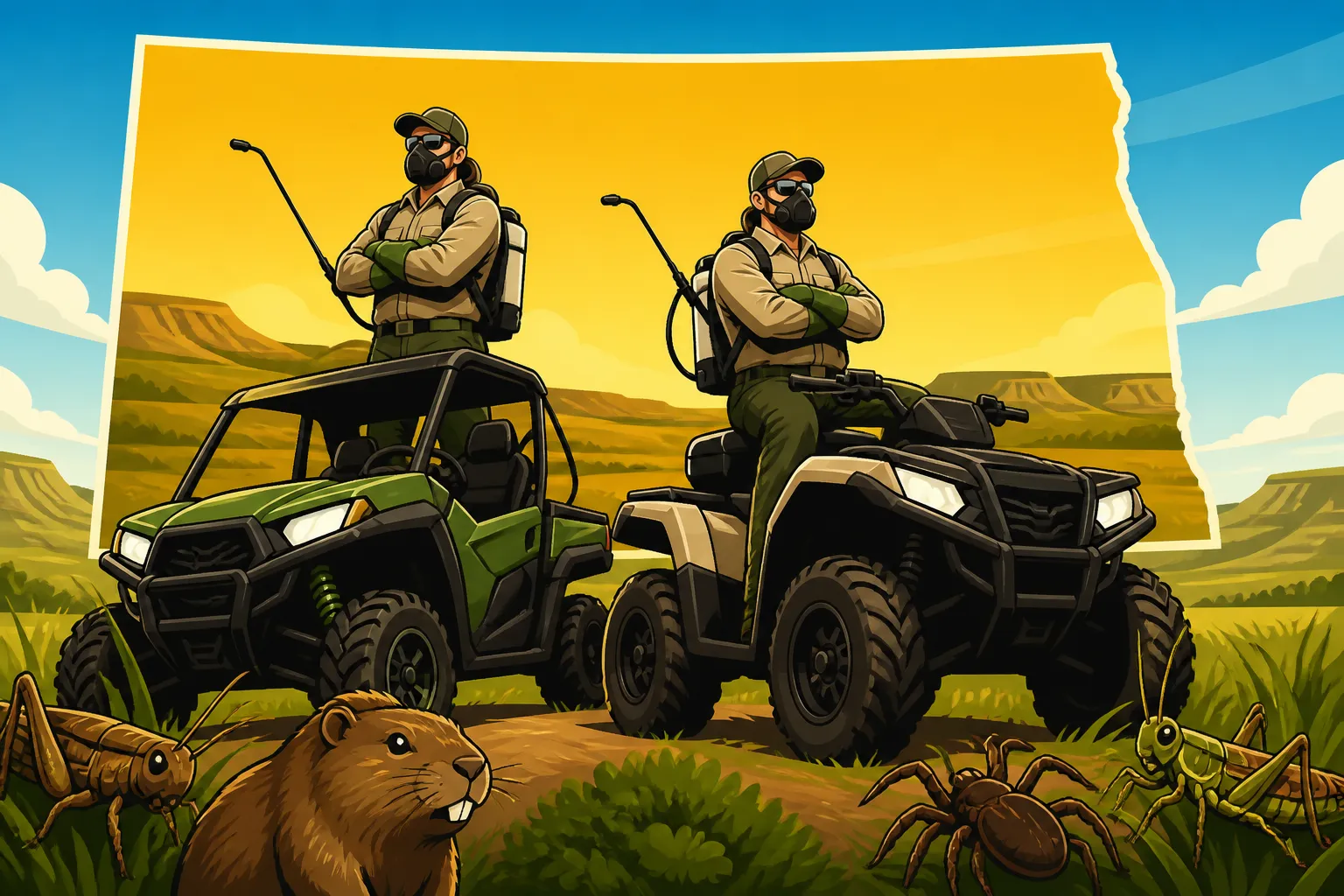
It's a common sight on North Dakota's sprawling network of roads: you're driving along, perhaps enjoying the open prairie, and you spot an ATV or UTV operating on the shoulder, seemingly where regular riders aren't allowed. This can be incredibly confusing, even a little frustrating, for off-highway vehicle (OHV) enthusiasts who are trying their best to follow the rules. This guide will clarify why pest control crews have a unique legal standing to operate on roadway shoulders and rights-of-way in North Dakota, and what distinguishes their activities from general recreational riding.
Understanding the Special Provisions for Pest Control Crews in North Dakota
When you're out riding your ATV or UTV, navigating the designated trails or legally approved ditch bottoms, it can be perplexing to see official vehicles operating in areas where you know private OHVs are typically restricted. This isn't just about government vehicles having a blanket exemption; specifically, pest control crews in North Dakota operate under carefully defined legal provisions that allow them to use roadway shoulders and rights-of-way for their critical work. Their presence isn't an invitation for others to follow suit, but rather a necessary exception carved out for public safety and agricultural health.
This special allowance is rooted in the unique demands of their job. Imagine trying to combat an invasive weed infestation or control insect populations that pose a threat to crops or public health if you were restricted to only official trails. The nature of pest control often requires access to specific areas along roadsides, easements, and other linear features that are otherwise off-limits to OHVs. The state recognizes this operational necessity, creating a distinct legal pathway for these essential services. It’s about ensuring that critical work can be done efficiently and effectively, even if it means bending some of the usual rules for off-road vehicle use.
The Legal Framework: North Dakota Century Code and Exemptions
North Dakota has a comprehensive set of laws governing OHV use, and for the general public, these laws clearly delineate where you can and cannot ride. However, the North Dakota Century Code includes specific provisions that grant exemptions for certain types of official or sanctioned operations, including those conducted by pest control crews. These aren't loopholes; they are intentional carve-outs designed to allow public service workers to perform their duties without being in violation of OHV regulations.
Statutory Basis for Special Access
The foundation for this special access lies within the state's motor vehicle and off-highway vehicle statutes. While the general rules for [What North Dakota's OHV Law Requires of Owners] often restrict OHVs from highway shoulders and rights-of-way, specific sections provide exceptions for "authorized emergency vehicles" or vehicles "engaged in maintenance, construction, or other governmental purposes" or those "operated under contract with the state or a political subdivision." Pest control operations, whether conducted by county weed boards, state agencies, or contracted entities, typically fall under these umbrellas. This means their activities are not merely tolerated but are explicitly permitted by law due to the essential nature of their work.
For instance, consider a county weed board tasked with eradicating leafy spurge along highway ditches. This noxious weed can quickly spread, devastating grazing land and impacting agricultural yields. To effectively spray these areas, a crew needs to traverse the length of the ditch and shoulder, often requiring specialized equipment mounted on an ATV or UTV. The law anticipates such needs, ensuring these workers can access the affected areas directly. Without these specific exemptions, the vital work of managing invasive species and agricultural pests would be significantly hampered, potentially leading to widespread economic and environmental damage across the state.
Differentiating from General Public Use
It's absolutely crucial to understand that these exemptions are not a blanket permission for any ATV or UTV rider to operate on roadway shoulders. The general rules for [North Dakota Ditch Riding: The Legal Right Explained] apply to recreational and private users, and those rules have specific limitations regarding where and how you can operate. When you see a pest control crew operating an OHV on a shoulder, they are doing so under specific authorization, typically with clear identification, specialized equipment, and a defined purpose.
A recreational rider, even one who lives near a field needing pest control, cannot simply decide to use their ATV to spray their land from the highway shoulder. That would be a clear violation of state law. The difference lies in the purpose of the operation and the authority under which it is conducted. Pest control crews are acting as agents of a government entity or under a specific contract, performing a public service. Their vehicles are often clearly marked with official signage, flashing amber lights, and sometimes even specialized utility components from brands like SuperATV, which makes a range of heavy-duty accessories suitable for such demanding applications. This clear distinction is key to maintaining both public safety and the integrity of OHV regulations for everyone else.
Operational Guidelines and Safety Considerations for Pest Control OHVs
Operating any vehicle on or near public roadways comes with inherent risks, and OHVs used by pest control crews are no exception. While they have specific legal exemptions for access, these crews are still bound by stringent operational guidelines and safety protocols to ensure the protection of themselves, other motorists, and the public. Their work isn't just about getting the job done; it's about doing it safely and responsibly within the framework of their unique permissions.
Safe Practices on Shoulders and Rights-of-Way
When a pest control crew is operating an OHV on a shoulder or within a highway right-of-way, safety is paramount. These machines often move at slow speeds, sometimes stopping frequently, making them less predictable than regular traffic. To mitigate risks, crews typically employ a variety of best practices:
- Visibility: Their vehicles are almost always equipped with amber warning lights that flash to alert oncoming and passing traffic. They'll often have highly visible reflective tape on the machine and wear high-visibility clothing themselves.
- Cones and Signage: For stationary work or when operations might impact traffic flow, temporary cones or "Work Ahead" signs may be deployed to warn motorists.
- Spotters: In some situations, especially where visibility is limited or complex maneuvers are required, a spotter may be used to guide the OHV operator and monitor traffic.
- Traffic Awareness: Operators are trained to constantly be aware of traffic conditions, pulling further off the roadway or pausing operations if traffic becomes heavy or hazardous.
These practices are not just suggestions; they are often mandatory protocols established by the agencies or companies employing these crews. They recognize the dangers of working alongside high-speed traffic and take every precaution to prevent accidents.
Equipment Requirements and Training
The OHVs used by pest control crews are typically not standard recreational models. They are often utility-focused machines, sometimes equipped with specialized accessories from companies like SuperATV, such as heavy-duty suspension components to handle the weight of spray tanks, robust skid plates for protection, or advanced lighting systems for early morning or late evening work. These machines must be properly maintained and equipped for their specific tasks.
Beyond the machinery, the operators themselves undergo specialized training. This training covers not only the application of pest control agents but also defensive driving techniques, traffic control procedures, and a thorough understanding of the legal frameworks governing their roadside operations. They are taught how to safely maneuver their OHVs in varied terrain, how to handle emergencies, and how to communicate effectively with passing motorists if necessary. This combination of specialized equipment and comprehensive training ensures that these crews can perform their duties effectively while minimizing the risks associated with operating in sensitive areas like highway shoulders.
Distinguishing Pest Control Use from General Public Riding
The sight of an OHV on a roadway shoulder, even an official one, can lead to confusion for recreational riders. It's vital to clearly distinguish why pest control crews are permitted to do this, while the general public is not. This isn't a matter of privilege, but a distinction based on purpose, legal authorization, and operational necessity.
The "Why Can't I?" Dilemma
It's perfectly natural to think, "If they can ride there, why can't I?" This question often arises when riders see what appears to be a deviation from the normal rules. The key difference lies in the nature of the activity. Recreational riding is, by definition, for leisure and personal enjoyment. Its purpose does not typically align with the public interest in a way that would warrant exemptions from standard traffic and OHV laws. When you're out on your machine for a fun ride, the expectation is that you will stick to designated trails, private property with permission, or legally opened [North Dakota Gravel Roads Open to Registered Machines] and specific ditch routes.
Pest control, on the other hand, is a public service. It protects agriculture, public health, and natural ecosystems from harmful invaders. Whether it's spraying for mosquitoes, controlling invasive weeds like Canada Thistle, or dealing with grasshopper outbreaks, these activities are deemed essential for the well-being of the state's residents and economy. The legal provisions that allow pest control crews to access roadway shoulders and rights-of-way are specifically tied to this public service function. It's not about the vehicle itself, but the authorized mission it's performing.
Defined Scope of Operation
The permissions granted to pest control crews are not open-ended. They are typically defined by the scope of their work, which includes:
- Specific Locations: Operations are confined to areas where pest control is required, such as roadside ditches, culverts, or areas prone to specific infestations.
- Specific Times: Work is often scheduled to minimize interference with traffic, sometimes taking place during off-peak hours.
- Specific Equipment: Their machines are equipped for their task, often carrying sprayers, tanks, and other tools, rather than recreational gear.
- Official Identification: Vehicles are clearly marked with agency logos, government plates, or contractor identification, making their purpose unmistakable.
In contrast, recreational riding has a much broader, non-specific scope. Riders might want to traverse the shoulder to get from one section line to another, or to avoid a particularly muddy section of a ditch. These reasons, while understandable from a rider's perspective, do not meet the stringent criteria for the exemptions granted to public service operations. Attempting to ride on a shoulder without official authorization could lead to significant penalties, as outlined in articles like [North Dakota Penalties for Riding Unregistered] or [North Dakota Ticket Cost for a Road Violation]. It's crucial for every rider to understand that seeing an official OHV on a shoulder is not a green light for personal use.
Here's a quick comparison of the distinctions:
| Feature | Pest Control Crews (Authorized Use) | General Public (Recreational Use) |
|---|---|---|
| Purpose | Public service, weed/pest management, agricultural protection | Recreation, sport, personal transportation |
| Legal Basis | Specific exemptions in ND Century Code for governmental/contracted work | General OHV laws, typically restricting shoulder/right-of-way use |
| Vehicle Identification | Clearly marked with agency/contractor logos, official plates | Standard OHV registration (decal or plate) |
| Equipment | Specialized sprayers, tanks, utility accessories, warning lights | Primarily recreational accessories, no specialized public service gear |
| Operator Training | Specialized safety and operational training for public roadways | OHV safety certification (for under 16), general riding experience |
| Insurance | Commercial liability coverage (often higher limits) | [North Dakota Insurance Requirements at Registration] (if applicable) |
| Visibility on Roadway | High-visibility markings, flashing amber lights | Standard lighting for OHVs, minimal extra warning for traffic |
| Access Area | Shoulders, rights-of-way directly relevant to pest issues | Designated trails, private land (with permission), specific ditch routes |
This table clearly illustrates why the visible presence of pest control OHVs on roadway shoulders doesn't alter the rules for the average North Dakota ATV or UTV rider.
Equipment and Visibility Requirements for Official Operations
When a pest control crew utilizes an OHV for their duties along North Dakota's roadsides, it's not simply a matter of strapping a sprayer onto any quad or side-by-side. These machines must meet specific equipment and visibility standards, many of which go beyond what a typical recreational rider needs. These requirements are in place to ensure both the safety of the operators and the motorists sharing the roadways, especially since these machines are often operating in close proximity to traffic at much lower speeds.
Enhancing Visibility for Safety
The most critical aspect for any vehicle operating near traffic, particularly one moving slowly or intermittently, is visibility. Pest control OHVs are required to be highly conspicuous to other road users. This usually includes:
- Amber Warning Lights: These are non-negotiable. Flashing amber lights, often mounted prominently on the highest point of the OHV, serve as an immediate visual cue to approaching drivers that there is work being done ahead or alongside the road. These lights must be visible from a significant distance to give drivers ample time to react and adjust their speed or lane position.
- Reflective Markings: Beyond active lighting, many of these vehicles are adorned with high-contrast reflective tape on various surfaces, ensuring they remain visible even in low light conditions or when headlights sweep across them.
- High-Visibility Clothing: The operators themselves are typically mandated to wear safety vests or jackets in bright colors like fluorescent orange or yellow, often with reflective strips. This makes the human element of the operation as visible as the machine itself.
These measures collectively create a "safety bubble" around the working OHV, maximizing its noticeability and reducing the risk of a collision.
Specialized Equipment for the Task
Beyond visibility, the OHVs used for pest control are usually outfitted with specialized equipment necessary for their work. This is where the "utility" aspect of UTVs and larger ATVs really shines.
- Sprayer Systems: The most obvious addition is a sprayer unit, which can range from small tank-and-boom setups to more elaborate systems with multiple nozzles and larger reservoirs. These systems often require robust mounting solutions and additional power, sometimes straining the machine's electrical system, making durable aftermarket components a valuable asset.
- Load-Bearing Capacity: Carrying hundreds of pounds of liquid chemical and associated equipment places a significant demand on the OHV's suspension and frame. Many crews opt for heavy-duty utility models, and some even upgrade with aftermarket parts designed for increased payload, such as reinforced springs or even full suspension kits. Brands like SuperATV, for instance, offer heavy-duty axles and suspension components that are popular among those who push their machines beyond recreational limits, making them suitable for the rigorous demands of pest control work.
- Work Lights: For early morning, late evening, or overcast conditions, auxiliary work lights are often installed to illuminate the spray area. While not always directly aimed at traffic, they further enhance the overall visibility of the work zone.
- Navigation and GPS: Many pest control operations require precise application, making GPS and mapping systems critical for tracking where chemicals have been applied and ensuring comprehensive coverage without overlap.
These specialized additions, from the sprayer itself to heavy-duty parts that ensure reliability, are what differentiate these working machines from a recreational ride. They are purpose-built and purpose-equipped to perform a specific, essential task safely and effectively along the public roadways. [North Dakota Equipment Required on a Roadway] for regular OHV use might include mirrors and horns, but pest control operations layer additional, often more robust, equipment specific to their mission.
Impact and Importance of These Operations
The presence of pest control crews operating OHVs on North Dakota's roadway shoulders isn't just a legal curiosity; it represents a critical component of the state's infrastructure and environmental management. These operations have a far-reaching impact, safeguarding agricultural output, protecting public health, and preserving the ecological balance of the prairie landscape. Without the ability to conduct these activities efficiently, North Dakota would face significant challenges.
Protecting Agriculture and Natural Resources
North Dakota's economy is deeply rooted in agriculture, making the control of noxious weeds and agricultural pests paramount. Invasive plant species, like absinth wormwood or Canada thistle, can quickly overtake pastureland and cropland, reducing yields and diminishing the value of agricultural land. Similarly, insect outbreaks, such as grasshoppers or mosquitos carrying diseases that affect livestock, can cause substantial economic losses.
Pest control crews, utilizing their specially equipped OHVs, can access the extensive network of ditches and rights-of-way that often serve as corridors for these pests to spread. By targeting these areas, they create a crucial buffer zone, preventing infestations from migrating into valuable fields. This proactive and reactive management directly supports the state's farmers and ranchers, helping to ensure the productivity and sustainability of North Dakota's agricultural sector. The efficient use of OHVs, sometimes equipped with rugged utility parts from companies like SuperATV, allows these teams to cover vast distances and difficult terrain quickly, making their efforts highly effective.
Safeguarding Public Health and Safety
Beyond agriculture, pest control operations also play a vital role in public health and safety. Mosquito control, for instance, is essential in preventing the spread of West Nile virus and other mosquito-borne illnesses. Roadside areas, with their potential for standing water, can be prime breeding grounds for these insects. Crews deploying OHVs can apply larvicides or adulticides to these areas, significantly reducing mosquito populations and mitigating health risks to residents and visitors.
Furthermore, managing vegetation along roadways improves visibility for motorists, especially at intersections and around curves. Overgrown weeds can obscure signs, oncoming traffic, and wildlife, increasing the risk of accidents. By controlling this growth, pest control crews contribute directly to safer driving conditions across the state. This demonstrates how what might seem like a small exception in OHV law serves a much larger public good, touching almost every aspect of life in North Dakota. Their work highlights why certain specific operations are granted permissions that differ from the general rules for personal OHV use, underscoring the deep connection between legal frameworks, public service, and the unique needs of a state like North Dakota.
Disclaimer
This article is for general informational purposes only and does not constitute professional advice. Laws, prices and regulations vary by location and change over time. Consult a qualified professional for guidance on your specific situation.