Towing With a Swivel Hitch in North Dakota
There’s a unique satisfaction that comes from hitching up a small trailer to your ATV or UTV and heading out to tackle a chore or embark on an adventure across North Dakota’s diverse landscape. Whether you’re hauling firewood for a cozy evening, feed for livestock, or an ice shanty for a winter fishing trip, your off-highway vehicle (OHV) is an incredibly versatile tool. But let's be honest, those moments of anxiety when the trailer starts pushing your machine around on uneven ground, or when you feel that jarring tug over a bump, can really take the joy out of the job. This guide is here to shed some light on why a swivel hitch might be your new best friend for towing in North Dakota and where it fits into the state’s OHV landscape, making your towing experiences safer and smoother.
Understanding North Dakota's Towing Regulations for OHVs
North Dakota is a state built on practicality and hard work, and its approach to OHVs often reflects that. While specific laws might not always detail every accessory, the overarching goal is safe and responsible operation, especially when you're interacting with public lands or roadways. When it comes to towing, this means ensuring your setup doesn't create undue hazards.
Why Swivel Hitches Are a Specific Consideration
Picture this: you're pulling a heavily loaded utility trailer across a bumpy field or a section of prairie that's far from flat. With a standard, fixed hitch, every dip, rise, or sideways lean of the trailer is directly transferred to your ATV or UTV. This can feel like the trailer is trying to steer your machine, forcing the rear tires to lose traction or even causing dangerous jackknifing, especially during braking or turns. It's not just uncomfortable; it's a genuine safety hazard that can lead to loss of control, spills, and damage to both your machine and your cargo.
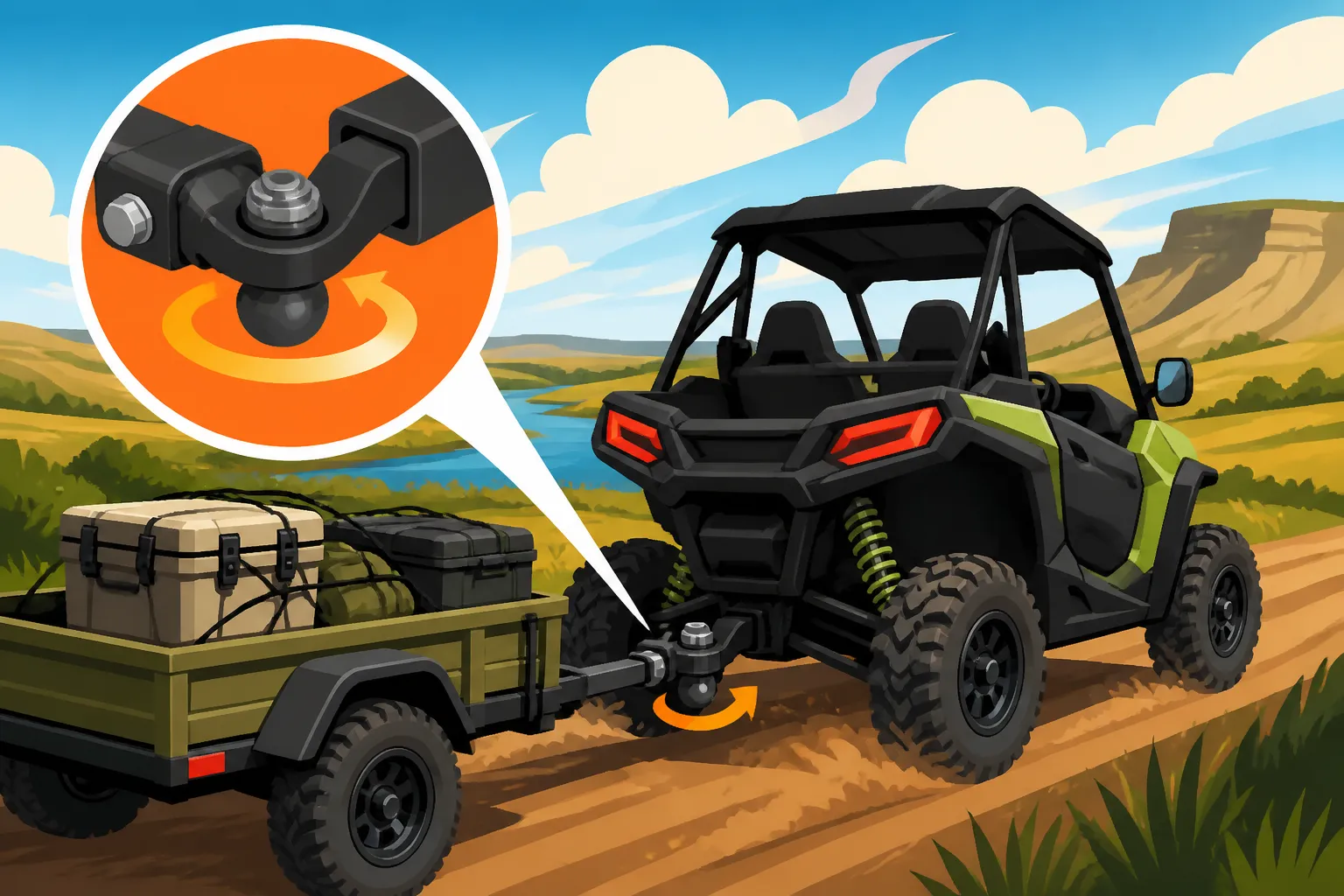
The swivel hitch, on the other hand, is ingeniously designed to prevent these issues. It incorporates a pivot point that allows the trailer to move independently from your OHV, both vertically and sometimes horizontally. This decoupling of movement means that when your trailer hits a rut or goes over a mound, your ATV or UTV isn't subjected to the same jarring forces. It's a simple mechanical solution to a very common and frustrating towing problem, significantly improving stability and control, particularly in those rugged, off-road conditions that North Dakota is famous for. For anyone who has ever wrestled a trailer on challenging terrain, the benefits are immediately obvious.
Legal Definitions and Interpretations
North Dakota’s OHV laws, while comprehensive in areas like registration and road use, generally don't get into the minutiae of hitch types. The focus is more on whether your OHV is properly registered, titled, and equipped for its intended use, especially if that use involves public access. When you're operating on public roads, ditches, or designated trails, the expectation is that your machine and any attached equipment are in safe working order and that you are operating them responsibly. This means that while the law might not explicitly say "thou shalt use a swivel hitch for towing," the implied requirement for safe operation means choosing appropriate equipment for the task at hand.
Consider, for example, the discussions around [North Dakota Equipment Required on a Roadway]. While this mainly pertains to lights, mirrors, and horns for the OHV itself, the spirit of the law extends to anything you attach to it. If a fixed hitch setup makes your towing operation unstable or unsafe on a public access route, then you could potentially be found in violation of general safety rules. A swivel hitch inherently contributes to safer operation, aligning with the state's implicit expectation for responsible OHV use. So, while it's not mandated, it's certainly a smart choice for anyone looking to ensure their towing operations are as safe as possible within North Dakota's regulatory framework.
The Benefits of Using a Swivel Hitch for Off-Road Towing
For those of us who regularly put our ATVs and UTVs to work, or simply enjoy exploring the less-traveled paths, the advantages of a swivel hitch go beyond mere convenience. They translate directly into enhanced safety, reduced wear on equipment, and a much more enjoyable experience.
Enhanced Safety and Control on Uneven Terrain
Imagine you’re out hunting near the Sheyenne National Grassland and you've successfully harvested an animal. Now comes the real work: getting it back to your truck. You load it into a small utility trailer, hitch it to your UTV, and start navigating through tall prairie grasses, over small rises, and across a few shallow creeks. With a fixed hitch, every time a trailer wheel drops into a hole or climbs over a mound, that motion is transferred directly to your UTV. It can feel like the trailer is a stubborn passenger, pushing and pulling you off course. This is particularly noticeable when going downhill, where the trailer's weight can actually dictate your descent path, or when attempting a sharp turn on a slippery surface, leading to potential jackknifing.
A quality swivel hitch eliminates this direct transfer of force. It acts as a flexible joint, allowing the trailer to articulate independently of your OHV. So, when that trailer wheel drops, your UTV remains largely stable and unaffected. This independent movement dramatically improves control, especially in challenging situations like traversing side slopes, pulling through deep snow, or navigating rocky streambeds. It reduces the risk of the trailer pushing the rear of your OHV around, giving you far greater steering stability and reducing the chances of a dangerous rollover or loss of traction. This level of control is absolutely paramount when you're far from paved roads and assistance.
Protecting Your OHV and Trailer from Damage
Beyond immediate safety, a swivel hitch offers significant long-term benefits for the longevity of your equipment. A fixed hitch creates a rigid connection between your OHV and the trailer. When you encounter uneven terrain, this rigid connection means both frames are subjected to twisting and bending forces. Think about pulling a log splitter up a steep, bumpy approach to a field road; the constant up-and-down movement of the trailer puts immense stress on your OHV's hitch receiver and frame, and likewise, on the trailer's tongue and frame. Over time, this repetitive stress can lead to cracked welds, bent components, and premature wear on suspension parts, not just on the trailer but on your ATV or UTV as well.
With a swivel hitch, because the trailer can move more freely, these torsional forces are largely absorbed by the hitch's pivot mechanism, rather than being transferred directly into the frames of your machines. This independent articulation reduces the strain on critical connection points and chassis components. It also minimizes the shock loads transmitted through the drivetrain and suspension, which can extend the life of universal joints, axles, and shock absorbers. Investing in a quality swivel hitch means you're not just buying safety; you're also making a smart decision to protect your valuable off-road vehicles from unnecessary wear and tear, ultimately saving you money on repairs down the line. It's a small change that yields big dividends in equipment preservation.
Where You Can Legally Use a Swivel Hitch in North Dakota
Navigating the rules for OHV use in North Dakota can sometimes feel like a puzzle, especially when you start adding accessories and specialized equipment. The good news is that a swivel hitch, by its very nature, enhances safety, which is always looked upon favorably. However, where you're operating your OHV with a trailer attached is key.
On Private Property and Designated Trails
On private land, the rules are largely set by the landowner. If you own the property or have explicit permission from the owner, you generally have a lot of leeway regarding what you can tow and how you hitch it up. This is where the utility of a swivel hitch truly shines without legal constraints. Hauling anything from gravel to hunting blinds across your own fields or wooded areas becomes a significantly safer and less stressful task. Many North Dakota residents rely on their OHVs for farm and ranch work, and a swivel hitch is an invaluable tool for these applications. [Farm Machines and North Dakota Paperwork] covers some of the general considerations for using OHVs in agricultural settings.
When it comes to designated OHV trails in North Dakota, such as the trails at Pembina Gorge or sections of the Roughrider OHV Trail, the primary focus is usually on recreational riding and minimizing environmental impact. While towing a personal trailer for things like maintenance or for specific permitted events might be allowed, general recreational towing is less common. However, if you are permitted to tow on these trails, a swivel hitch is absolutely the smart choice for safety and control. These trails often feature challenging terrain, sharp turns, and elevation changes, where the stability offered by a swivel hitch becomes a major asset. Always check with the specific trail management authority, like North Dakota Parks and Recreation, for any unique towing restrictions or requirements before heading out. For more on where to ride, check out [North Dakota OHV Trails: All Four Riding Areas].
Navigating Public Roads and Ditch Bottoms
This is where the landscape of North Dakota OHV law becomes a bit more nuanced. North Dakota has specific statutes governing where and how OHVs can operate on public roads and within highway rights-of-way, including the ubiquitous ditch bottoms. The law generally permits OHVs on unpaved roadways, gravel roads, and within the ditch bottoms, provided they are properly registered and equipped. [North Dakota Ditch Riding: The Legal Right Explained] provides a comprehensive look at these regulations. If your OHV is legally permitted on a particular road surface or ditch, then any towing apparatus you use must be safe and not impede the safe operation of your vehicle.
While the law doesn't single out "swivel hitches," it does demand safe equipment. If you're utilizing your OHV on a section line or a township road, a swivel hitch helps ensure that your trailer behaves predictably, even if you encounter washboards, potholes, or soft shoulders. This contributes directly to compliance with general safe operation clauses. For instance, if you need to use [North Dakota's Obstruction Exception] to briefly leave the ditch bottom to pass a culvert, having a stable towing setup is critical for that quick, safe transition back into the legal riding area. It’s also important to remember that trailer registration may be required for certain trailers if they are used on public roads, so don't forget to check [North Dakota Trailer Registration in North Dakota] for specifics. Using a swivel hitch in these scenarios isn't just a preference; it’s a proactive step toward safer, more compliant use of your OHV on North Dakota's public access routes.
Choosing the Right Swivel Hitch for Your North Dakota Needs
Just like selecting the right ATV or UTV for the job, choosing a swivel hitch isn't a one-size-fits-all decision. The terrain you’ll cover, the weight you’ll pull, and the specific needs of your North Dakota adventures or chores will all play a role in finding the perfect fit.
Key Features and Considerations
When you start looking for a swivel hitch, you’ll quickly notice that they come in various designs and capacities. First and foremost, consider the material and construction. You want something robust – heavy-duty steel is a common choice for its strength and durability, especially when you're expecting to tackle tough conditions or heavy loads. Pay attention to the weight capacity of the hitch. This needs to match, or ideally exceed, the maximum weight you anticipate towing, including the trailer itself and its full cargo. Exceeding the rated capacity is a recipe for disaster and can void warranties or lead to catastrophic failure.
Next, think about the hitch receiver size on your ATV or UTV. Most utility vehicles will have either a 1.25-inch or a 2-inch receiver. Ensure the swivel hitch you select is compatible with your machine’s receiver. The actual swivel mechanism itself is crucial. Some offer a full 360-degree rotation, while others might provide a limited but sufficient pivot range. For extreme off-road articulation, a 360-degree rotation offers maximum flexibility. Consider the ease of installation and removal – do you want something you can quickly attach and detach, or is it a more permanent fixture? Brands like SuperATV offer a range of heavy-duty towing solutions, including various swivel hitches, designed with demanding off-road use in mind. Their products often feature robust construction and innovative designs that cater to the needs of riders who push their machines, making them a popular choice for durable, high-performance accessories that can withstand the rigors of the North Dakota environment.
Maintenance and Inspection Tips
Even the toughest gear needs a little love to perform at its best, and your swivel hitch is no exception. Regular maintenance and inspection are vital to ensure its continued safety and reliability, especially given North Dakota's sometimes harsh weather conditions and dusty trails.
Start with regular lubrication of the swivel mechanism. Depending on the design, this might involve grease zerks that you can hit with a grease gun, or simply applying a high-quality grease to pivot points. Dust, mud, and moisture can quickly gum up moving parts, leading to increased friction, wear, and even corrosion. A well-lubricated hitch operates smoothly and quietly, reducing strain on its components. After a particularly muddy or dusty ride, it's always a good idea to clean the hitch thoroughly before re-lubricating.
Before each towing session, make it a habit to perform a quick visual inspection. Look for any signs of wear and tear:
- Cracks: Check the welds and main structural components for any hairline cracks, which can indicate fatigue.
- Bent components: Ensure all parts are straight and not deformed from impacts or overloading.
- Loose bolts or pins: Verify that all fasteners are tight and secure. Any play in the connection can quickly lead to more significant problems.
- Corrosion: While robust materials resist rust, surface corrosion can still occur. Address it early to prevent structural weakening.
If you notice any significant damage or excessive play, address it immediately. It’s better to repair or replace a component than to risk a breakdown or accident far from home. Proper care will ensure your swivel hitch remains a dependable part of your OHV setup for years to come, no matter what North Dakota throws at it.
Practical Scenarios: When a Swivel Hitch Shines in North Dakota
North Dakota life often calls for robust solutions, and nowhere is this more true than when your ATV or UTV is pressed into service. A swivel hitch isn't just a "nice-to-have" accessory; it's a game-changer for many common tasks and recreational pursuits in the state.
Hauling for Farm, Ranch, or Hunting
For farmers and ranchers across North Dakota, an ATV or UTV is an indispensable workhorse. Imagine needing to haul a new section of fencing, a pallet of feed, or a sprayer full of weed killer across a vast, uneven pasture. With a fixed hitch, the trailer bounces and shoves, making it a jarring, uncomfortable, and potentially dangerous journey, especially if you’re traversing divots left by cattle or old cultivation lines. A swivel hitch allows the trailer to absorb these shocks independently, letting your OHV maintain its composure and traction. This means less stress on your back, less wear on your equipment, and a much more efficient way to get those critical supplies where they need to go. [Farm Machines and North Dakota Paperwork] highlights the extensive use of OHVs in agriculture.
Hunting is another area where the swivel hitch proves its worth. After a successful deer hunt in the rolling hills near the Missouri River, retrieving your game can be the hardest part of the day. Dragging a carcass is tough, but using a small utility trailer is far more efficient. However, navigating through brush, over downed logs, and across creeks with a heavy, potentially unwieldy load can be treacherous. With a swivel hitch, the trailer can articulate over obstacles without transmitting severe jolts or lateral forces to your ATV or UTV. This makes the retrieve safer, preventing the trailer from jackknifing or overturning on challenging terrain. It ensures that both your prize and your ride home are handled with greater stability and less effort.
Recreational and Utility Towing
Beyond the farm, North Dakota's outdoor enthusiasts find countless uses for a swivel hitch. Consider the ice fishing season, a staple of winter recreation. Hauling an ice fishing shanty, auger, and all your gear across a frozen lake, especially one with a snow-covered, bumpy surface, can be a real struggle with a standard hitch. The shanty wants to pull your rear end sideways with every bump. With a swivel hitch, the shanty floats independently, allowing you to maintain a straighter, more controlled path, even on slick ice or through drifts. This makes getting to your favorite fishing spot less of a wrestling match and more of a smooth glide.
Even for general utility, like hauling firewood to a remote campsite in the Turtle Mountains, a swivel hitch provides peace of mind. As you navigate twisting, root-filled trails, the independent movement of the trailer means you’re less likely to get hung up or have the trailer push you into a tight spot. Similarly, if you’re moving landscaping materials around a lake cabin, a swivel hitch makes maneuvering over uneven ground, through tall grass, and around obstacles far easier. It transforms a task that could be frustrating and risky into something manageable and even enjoyable, allowing you to get the most out of your OHV’s towing capabilities in any North Dakota season.
Towing Safety Checklist for North Dakota OHV Riders
When you're hitching up a trailer to your ATV or UTV in North Dakota, whether for work or play, safety should always be your top priority. Using a swivel hitch already puts you ahead in terms of control, but a comprehensive pre-towing checklist ensures you've covered all your bases.
| Checklist Item | Description | Swivel Hitch Benefit |
|---|---|---|
| OHV Inspection | Check tires (pressure, tread), brakes, lights, fluid levels, and overall mechanical condition of your ATV/UTV. | Ensures the primary vehicle is stable and capable, complementing the hitch's performance. |
| Hitch & Coupler Inspection | Verify the swivel hitch is securely attached to the OHV receiver. Check for wear, damage, and proper lubrication. Ensure the trailer coupler is fully engaged and latched. | The swivel mechanism should move freely without excessive play, confirming independent articulation for better control. |
| Safety Chains | Attach safety chains in a crisscross pattern under the coupler, providing a fail-safe in case of hitch failure. | Essential for all towing, even with a superior swivel hitch, for maximum security. |
| Trailer Lights | Test all trailer lights (tail, brake, turn signals) to ensure they are functioning correctly and visible, especially when on or near public access routes. | Maintains legal visibility for safety, particularly when interacting with other vehicles. |
| Load Distribution | Distribute cargo evenly in the trailer, with approximately 10-15% of the total trailer weight (GTW) on the tongue. Secure the load to prevent shifting. | Proper load distribution is critical for stability; a swivel hitch helps manage minor shifts on uneven terrain better than a fixed hitch. |
| Tire Pressure (Trailer) | Inflate trailer tires to the manufacturer's recommended pressure. Underinflated tires can cause instability. | Ensures the trailer itself tracks smoothly, allowing the swivel hitch to perform optimally in absorbing shocks. |
| Speed & Terrain | Adjust your speed for terrain, load weight, and visibility. Avoid sudden starts, stops, or turns. Drive slower than you would without a trailer. | A swivel hitch provides more forgiveness, but prudent driving habits are still paramount for safe navigation over varied North Dakota landscapes. |
| Clearance | Be mindful of your increased length and width, especially when turning or backing up in tight spaces or through gates on private land. | Increased articulation helps with navigating tight spots, but overall dimensions remain a factor. |
| Muffler Check | Ensure your OHV and any attached equipment meet [North Dakota Muffler Requirements] to avoid noise complaints, especially in recreational areas. | A well-maintained OHV (including its exhaust system) contributes to a pleasant and compliant riding experience while towing. |
| Insurance & Registration | Carry proof of current [North Dakota Insurance Requirements at Registration] and valid OHV registration, especially if operating on public lands or roads. | Essential legal compliance, protecting you and others in the event of an incident while towing. |
| Local Regulations | Be aware of North Dakota Rules for Riding a Section Line or [North Dakota Posted Land Rules for Riders] as they apply to your specific towing route. | Adhering to local rules ensures your towing operation is permissible in your chosen area. |
Remember, while a swivel hitch is an excellent safety enhancement, it doesn't replace common sense or thorough preparation. A little proactive checking goes a long way in ensuring a safe and enjoyable towing experience across North Dakota.
Disclaimer
This article is for general informational purposes only and does not constitute professional advice. Laws, prices and regulations vary by location and change over time. Consult a qualified professional for guidance on your specific situation.