Riding on a Parent’s Land Without a Card
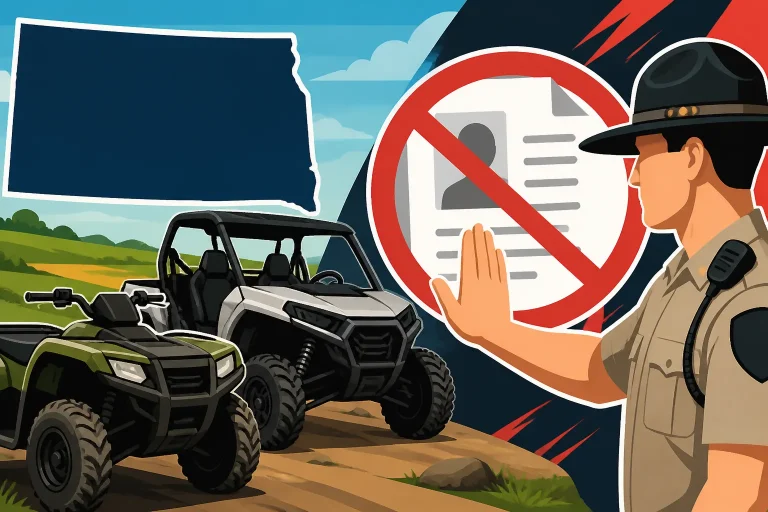
If your child rides an ATV or UTV on land owned by a parent, North Dakota’s safety-card rule is different from the rule for public land and other property. The key is knowing where the exception ends: a parent’s land does not automatically mean a rider is cleared for nearby trails, ditches, or someone else’s property.
What the parent’s-land exception means
North Dakota requires a safety certification for certain young OHV riders when they operate away from a parent’s land. According to the North Dakota Parks and Recreation Department, youth ages 12 through 15 who do not have a valid driver’s license or learner’s permit must take a safety certification class to legally operate an OHV on allowed public lands. The department also says certification is required on land other than the parent’s, including designated trails and ditches.
In practical terms, a child in that age group who does not have the required license or permit may ride on a parent’s land without the OHV safety card. That exception is tied to the location, not to the machine or the rider’s relationship to the parent. Once the ride moves beyond the parent’s land, the certification requirement can apply.
| Where the rider operates | Does the parent’s-land exception cover the ride? | What to keep in mind |
|---|---|---|
| Land owned by a parent | Yes, for the safety-certification requirement described by the North Dakota Parks and Recreation Department | The exception concerns the safety card; it does not establish that every other riding rule is waived. |
| A designated public trail | No | A qualifying youth needs safety certification to operate legally there. |
| A ditch | No | The department specifically includes ditches among the places where certification is required. Other rules may also control whether riding there is allowed. |
| Land owned by someone else | No | A parent’s permission or supervision does not turn another person’s land into the parent’s land. |
| A route that starts on parent-owned land and continues elsewhere | Only the portion on the parent’s land | Plan for the rules that apply as soon as the route leaves the parent’s property. |
The exception should not be treated as a general “family ride” exemption. If a parent accompanies a child onto a trail, that does not make the trail part of the parent’s land. Likewise, having the property owner’s permission to ride on another parcel may address permission to enter, but it does not make that parcel the parent’s land for the certification rule.
A useful planning question is: “Whose land is the machine actually on?” If the answer changes during the ride, the rules can change too. Before leaving a yard, field, or private track, check whether the planned route crosses a public trail, a ditch, or property belonging to someone else. For the broader distinction between riding on family property and riding elsewhere, see North Dakota Riders on a Parent’s Land.
The word “card” can also cause confusion. Here, it refers to proof of OHV safety certification. It is not the same as an OHV registration, a non-resident access permit, a driver’s license, or permission to use private property. Meeting one requirement does not automatically meet the others.
When certification is needed and how to get it
The North Dakota Parks and Recreation Department says youth ages 12 through 15 without a valid driver’s license or learner’s permit need safety certification to operate OHVs on allowed public lands. The department also describes the law as requiring certification for youth ages 12 to 16 without a valid driver’s license or learner’s permit. Because the age wording may be presented differently across agency information, families should confirm the rule for the rider’s exact age and circumstances with the department before relying on an exception.
To become certified for OHV operation, the North Dakota Parks and Recreation Department says a rider must be at least 12 years old. A child who is 11 but will turn 12 within six months of a class date may take the safety certification test or hands-on course, but the department says the child does not receive the certification card until turning 12. For a closer look at the age rule, see North Dakota Safety Course Minimum Age.
Families can choose between an online course and an in-person option. The North Dakota Parks and Recreation Department says students taking the hands-on course must first complete the introductory e-course online and bring their certificate number to class. The department offers North Dakota Safety Course Online information for families considering the online route, but check the current course instructions before enrolling so you choose the correct option.
The hands-on class is a practical choice for a young rider who benefits from instruction in person. According to the North Dakota Parks and Recreation Department, those sessions are held from May through August, are free, and are limited to eight participants per class. Students must wear over-the-toe shoes, long pants, and a long-sleeve shirt, and they must provide their own eye protection. The department provides a free helmet at the beginning of the course for students to keep.
The full online certification course has a fee. The North Dakota Parks and Recreation Department lists that fee as $34.95 as of November 2026; check the department for the current amount and course details before starting. In-person classes are limited in enrollment, so families should check North Dakota Safety Class Schedule early rather than assuming a preferred date will have a place.
A safety course is not a substitute for checking where the child may ride. Certification addresses the rider’s training requirement; it does not grant access to land, replace registration or permits, or make a closed route legal to use. For questions about whether a rider’s certification has been issued or can be verified, North Dakota Safety Certificate Lookup may help.
A safety card is not the only rule
The parent’s-land exception is narrow. It concerns the youth safety-certification requirement and should not be read as a waiver of every rule that might apply to an ATV or UTV. Before a child rides, consider the machine, the rider, the property, and the route as separate checks.
Helmet use still matters. The North Dakota Parks and Recreation Department says riders and passengers under age 18 must wear a DOT-approved helmet when riding any OHV, including dirt bikes, ATVs, and side-by-sides. The department also advises checking for a DOT stamp or sticker on a helmet. If you are buying a helmet online, including through Amazon, verify that the particular helmet meets the DOT requirement rather than relying only on a product title or a general claim that it is protective. See North Dakota Helmet Law Age Limit for more on the age-based rule.
Permission and access are separate from certification. A safety card does not give a child permission to ride on another person’s property. The owner’s permission may be needed, and posted-land rules can matter even when a rider has been invited. Before a family ride crosses a property boundary, confirm the permission and route rather than assuming that an open gate or familiar path means riding is allowed. North Dakota Posted Land Rules for Riders covers the separate access question.
Public land brings registration or permit requirements. The North Dakota Parks and Recreation Department says OHVs operated on public land in North Dakota generally must be registered with the North Dakota Department of Transportation, and all riders must be properly registered or permitted to ride legally. The department says the registration application asks for the owner’s name and address, the machine’s make and year, and its serial number. For the general registration question, see Do You Need to Register an ATV in North Dakota?.
An out-of-state registration does not by itself settle North Dakota access requirements. According to the North Dakota Parks and Recreation Department, owners of out-of-state registered OHVs must purchase a non-resident public trails and lands access permit. Families bringing a visiting machine should check North Dakota Permit for a Visiting Machine before traveling. Registration and trail access are distinct from a young rider’s safety card; a family may need to address both. North Dakota Registration and Trail Access explains that distinction in more detail.
The same care applies to insurance. The North Dakota Parks and Recreation Department says operators must be able to provide proof of liability insurance coverage. A parent should not assume that the child’s safety certificate or the machine’s registration takes care of insurance. Check the applicable coverage and proof requirements separately; North Dakota Insurance Rules for OHV Riders is a useful next step.
Finally, a parent’s land does not turn a roadway into private riding space. If a ride approaches a road, stop and verify the rules for that road and machine instead of treating the property exception as permission to continue. Road operation has its own requirements, which are separate from safety certification and land access.
A practical plan for a family ride
The simplest way to avoid a last-minute problem is to decide the route before starting the machine. Mark the boundaries of the parent’s land, identify any trails or ditches the group might reach, and decide in advance where a rider without certification must turn back. A route that stays entirely on the parent’s land is different from one that uses a trail connection, even if the trail is only a short distance away.
Use this checklist before the ride:
- Confirm the rider’s age and license status. The North Dakota Parks and Recreation Department’s safety-certification rule applies to qualifying youth without a valid driver’s license or learner’s permit. If the rider is near an age threshold or the family is unsure which wording applies, ask the department to confirm the requirement.
- Identify whose land the route uses. The exception is for the parent’s land, not any land where a parent is present. Get permission for other private property and check the rules for any public route.
- Decide whether certification is needed. If the planned ride leaves the parent’s land for a designated trail, ditch, or other property, arrange certification before the ride when it is required.
- Check registration or permit status. The North Dakota Parks and Recreation Department says OHVs on public land generally need registration, and out-of-state owners need a non-resident access permit.
- Check the helmet and other riding basics. The department requires riders and passengers under age 18 to wear a DOT-approved helmet. Check fit and condition, and make sure required gear is ready before setting out.
- Keep the plan within the rider’s ability. A card shows completion of a safety requirement; it does not make every route or machine appropriate for every child. Match the ride to the rider’s maturity and experience, and keep the adult’s supervision practical and attentive.
If the child has not yet completed certification, the family does not have to abandon riding altogether. Staying on the parent’s land may fit the safety-card exception, provided the family follows other applicable requirements and stays within the property. If the goal is to ride a public trail or cross land beyond the parent’s property, plan for certification and access rules first. That distinction lets families enjoy private-land riding without mistaking it for a pass to ride anywhere else in North Dakota.
Sources
- North Dakota Parks and Recreation Department — OHV Safety | ND Parks and Recreation – Business and Grants (checked November 3, 2026)
- North Dakota Parks and Recreation Department — Motorized Safety | North Dakota Parks and Recreation (checked November 3, 2026)
- North Dakota Parks and Recreation Department — Snowmobile Trails | ND Parks and Recreation – Business and Grants (checked November 3, 2026)
Disclaimer
This article is for general informational purposes only and does not constitute professional advice. Laws, prices and regulations vary by location and change over time. Consult a qualified professional for guidance on your specific situation.