Hidden Culverts and Approaches
Riding the wide-open spaces of North Dakota on your ATV or UTV is an experience like no other, but it comes with its own unique set of challenges. One of the biggest headaches—and often, a serious safety concern—is the unexpected encounter with hidden culverts and approaches, especially when you're traversing ditch bottoms or moving between fields. These seemingly innocuous features can cause sudden jolts, control loss, or even serious rollovers if you're not prepared, making every ride feel like a game of chance. This guide will help you understand these common obstacles, learn how to spot them, and master safe techniques to navigate them, ensuring your North Dakota adventures remain thrilling and accident-free.
Understanding the Landscape: North Dakota's Unique Challenges for Riders
North Dakota’s rural landscape is defined by vast fields, long stretches of roads, and the omnipresent ditch systems that manage water flow and provide access. For ATV and UTV riders, these ditches and section lines often serve as informal trails, connecting properties or providing direct routes that aren't available on paved roads. However, this convenience comes with inherent risks, primarily from the infrastructure designed to coexist with this agricultural and transportation reality: culverts and approaches.
What Makes North Dakota Terrain Tricky?
The flat, often featureless terrain of much of North Dakota can be deceptive. What looks like a smooth, endless path can quickly change character. Farmers rely on culverts to ensure water drains properly across their fields and under field approaches, preventing flooding and maintaining arable land. Meanwhile, road approaches – the sloped sections that allow vehicles to enter and exit fields or driveways from a main road – are everywhere. While these are essential for daily life and agriculture, they often aren't designed with recreational off-road vehicle travel in mind, especially in the ditch bottom. The subtle undulations of the prairie can hide these transitions until you're right on top of them. Add in tall grass, snow, or shadows, and what was a minor dip becomes a true trap. This is particularly true when you’re riding at speed or when visibility is poor, whether due to weather or dwindling daylight. [North Dakota Ditch Riding: The Legal Right Explained] covers many of the nuances of permissible travel, but the physical reality of the ditch is often overlooked until it's too late.
The Ever-Present Dangers of Culverts
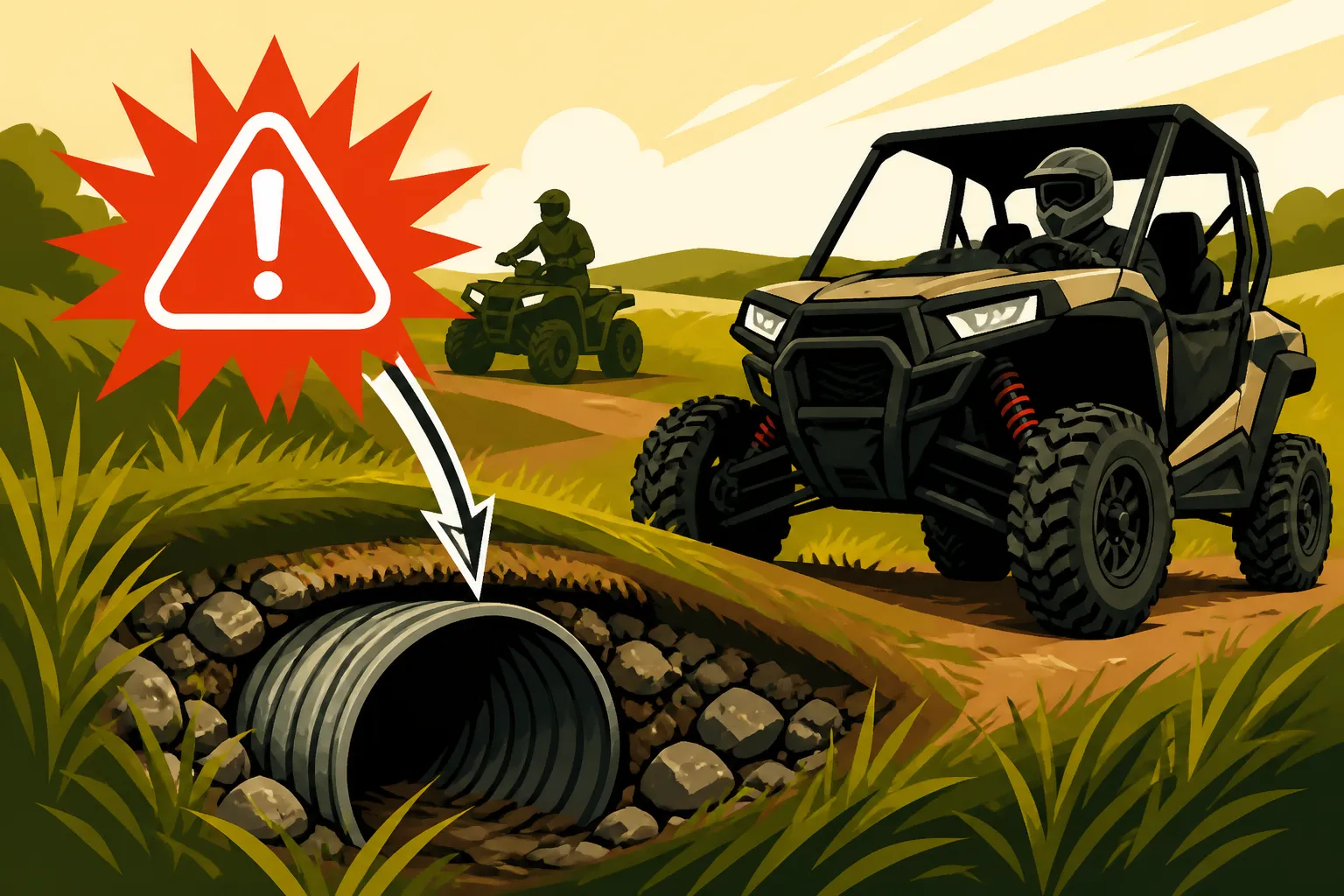
Culverts are essentially pipes or enclosed channels that allow water to flow under roads, driveways, or field approaches. In the context of ATV and UTV riding, they represent a significant hazard because they create an abrupt change in the ditch bottom's contour. Imagine you're cruising along a ditch, enjoying the ride, when suddenly the ground drops into a deep, narrow channel where a culvert is buried, or worse, partially exposed. If you hit this at speed, especially if your machine isn't equipped to absorb such a shock, you could easily lose control. The front wheels might drop in unexpectedly, causing you to pitch forward, or the rear wheels could lose traction if the culvert is slippery. Rusting or collapsed culverts can also present sharp edges or unstable ground, leading to tire damage or even suspension component failure. It’s not uncommon for these structures to be old and poorly maintained in remote areas, exacerbating the danger.
Navigating Approaches: More Than Just a Ramp
Approaches, whether they're for a field entrance, a private driveway, or a section line road, are essentially ramps built to bridge the gap between a lower elevation (like a ditch or field) and a higher one (the road grade). While they might seem less dangerous than an open culvert, approaches still pose considerable risks. The angle of an approach can vary wildly; some are gentle, while others are incredibly steep. Hitting a steep approach too fast can launch your machine into the air, leading to a hard landing and potential injury, especially if you're carrying a passenger. [North Dakota Rules for a Passenger] are always worth reviewing, as an unexpected bump can turn into a serious incident. The edges of approaches can also be worn or eroded, creating ruts or soft spots that can grab a tire and pull your machine off course. Furthermore, approaches often feature gravel, loose dirt, or even paved surfaces, each demanding a different riding technique. The transition from soft ditch bottom to a hard-packed approach can be jarring and lead to a momentary loss of control.
Spotting the Hidden Dangers: How to Identify Culverts and Approaches
The key to safely navigating North Dakota's landscape is early detection. You can't avoid what you don't see, and in an off-road environment, visibility is often compromised by vegetation, dust, or light conditions. Learning to anticipate and identify culverts and approaches before they become an immediate threat is a skill every rider needs to develop.
Reading the Terrain: Subtle Clues to Look For
Even when a culvert or approach isn't immediately obvious, the terrain usually provides subtle clues. Look for changes in the vegetation, for instance. A line of shorter, coarser grass or a patch of different plant species can sometimes indicate a disturbed area where a culvert might be buried. Also, pay attention to the overall flow of the land. If you notice a faint depression running perpendicular to your direction of travel, or a slight rise that seems out of place, it could be an approach. On sunny days, shadows can betray hidden features; a long shadow cast by a small rise could indicate an approach leading up to a field or a roadway. Conversely, a deep, sharp shadow across your path in a ditch bottom might signal an open culvert or a significant washout. Always be scanning ahead, not just at your front fender. The further ahead you can read the terrain, the more time you have to react.
The Impact of Visibility: Light, Weather, and Speed
Visibility plays a colossal role in your ability to spot these hazards. Riding at dawn, dusk, or night drastically reduces your ability to see subtle changes in the terrain. Headlamps are crucial, and sometimes even factory lights aren't enough. Consider aftermarket lighting options, like those offered by SuperATV, which can dramatically improve your forward visibility and spread. In North Dakota, early mornings or late evenings can mean long shadows that obscure obstacles or bright, low sun that blinds you to what's ahead. [North Dakota Rules for Riding After Dark] really drive home the need for proper lighting and awareness.
Weather conditions also compound the problem. Dust kicked up by your own machine or a group can create a thick cloud, rendering culverts and approaches invisible until you're right on them. Rain can turn dirt approaches into slick, muddy slides, and it can fill culverts, making them indistinguishable from puddles until you hit the hard bottom. Snowfall is perhaps the most deceptive, as it can completely blanket and hide these features, turning a solid approach into a deceptive snowdrift or an open culvert into a treacherous void. Adjusting your speed to match visibility conditions is paramount. While it might be tempting to open up the throttle on a seemingly clear stretch, lowering your speed gives you precious seconds to react to unforeseen obstacles.
Essential Equipment for Enhanced Detection
While careful observation is your best tool, certain equipment can give you an edge. Good quality headlamps, as mentioned, are non-negotiable for riding outside of midday. For more adventurous night riding or low-light conditions, additional LED light bars can illuminate a much wider and deeper area, giving you crucial lead time to react. A powerful light bar from a brand like SuperATV can make all the difference in spotting a hidden culvert before you’re on top of it. A GPS unit with detailed topographical maps can also be incredibly helpful, as some maps might indicate the presence of drainages or roads that correlate with culverts and approaches. While not foolproof, it adds another layer of awareness. Finally, maintain your suspension. Well-maintained shocks and tires with good tread can help absorb unexpected impacts and maintain control if you do hit something unseen. Checking your [North Dakota Equipment Required on a Roadway] for basic safety items is always a good practice.
Safe Crossing Techniques: Navigating Approaches and Culverts
Once you've spotted an approach or a culvert, the next step is to navigate it safely. This isn't just about slowing down; it's about understanding the mechanics of your machine and applying specific techniques to maintain control and minimize impact.
Slow and Steady: The Golden Rule
This cannot be stressed enough: slow down. As you approach a known or suspected culvert or approach, reduce your speed significantly. This gives you more time to assess the exact nature of the obstacle, choose the safest line, and apply precise control inputs. Hitting a culvert at high speed can lead to bent rims, broken suspension components, or even a flipped machine. For an approach, too much speed can result in a launch, followed by a hard, uncontrolled landing. Ease off the throttle, cover your brakes, and shift your weight to prepare for the change in terrain. Always remember that even if you're riding a Class III machine on a paved section line that allows 65 mph, that speed is for the smooth road, not the ditch bottom or approach.
Mastering Weight Transfer and Body Positioning
Proper body positioning is critical, especially on steep approaches or when crossing an uneven culvert. As you ascend an approach, lean forward to keep weight over the front wheels, preventing the front end from lifting too much and potentially flipping the machine backward. Conversely, as you descend, shift your weight back to prevent the front wheels from digging in and pitching you over the handlebars. When crossing a culvert or any significant dip, stand up on the footpegs and bend your knees and elbows, effectively turning your body into a "secondary suspension system." This allows your machine to move beneath you and absorb the shock without transferring the full impact directly to your body. It also keeps your vision level and helps you maintain balance.
Here’s a quick overview of how to approach different situations:
| Obstacle Type | Best Approach | Body Positioning | Speed Management | Risks if Ignored |
|---|---|---|---|---|
| Culvert (Visible) | Assess depth & width. If shallow, cross straight. If deep, angle slightly. | Stand, knees & elbows bent; absorb impact. | Very slow, controlled crawl. | Loss of control, bent wheels, suspension damage, rollover. |
| Culvert (Hidden) | Scan for clues, slow down, anticipate impact. | Be prepared to stand and absorb sudden jolt. | Significantly reduce speed; expect the unexpected. | Sudden impact, severe control loss, front end dive. |
| Steep Approach (Ascending) | Attack straight-on, gentle throttle to maintain momentum. | Lean forward, keep weight over front wheels. | Moderate, consistent speed; avoid sudden acceleration. | Rear flip, loss of traction. |
| Steep Approach (Descending) | Straight-on, use engine braking, light brake application. | Lean back, shift weight rearward. | Slow, controlled descent; avoid skidding. | Front end dive, loss of steering control. |
| Eroded/Rutted Approach | Choose highest, least damaged line. Avoid deep ruts if possible. | Stand, keep eyes up, gentle steering inputs. | Slow and steady, maintain momentum. | Tires catching ruts, machine pulling sideways, high-siding. |
The "A-Ha!" Moment: Getting Over It
For wider culverts or particularly challenging approaches, sometimes the best technique is to "pop" the front end. This doesn't mean jumping; it means giving a quick burst of throttle and a slight pull on the handlebars just as your front tires reach the lip of the obstacle. This lifts the front wheels slightly, allowing them to clear the immediate edge and land on the opposite side, rather than dropping directly into a hole or hitting a sharp edge head-on. This technique requires practice and is best learned in a controlled environment, but it can be incredibly effective for clearing tricky obstacles. Just ensure you have ample clearance and know your machine's capabilities. Remember, proper [North Dakota Insurance Requirements at Registration] are important not just for legal compliance, but for protecting you if something unexpected happens.
Gear and Preparedness: Enhancing Your Safety on the Trail
Beyond riding technique, your gear and overall preparedness play a massive role in mitigating the risks associated with hidden culverts and approaches. A little foresight can save a lot of trouble (and pain).
Essential Safety Gear for Riders
First and foremost, never ride without proper safety gear. A DOT-approved helmet is absolutely non-negotiable, even if you’re an adult and [North Dakota Helmet Law for Riders Under 18] technically only mandates it for younger riders. A full-face helmet offers the best protection against impacts and keeps dust and debris out of your eyes. Eye protection, whether integrated into your helmet or separate goggles, is also crucial. Gloves protect your hands and improve grip, while sturdy boots protect your ankles and feet. Long pants and a long-sleeved shirt, preferably made from durable material, will protect you from scrapes, branches, and the sun. This gear isn't just for extreme trail riding; it's for every time you swing a leg over your machine, even if you're just heading to the back forty.
Upgrading Your Machine for North Dakota's Demands
While a stock machine can handle a lot, a few smart upgrades can significantly improve your ability to deal with North Dakota's specific challenges.
- Skid Plates and A-Arm Guards: These are your machine's armor. If you do hit a hidden culvert or a sharp edge on an approach, skid plates protect your frame, engine, and drivetrain from serious damage. A-arm guards protect your suspension components, which are particularly vulnerable to impacts. Brands like SuperATV offer robust options designed to withstand tough conditions.
- Winch: A winch is an invaluable tool for any off-road rider. If your machine gets stuck in a muddy culvert or high-centered on a tricky approach, a winch can get you out. It's also great for helping out a fellow rider. [Towing With a Swivel Hitch in North Dakota] for other machines highlights how useful it can be.
- Improved Suspension: Aftermarket shocks and springs can provide greater ground clearance, better articulation, and a much smoother ride, especially when encountering unexpected bumps. A well-tuned suspension will absorb impacts more effectively, reducing the jarring sensation and keeping your tires in contact with the ground, which translates to better control.
- Enhanced Lighting: We've talked about it before, but truly, upgrading your headlamps or adding LED light bars is a game-changer for visibility, especially when you're anticipating difficult terrain or riding in low light conditions. The more you can see, the safer you'll be. Consider [North Dakota Headlamp Distance Standards] when choosing your lights to ensure you're compliant and effective.
Planning Your Route and Riding with Companions
Before you even leave your driveway, plan your route. If you're exploring new territory, consult maps, talk to local riders, or even use satellite imagery to get a lay of the land. Look for obvious culvert crossings, changes in elevation, and areas where approaches might be present. Never rely solely on a single source of information; combine observation with local knowledge. Furthermore, riding with a buddy or a group is always safer than riding alone. If something goes wrong—you hit a culvert and bend a wheel, or get stuck—your companions can assist. They can also help spot hazards you might miss and provide an extra set of eyes. Ensure your group knows your planned route and has communication methods in case you get separated. Cell service can be spotty in some parts of North Dakota, so a satellite communicator or two-way radios can be a lifesaver. Being prepared also means understanding [North Dakota Registration for a Second Machine] if you have multiple vehicles, ensuring everything is properly registered before hitting the trails or ditches.
Riding in North Dakota offers an incredible sense of freedom and adventure. By understanding the unique challenges posed by hidden culverts and approaches, investing in the right gear, and practicing safe riding techniques, you can ensure your experiences are safe, enjoyable, and free from unexpected surprises. Stay vigilant, stay prepared, and enjoy those wide-open spaces responsibly!
Disclaimer
This article is for general informational purposes only and does not constitute professional advice. Laws, prices and regulations vary by location and change over time. Consult a qualified professional for guidance on your specific situation.