Does a Trade-In Lower North Dakota’s 5 Percent Excise Tax?
Buying a new or even a "new-to-you" off-highway vehicle (OHV) in North Dakota often comes with a bit of sticker shock, and it's not just the price tag of the machine itself. Many riders get tangled up in questions about taxes and fees, especially when they're hoping to offset some of that cost by trading in their current ATV or UTV. It's a common dilemma: will trading in your old machine actually reduce the amount of tax you owe? This guide is here to clear up that confusion and walk you through exactly how trade-ins factor into North Dakota's 5 percent excise tax, so you can make informed decisions and budget wisely for your next adventure.
Understanding North Dakota's 5 Percent Excise Tax on OHVs
Let's start by demystifying North Dakota's approach to taxing OHVs. Unlike many states that charge a traditional sales tax on vehicle purchases, North Dakota assesses what's called a motor vehicle excise tax. It might sound like fancy government jargon, but it's a critical distinction to understand when you're thinking about your overall cost. This 5 percent tax is specifically applied to the purchase price of your off-highway vehicle, whether it's an ATV, UTV, or dirt bike, and it's paid when you go to title the machine.
The primary reason this excise tax exists is to generate revenue that supports various state services, including those related to motor vehicles and off-highway trails. It's a one-time fee paid at the point of titling, which typically happens soon after you acquire the machine. For many, it's an unexpected addition to the purchase price, especially if they're used to only seeing sales tax on most other goods. It's important to remember that this is a state-level tax, and it applies uniformly across North Dakota, regardless of where you make your purchase. You'll definitely want to get a grasp on [North Dakota's 5 Percent Motor Vehicle Excise Tax] before you finalize your deal.
Excise Tax on New vs. Used Machines
One of the biggest questions that often pops up is whether this excise tax applies differently to new machines versus used ones. The straightforward answer is that the 5 percent excise tax applies to both new and used OHVs in North Dakota. The state doesn't differentiate based on whether you're buying from a shiny dealership showroom or a private seller listing their used quad online. The underlying principle is that when there's a transfer of ownership for a titled off-highway vehicle, that transaction is subject to the excise tax.
When you're buying a brand-new ATV or UTV from a dealership, the excise tax calculation is usually pretty clear-cut. The dealer will typically handle the paperwork and include the tax based on the agreed-upon purchase price of the new machine. This means the excise tax is a part of the "out-the-door" cost you'll see on your invoice. If you're looking at a [North Dakota Excise Tax on a Dealer Purchase], the process is usually smooth, but you still need to know what you're paying for.
For used machines acquired through a private sale, the process is a bit more hands-on for the buyer. You'll be responsible for submitting the necessary titling documents and paying the excise tax yourself directly to the Department of Motor Vehicles. The tax will be calculated on the purchase price stated on your bill of sale. It's crucial to be honest and accurate with this figure, as the state will compare it to fair market values. Don't be surprised if you're asked for additional documentation if the stated price seems unusually low. Understanding [North Dakota Excise Tax on a Private Sale] can help you avoid surprises.
How the Purchase Price is Determined
So, how exactly does North Dakota determine the "purchase price" for the 5 percent excise tax? This is where clarity is key, especially when a trade-in comes into play. For transactions involving a direct sale, whether from a dealer or a private party, the purchase price is generally the amount of money or other consideration exchanged for the OHV. This is usually the figure you've agreed upon and written down on the bill of sale.
However, the state also pays attention to the "fair market value" of the machine. If the purchase price stated on your bill of sale seems significantly lower than what comparable machines are selling for, the North Dakota Department of Transportation (NDDOT) might question it. They want to ensure the tax is collected fairly based on the actual value of the transaction. This is particularly relevant in private sales where there might be a temptation to undervalue the machine to reduce the tax burden, which is, of course, not advisable. Sometimes, if the sale price is questioned, you might be asked to provide additional proof of value, such as a dealer appraisal or printouts of similar listings. If you ever need to justify the value, knowing about [Proving Fair Market Value With a Dealer Appraisal] can be a lifesaver.
It's also important to note that the excise tax is distinct from any local sales taxes. North Dakota is one of those states where [North Dakota Sales Tax Versus Excise Tax] is a real point of clarification for many. The 5 percent excise tax is a state-level charge specifically on the vehicle, and typical city or county sales taxes generally do not stack on top of this for OHV purchases. This streamlined approach actually simplifies things a bit, as you don't have to worry about varying rates depending on which town you buy your machine in.
The Role of a Trade-In in North Dakota OHV Transactions
Now, let's get to the heart of the matter: how does trading in your current OHV impact the excise tax on your new purchase? When you decide to trade in an existing ATV or UTV, you're essentially using its value as a credit towards the purchase of another machine. Instead of selling your old quad outright and then using that cash to buy a new one, you're combining both transactions into a single deal, usually with a dealer.
People choose to trade in their machines for a host of reasons. Convenience is a big one – you don't have to deal with the hassle of listing your machine, fielding inquiries, or meeting strangers for test rides. It also simplifies the financial aspect, as the trade-in value directly reduces the amount of cash you need to come up with or the amount you need to finance. For many, it's simply the path of least resistance when upgrading their ride. However, the convenience often comes with questions about how it affects the taxes you owe.
Trade-In Value and the Taxable Amount
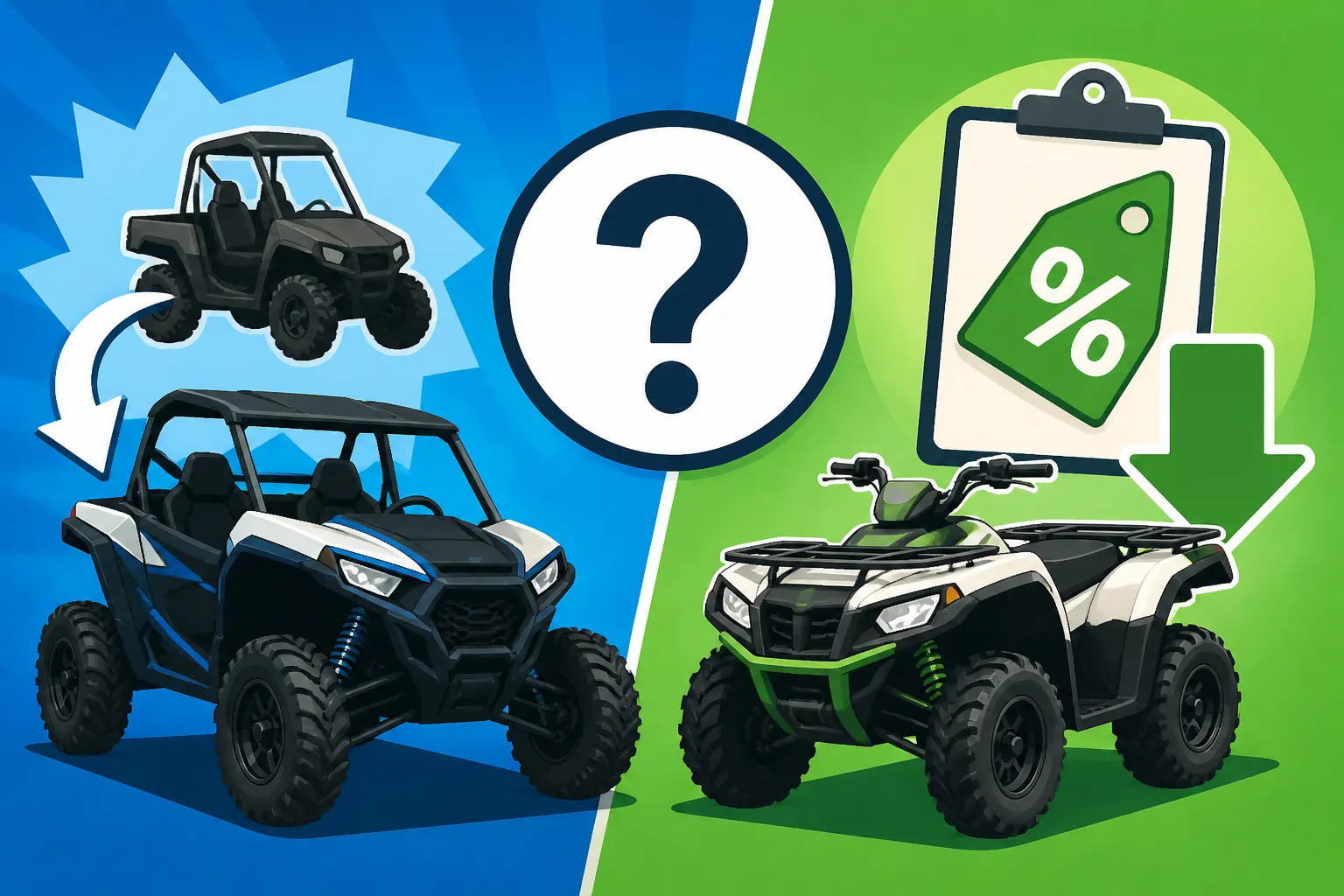
Here's the good news that many riders are hoping for: yes, a trade-in absolutely lowers the taxable amount for North Dakota's 5 percent excise tax. This is a significant benefit to trading in your machine, and it's something many buyers overlook or aren't sure about. The state calculates the excise tax based on the net purchase price, which is the price of the new machine minus the value of your trade-in.
Let's run through a quick example to make this crystal clear. Imagine you're eyeing a brand-new side-by-side that costs $15,000. If you were to buy it outright with no trade-in, your excise tax would be 5% of $15,000, which comes out to $750. Now, let's say you have an older ATV you want to trade in, and the dealer offers you $5,000 for it.
With the trade-in, your transaction looks like this:
- New Machine Price: $15,000
- Trade-In Value: -$5,000
- Net Purchase Price: $10,000
In this scenario, the 5 percent excise tax would be calculated on that $10,000 net purchase price, resulting in an excise tax of $500. That's a $250 savings in tax compared to not trading in! This reduction is a real incentive to consider trading in, as it directly puts money back into your pocket. The state effectively taxes only the "new money" you're bringing to the transaction, acknowledging that the trade-in value is simply a transfer of existing value. Knowing about [Trade-In Allowances and the Tax Base] can really help you budget.
Documenting Your Trade-In for Tax Purposes
Proper documentation is absolutely critical when you involve a trade-in, especially if you want to ensure the excise tax is calculated correctly and avoid any hiccups with the NDDOT. When you complete a trade-in at a dealership, they are typically experts at handling all the necessary paperwork. The bill of sale they provide should clearly itemize the price of the new machine, the value of your trade-in, and the resulting net purchase price. This document is what the state will use to calculate your excise tax, so make sure it's accurate and detailed.
For those rare private sales that involve a trade-in or barter, the responsibility for documentation falls squarely on you and the other party. It's essential to create a comprehensive bill of sale that explicitly outlines both the value of the machine you're acquiring and the value of the machine you're trading away. You might even consider having a separate bill of sale for each machine to ensure clarity, even if it's all part of a single exchange. A detailed [North Dakota Bill of Sale Form SFN 2888] can be immensely helpful here, and using a service like LawDepot can assist you in generating professionally structured documents that cover all the legal necessities. This attention to detail will prevent any confusion when you go to title your "new-to-you" OHV and pay the excise tax.
It’s always a good practice to keep copies of all transaction documents, including the bill of sale, appraisal forms, and any correspondence related to the trade-in. These records serve as your proof to the state regarding the agreed-upon values and the basis for your excise tax calculation. Without clear documentation, you might face delays or questions from the NDDOT, potentially complicating the titling process.
Practical Scenarios and Considerations
While the general rule is that trade-ins reduce your taxable amount, the real world often throws in a few curveballs. Let's look at some practical scenarios and additional considerations that might affect your specific situation. Understanding these nuances can help you navigate your purchase with confidence.
Dealer Purchases with a Trade-In
Most trade-in transactions happen at licensed dealerships, and for good reason. Dealers are accustomed to the process and usually have systems in place to make it as smooth as possible for you. When you trade in your machine to a dealer, they'll perform an appraisal to determine its value. This trade-in value is then subtracted from the selling price of the new machine. As discussed, the 5 percent excise tax is applied to this reduced, net amount.
For instance, if you're upgrading from an older side-by-side to a newer, more powerful model at your local North Dakota dealership, they'll factor in the trade-in value directly. The dealer will complete the necessary paperwork, including the title application (SFN 2872) and the bill of sale, detailing both the purchase price and the trade-in allowance. This streamlined process means you often leave the dealership with your new machine, and they handle the submission of your old title and the payment of your excise tax. It’s part of the comprehensive [North Dakota Dealer Paperwork at Delivery] that makes buying from them convenient. It’s a clean break, and you don't have to worry about selling your old machine privately.
However, it's always smart to have a general idea of what your trade-in is worth before you go to the dealer. Do a little research on comparable machines in your area, noting their condition, mileage/hours, and features. While a dealer's trade-in offer might be less than what you could get in a private sale (they need to make a profit, after all), the tax savings on the new purchase can sometimes bridge that gap, making the trade-in option financially competitive in the long run.
Private Sales with a Partial Trade or Barter
While less common, some private party transactions can involve a partial trade or barter, where money isn't the only form of exchange. This can get a bit trickier from a tax perspective, but the principle of reducing the taxable amount still applies. If you're trading one OHV for another, or trading an OHV plus some cash for a more valuable machine, the state still expects the excise tax to be paid on the net value received.
For example, if you agree to trade your $5,000 ATV plus $3,000 cash for a friend's $8,000 UTV, the "purchase price" from your perspective for the UTV is essentially the $5,000 value of your ATV plus the $3,000 cash, totaling $8,000. However, if your friend is giving you their UTV for your ATV plus $3,000, and you're the one acquiring the UTV, the taxable amount would be calculated on the full value of the UTV, minus the value of the ATV you traded in. So, the $8,000 UTV minus your $5,000 ATV trade-in means you'd pay tax on the $3,000 cash difference.
The key in these private, non-cash trade scenarios is to clearly establish and document the fair market value of both machines involved in the exchange on your bill of sale. If there's a cash component, that's straightforward. If it's a direct swap or a partial trade, you need to assign a reasonable value to each machine as if they were being sold independently. This ensures that the NDDOT has a clear basis for calculating the excise tax. If the values seem out of line with market rates, the state might require additional proof of fair market value. When you're [Buying From a Private Seller in North Dakota], always keep this in mind. It's often safer to stick to cash transactions in private sales, selling your old machine separately, and then using that cash for your new purchase, purely to simplify the tax calculation.
Maximizing Your Trade-In Value to Reduce Tax
Since a higher trade-in value directly translates to a lower taxable amount for the excise tax, it makes sense to put in a little effort to maximize what your current OHV is worth. Think of it as investing a bit of time to save a good chunk of change on your next purchase.
Preparing Your OHV for Trade-In
Just like selling a car, presenting your ATV or UTV in the best possible light can significantly increase its trade-in appeal and value. Dealers are looking for machines that require minimal work to resell.
- Clean it up: A thorough wash, polish, and interior cleaning (for UTVs) can make a huge difference. Get rid of the mud, dust, and any lingering smells. A clean machine suggests it's been cared for.
- Perform basic maintenance: Ensure all fluids are topped off, tires are properly inflated, and lights are working. Fix any minor issues like a loose mirror or a squeaky brake. If it needs a more substantial service, weigh the cost of the repair against the potential increase in trade-in value. Sometimes, a dealer can do it cheaper, but addressing obvious flaws removes bargaining points for them.
- Gather service records: If you have documentation of regular oil changes, filter replacements, or any major repairs, present these. Service records demonstrate a history of care and can instill confidence in the machine's reliability.
- Address cosmetic flaws: While you might not want to repaint an entire fender, small touch-ups, like repairing a cracked plastic piece or tightening a loose grab bar, can improve the overall impression.
- Remove personal accessories: Take off any aftermarket accessories that are specific to your style and might not appeal to a broad buyer base. You can often sell these separately for more value.
By taking these steps, you're not just making your machine look better; you're also signaling to the dealer that it's a well-maintained piece of equipment, which can lead to a more favorable trade-in offer.
Researching Market Value
Walking into a dealership armed with knowledge about your OHV's market value is one of your most powerful negotiation tools. If you know what similar machines are selling for, you'll be better equipped to assess the fairness of a trade-in offer.
- Check online marketplaces: Look at popular ATV and UTV listing sites, both local and national. Filter by make, model, year, and condition to find machines similar to yours. Pay attention to the asking prices, but also recognize that listing prices can be higher than actual sale prices.
- Consult pricing guides: While specialized OHV blue books might be less common than for cars, some general powersports guides or online valuation tools can give you a ballpark figure.
- Visit other dealers: Don't be afraid to get trade-in quotes from a couple of different dealerships. This gives you leverage and a better sense of your machine's wholesale value.
- Factor in condition and mileage/hours: Be realistic about your machine's condition. A well-used ranch utility vehicle with high hours will naturally command a different price than a lightly used sport quad. For instance, knowing typical [North Dakota Used Side-by-Side Prices] can set your expectations.
By understanding the current market, you can confidently discuss the trade-in value with the dealer, ensuring you get the best possible allowance, which in turn maximizes your excise tax savings. Sometimes, you might find that [North Dakota Used Machine Prices by Season] fluctuate, so timing your trade-in could also make a difference.
Trade-In Value & Excise Tax: A Quick Comparison
To help visualize how a trade-in impacts your excise tax, here's a simple comparison table:
| Scenario | New OHV Price | Trade-In Value | Net Purchase Price | 5% Excise Tax Calculation | Total Excise Tax |
|---|---|---|---|---|---|
| No Trade-In | $18,000 | $0 | $18,000 | 0.05 x $18,000 | $900 |
| With $6,000 Trade-In | $18,000 | $6,000 | $12,000 | 0.05 x $12,000 | $600 |
| With $10,000 Trade-In | $18,000 | $10,000 | $8,000 | 0.05 x $8,000 | $400 |
As you can clearly see, the higher your trade-in value, the lower the "net purchase price," and consequently, the less North Dakota excise tax you'll have to pay. This difference can add up to significant savings, making a trade-in a smart financial move if you're looking to minimize your out-of-pocket expenses when buying your next OHV.
Disclaimer
This article is for general informational purposes only and does not constitute professional advice. Laws, prices and regulations vary by location and change over time. Consult a qualified professional for guidance on your specific situation.