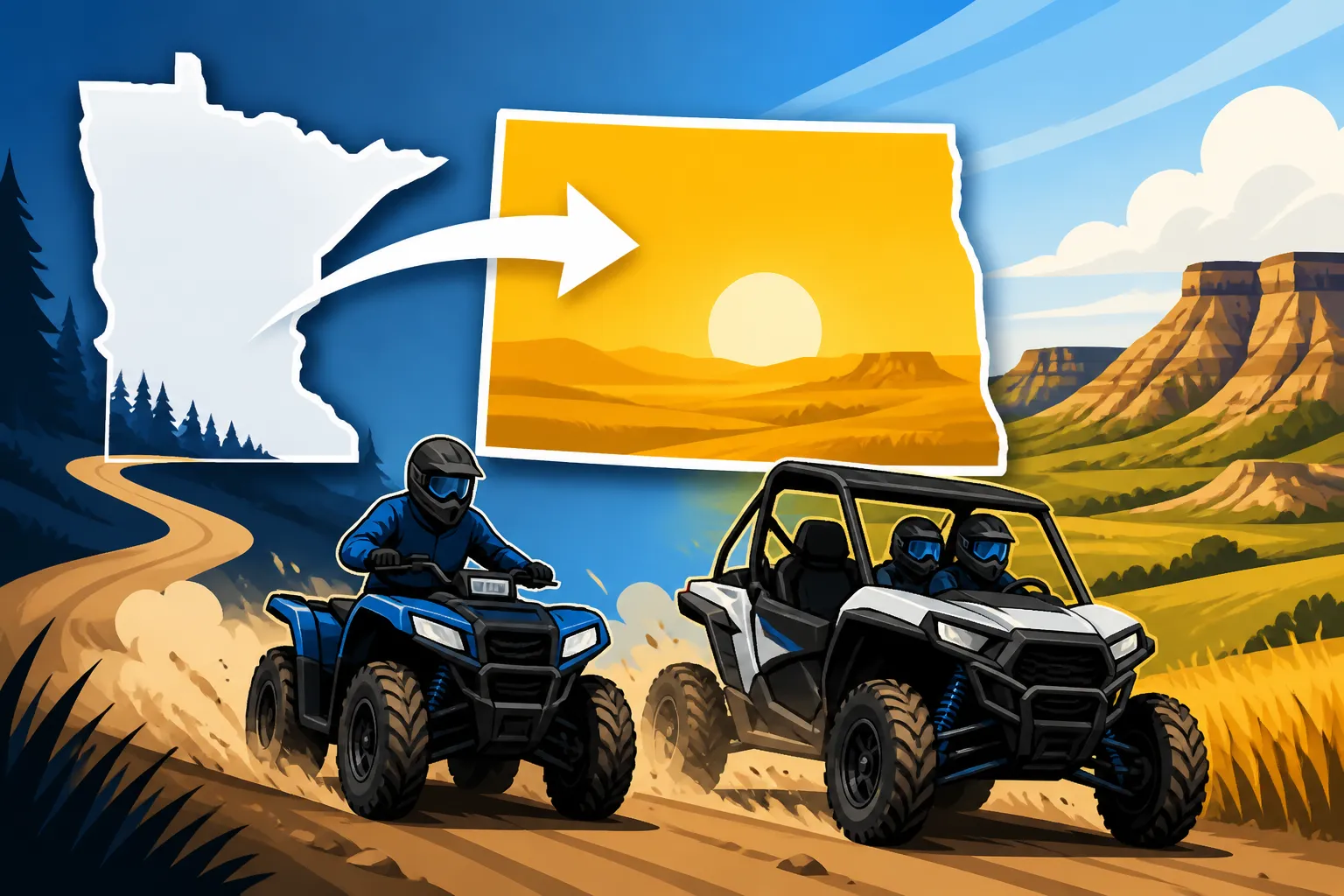
North Dakota Visitors From Minnesota
A Minnesota registration sticker can make it tempting to assume your ATV or UTV is cleared to ride across the border. North Dakota treats visitor permits, machine registration, rider safety requirements and land access as separate questions. This guide explains what to check before you load up, what the 30-day rule does and does not mean, and how to avoid arriving at a trailhead without the right paperwork.
Minnesota registration does not automatically cover a North Dakota ride
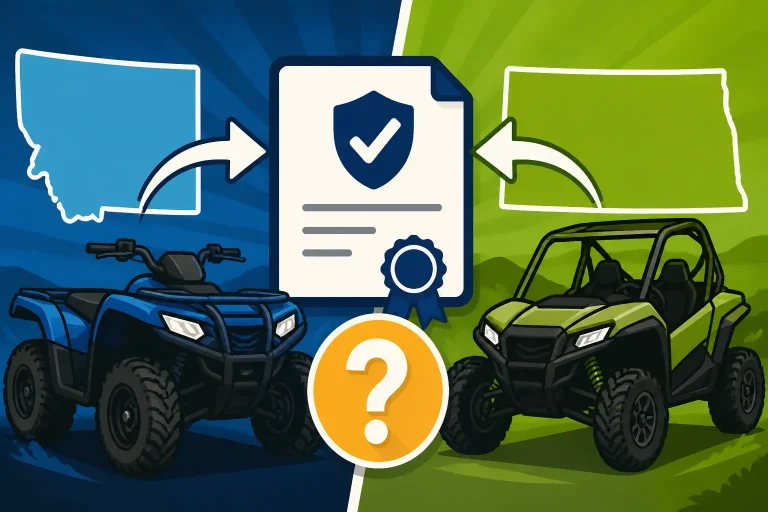
North Dakota does not have a broad reciprocity agreement that lets visitors rely on another state’s OHV paperwork for every North Dakota requirement. A Minnesota registration or decal is useful proof that the machine is registered at home, but it does not automatically replace North Dakota’s nonresident permit. For the practical background, see North Dakota Has No Reciprocity With Any State.
For a Minnesota resident bringing a quad, ATV or side-by-side across the border for recreation, plan to check and obtain the applicable North Dakota nonresident OHV permit before riding. This is a separate step from registering the machine in Minnesota. The permit is not a new Minnesota registration, and it does not transfer ownership or alter the machine’s home-state status.
It helps to think in terms of separate documents and permissions:
- Minnesota registration addresses the machine’s status under Minnesota rules.
- North Dakota’s nonresident permit addresses a visitor’s operation of an OHV in North Dakota where the permit is required.
- North Dakota registration may become relevant if the machine is kept or operated in the state beyond the visitor allowance.
- Land access rules determine whether you may ride in a particular area. A permit does not make a closed trail or private parcel open.
- Rider requirements such as safety training are separate from machine paperwork.
The distinctions matter because having one document does not necessarily answer the other questions. A Minnesota plate or decal is not a promise that you can ride any public trail, road or recreation area in North Dakota. Likewise, a North Dakota visitor permit is not permission to use land where OHVs are prohibited.
If your ride is on a designated public trail, check the permit rules for that riding area as well as the state’s general nonresident requirements. If you are using a North Dakota grassland road, private land or a road ditch, different access rules may apply. A route that looks open on a map may have restrictions or require landowner permission.
What the North Dakota visitor permit does
North Dakota’s nonresident OHV permit is intended for people who bring a machine from outside the state. It is not the same thing as a resident registration, and it does not give a visitor the same paperwork status as a North Dakota owner. The state’s visitor-permit system is covered in more detail in North Dakota’s Non-Resident OHV Permit.
Visitors should check the current official permit instructions before traveling. Confirm which machines need a permit, where the permit must be displayed or carried, which riding areas it applies to, and the current fee. Requirements and fees can change, so don’t rely on an old receipt, social media post or a friend’s memory as your only source.
A visitor permit generally relates to the machine, not just the person who paid for it. If you bring two machines, don’t assume one permit covers both. Check the rules for each machine, including a second ATV or a tracked dirt bike. A tracked machine may have an additional permit requirement; see North Dakota Tracked Dirt Bike Permits if that applies to your ride.
| Question | What to keep in mind |
|---|---|
| Is Minnesota registration enough by itself? | Don’t assume so. Check North Dakota’s nonresident permit requirements before riding. |
| Does a visitor permit register the machine in North Dakota? | No. A permit and registration address different requirements. |
| Does a permit open every trail or parcel? | No. You still need to follow trail closures, land rules and local restrictions. |
| Does one permit necessarily cover several machines? | Don’t assume it does. Check whether each machine needs its own permit. |
| Does the 30-day rule erase all other visitor requirements? | No. It concerns an out-of-state machine’s registration status, not every rule that may apply. |
| Does a state park entrance permit cover OHV riding? | Not necessarily. Park entrance and OHV access are separate issues. |
A permit is also not a substitute for proof of ownership or registration. Carry the machine’s Minnesota registration information and any other paperwork that applies to your situation. If you’re asked to show documents, it is easier to resolve a question when you can produce the relevant records than when you have to rely on an explanation from memory.
For travel, keep a digital copy of the paperwork on your phone and a readable copy with your riding gear. A simple document pouch can help keep paper records together in a dusty or wet vehicle. If you buy one through Amazon or another retailer, choose a pouch that closes securely and is easy to find when you need it; it is a convenience, not a substitute for having the actual permit and required documents.
How the 30-day rule fits in
North Dakota has a visitor rule that can allow an out-of-state-registered OHV to operate for a limited period before North Dakota registration becomes an issue. The key point is that the 30-day allowance concerns the machine’s registration obligations. It should not be treated as a general exemption from every visitor requirement.
That distinction trips people up. A rider may hear that a Minnesota-registered ATV can be operated in North Dakota for a limited stay and conclude that no North Dakota paperwork is needed at all. The safer interpretation is to handle the questions separately: check whether your out-of-state registration remains acceptable for your length of stay, and check whether you also need a nonresident permit for the riding you plan to do.
The relevant visitor rule is explained in North Dakota’s 30-Day Visitor Threshold. In practice, pay attention to how the time period is counted, what happens if the machine stays in North Dakota, and whether your plans involve more than a short visit. Don’t assume the allowance resets because you moved the machine to another trailhead or crossed back and forth over the state line. If you are close to the limit or have a complicated travel schedule, ask the responsible state office how it applies to your circumstances.
A short weekend trip is different from leaving a machine at a cabin for much of the season. If you store an ATV or UTV in North Dakota, use it repeatedly over an extended stay, or move into the state, ask whether you must register it in North Dakota. You can also review North Dakota Registration for a New Resident if you have recently moved.
Keep evidence of your travel dates if the timing could matter. That might include a dated transport receipt, lodging confirmation or other ordinary record showing when the machine arrived. You may never need it, but it is better to have a clear timeline than to reconstruct one months later.
Here is a practical way to apply the distinction:
- Confirm that the machine is properly registered in Minnesota. Make sure the registration is current and that the identifying information matches the machine.
- Check North Dakota’s nonresident permit rules. Do this even if your visit is brief and the machine is registered at home.
- Work out how long the machine will remain or operate in North Dakota. A longer stay can raise a separate North Dakota registration question.
- Check the riding location. Verify that the trail, public land, road or private property is open to your machine and that you have any required permission.
- Confirm the rules for each machine and rider. A permit for one ATV may not cover a second machine, and the person riding may have separate safety requirements.
This approach is more reliable than trying to find one document that supposedly covers everything. North Dakota separates permits, registration, rider qualifications and land access; your trip plan should do the same.
Check rider rules, insurance and trail access too
A properly permitted machine can still be ridden unlawfully if the rider does not meet age or safety requirements, or if the route is closed. Before leaving Minnesota, check the rules for everyone who will ride, especially children and teens. North Dakota’s safety course rules are separate from the machine’s permit. If a young rider is in your group, start with North Dakota Safety Course Minimum Age and confirm whether that rider needs a North Dakota certificate or whether a certificate from another state is accepted.
Do not assume that a Minnesota safety card automatically satisfies a North Dakota requirement. Recognition rules can be specific, and the rider’s age and circumstances can matter. If the answer is unclear, confirm it with the state agency before your trip rather than asking a ranger to settle it at the trailhead.
Insurance is another separate issue. A permit is not an insurance policy, and a valid registration does not necessarily tell you whether your policy covers the planned ride. Ask your insurer whether your ATV or UTV remains covered while you ride in North Dakota, including on public trails or roads if those are part of your itinerary. For a closer look at the state-side questions, see North Dakota Insurance Rules for OHV Riders.
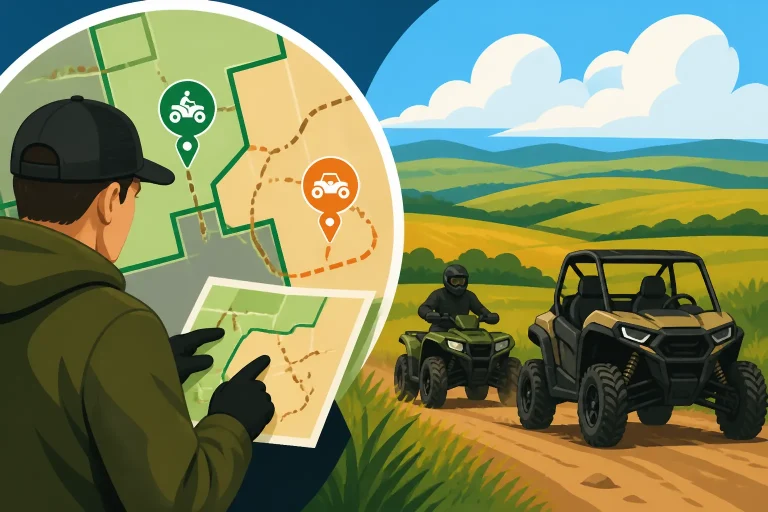
Then check the place where you intend to ride. North Dakota has designated OHV areas, public-land roads and other places with different rules. Some routes are open only to certain machine types or widths. A trail map can also be out of date if a route has closed because of weather, maintenance or land-management decisions. Confirm current status close to the day of the ride.
If your itinerary includes a state park, treat the park’s entrance rules as a separate item. A vehicle entrance permit, where required, is not the same as an OHV visitor permit, and neither one automatically grants access to every trail. Review North Dakota State Park Entrance Permits and the park’s own riding information before you tow in.
Keep land access especially clear if you plan to ride beyond a designated trail system. Private land requires the appropriate permission, and posted land remains off limits unless you have permission. Public access can also be limited by a local rule, a seasonal closure or the land manager’s designation. A North Dakota visitor permit does not override any of those restrictions.
A quick pre-ride check can prevent a long drive for a ride you can’t legally take:
- Confirm the visitor permit requirement and purchase process.
- Confirm the machine’s Minnesota registration is current.
- Check the planned route’s current status and machine restrictions.
- Verify rider age and safety-certificate requirements.
- Confirm insurance coverage for the type of riding planned.
- Obtain permission for private land.
- Check whether a separate park entrance permit applies to the towing vehicle.
- Carry your documents and know where they are stored.
If you’re assembling a basic travel kit, include a phone charger, a paper trail map where useful, and a secure place for documents. Amazon can be one option for a waterproof pouch or map case, but check the size and closure before relying on it in the field. The best storage solution is one you can reach quickly without leaving paperwork loose in the truck or cargo box.
A practical border-crossing checklist for Minnesota riders
A little preparation is usually simpler than sorting out paperwork after you arrive. Use this checklist for a single-day ride or a longer stay, adjusting it to the machine and riding area.
Before loading the machine
Write down the machine’s make, model, vehicle identification number and Minnesota registration details. Check that the registration is current and that the documents refer to the machine you’re actually towing. If you recently bought the ATV or UTV, make sure the registration and ownership paperwork are in order before crossing the border.
Next, confirm North Dakota’s nonresident permit requirements and how to obtain the permit. The state describes its permit period in North Dakota Non-Resident Permits Run January to December. Confirm the current process directly with the responsible agency, including any display or proof requirements. Don’t assume that a permit from a previous year remains valid for a new trip.
If you are carrying several machines, make a separate line on your checklist for each one. Record its registration status, permit status and any special equipment or access restrictions. This matters for families and groups where one person may be hauling a youth quad, a full-size ATV and a side-by-side together.
Before choosing a trail
Pick a specific riding area and check its current rules rather than relying on a general map alone. Confirm whether the area accepts your machine type and width, whether the route is open, and whether there are seasonal or weather-related closures. If your plan depends on riding a road or ditch, verify that the road segment is legally open to OHVs and that all equipment and operating rules are met.
For a private riding destination, get permission from the landowner before unloading. If the property is posted or access is controlled by a gate, do not treat the absence of a person at the entrance as permission to proceed. Stay on the route the landowner approved and respect livestock, crops and other property.
Before the first ride
Put the required documents where the operator can access them. Make sure each rider understands the planned route, meeting point and what to do if the group gets separated. For a family ride, discuss passenger limits and make sure each machine is being used as designed. A side-by-side’s seating capacity and an ATV’s passenger arrangement are not interchangeable.
Check the vehicle’s basic condition, including brakes, tires, lights and fuel. Bring water, a first-aid kit and a way to contact someone if the group has a breakdown or an injury. Coverage may be limited in remote areas, so download maps or save route information before heading out. If you buy safety or storage items through Amazon, review the product’s size, ratings and compatibility rather than assuming every accessory fits every machine.
If you are staying longer
A long visit deserves a fresh check, not just a repeat of the weekend plan. Keep track of how long the machine has been in North Dakota, and ask the state office whether your circumstances require North Dakota registration. Do this before the visitor period becomes a problem. The answer may depend on residency, how the machine is registered and how long it is kept or operated in the state.
If you move to North Dakota, the question changes from a visitor trip to a resident registration issue. If you leave a machine at a seasonal property, don’t assume that being stored rather than ridden pauses the relevant time period. Ask directly how the rule applies to your use and location.
Common mistakes to avoid
The most frequent mistake is treating “registered at home” as the same thing as “all set in North Dakota.” It may establish that the machine is registered in Minnesota, but North Dakota’s visitor-permit requirement is a distinct question.
Another mistake is thinking the visitor permit is a trail pass. It does not open every trail or replace local access rules. Check the specific riding area, any applicable land-manager restrictions and current closures.
Visitors can also overlook that the permit may be machine-specific. If you bring a second quad, lend your machine to another rider or switch machines during a trip, make sure the paperwork still matches what is being operated. Keep the permit information with the correct machine so it is not accidentally associated with the wrong one.
Finally, don’t wait until you reach the trailhead to resolve an unclear rule. A quick call or official permit check before leaving Minnesota is easier than trying to interpret a sign, search for cell service or find an open office after arrival. If your situation involves an extended stay, a recently purchased machine, a youth rider or unusual equipment, ask the state agency the precise question and keep its answer with your trip notes.
For everyday organization, a simple printed checklist can be more useful than a phone full of screenshots. Store the permit, registration and insurance details together, but keep their purposes clear. If a paper copy gets wet or damaged, a saved digital copy may help you refer to the information, but it may not replace a required original or displayed permit. Check the official instructions for what you must carry or show.
Disclaimer
This article is for general informational purposes only and does not constitute professional advice. Laws, prices and regulations vary by location and change over time. Consult a qualified professional for guidance on your specific situation.