North Dakota Has No Reciprocity With Any State
A valid ATV sticker from Minnesota, Montana, or another nearby state does not automatically cover a ride in North Dakota. That can be frustrating when you are trailering in for a weekend and assume your home-state paperwork travels with you. This guide explains what “no reciprocity” means, which North Dakota permit visitors should plan for, and how the 30-day rule fits in.
What North Dakota’s no-reciprocity rule means
Your home-state sticker is not a North Dakota permit
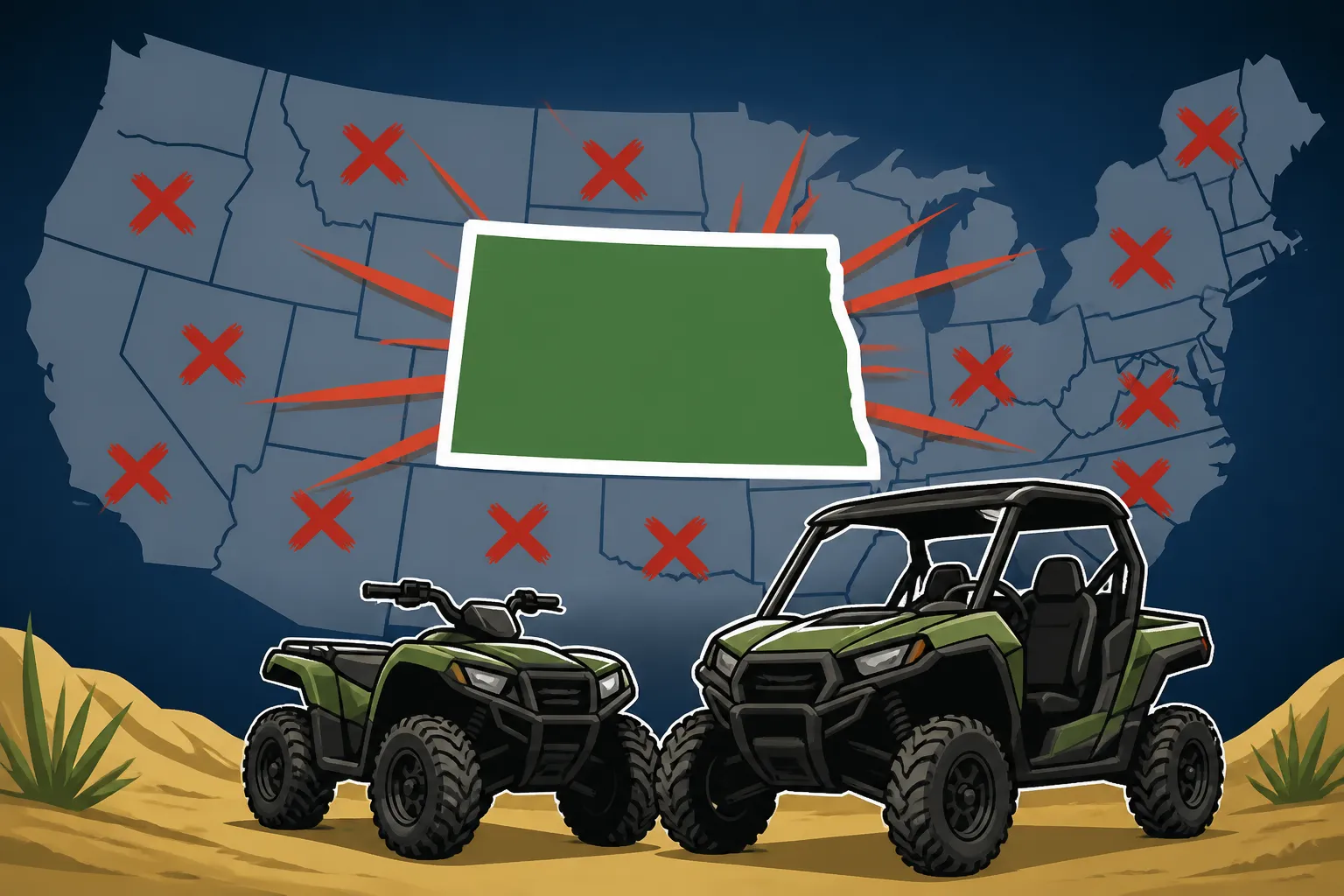
North Dakota does not treat another state’s ATV or UTV registration, decal, or trail permit as a substitute for its own nonresident OHV permit. In practical terms, a rider visiting from Minnesota, Montana, South Dakota, or elsewhere should not assume that being legal at home automatically makes the machine legal to ride on North Dakota ground.
That distinction can catch people off guard. A visitor may have a current registration card tucked in the glove box, a clearly visible home-state decal, and a machine that is perfectly legal for local riding back home. Those documents may still be useful to show where the machine is registered, but they do not replace a North Dakota permit when one is required.
The rule applies to both ATVs and UTVs that qualify as off-highway vehicles under North Dakota’s rules. A side-by-side does not get a pass simply because its home state calls it a recreational vehicle or issues different paperwork. Before leaving home, identify the vehicle’s North Dakota classification and check which permit applies to that machine.
For a closer look at the central issue, see North Dakota Has No Reciprocity With Any State. The practical takeaway is simple: treat North Dakota’s requirement as a separate step rather than expecting another state’s sticker to carry over.
No reciprocity does not mean every machine must be registered in North Dakota
“North Dakota has no reciprocity” is easy to misread as “every out-of-state machine must be registered here.” Those are not the same thing. A temporary visitor may be able to operate a properly registered out-of-state machine for a limited period without obtaining North Dakota resident registration, while still needing the separate North Dakota nonresident permit.
That difference matters for a short trip. Imagine a family from Fargo’s neighboring Minnesota communities hauling a registered ATV to Pembina Gorge for a weekend. They may not need to complete the same registration process as a North Dakota resident buying a machine, but they should still plan for the visitor-permit requirement. Avoid treating the short-stay registration rule as a blanket permit exemption.
It also works the other way around: buying a visitor permit does not necessarily resolve every registration, ownership, or road-use issue. A permit is one piece of compliance. The machine may still need valid home-state documentation, and separate rules may apply if it is used on a roadway, kept in North Dakota for an extended stay, or operated somewhere with its own access restrictions.
This is why it helps to think in separate questions: Is the machine registered where it belongs? Does it need a North Dakota nonresident permit? Is this particular location open to OHVs? Is the planned route legal for this class of machine? Answering each one prevents a valid decal from creating a false sense of security.
The North Dakota permit visiting riders should plan for
The nonresident permit is separate from home-state registration
A nonresident permit is North Dakota’s own authorization for an eligible visiting machine to be operated where the state’s OHV permit rules apply. It is not simply a second copy of a home-state registration, and it does not transfer automatically from one machine to another. If you are bringing more than one ATV or UTV, check the permit requirement for each machine rather than assuming one purchase covers the whole trailer.
The state’s nonresident permit is commonly listed at $10. Permit details and purchasing options can change, so confirm the current fee and process before your trip. The important planning point is that the permit is a separate expense and task, even if you have paid registration or trail fees in your home state.
The permit is generally tied to the machine, not to the trailer or the group traveling together. If you and a friend bring two separate machines, do not assume one permit covers both just because you arrive in the same truck. A passenger riding in a properly permitted machine is a different issue from bringing an additional machine that needs its own paperwork.
For permit-specific details, start with North Dakota’s Non-Resident OHV Permit and North Dakota Permit for a Visiting Machine. If you are bringing a second vehicle, [North Dakota Permit for a Second Machine] is also a useful related topic.
Where to buy and what to have ready
Visitors can commonly arrange a permit through state channels before traveling or at an authorized location, including certain state park offices. Buying ahead can be helpful if your first stop is a trailhead rather than a staffed office. It also gives you a chance to catch a missing detail before you are standing beside a loaded trailer, trying to sort out paperwork while your riding group waits.
Before purchasing, gather the basic information that identifies the machine. Depending on the process, you may need details such as the vehicle identification number, make, model, or registration information. Have the machine’s paperwork available and make sure the information you enter matches the vehicle. A typo in an identification number is a small mistake that can become a frustrating problem when someone checks the permit against the machine.
Keep proof of the permit accessible while riding. A paper confirmation can be useful if the permit is issued electronically, and a phone screenshot may help if service is poor at the trailhead. Do not rely on having a signal in a remote area to retrieve a confirmation email or account page. Save or print the documentation before leaving a place with reliable service.
If your permit is lost, damaged, or difficult to display, resolve the issue before heading out rather than assuming the purchase record alone will satisfy a check. See [North Dakota Permit Replacement If Lost] for the related replacement question, and Buying a Permit Online Before You Travel for a pre-trip option.
The permit is not a trail pass for every place
A North Dakota nonresident OHV permit does not give you permission to ride everywhere. It does not open private land, convert a closed route into an open one, or replace a land manager’s access rules. A machine can have all the right paperwork and still be on the wrong trail.
For example, a visitor could arrive with a valid permit and head toward a state recreation area expecting every road and path to be open to motorized riding. Access may be limited to designated routes, and some public properties are closed to OHVs. Before traveling, confirm the rules for the specific riding area, not just the general permit requirement.
Also distinguish the OHV permit from a state park entrance permit. These relate to different things: one concerns the machine’s OHV permit status, while the other concerns park entry or vehicle access under park rules. If your trip includes a state park, confirm whether you need both types of authorization for your specific plan.
This is especially important when a route crosses land managed by different agencies or connects a trail system to a road. Check the trailhead information, posted signs, and land-manager guidance. For riding-area planning, North Dakota OHV Trails: All Four Riding Areas offers a useful starting point, but always confirm the rules for the particular place you intend to visit.
| What you have or plan to do | What it does not automatically cover | What to check |
|---|---|---|
| Home-state registration or decal | North Dakota’s nonresident OHV permit | Whether the visiting machine needs a North Dakota permit |
| A North Dakota nonresident permit | Access to every public or private riding area | The local trail, property, and land-manager rules |
| A short visit with an out-of-state machine | Every registration or roadway requirement | The 30-day rule and the machine’s legal status |
| A state park entrance permit | The OHV permit requirement | Whether both types of authorization apply |
| A permit for one ATV or UTV | A second machine in the same group | Whether each machine needs its own permit |
How the 30-day rule fits with no reciprocity
The temporary-use rule is not full reciprocity
North Dakota’s 30-day rule is often the source of confusion. The rule concerns how long a properly registered out-of-state machine may be operated in North Dakota before North Dakota registration requirements may come into play. It does not mean that North Dakota has agreed to honor every other state’s OHV permit or registration for all purposes.
Think of it as a limited allowance for temporary operation, not a broad agreement between states. A visitor’s machine may be able to remain under its home-state registration for a short visit, while the rider still needs to meet North Dakota’s separate nonresident permit requirement. That is the key difference between temporary registration treatment and reciprocity.
For instance, a Montana resident who brings a UTV to western North Dakota for a few days should not confuse “I am visiting briefly” with “my Montana paperwork replaces every North Dakota requirement.” A short stay may affect whether North Dakota resident registration is needed, but it does not automatically waive the visitor permit.
The details matter if your machine will stay in the state, if you are moving to North Dakota, or if you expect to ride over a longer period. Read North Dakota’s 30-Day Out-of-State Rule and Thirty Consecutive Days and What Follows before relying on a temporary-use exception.
Count the stay carefully and plan for changes
A weekend ride is straightforward compared with a machine left at a lake cabin for months. If your ATV or UTV is stored in North Dakota and used repeatedly, do not assume that each individual weekend starts a brand-new temporary period. The relevant rule may depend on consecutive days of operation, the machine’s registration status, and the facts of your stay.
Keep a basic record of when the machine arrives, where it is kept, and when it is operated. This is useful if you are a seasonal visitor, own property in the state, or leave a machine with relatives. A simple note in your phone or maintenance log can help you avoid reconstructing dates later from fuel receipts and calendar reminders.
If your plans change from a brief visit to a longer stay, revisit the paperwork before the original plan runs out. Someone who came for a week and later decides to leave a UTV near Lake Sakakawea for the season has a different compliance question from someone hauling the machine home after two days. The right answer may change because the use pattern has changed.
New residents should also treat relocation as a separate situation, not as an extended vacation. Moving to North Dakota can bring registration and residency requirements into play. See North Dakota Registration for a New Resident if the machine will become part of a permanent in-state household.
How the rule affects visitors from neighboring states
Minnesota, Montana, and South Dakota visitors
North Dakota’s lack of reciprocity is not limited to one neighboring state. A Minnesota ATV permit, Montana OHV sticker, or South Dakota registration does not create a general exemption from North Dakota’s own visitor requirements. The paperwork may prove the machine’s home-state status, but it does not automatically serve as a North Dakota nonresident permit.
That is easy to overlook because many riding trips cross state lines. A group might spend one day near home, trailer north for a long weekend, and expect one sticker to cover the entire itinerary. Instead, treat every state as a separate stop on the compliance checklist. The rules in a home riding area do not necessarily match those in North Dakota.
The machine’s home state can still matter. For example, valid registration in the home state may help establish that the vehicle is properly registered there, which is relevant to temporary operation. But that is different from North Dakota recognizing the home-state trail permit as its own. One document may answer one question while leaving another unanswered.
Visitors can review the state-specific guides for North Dakota Visitors From Minnesota, North Dakota Visitors From Montana, and North Dakota Visitors From South Dakota. These can help clarify common visitor situations without changing the central rule: check North Dakota’s permit requirement separately.
Manitoba and other international visitors
The same practical approach applies to riders arriving from Manitoba or another Canadian province. Do not assume that a provincial registration, permit, or plate is automatically accepted as a North Dakota nonresident OHV permit. Cross-border travel can add another layer of planning, so verify the machine’s documentation and North Dakota permit status before entering the state.
Keep ownership and registration documents together. If the machine is not registered in the same person’s name as the person transporting it, carry paperwork that explains the relationship, such as permission to use the machine or a bill of sale where relevant. Border travel and state OHV compliance are separate processes, but having clear records can make questions easier to answer.
Also check the route and destination rather than assuming that a border crossing leads directly to an open trail. You may need to trailer the machine to a designated riding area, and the legal route for driving the truck and trailer is not necessarily a legal route for operating the ATV or UTV itself.
For a province-specific starting point, see North Dakota Visitors From Manitoba. If you are traveling from another jurisdiction, use the same checklist: confirm the machine’s home registration, obtain the North Dakota permit if required, and verify that the destination allows OHV use.
Paperwork and rules the permit does not replace
Registration, title, and proof of ownership
A visitor permit is not a title, and it does not prove ownership. Keep the machine’s registration and ownership records with you, particularly if you bought it recently, borrowed it, or are transporting it for someone else. A North Dakota permit addresses the state’s OHV permit requirement; it does not settle a dispute over who owns the vehicle.
For a recently purchased machine, bring the bill of sale and any available title or registration documents. This is especially helpful when the seller has not yet completed a transfer or when the machine’s identifying number is hard to read. Take a clear photograph of the VIN before the trip, but do not rely on a photo as a replacement for required original paperwork.
If the VIN is damaged, missing, or difficult to locate, resolve that issue before setting out for a ride. A permit with an incorrect or incomplete vehicle number can create avoidable confusion. Make sure the identifier on the machine matches the identifier on the relevant records and permit information.
A visitor carrying another person’s machine should have written permission and a way to contact the owner. That is not a substitute for state paperwork, but it can help explain why the name on the registration differs from the rider’s name. For related ownership-transfer questions, North Dakota Ownership Transfer in 15 Days is worth reviewing.
Insurance and roadway use are separate questions
Do not assume that a permit automatically satisfies insurance requirements or makes a machine legal on public roads. Whether insurance is required can depend on where and how the machine is operated, and roadway use has its own equipment, speed, and road-type rules. Trail access and road legality should be checked independently.
A rider planning to travel from a trailhead to a nearby destination may be tempted to use a gravel road or ditch as a shortcut. That can create a legal problem even when the ATV is registered and permitted. North Dakota’s rules vary by roadway type and operating conditions, so map the intended route before riding rather than deciding at the intersection.
Insurance deserves a separate check, especially if you will ride outside your own property or on a route where liability coverage is required. Contact your insurer to confirm how your policy applies in North Dakota and whether it covers the machine’s intended use. A policy that works for private-property riding may not provide the protection you expect on public land or a roadway.
For focused information, review North Dakota Insurance Rules for OHV Riders and North Dakota ATV Road Rules by Surface Type. Those topics address issues the nonresident permit itself does not answer.
Youth riders, passengers, and group trips
A visitor permit does not replace a safety certificate
Permit paperwork and rider qualifications are separate. A machine may have the correct North Dakota permit while a young rider still needs to meet age, safety-training, supervision, or operating requirements. Parents should check the rider rules before loading the machine, rather than discovering at the trailhead that the child’s certificate or riding arrangement is not sufficient.
This is particularly relevant for families traveling with children who have completed a safety course in another state. Do not assume that a home-state card automatically satisfies every North Dakota requirement. Confirm whether the certificate is recognized for the intended rider and activity, and keep the proof available while riding.
Age rules can also depend on the setting. A child riding on family land, a young person riding on public ground, and a participant in an organized event may fall under different conditions. A child who is allowed to ride at home may not automatically be allowed to operate the same machine on every North Dakota route.
Families can begin with Do North Dakota Kids Need a Permit? and North Dakota OHV Safety Certificates at Age 12. Check the specific rules for the child’s age, machine, supervision, and location before the trip.
Passengers and multiple machines need their own checks
A UTV’s passenger capacity is not determined by how many people can squeeze onto the bench. Follow the manufacturer’s seating and passenger limits, and make sure riders have appropriate restraint and protective equipment. For ATVs, do not carry a passenger unless the machine is designed to do so and the rules allow it.
A group also needs to account for every machine, not simply every rider. If two families combine their trip, count the ATVs and UTVs and confirm the permit status of each one. A single permit for the lead machine does not automatically cover the other vehicles following in the group.
Before departing, identify who is responsible for each machine’s documents. One adult can keep a shared checklist, but each operator should know where the permit and registration information are stored. If the group separates, the rider should not be left without the paperwork needed to identify the machine or answer a basic compliance question.
For a larger outing, share the route, trailhead, and permit plan with the group in advance. That avoids the awkward moment when one family arrives ready to ride and another is still trying to purchase a permit or confirm whether its UTV fits the trail’s width limits.
A practical pre-ride checklist for out-of-state riders
Before you leave home
Start by confirming that the machine is properly registered or documented in its home jurisdiction. Check the make, model, VIN, and registration information for accuracy, and make sure the paperwork belongs to the machine you are actually hauling. If you recently bought it, keep the bill of sale and any available ownership records together.
Next, determine whether the North Dakota nonresident permit is required for your intended use, then arrange it through an appropriate state channel. If you are bringing more than one machine, check each one individually. Save proof offline or carry a printed copy so you are not dependent on phone service at a remote riding area.
Look up the rules for the specific destination. Confirm whether the area is open to OHVs, whether there are width or machine-class restrictions, and whether a separate park entrance authorization applies. Check conditions before leaving, since a route or trail can be closed even when the vehicle and paperwork are otherwise in order.
Finally, plan the actual riding route. If you expect to use a public road, ditch, or connector, verify that the route is legal for your machine and that required equipment is in place. A permit is not a route plan, and a navigation app may show a road without telling you whether OHV travel is allowed.
At the trailhead and while riding
Before unloading, compare the permit information with the machine’s VIN and make sure the decal or proof is displayed or carried as directed. Check the posted signs at the entrance and follow any local instructions. If posted information conflicts with what you expected, pause and get clarification rather than riding first and sorting it out later.
Carry the machine’s relevant documents in a secure, accessible place. A waterproof pouch or a protected compartment can keep papers readable through dust, mud, or rain. If you rely on digital copies, save them for offline access and keep your phone charged.
Do not lend the permitted machine to someone who is unfamiliar with the rules or assume that your permit covers their separate machine. Make sure everyone in the group knows the boundaries of the riding area, the permitted routes, and any restrictions on passengers or road crossings.
If you are unsure whether your home-state registration changes a North Dakota requirement, use the conservative approach: verify before riding. A few minutes spent checking the permit, location, and route is much easier than dealing with a citation, a closed trail, or a ride cut short after the machines are already unloaded.
Disclaimer
This article is for general informational purposes only and does not constitute professional advice. Laws, prices and regulations vary by location and change over time. Consult a qualified professional for guidance on your specific situation.