Why Controlled-Access Rights of Way Stay Closed
It's incredibly frustrating when you're itching to explore North Dakota's vast landscapes on your ATV or UTV, only to encounter signs that explicitly forbid entry on what seem like perfectly good roads. Many riders, especially those new to the state or just getting into the hobby, scratch their heads wondering why certain stretches of pavement, specifically controlled-access rights of way, are completely off-limits. This guide will dive deep into the legal and practical reasons behind these restrictions, helping you understand where you can and cannot ride safely and legally across the Peace Garden State.
Understanding Controlled-Access Rights of Way in North Dakota
When we talk about "controlled-access rights of way," it's not just a fancy legal term. It refers to a specific type of roadway designed for high-speed, uninterrupted travel, and its very nature makes it fundamentally unsuitable and dangerous for off-highway vehicles (OHVs). Understanding what these roads are and how they differ from other routes is key to grasping why they remain closed to our beloved quads and side-by-sides.
What Exactly is a Controlled-Access Right of Way?
Think of controlled-access rights of way as the arteries of our transportation system. In North Dakota, this primarily means our interstate highways—like I-94 running east to west or I-29 stretching north to south—and other major limited-access, four-lane roadways that function similarly. The defining characteristics are quite clear:
- No Direct Property Access: Unlike a rural county road where you might have driveways connecting directly to homes or farms, these highways are buffered. You can't just pull off onto someone's land from the main lane.
- Grade Separations: You'll often see overpasses and underpasses, meaning intersecting roads don't cross at the same level. This eliminates stop-and-go traffic and potential T-bone collisions at intersections.
- Limited Entry and Exit Points: Access is only permitted at designated interchanges, ramps, or service roads. There are no stop signs or traffic lights on the main thoroughfare; traffic flows continuously.
These features are what set them apart from, say, a gravel section line, a paved rural highway, or even a local city street, all of which might have different rules and regulations for OHV access. It's a critical distinction, because while you might find yourself legally cruising a gravel road or even a lower-speed paved road in North Dakota with your UTV, you'll never find the same allowance on an interstate.
The Core Reason: Safety and Speed Differentials
The number one reason controlled-access rights of way remain closed to ATVs and UTVs boils down to safety, pure and simple. These roads are engineered for vehicles traveling at high rates of speed, typically 70-75 miles per hour or more. Most OHVs, even the larger, more powerful side-by-sides, are simply not designed to safely operate at these speeds or within this traffic environment.
Imagine a heavily loaded semi-truck barreling down I-94 at 75 mph, suddenly encountering an ATV doing 45 mph. The speed differential creates an incredibly dangerous situation. The closing speed between the two vehicles is massive, drastically reducing the reaction time for both the OHV operator and the driver of the conventional vehicle. Furthermore, OHVs generally have a higher center of gravity, narrower wheelbase compared to their height, and less forgiving suspension systems than passenger cars, making them less stable at sustained high speeds and more susceptible to crosswinds or uneven pavement. While a tough UTV from a brand like SuperATV might feel incredibly stable and powerful off-road, it's a completely different beast when confronted with interstate traffic. The potential for catastrophic accidents involving OHVs on these highways is simply too high, which is why lawmakers prioritize public safety by keeping them off.
North Dakota Law and OHV Access Restrictions
North Dakota has a very clear stance on where off-highway vehicles can and cannot operate, and these laws are meticulously designed to protect riders and other motorists alike. It's not just a suggestion; it's the law.
The Specifics of North Dakota's OHV Statutes
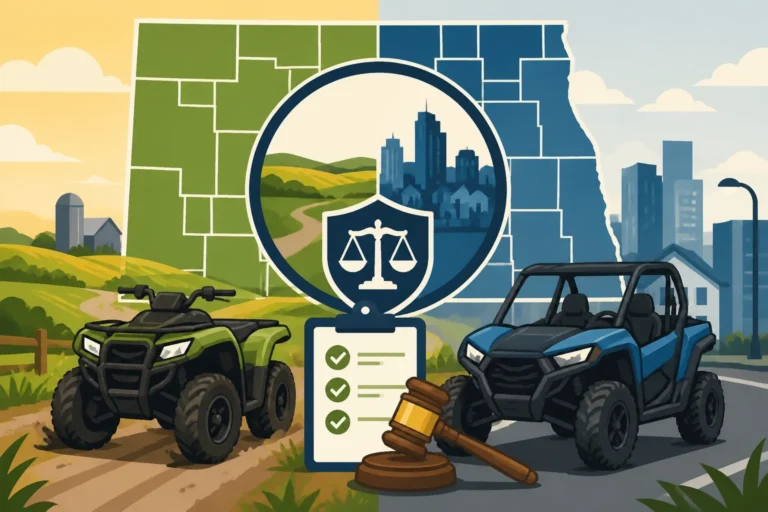
North Dakota state law, specifically within the chapters governing off-highway vehicles, explicitly prohibits the operation of ATVs and UTVs on controlled-access highways. This isn't an oversight or a vague interpretation; it's a direct and unambiguous restriction. The legislative intent behind these rules is quite transparent: to prevent accidents, maintain the intended flow of high-speed traffic, and protect all users of the highway system.
These statutes consider the inherent design and performance characteristics of OHVs. While manufacturers like Polaris, Can-Am, or Honda build incredibly capable machines for various terrains, they are fundamentally different from passenger cars or heavy-duty trucks designed for highway use. These laws apply to all OHVs, regardless of their size, engine displacement, or how much aftermarket gear you've added. Even if your UTV is a behemoth outfitted with every accessory under the sun from a company like SuperATV, it still falls under the same OHV classification for these specific road types. You can't just slap a license plate on it and expect to cruise down the interstate.
Why No Conversion Path Exists for Interstates
This is a common point of confusion for many riders. They might see "street legal" kits that include mirrors, turn signals, and horns, and naturally wonder if those modifications would then make their ATV or UTV eligible for interstate travel. The short answer is: no.
While North Dakota does allow for the operation of certain OHVs on specific types of paved or gravel roads if they meet certain criteria (such as a minimum engine displacement of [North Dakota's 350cc Minimum for Road Riding] and equipped with safety features like mirrors and horns), these allowances do not extend to controlled-access highways. The legal definition of what constitutes a "highway vehicle" for interstate purposes is far more stringent, encompassing aspects of crashworthiness, braking performance at high speeds, lighting standards, and overall vehicle dynamics that are simply not met by OHVs, even those modified for other "street legal" purposes.
It's a matter of fundamental vehicle classification and safety engineering. A vehicle designed primarily for off-road use, even one that can hit speeds high enough for many rural roads, is not built to safely integrate into the environment of a multi-lane interstate where traffic moves at sustained, high velocities. There is [Why There Is No Conversion Path] for an ATV or UTV to become "interstate legal" in North Dakota, regardless of how many accessories you bolt on or how much you spend.
Practical Implications and Alternatives for Riders
Understanding the rules is one thing, but knowing the consequences and finding viable, legal alternatives is another. It's important to respect these restrictions not just to avoid penalties, but to ensure your own safety and the safety of others.
The Consequences of Violating Controlled-Access Restrictions
Riding an ATV or UTV on a controlled-access highway in North Dakota is not just frowned upon; it's illegal, and the consequences can be severe. First and foremost, you're looking at potential citations and fines. While the exact amounts can vary, even a basic OHV violation can carry a significant cost, and you might face additional charges depending on the specifics of the situation. Law enforcement takes these violations seriously because of the inherent dangers involved.
Beyond the immediate financial penalties, there's the very real risk of your machine being impounded, leading to further costs for towing and storage. More critically, operating your OHV illegally could void your insurance coverage in the event of an accident. Imagine a collision on an interstate—the damages, injuries, and liabilities could be astronomical, and if your insurance company determines you were operating outside the law, you could be left to shoulder all of those expenses yourself. This can be financially devastating. Ultimately, the most dire consequence is the risk to your life and the lives of others. The chances of a severe accident increase dramatically when an OHV is on a roadway it's not designed for, mixing with traffic traveling at vastly different speeds. It’s simply not worth the gamble.
Finding Legal and Safe Riding Opportunities
Just because you can't ride your ATV or UTV on an interstate doesn't mean North Dakota is devoid of fantastic riding opportunities. Far from it! The state actually offers a variety of legal and enjoyable places to ride.
Here's where you can typically find legal riding:
| Road/Area Type | OHV Access in North Dakota (General) | Important Considerations |
|---|---|---|
| Controlled-Access Hwy | No access (Interstates, major limited-access four-lane roads) | Illegal, extremely dangerous, severe penalties. |
| Paved Rural Highways | Limited access for registered, equipped OHVs. Speeds typically 55 mph or less. [North Dakota Paved Roads Posted at 55] | Machine must be capable of 30 mph, equipped with mirrors, horn, lights. Check local ordinances. [North Dakota Equipment Required on a Roadway] |
| Gravel Roads | Generally open for registered, equipped OHVs. | Machine must be registered. Check local ordinances, speed limits, and respect private land. [North Dakota Rules for Riding a Gravel Road] |
| Section Lines | Often allowed, but depends on local interpretation and land ownership. | Varies by county. Always verify with local authorities and respect private property. Can You Ride a North Dakota Section Line? |
| Ditch Bottoms/Backslopes | Generally allowed. [North Dakota Ditch Riding: The Legal Right Explained] | Specific rules for inslopes/shoulders and obstructions. Stay out of the main traffic lanes. [North Dakota Back-Slopes and Ditch Bottoms] |
| Designated OHV Trails | Open to registered OHVs. | Specific trails like Pembina Gorge, Roughrider, Turtle Mountain, Kimball Bottoms. Follow trail rules. North Dakota OHV Trails: All Four Riding Areas |
| Private Land | With landowner permission. | Always obtain explicit permission in writing. Respect their land. North Dakota Landowner Permission Forms |
Your best bet for legal and enjoyable riding often lies in the expansive ditch bottoms and back-slopes along many North Dakota roadways, the numerous gravel roads, and specific designated OHV trail systems. North Dakota has great places like Pembina Gorge, the Roughrider OHV Trail, and the riding areas around Turtle Mountain, all offering unique experiences. Always make sure your machine is properly registered in North Dakota, which often involves a minimal [North Dakota's Two-Year OHV Registration] fee and a [North Dakota Off-Highway Trail Tax].
Before you head out, it's absolutely crucial to check local county and city ordinances. While state law provides a framework, local jurisdictions can and do implement additional restrictions, such as [North Dakota Counties That Restrict Riding] or specific hours of operation. A quick call to the county sheriff's office or checking their website can save you a lot of hassle. Remember, responsible riding means respecting the rules, protecting yourself, and preserving access for all riders by being a good steward of the land and the roads. Always be aware of [North Dakota Posted Land Rules for Riders] and ensure you have permission if you're ever venturing onto private property.
Disclaimer
This article is for general informational purposes only and does not constitute professional advice. Laws, prices and regulations vary by location and change over time. Consult a qualified professional for guidance on your specific situation.