North Dakota Mirror Rules on a Quad
There’s nothing quite like hitting the open gravel roads or cruising along a section line in North Dakota on your ATV or UTV. The wind in your face, the wide-open spaces – it’s pure freedom. But that freedom comes with a responsibility to understand and follow the rules, especially when you venture onto public roadways. One of the questions I hear most often from fellow riders, whether they're seasoned veterans or just starting out, is about mirrors. Do you really need one? What kind? This guide is here to clear up all that confusion, helping you stay legal, safe, and fully enjoying your ride across our beautiful state.
The Core Rule: When Mirrors Become a Must-Have in North Dakota
It’s easy to get caught up in the excitement of a ride and overlook the smaller details, but when it comes to mirrors on your ATV or UTV in North Dakota, these details matter a whole lot. The biggest point of confusion often revolves around when a mirror is actually required. The answer hinges on where you're riding.
Understanding "Roadway" vs. "Off-Road" Definitions
Let's be real: when you're tearing through a field on private land or navigating a winding trail in Pembina Gorge, you're probably not thinking about a rearview mirror. And for pure off-road use, North Dakota state law generally doesn't mandate mirrors. Your focus there is on what's in front of you, the terrain you're tackling, and perhaps keeping an eye on your riding buddies. Safety is still paramount, of course, and good situational awareness is always a plus, but a rearview mirror isn't a legal requirement in these strictly off-road environments.
However, the moment your tires touch a public roadway – and this includes a lot more than just paved highways – the game changes. North Dakota defines "roadway" quite broadly, encompassing everything from county gravel roads to township roads, and even the "ditch bottom" and "back-slope" in many areas. So, if your ride involves getting from point A to point B on any sort of public access route, even if it's just to cross a highway or get to another trail system, you absolutely need to be compliant. You might be surprised how often your ride inadvertently puts you on a legal roadway, making this rule apply more frequently than some riders realize. Understanding [North Dakota ATV Road Rules by Surface Type] and the specifics of [North Dakota Ditch Riding: The Legal Right Explained] is crucial here.
The Legal Mandate for On-Road Operation
When you're operating an off-highway vehicle (OHV) on a public road, North Dakota law becomes very specific. The statute clearly states that an OHV, including your ATV or UTV, must be equipped with a "rearview mirror" if it's going to be used on a highway or public road. This isn't a suggestion; it's a legal requirement. And it's not just any mirror; it has to be a rearview mirror. While side mirrors can certainly enhance your visibility and are a fantastic safety addition, the core legal mandate is for that central rearview perspective.
So, for those times you're cruising down a gravel county road to get to your favorite fishing spot, or using a section line to cut between fields, that rearview mirror needs to be in place and functional. This applies to registered machines operating under the provisions that allow them on certain roads. Don't think for a second that a quick jaunt down the road to your neighbor's place is exempt; if it's a public roadway, the rule applies. Being compliant means one less thing to worry about if you encounter law enforcement, and it certainly adds a layer of safety for you and others on the road.
What "Ten Square Inches" Really Means for Your Quad
Beyond simply having a mirror, North Dakota law gets down to brass tacks with a specific size requirement. This isn't just about sticking any reflective surface on your machine and calling it good. The law specifies that your rearview mirror must have "at least ten square inches of reflective surface." This detail is often overlooked, but it's important for genuine safety and legal compliance.
Measuring Up: Ensuring Your Mirror Meets the Standard
Ten square inches might sound like a small area, but it's specific enough to rule out many of the tiny, novelty mirrors you might sometimes see. To make sure your mirror passes muster, you'll need to do a little measuring. For a rectangular mirror, it's straightforward: multiply the length by the width. For example, a mirror that is 2 inches wide by 5 inches long gives you exactly 10 square inches – just enough. A 3-inch by 4-inch mirror offers 12 square inches, providing a bit of a buffer and better visibility.
If your mirror is round or oval, the calculation is a bit more complex (involving pi for perfect circles), but you can usually get a good estimate. The main takeaway is that a very small, compact mirror designed more for a bicycle than a full-sized ATV might not cut it. Don't just eyeball it; grab a ruler or tape measure. It's a small step that can save you a headache down the road. This specification highlights that the state wants you to have a meaningful field of vision to your rear, not just a token reflective surface.
Visibility and Placement: More Than Just Size
While size is important, the ultimate goal of a mirror is visibility. A 10-square-inch mirror that's constantly vibrating, covered in mud, or positioned where you can only see your own shoulder isn't doing its job. The spirit of the law, and indeed the essence of safety, is that your mirror must provide a clear, unobstructed view of at least 200 feet to the rear of your machine. This means careful placement and regular adjustment are just as vital as the mirror's dimensions.
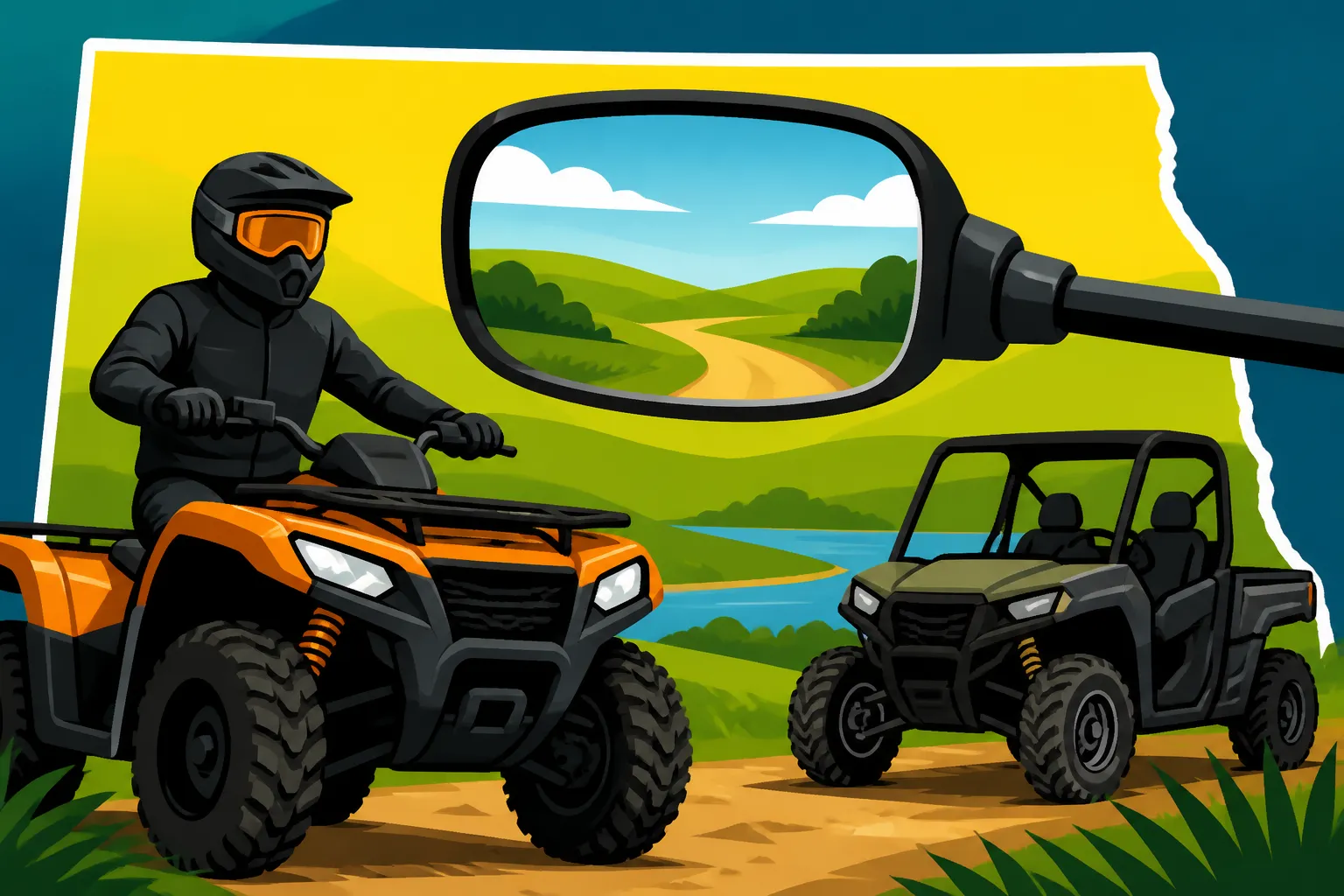
For a UTV, a center-mounted rearview mirror, often attached to the roll cage, is a common and effective solution. It mimics the setup in a car and provides excellent rearward vision. For ATVs, handlebar-mounted mirrors are the most practical. You'll want to position it so that with a quick glance, you can easily scan the area behind you without excessive head movement. Think about what you'll see: is it a clear view of the road behind you, or mostly your cargo rack? If you're carrying a lot of gear or have a passenger, especially one that might block your view, you'll need to adjust or even consider additional mirrors. [North Dakota Passenger Rules on an OHV] are a good read to understand how others on your machine affect your visibility. Remember, a mirror is only useful if you can actually use it to see what's coming up behind you.
Choosing and Installing the Right Mirrors for North Dakota Roads
Alright, so you know when and what size mirror you need. Now, let's talk about the practical side of things: actually picking one out and getting it securely mounted on your machine. There are a ton of options out there, and what works best depends a lot on your specific ATV or UTV and how you ride.
Types of Mirrors and Mounting Options
When you start looking, you'll find a variety of mirror types, each with its own advantages:
- Handlebar Mirrors (for ATVs): These are perhaps the most common for ATVs. They clamp directly onto your handlebars, often near the grips. They're generally easy to install and adjust. The downside is that in the event of a rollover, they can be vulnerable to breakage. However, many modern designs are quite robust. Look for models that offer good vibration dampening, because a shaky mirror is a useless mirror.
- Roll Cage Mirrors (for UTVs/Side-by-Sides): For UTVs, mirrors designed to clamp onto the roll cage are the standard. You can get a single center-mounted rearview mirror, or a pair of side mirrors, or even a combination. Brands like SuperATV offer a wide selection of these, designed to be tough enough for off-road use while providing excellent visibility. They usually feature sturdy clamps that securely fasten to different roll cage diameters, ensuring they stay put even over rough terrain.
- Folding Mirrors: These are a fantastic hybrid option. They're designed to fold inward or outward, allowing you to tuck them away when you're on tight trails or in dense brush, protecting them from damage. Then, when you hit a public road, you can easily flip them back out into position. This versatility makes them popular for riders who transition frequently between off-road and on-road riding.
- Breakaway Mirrors: Similar in concept to folding mirrors, breakaway mirrors are designed with a pivot point that allows the mirror to swing out of the way on impact, rather than snapping off. This can significantly reduce damage from unexpected bumps or minor tip-overs, making them a durable choice for riders who push their machines hard.
When choosing, think about your primary riding style, the environment you ride in most often, and the specific needs of your machine. Do you need maximum durability? Easy adjustability? Or something that can withstand an occasional brush with a tree branch?
Practical Installation Tips and Avoiding Pitfalls
Once you have your mirror, proper installation is key. A mirror that's loose, improperly mounted, or constantly vibrating isn't just annoying; it's a safety hazard and won't meet the legal requirement for providing a clear rear view.
For handlebar mirrors, first, find a spot on your handlebar that doesn't interfere with your controls (throttle, brakes, kill switch) or your grip. Use the appropriate tools to tighten the clamp securely, but don't overtighten and strip the threads. Many come with different size shims to ensure a snug fit. Once mounted, sit on your ATV and adjust the mirror so you have the best possible view behind you with minimal head movement. You might need to experiment a bit to find the sweet spot.
For roll cage mirrors on UTVs, measure your roll cage tubing diameter to ensure you get the correct clamp size. Most roll cage mirrors come with universal clamps or specific inserts. Position the mirror so it provides a wide, unobstructed view. For side mirrors, ensure they're far enough out to give you a good look past the width of your UTV. Tighten all bolts evenly to prevent loosening from vibrations. After installation, take a short, slow ride and check for any excessive vibration or movement. A little blue threadlocker can be your best friend here to keep bolts from backing out over time.
One common pitfall is ignoring vibrations. If your mirror is constantly shaking, it's virtually useless. Look for mirrors with good dampening systems or consider adding rubber washers to the mounting points. Another issue is glare; some mirrors have anti-glare coatings that can make a big difference, especially during sunrise or sunset rides. Always ensure your mirror doesn't obstruct any other vital equipment or your line of sight forward.
| Mirror Type | Pros | Cons | Best For |
|---|---|---|---|
| Handlebar (ATV) | Easy installation, direct line of sight from riding position | Vulnerable in rollovers, can vibrate | ATVs, casual riders, easy on/off road transitions |
| Roll Cage (UTV) | Very stable, good for multiple angles, durable | Requires roll cage, might need specific clamp size | UTVs/Side-by-Sides, all types of terrain |
| Folding/Breakaway | Protects mirror on trails, versatile for mixed riding, durable | Can be more expensive, might require more frequent adjustment | Riders frequently switching between tight trails and roads |
The Consequences of Mirror Neglect
It's tempting to think that a small thing like a mirror isn't a big deal, but in North Dakota, if you're riding on public roads, it absolutely is. Ignoring the mirror rule isn't just a minor oversight; it carries both legal and, more importantly, safety repercussions. As a veteran rider, I've seen firsthand how quickly things can go sideways when you don't have all the tools for awareness.
Enforcement and Penalties
Let's address the legal side first. If you're pulled over by local law enforcement, a county sheriff, or the North Dakota Highway Patrol while operating your ATV or UTV on a public road without the required rearview mirror, you could face a citation. [What an Officer Can Ask to See] includes ensuring your machine meets all equipment requirements for road use. While I can't give you exact figures (those change), what was once a relatively minor [North Dakota Ticket Cost for a Road Violation] for an OHV violation has seen increases, and it's certainly more expensive than simply buying and installing a compliant mirror in the first place.
Think about it: you're out enjoying a beautiful day, maybe heading to a favorite spot, and suddenly you're dealing with a traffic stop, a fine, and the inconvenience of a ticket. It puts a real damper on the fun. The officers aren't trying to ruin your day; they're enforcing rules designed to keep everyone safe. If you're on a road where a mirror is required, it's expected to be there and functional. Don't give them a reason to pull you over.
Safety First: Why Mirrors Are More Than Just a Legal Nuisance
Beyond the fines and the hassle, the most critical consequence of not having a mirror is the impact on your safety. Riding an OHV on a public roadway, even a quiet gravel road, means sharing that space with other vehicles. Cars, trucks, tractors – they all move faster and often have much larger blind spots than you might realize. A rearview mirror allows you to:
- Monitor traffic behind you: This is absolutely crucial when preparing to turn into a field, pull off to the side, or even just assess whether a vehicle is approaching too quickly. Imagine needing to turn left off a [A Roadway Posted at 55] and not knowing if there's a semi bearing down on you from behind.
- Make informed decisions: Whether you're considering a brief stop, navigating around an obstruction, or just maintaining your position in a lane, seeing what's behind you allows for safer, more confident maneuvers.
- Increase situational awareness: Good riders are constantly scanning their surroundings – front, sides, and rear. A mirror is an indispensable tool for expanding that awareness, reducing the chance of an unexpected collision.
- Aid in ditch riding: Even when riding in the [Riding North Dakota's Ditch Bottom and Back-Slope], you're often parallel to traffic. Knowing what's coming up behind you is essential if you need to quickly transition out of the ditch or are approaching an area where you might re-enter the main flow of traffic.
For riders who frequently use their machines for farm work or hunting, crossing roads is a common occurrence. A mirror ensures you can safely cross or merge without causing a dangerous situation. This is especially true when [North Dakota Rules for Riding After Dark], where visibility is already reduced. The laws requiring equipment like mirrors, [North Dakota Mirror and Horn Requirements], and even a [North Dakota Speedometer Rules on a Quad] aren't just bureaucratic red tape; they are practical measures designed to prevent accidents and protect lives. Think of your rearview mirror as another set of eyes, providing vital information that could literally save your ride – and your life.
Disclaimer
This article is for general informational purposes only and does not constitute professional advice. Laws, prices and regulations vary by location and change over time. Consult a qualified professional for guidance on your specific situation.