North Dakota Helmet Law Age Limit
It's incredibly frustrating when you're trying to do the right thing, especially concerning the safety of younger riders, but the laws can sometimes feel like a maze of specifics and exceptions. Many parents and guardians in North Dakota wonder exactly what the state's off-highway vehicle (OHV) helmet law means for their kids, or even for themselves, feeling a bit lost in the details. This guide is here to untangle North Dakota's helmet requirements, ensuring you understand who needs to wear one, why it's so important, and how to stay compliant with the law when riding ATVs, UTVs, and dirt bikes across the Peace Garden State.
The Core North Dakota Helmet Law for OHV Riders
North Dakota has a very clear, straightforward rule when it comes to helmets and off-highway vehicles: it's all about age. This isn't a suggestion or a guideline; it's a firm legal requirement designed to protect our most vulnerable riders. Ignoring it can lead to more than just a stern look from a local law enforcement officer; it can lead to significant safety risks and legal repercussions.
The "Under 18" Rule: Who it Applies To
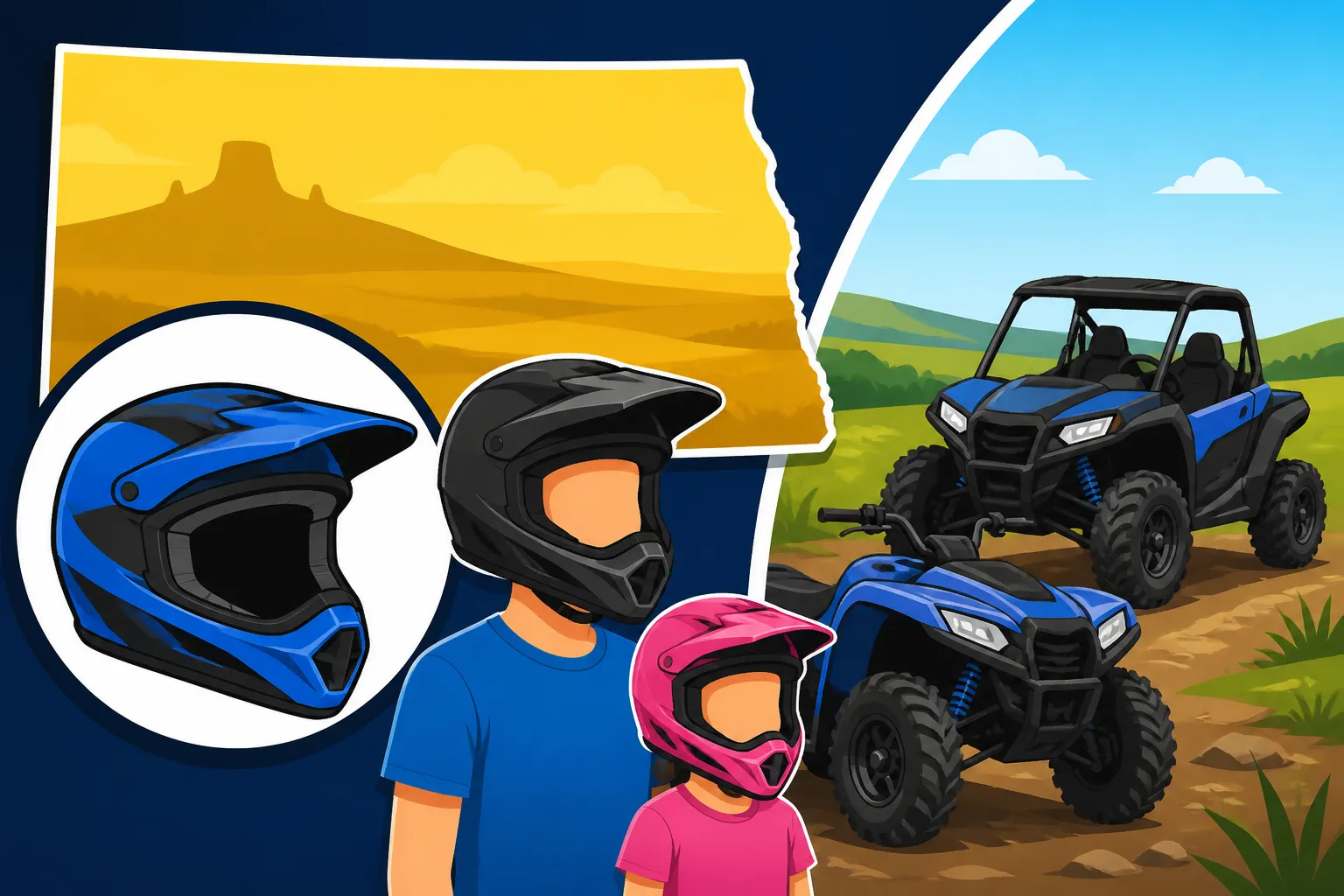
In North Dakota, if you are operating or riding as a passenger on an off-highway vehicle and you are under the age of 18, you must wear a protective helmet. This rule applies across the board, whether you're tearing up the trails at Pembina Gorge, cruising a gravel road near your cabin, or just exploring some open fields. It doesn't matter if you're the driver, a passenger on a side-by-side, or a kiddo riding their own youth quad; if you haven't reached your 18th birthday, that helmet needs to be securely fastened. This is a fundamental aspect of [North Dakota Helmet Law for Riders Under 18] and something every rider and parent needs to internalize. It's not about how skilled the young rider is, or how slow they're going; it's simply about their age.
For example, imagine a family weekend at a cabin outside of Bottineau. Your 16-year-old is excited to take their dirt bike for a spin, and your 10-year-old wants to ride shotgun in the UTV. Even though you might be riding on a quiet, low-traffic township road, both of those kids absolutely need to have helmets on. It’s a blanket rule for anyone under 18, regardless of the type of OHV, the speed, or the riding location (as long as it's not strictly private, fenced land with permission, which we'll discuss later). This rule extends to anyone under the age floor, even if they're close to being 18.
Consequences of Non-Compliance: What to Expect
Let's be realistic: nobody wants to get a ticket, especially when you're just trying to enjoy some outdoor recreation. If a law enforcement officer spots an underage rider without a helmet, they have the authority to issue a citation. While the initial goal is always safety, ignoring these laws can lead to financial penalties. We're talking about a basic OHV violation, which can carry a fine. The officer might also choose to educate rather than penalize, especially for a first offense, but counting on leniency isn't a strategy. Remember, [North Dakota's 30 mph Capability Rule] often applies on roads, but helmet rules are separate and apply universally to underage riders.
Beyond the immediate fine, there are other, more significant consequences. If there's an accident and a minor rider without a helmet suffers a head injury, it can complicate insurance claims and potentially lead to more severe legal liability for the adult who permitted the riding. No amount of money is worth the trauma of a serious head injury, and the law is there to prevent just that. Imagine explaining to an emergency room doctor why your 14-year-old wasn't wearing a helmet when they had an accident, and then dealing with the subsequent investigation. It's a scenario every responsible adult wants to avoid.
How the Law Protects Young Riders
The reason behind the "under 18" helmet law is rooted in common sense and a desire to protect developing brains. Children and teenagers are, quite simply, more vulnerable to serious injuries. Their judgment isn't fully developed, their reaction times can be slower, and their bodies are still growing. An OHV accident, even at low speeds, can result in a significant impact. A properly fitted helmet provides a crucial layer of protection, absorbing impact energy and distributing forces away from the skull and brain. This is why [Helmets Meeting the DOT Standard] are specifically mentioned—they’ve been tested and proven to offer a certain level of protection.
Consider the dynamic nature of off-road riding. You're dealing with uneven terrain, potential obstacles, and the inherent risk of rollovers or collisions. A helmet drastically reduces the risk of traumatic brain injury (TBI), which can have lifelong consequences, from cognitive impairments to personality changes. The law isn't there to hinder fun; it's there to ensure that the fun doesn't end in tragedy. By enforcing this age limit, North Dakota is trying to foster a culture of safety from a young age, hoping that these habits will carry forward as riders grow into adults.
Why Helmets Matter Beyond the Law
While legal compliance is a must, the true value of a helmet goes far beyond avoiding a ticket. It's about personal safety, responsibility, and understanding the very real dangers that off-road riding, as exhilarating as it is, can present. Every rider, regardless of age, should strongly consider wearing a helmet every time they climb onto an OHV.
Understanding Head Injuries: The Harsh Reality
It's easy to think "it won't happen to me," but accidents are unpredictable. A tumble off a dirt bike, a rollover in a UTV, or even just hitting an unseen rut can launch a rider or passenger. The human skull is tough, but it's not invincible. Head injuries can range from concussions, which can have lingering effects like headaches, dizziness, and difficulty concentrating, to much more severe traumatic brain injuries (TBIs). These severe injuries can lead to permanent brain damage, paralysis, coma, or even death. Helmets are specifically designed to mitigate these forces.
Imagine a scenario: you're enjoying a beautiful fall day on the [Roughrider OHV Trail] near Mandan, the leaves are turning, and the air is crisp. Suddenly, you hit a patch of loose gravel on a turn, and your UTV slides, tipping onto its side. Even at moderate speeds, the impact of your head against the ground or the vehicle's roll cage can be devastating if unprotected. A helmet, particularly one that meets rigorous safety standards, acts as a sacrificial layer. It crushes and deforms to absorb energy, preventing that energy from being transferred directly to your brain. This crucial protection is why even adult riders, for whom helmets aren't legally mandated, often choose to wear them.
Reducing Risk on the Trails and Roads
Whether you're exploring the limited public access roads or riding on private land, risks are inherent to OHV operation. Blind corners, unexpected wildlife, changes in terrain, and other riders are all factors that can lead to an incident. A helmet provides protection in all these scenarios. It's not just about a direct impact from a crash; it can also protect against flying debris like rocks, branches, or even dust and insects that can impair vision and cause a momentary distraction, potentially leading to a crash.
When considering gear, many riders focus on performance upgrades for their machines—new tires for better grip, a winch from SuperATV for recovery, or upgraded suspension for a smoother ride. These are great, but no mechanical upgrade protects your head. The best equipment you can invest in for safety is personal protective gear, starting with a helmet. Think about it: you spend good money on your machine and its maintenance; shouldn't your personal safety be an even higher priority?
Setting a Good Example for Younger Riders
Even if you're an adult and legally not required to wear a helmet in North Dakota, choosing to wear one sets an invaluable example. Children and teenagers learn by observing the adults around them. If they see you, a seasoned rider, consistently putting on your helmet before every ride, they are far more likely to adopt that habit themselves. It reinforces the idea that helmet use isn't just a rule to avoid punishment, but a fundamental part of safe riding. This is especially true if you're riding with a child who is required to wear one, like a [North Dakota Parent Riding With a Child].
This goes beyond just helmets. It extends to all aspects of safe riding: wearing appropriate riding gear like gloves, long pants, and sturdy boots, understanding trail etiquette, and respecting posted land rules. When kids see adults prioritizing safety, they learn that off-roading is a serious activity that requires respect and responsibility, not just an opportunity for thrills. You're not just protecting yourself; you're shaping the future generation of safe North Dakota riders.
Exceptions and Special Considerations
While the "under 18" rule is quite broad, there are a few nuances and related topics that riders in North Dakota often ask about. Understanding these can help clarify when and where the helmet law applies, and how other safety measures fit into the overall picture.
Riding on Private Land: What Changes (and What Doesn't)
A common question is whether the helmet law applies when riding on private land. This is where things get a little nuanced. Generally, North Dakota's helmet law for underage riders (under 18) applies on "public land or trails, or a public right-of-way." If you are strictly on private property that is completely enclosed and inaccessible to the public, such as your own farm or a friend's fenced ranch with explicit permission, the state's helmet law technically may not apply. However, this is a legal interpretation, and the spirit of the law, which is rider safety, still absolutely stands.
Even if the letter of the law provides a loophole for private land, the risk of injury does not magically disappear. A rollover on your back forty is just as dangerous as one on a state trail. Many seasoned riders and parents strongly advocate for helmet use regardless of the location, precisely because accidents can happen anywhere. Furthermore, if your private land borders public land or is easily accessible, proving to a passing deputy that you were exclusively on private property can be difficult. It's often simpler, and always safer, to just wear the helmet, especially for underage riders. [North Dakota's Exemption for Machines Used on Private Land] might exempt you from registration in certain cases, but it doesn't exempt you from the fundamental need for safety gear.
Organized Events and Competitions: Are There Different Rules?
When it comes to organized events, rallies, or competitions, the rules can vary depending on the specific event and its organizers. Many events, especially those sanctioned by racing organizations or held in designated parks, will have their own stringent safety requirements, which often include mandatory helmet use for all participants, regardless of age. These events frequently require even higher standards of protective gear than state law mandates.
For instance, if you're participating in a charity poker run or an organized race at a facility that hosts events like this, you'll likely find that helmets are required for everyone, period. These events prioritize safety and often have waivers and specific gear lists. While [North Dakota Organized Sporting Event Exception] might exist for certain aspects of OHV regulation, it rarely waives fundamental safety requirements like helmets. Always check with the event organizers beforehand to understand their specific rules regarding helmets and other protective gear. It's better to be over-prepared than to show up and be turned away for not having the right equipment.
North Dakota's Safety Certificate and Helmets
North Dakota does have requirements for OHV safety certificates for young riders. Specifically, anyone between the ages of 12 and 16 operating an OHV on public land must possess a valid safety certificate. While the certificate itself isn't directly tied to the helmet law in terms of age, the two often go hand-in-hand. Safety courses, like those covered in [North Dakota Safety Course Minimum Age] and [North Dakota Safety Certificates at Age 12], heavily emphasize the importance of helmets and other protective gear.
Think of it this way: a safety certificate teaches young riders how to ride safely, including understanding the risks and knowing when and why to use protective equipment. The helmet law ensures that a critical piece of that protective equipment is always used by those who are legally deemed most in need of it. So, while you can have a safety certificate without wearing a helmet (if you're 18+), you cannot be an underage rider on public land in North Dakota without both the certificate (if applicable) and a helmet. They are both pillars of youth OHV safety in the state.
Choosing the Right Helmet for North Dakota Riding
Okay, so we know who needs a helmet and why. Now, let's talk about what makes a helmet effective. It's not enough to just put any old helmet on; it needs to be the right kind, properly fitted, and in good condition to offer the protection it's designed for.
DOT Compliance: Your Non-Negotiable Standard
When selecting a helmet for any rider, especially for those under 18, the absolute minimum standard you should look for is a "DOT certified" label. This means the helmet meets the safety standards set by the U.S. Department of Transportation. A DOT sticker indicates that the helmet has undergone rigorous testing to ensure it can withstand certain impact forces and provide adequate coverage. Without this certification, you cannot be sure the helmet offers meaningful protection. [Helmets Meeting the DOT Standard] are a critical component of safe riding.
It's tempting to buy a cheaper, uncertified helmet, especially for kids who might outgrow them quickly. However, these "novelty" helmets offer little to no real protection in a crash and can give a false sense of security. Always check for the DOT sticker on the back of the helmet. Reputable brands, whether they specialize in youth gear or offer a range of sizes, will proudly display this certification. Investing in a DOT-compliant helmet is investing in your rider's safety.
Fit, Comfort, and Features: Making the Right Choice
Beyond DOT compliance, a helmet needs to fit correctly to do its job. A helmet that's too loose can shift during an impact, failing to protect critical areas, or even come off entirely. One that's too tight can be uncomfortable and distracting. When trying on a helmet:
- Snug Fit: It should feel snug all around your head, with no pressure points. Your cheeks should feel compressed.
- No Movement: When you shake your head side-to-side and up-and-down, the helmet should not slide or wiggle. Your skin should move with the helmet.
- Field of Vision: Ensure it doesn't obstruct your peripheral vision.
- Strap Security: The chin strap should be adjusted so it's snug under your chin, and you can't roll the helmet off your head.
Here's a quick comparison of common helmet types suitable for OHV riding:
| Helmet Type | Key Features | Best For | Considerations |
|---|---|---|---|
| Full-Face | All-around protection, chin bar, visor | Trail riding, higher speeds, street-legal UTVs | Can be hot, visor may fog |
| Motocross/Off-Road | Extended chin bar, large eyeport for goggles, peak | Dirt bikes, aggressive ATV riding, mudding | Requires separate goggles, less wind protection |
| Open-Face (3/4) | Covers top, back, and sides of head; no chin bar | Casual UTV riding, lower speeds | No chin protection, requires separate eye protection |
For North Dakota riding, particularly when dealing with dust, wind, and potential mud, a full-face or motocross style helmet often offers the most comprehensive protection. And remember, when you're looking for other ways to keep your machine ready for anything the North Dakota terrain throws at it, accessories from companies like SuperATV can really enhance your ride, but safety gear for you and your passengers always comes first.
When to Replace Your Helmet
Helmets aren't meant to last forever. They are designed to absorb and dissipate energy in a single significant impact. If a helmet has been involved in a crash, even if there's no visible damage, it should be replaced immediately. The internal foam liners compress upon impact, losing their protective capabilities. It's a one-and-done deal for serious incidents.
Even without a crash, helmets degrade over time. The materials can break down due to UV exposure, sweat, and general wear and tear. A good rule of thumb is to replace a helmet every five years, or sooner if you notice any signs of wear, cracks, or loose components. The straps, padding, and outer shell can all weaken. Don't compromise on this critical piece of safety equipment. Regularly inspect your helmet for any issues and make sure your young riders are always equipped with gear that is not only DOT-compliant but also in top condition.
Disclaimer
This article is for general informational purposes only and does not constitute professional advice. Laws, prices and regulations vary by location and change over time. Consult a qualified professional for guidance on your specific situation.