Salvage Rules Without an Inspection
It’s a heart-dropping moment when your beloved ATV or UTV suffers significant damage, perhaps from an accident, a flood, or even a recovery after theft. Suddenly, you're not just dealing with repairs; you're staring down the confusing path of a "salvage" designation. Many North Dakota off-highway vehicle (OHV) owners assume that once a machine is branded salvage, it automatically triggers a mandatory inspection process, no matter what. But the truth is, there are specific circumstances under North Dakota law where you might deal with salvage rules without needing that comprehensive vehicle inspection. This guide will walk you through those often-misunderstood situations, helping you navigate the paperwork and understand your options when an inspection isn't the immediate next step.
Understanding North Dakota's Salvage Title for OHVs
When your ATV or UTV is involved in an incident that leads to it being declared a "total loss" by an insurance company, or if the cost of repairs exceeds a certain percentage of its fair market value, it often gets branded with a "salvage" title. This isn't just a label; it's a permanent mark on the vehicle's history that signifies significant damage and often means the vehicle is no longer considered safe or legal for operation on public lands without further steps.
What Constitutes a Salvage OHV?
In North Dakota, an OHV is typically designated as salvage if an insurance company pays out a total loss claim for it. This can happen for a multitude of reasons: a rollover accident that crumples the frame, extensive water damage from a flash flood, or even if it's recovered after being stolen and significant parts are missing or damaged beyond economical repair. The key here is that the vehicle's condition makes its repair economically unfeasible or unsafe without substantial work. The title is "branded" to alert future owners to its history. This is a critical distinction from a clean title, which implies the vehicle has never sustained damage severe enough to be declared a total loss. Understanding this brand is the first step in navigating the salvage process, especially when you consider its future use or sale.
The General Rule: Inspections for Rebuilt Salvage
Generally speaking, if you plan to take a salvage-branded OHV, repair it, and then ride it again on public lands or trails in North Dakota, you absolutely will need a vehicle inspection. This inspection, often conducted by a certified law enforcement officer or an authorized agent, is designed to ensure two crucial things: first, that the vehicle's identity (its VIN) is legitimate and hasn't been tampered with, and second, that all major components have been repaired or replaced safely and legally. This process is rigorous for good reason; it protects both the public and the new owner by verifying that a severely damaged machine has been made roadworthy or trail-worthy once more. The state wants to ensure that a rebuilt machine is safe, structurally sound, and meets all equipment requirements before it's given a clean bill of health to rejoin the trails.
Specific Scenarios Where an Inspection Might Be Waived for a Salvage Title
Now, let's get to the crux of the matter: those particular instances where you might encounter salvage rules without an immediate inspection. These scenarios usually revolve around the machine's intended future use or the nature of its transfer, rather than a plan to immediately rebuild and re-register it for public operation.
When an OHV is Salvaged for Parts Only
Perhaps you have an older utility quad, and it's been deemed salvage after a nasty accident. You know it's not worth repairing to ride again, but the engine is still good, and you have another similar machine that could use those parts. In this situation, if your intention is solely to strip the salvage OHV for its components or to keep it exclusively on your private property for tasks like hauling firewood, you typically won't be required to put it through a full vehicle inspection to obtain a rebuilt title.
The key here is that the machine will not be registered or titled for public use. Instead, you might surrender the salvage title, or simply hold onto it as proof of ownership for the parts. If you're going to use the machine only on your own land and it will never touch a public trail or road, the state's concern about its safety for public operation is removed. This ties into [North Dakota's Exemption for Machines Used on Private Land], which states that OHVs used exclusively on private property are exempt from many registration requirements, and by extension, the inspection needed to restore a salvage title for public use. It’s about the purpose and placement of the machine.
Transferring a Salvage Title Without Rebuilding
Imagine you're selling an OHV that you bought salvage, but you never got around to fixing it up. You simply want to transfer the salvage title to a new owner who has their own plans for rebuilding or parting it out. In this scenario, the transfer of the existing salvage title itself generally does not require a vehicle inspection on your part, the seller. The machine is being sold "as is," with its salvage branding intact.
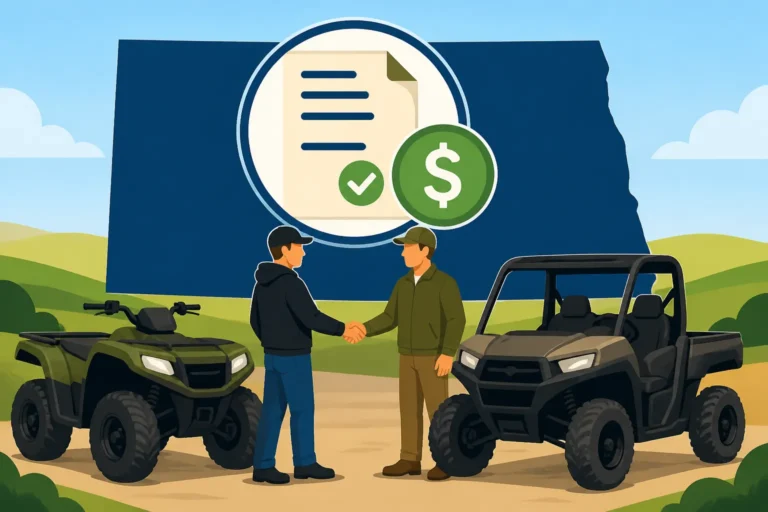
The new owner then receives the salvage title, and it becomes their responsibility to undertake any necessary repairs and subsequent inspections if they intend to register and operate the OHV on public lands. For this type of transaction, clear documentation is paramount. A detailed [North Dakota Bill of Sale Form SFN 2888] is essential, explicitly stating that the vehicle is being sold with a salvage title. You might find resources like LawDepot helpful for creating a legally sound bill of sale that clarifies the transaction and protects both parties. This ensures there's no misunderstanding about the vehicle's condition or its legal status. The state's interest at this point is in tracking ownership of the branded vehicle, not its operational readiness.
Insurance Company Total Loss and Disposal
When an insurance company declares your OHV a total loss, they typically take possession of the machine. The insurance company then often sells the salvage vehicle to an auction house, a salvage yard, or a specialized buyer. In these cases, the transfer of the salvage title from the insurance company to the new buyer (the salvage yard or subsequent individual) happens without the original owner (you) needing to get an inspection.
The insurance company's role is to compensate you and then legally dispose of the vehicle. The new owner, typically a business dealing in salvage, acquires the vehicle with its salvage title. If that new owner or a subsequent buyer decides to rebuild the machine for public use, they will then be responsible for the required inspection process to obtain a rebuilt title. This chain of custody, from original owner to insurer to salvage buyer, is a common path for totaled vehicles, and it's an important scenario where the initial salvage transaction doesn't involve the previous owner undergoing an inspection. The paperwork involved might include a [North Dakota Statement of Ownership Form SFN 2903] if the original title is complicated, or just a straightforward transfer from the insurance company.
Documentation and Best Practices for Salvage OHVs
Even when an inspection isn't immediately required, dealing with a salvage-branded OHV demands meticulous attention to paperwork and clear communication. Cutting corners here can lead to headaches down the road, especially if the machine's status or ownership ever comes into question.
Essential Paperwork for Salvage Transactions
When you're involved in a salvage OHV transaction, whether as a seller or a buyer, having all your ducks in a row with documentation is crucial. First and foremost, you need the actual salvage title. This document, clearly marked with its "salvage" brand, is the legal proof of ownership and the vehicle's history. For private sales, a comprehensive bill of sale is indispensable. This document should detail the sale price, the VIN, the odometer reading (if applicable and accurate), and explicitly state that the vehicle is being sold with a salvage title and "as-is." Platforms like LawDepot can be incredibly helpful for customizing a robust bill of sale that covers all these points and provides an added layer of legal protection.
If the original title is lost or there are complications with establishing clear ownership, a [North Dakota Statement of Ownership Form SFN 2903] might be required to clarify the chain of custody before any transfer can occur. Additionally, any paperwork from the insurance company related to the total loss claim is valuable, as it provides a clear record of how the vehicle came to be branded salvage. This comprehensive paper trail is your best defense against future disputes.
Why Clarity is Key in Salvage Deals
Transparency is not just good practice; it's essential when dealing with salvage OHVs. For sellers, being upfront about the salvage title and the vehicle's known damage prevents accusations of misrepresentation. You should disclose everything you know about the machine's history and its current condition. Clearly communicate that the buyer will be responsible for any repairs and subsequent inspections if they intend to use the OHV on public lands.
For buyers, exercising extreme caution is warranted. Purchasing a salvage OHV often means inheriting its problems. You should fully understand what you're getting into. Ask for all available documentation, including the salvage title and the bill of sale. It's also wise to perform a VIN check to review the vehicle's history through services like the National Motor Vehicle Title Information System (NMVTIS), which can offer insights into its past. This is why [NMVTIS Checks Before a Title] are so important, even for an OHV. Understanding the vehicle's full story helps you anticipate potential repair costs and the effort required to make it legally operable again. A salvage title typically affects future resale value, even after a proper rebuild, so factor that into your purchase decision.
The Role of a Motor Vehicle Branch in Salvage Transfers
Even if a vehicle inspection isn't part of the immediate salvage transfer, the North Dakota Department of Transportation (NDDOT) or a local motor vehicle branch still plays a vital role. All transfers of ownership, including those involving salvage titles, must be processed through these official channels. When you [Registering at a Motor Vehicle Branch], the clerks will process the transfer of the salvage title, ensuring that the "salvage" brand is correctly carried over to the new owner's documentation. This maintains an accurate record of the vehicle's status and ownership history within the state's system. They are the gatekeepers of official records, ensuring that the state is aware of who owns what, even if that "what" is a salvage vehicle. They'll also handle any associated fees for the title transfer itself, ensuring that all legal requirements are met for the change of ownership.
The Financial and Practical Considerations of Salvage OHVs
Beyond the immediate paperwork and inspection rules, owning or acquiring a salvage OHV in North Dakota carries significant financial and practical implications that every owner should consider. It's not just about the upfront cost; it's about the long-term value, usability, and expenses.
Excise Tax on a Salvage Purchase
Even if you're purchasing an OHV with a salvage title, North Dakota's 5 percent motor vehicle excise tax generally still applies. This tax is typically calculated based on the purchase price or the fair market value of the machine, whichever is higher. So, while you might get a "deal" on a salvage OHV, you'll still need to budget for the [North Dakota Excise Tax on an ATV Purchase] when you title it in your name.
It's important to understand that the "salvage" status might significantly impact the fair market value of the vehicle. An assessor or the NDDOT might determine a lower fair market value due to the damage, which could reduce the excise tax compared to a similar non-salvage machine. However, the tax is still a mandatory component of the acquisition cost, and it's something many first-time salvage buyers overlook until they get to the motor vehicle branch. Always confirm how the tax will be calculated for a salvage vehicle to avoid any surprises.
Long-Term Implications for Owners
The decision to acquire a salvage OHV, even one that doesn't immediately require an inspection, has lasting consequences. If you do eventually repair the machine and get it inspected to acquire a "rebuilt" title, the "salvage" brand will likely remain on its history, even if it's now deemed roadworthy. This permanent branding can significantly affect the OHV's resale value down the line. Potential buyers will always see its past, and it often creates a perception of risk, regardless of how well it was repaired.
Furthermore, obtaining [North Dakota Insurance Requirements at Registration] for a salvage-branded machine can be more challenging and potentially more expensive. Insurance companies might be hesitant to fully cover a vehicle with a history of extensive damage, or they might offer coverage at a higher premium. You might face limitations on comprehensive or collision coverage. It’s crucial to talk to your insurance provider before you invest heavily in a salvage OHV, as coverage could be a significant hurdle to its long-term operability and financial protection. Understanding these [North Dakota Registration and Lien Records] and how they're affected by a salvage brand is also important for future sales or collateral.
Legal vs. Practical Use of Salvage Machines
The distinction between simply owning a salvage machine and legally operating it on public lands is paramount. While the initial transfer of a salvage title might occur "without an inspection" under certain conditions (like being used for parts or sold as-is), this absolutely does not mean you can then take that machine and hit the trails.
The moment you intend to use that OHV on any public land, including designated trails, ditches, or roads where OHVs are permitted, it must be properly repaired, pass a vehicle inspection, and be titled as "rebuilt" and registered. The rules for [North Dakota Titling an ATV in North Dakota] and [North Dakota Ownership Transfer in 15 Days] still apply, but with the added complexity of clearing the salvage brand. Until that process is complete, the machine is, for all intents and purposes, restricted to private property use. Ignoring this distinction can lead to significant penalties, fines, and even confiscation if you're caught operating an unregistered or improperly titled salvage OHV on public grounds. Always err on the side of caution and complete all necessary steps if public use is your goal.
Disclaimer
This article is for general informational purposes only and does not constitute professional advice. Laws, prices and regulations vary by location and change over time. Consult a qualified professional for guidance on your specific situation.