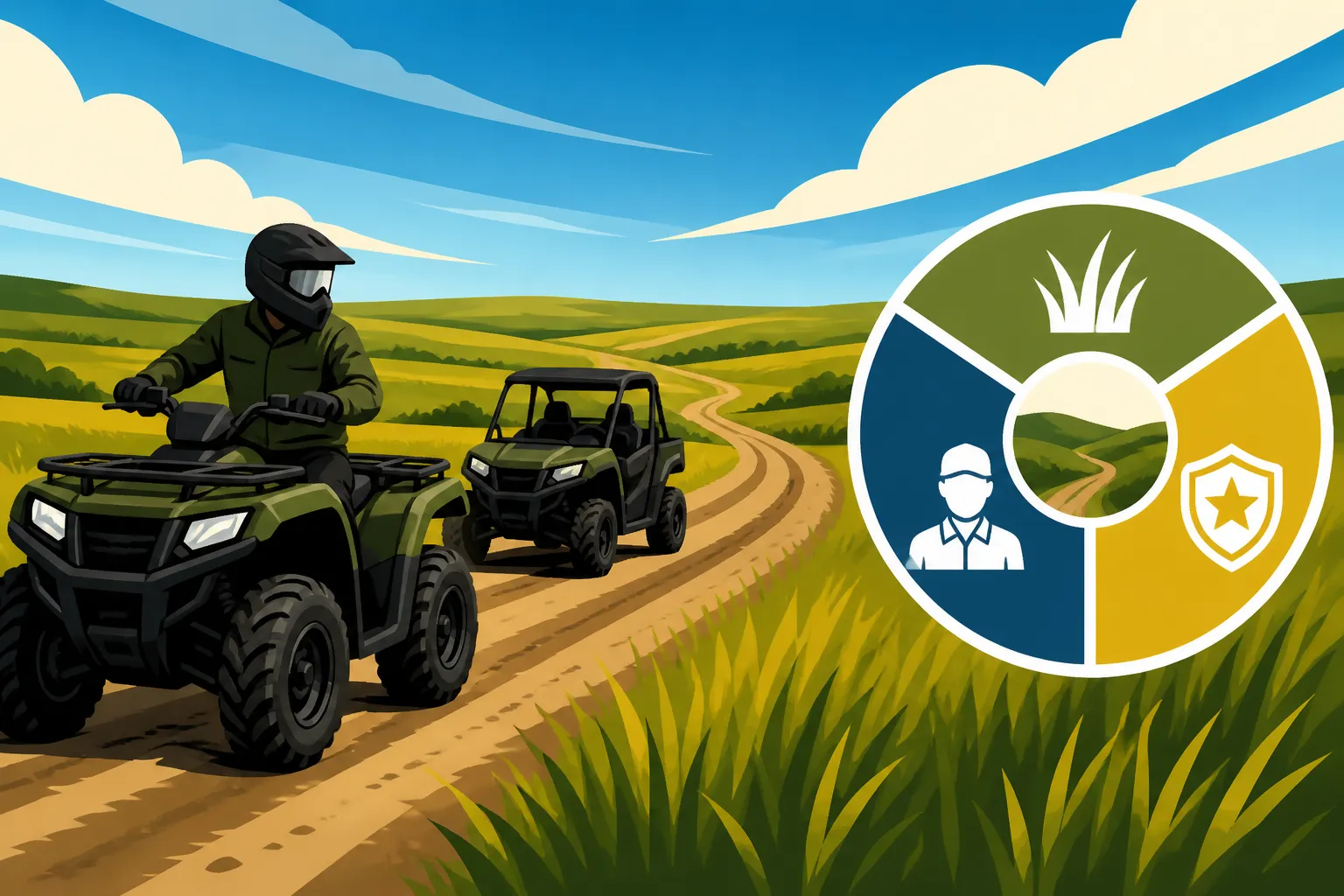
Grassland Roads and Who Manages Them
North Dakota’s grassland roads can offer long, quiet routes through open country, but “public land” does not mean every track is open to OHVs. The key is knowing who manages the ground, which roads are designated for motorized use, and what registration or permit applies to your machine. Here’s how to plan without mistaking a road network for an unrestricted trail system.
Who manages North Dakota’s grassland roads
The U.S. Forest Service manages North Dakota’s national grassland areas. According to the North Dakota Parks and Recreation Department, the grassland managed by the U.S. Forest Service has over 1,000 miles of country roads to explore. Those roads are different from a single, purpose-built OHV trail: they are part of a wider network used to access public land and travel across the grassland.
That distinction matters when you are planning a ride. Being on land managed by a public agency does not automatically make every road, two-track, or open patch available for motorized travel. The route you use needs to be open to your type of vehicle. Start with the grassland’s motor vehicle use information and confirm that the specific road is designated for the kind of travel you intend.
A useful starting point is Roads, Not Trails, on the Dakota Prairie Grasslands. It helps frame the experience: on the grassland, the riding opportunity is primarily about following roads, rather than assuming there is a marked OHV trail system throughout the area. North Dakota Grassland Motor Vehicle Use Maps and Reading a Grassland Vehicle Use Map can help you understand how to check routes before heading out.
A map is not just a navigation aid. It can help you avoid treating an unmarked track as an approved route, and it gives you a reference if you reach a junction or gate and need to reassess. If you carry a paper copy, keep it protected from wind and weather; a waterproof map case, such as one sold through Amazon, can be a simple backup for a phone-based map.
The manager of the ground also matters because grassland roads are not the only public riding option in North Dakota. For example, Kimball Bottoms, also known as The Desert, is managed by the U.S. Army Corps of Engineers, according to the North Dakota Parks and Recreation Department. Do not assume that directions, maps, or access information for one public area apply to another. Check the information for the particular place you plan to visit.
How to tell whether a road is open to your OHV
The safest planning habit is to confirm the route before you ride, not after you have already turned onto it. Look for the current motor vehicle use map and use it to identify roads designated for motorized travel. Pay attention to the route itself, not just the color or label of the surrounding land: a large public parcel can include roads with different access rules.
If a route is unclear, do not treat the lack of a sign as permission. Check the official map or contact the land manager for clarification. Conditions and access can change, and a road that appears on a general navigation app may not be designated for OHV use. North Dakota Cross-Country Travel Is Banned explains why riding off the mapped road network should not be treated as a substitute for a designated route.
Road riding rules are another layer. An open road is not necessarily suitable for every machine, and road access does not mean an OHV can be driven anywhere on the road corridor. According to the North Dakota Parks and Recreation Department, operating an OHV on a highway shoulder or inside slope is illegal. For a grassland ride, stay on the route shown as open and do not use the shoulder, slope, or surrounding ground as a shortcut.
Some roadway requirements depend on the route and machine. According to the North Dakota Parks and Recreation Department, roadway operation requires an OHV motor with a minimum of 350 cubic centimeters. The agency also says a licensed driver over 16 may operate a registered Class III OHV on a paved highway designated and posted at a speed not exceeding 65 miles per hour, provided the machine can attain at least 30 miles per hour. Do not assume those provisions make every grassland road open to a UTV; confirm both the route designation and the requirements that apply to your vehicle.
Use these distinctions when planning:
| Question | What to check |
|---|---|
| Who manages the land? | Identify the land manager for the area, then use its current access information. |
| Is this particular road open? | Confirm the route on the relevant motor vehicle use map or with the manager. |
| Is it a road or a trail? | Do not assume a country road has the same rules or features as a designated OHV trail. |
| Can your machine use it legally? | Check roadway requirements for your OHV class and the type of route. |
| Is the ground beside the road an option? | Do not leave the designated route unless the manager clearly allows it. |
For riding on gravel routes, North Dakota Rules for Riding a Gravel Road can help you sort out road-specific questions. If your plan includes a paved segment, review North Dakota Rules for Riding a Paved Road rather than assuming the gravel-road rules carry over.
Registration, permits, and out-of-state machines
Road access and vehicle paperwork are separate questions. First confirm that the route is open; then make sure the machine is properly registered or permitted. According to the North Dakota Parks and Recreation Department, OHVs operated on public land in North Dakota generally must be registered with the North Dakota Department of Transportation. The department also says all riders must be properly registered or permitted to ride legally in North Dakota.
For an owner registering a machine in North Dakota, the application asks for the owner’s name and address, along with the machine’s make, year, and serial number, according to the North Dakota Parks and Recreation Department. Keep the information handy before starting the application, especially the serial number, and make sure it matches the machine’s identifying information.
The registration fee and registration cycle can affect when you need to renew, so check the current instructions with the North Dakota Department of Transportation before submitting paperwork. The North Dakota Parks and Recreation Department describes resident OHV registration as covering public-land and trail operation, but registration is not a blanket authorization for every road or parcel. For more on how paperwork relates to access, see North Dakota OHV Registration and Trail Access.
If your OHV is registered in another state, do not assume that your home-state registration alone covers public riding in North Dakota. According to the North Dakota Parks and Recreation Department, owners of out-of-state registered OHVs must purchase a non-resident public trails and lands access permit. The permit is valid from January 1 to December 31, according to the department. Check its current requirements and availability before traveling; a permit does not make a closed or undesignated road open.
That is the practical difference between reciprocity and access: having valid paperwork from home does not automatically substitute for North Dakota’s non-resident permit requirement. The permit addresses access eligibility, while the land manager’s route information determines where you may ride. North Dakota Non-Resident OHV Permit and North Dakota Has No Reciprocity With Any State cover those visitor questions in more detail.
A quick paperwork check before leaving can prevent a frustrating trip:
- Confirm whether the OHV is registered in North Dakota or needs the non-resident access permit.
- Check that the registration details match the machine and that the serial number is legible.
- Keep proof of registration or the permit accessible while riding.
- Verify route access separately, using the current information for the grassland.
- If traveling with more than one machine, check the permit rules for each one rather than assuming one document covers the group.
A practical plan for riding the grassland
Start with the route, then work through the machine and travel details. The grassland’s country roads may be extensive, but distance alone does not tell you whether a particular route is open or appropriate for your OHV. Choose a route from official motor vehicle use information and build your ride around confirmed roads, not promising-looking tracks on a general map.
Before departure, check that your phone has the map information you need and that you can still navigate if service is unreliable. A paper map is a useful backup, especially if the ride includes remote stretches or multiple junctions. Tell someone where you intend to ride and when you expect to return. These are sensible trip-planning steps, not a substitute for checking route status with the land manager.
At the trailhead or road entrance, pause to read signs and look for closures or access limits. If a gate is closed or a road appears to be restricted, do not go around it. If you find that the route on your map and the posted information do not agree, stop and verify rather than choosing the interpretation that lets you continue.
Make sure your machine is suitable for the route you have selected. Roadway rules may differ from trail rules, and the North Dakota Parks and Recreation Department lists specific equipment and machine requirements for roadway operation. If you are uncertain whether the road is treated as a roadway for those requirements, ask the appropriate land manager or state agency before riding it. What an Officer Can Ask to See is a useful companion for understanding what documentation may matter during a stop.
Finally, keep the purpose of the trip in mind: follow the roads that are open, respect the management boundaries, and treat neighboring ground as closed unless access is clearly allowed. The grassland’s size and road mileage can make it tempting to improvise, but a careful route check is what turns a large public landscape into a ride you can enjoy with confidence.
Sources
- North Dakota Parks and Recreation Department — OHV Permits & Registration | ND Parks and Recreation – Business and Grants (checked November 3, 2026)
- North Dakota Parks and Recreation Department — OHV Trails | ND Parks and Recreation – Business and Grants (checked November 3, 2026)
- North Dakota Parks and Recreation Department — Snowmobile Trails | ND Parks and Recreation – Business and Grants (checked November 3, 2026)
- North Dakota Parks and Recreation Department — 04-2022%20OHV%20Brochure%20WEB.pdf (checked November 3, 2026)
Disclaimer
This article is for general informational purposes only and does not constitute professional advice. Laws, prices and regulations vary by location and change over time. Consult a qualified professional for guidance on your specific situation.